Author: flowie, ChainCatcher
Editor: TB, ChainCatcher
If you are still hopeful about altcoins, you might lose some illusions after seeing this set of data.
According to the Dune dashboard data created by @cgrogan, the number of cryptocurrency tokens has surged from over 3.4 million in 2022 to over 39 million in 2025. The crypto market created over 10.09 million and more than 18.7 million tokens in 2024 and 2023, respectively.
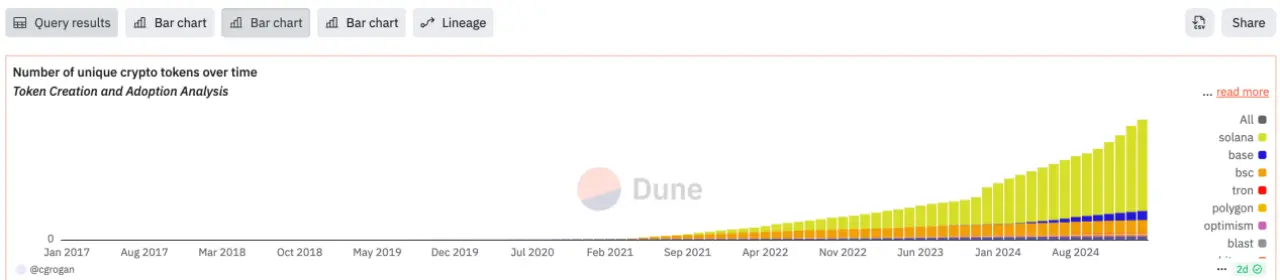
In stark contrast to the explosive growth of altcoins in this bull market is the decline in the number of cryptocurrency developers. The Electric Capital "Cryptocurrency Developer Report" shows that the total number of crypto developers decreased by 7% and 24% in 2024 and 2023, respectively.
The crypto market has long been an enormous "token issuance" factory, where, apart from the innovative token issuance models and casino-like operations, there is hardly any new paradigm innovation to be seen.
The flip side of fairness and overnight wealth is the extremely low cost of wrongdoing and the large number of ordinary users who have been defrauded. In the long-term PvP, all important participants, including users, have been educated to become smart short-termists.
Exit or Wait for a Turnaround
Yesterday, the cryptocurrency fear and greed index dropped to 10, the lowest level since June 2022. @ZKSgu refuted the externalities of Crypto, stating that those in the market are unable to stay.
Exchanges and VCs, as the most criticized stakeholders in this bull market, are looking for exit opportunities or are being forced to exit.
The veteran crypto derivatives exchange BitMEX is seeking to sell, and informed sources told ChainCatcher that the largest crypto options exchange Deribit has completed its sale, with the acquisition amount possibly reaching $5 billion.
Not only exchanges, but the entire crypto sector is also experiencing a wave of mergers and acquisitions. According to RootData, there have been over 20 M&A events in the crypto sector in the first two months of 2025, averaging more than 10 crypto mergers per month.
Many VCs are facing elimination. YettaS felt that at Consensus HK, the VC scene was filled with despair: some VCs cannot raise the next round of funding, some have lost half their team, some have shifted to strategic investments and no longer invest independently, and some VCs are even considering issuing memes to raise funds.
Investor @26x14eth has begun to urge young people not to waste their most precious time mining in the crypto space, but to seek internships in promising AI and robotics industries. Because this is no longer the period from 2017 to 2021 when everyone could make money; the most valuable asset now is time.
But some are waiting for a turnaround. Crypto KOL @cmdefi is not so pessimistic. He feels that the current market is like 2018-2019, when everyone thought there was no hope for the market after the ICO bubble burst, and it was all a scam.
"But then came the DeFi Summer in 2020, speculative funds decreased, and the market focused more on application innovation. Stay in the game. (Wait for a turnaround)."
The Crazy "Bloodsucking" of Token Production Lines
This bull market is indeed hellishly difficult.
There is hardly any surprising crypto development. From Trump leading the celebrity coin "harvest" wave, to the Pi coin hype, and recently Safe being hacked, everyone has awakened to the absurdity and fragility of the crypto system.
The current state of the crypto ecosystem drawn by overseas KOL @sherlock has resonated with the market; apart from the flimsy crypto development, conspiracy groups are everywhere.
In this bull market, making money has become even harder.
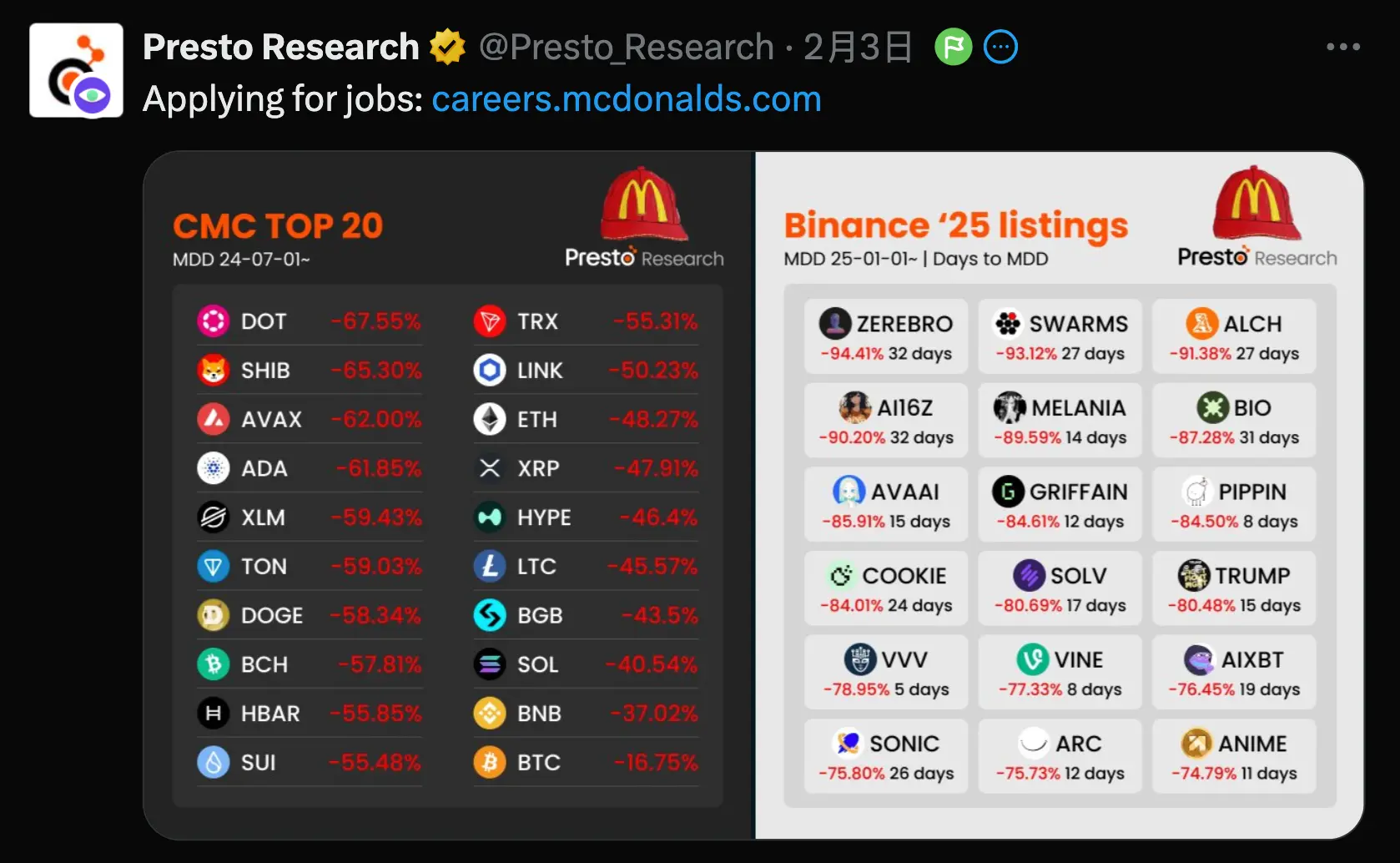
Players who have experienced the last bull market may be particularly pained. Binance and other wealth-generating legends have become dumping grounds for project teams' shitcoins, and the so-called alpha listings have become peaks. Presto Research reported that 100% of the tokens listed on Binance in the first month of 2025 have dropped over 70%.
If you are a beta diamond hand holding a top 20 market cap token, you are no longer rewarded. From July 2024 to now, the top 20 tokens by market cap have generally dropped over 60%. Meanwhile, those looking to profit lament that no matter how they upgrade, they still cannot escape being counter-harvested.
The seemingly fair on-chain PvP is a mess.
As of February 26, the Pump.fun platform has issued over 8.1 million tokens, with nearly 32 meme coins having a market cap exceeding $100 million, and only 154 with a market cap over $10 million. After experiencing scandals like Libra and other celebrity coins, on-chain PvP is also coming to an end.
Without actual crypto development, most people cannot make money; where is all the money going?
Conflux co-founder Yuanjie may have revealed the truth: apart from a very few lucky smart individuals, the vast majority have flowed to various stakeholders of the "token issuance factory."
Yuanjie shared on Twitter, "In the 'token issuance factory,' there are not only VCs, serial entrepreneurs, market makers, OL agencies, studios, large holders, and exchanges, but a complete production line that greedily sucks the life out of this industry and the retail investors."
In the crypto market, token creation and selling is the biggest business model.
In Yuanjie's view, under the "token issuance factory" model, the wealth creation process for project teams mainly focuses on two core aspects: chip distribution and listing. The token issuance production line model is as follows:
- Find founders backed by core circles (like Vitalik, A16Z, Binance, etc.) or influential meme leaders to acquire low-priced chips.
- Fabricate a beautiful narrative and use artificial data (TVL, on-chain data, node scale, etc.).
- Bind interests with KOL groups to complete Twitter shilling (promotion).
- Hunt down the core decision-makers influencing the listing (how to make the final push).
- After listing, start dumping through market makers and repeat the above steps to concoct the next project.
An investor in both Web2 and Web3 also told ChainCatcher that because there is no R&D investment and the team does not need to support many people, as long as they complete the token listing and harvesting, they won't die. "The market elimination mechanism has completely failed, and the number of garbage projects and tokens continues to increase."
But when ordinary users are no longer easily deceived by the "narrative" collusion of project teams and VCs, a more brutal meme token creation model has emerged. The methodology is similar, just without VCs involved.
The seemingly fair token issuance has extremely low costs for wrongdoing behind it. Primitive Crypto investment partner @YettaSing believes that the meme model is essentially a darker on-chain world than the VC model. Due to the lack of product and technical support, "absolute fairness" is often just a facade. Scandals like Libra have unveiled the last piece of the meme's cover.
Where Should the First Shot of Reform Be Aimed?
The wealth effect is failing everywhere, and the industry is beginning to collectively reflect and hold accountable.
Recent public opinion has once again targeted the profit-harvesting studios. Crypto KOL @mscryptojiayi believes that altcoins cannot hold their heads up, and it should trace back to the moment when the "bribery system" became prevalent; the first shot of industry reform should be aimed at the profit-harvesting studios.
In her view, studios and project teams have "colluded" to create a "false prosperity" in the industry, which not only dilutes ordinary users' expected returns but also weakens users' long-term loyalty to projects, leading communities to degenerate from value communities into interest transaction markets, while also laying mines for secondary market dumping.
She criticized that many studios, lacking bottom lines, collude with fraudulent projects to implement shameless behaviors like building mouse warehouses and deceiving exchanges and users.
However, the KOL in the airdrop space, Ice Frog @Ice_Frog666666, refuted this. He believes that "false prosperity" is a result of the industry's distorted development, not the cause. Studios are not the biggest vested interests and rule-makers; if the knife does not cut towards the biggest vested interests and does not confront the rule-makers, reform is destined to be ineffective.
Apart from profit-harvesting studios, in this bull market, the collusion between project teams and the two major vested interests, VCs and CEXs, has been repeatedly attacked.
During the Hong Kong Consensus Conference, regarding the chaos of junk coins flying around, a Crypto VC even criticized, "90% of VCs should close their doors."
The rise of VC coins also stems from the numerous crypto scams after ICOs, with VCs filtering and endorsing projects, gradually gaining recognition from retail investors.
However, the leading retail investors have lost trust. Retail investors believe that VCs can acquire chips at a lower cost and have information advantages, colluding with project teams to dump tokens and harvest users.
In this bull market, VC coins are generally overvalued with low liquidity, leading to dumping immediately after listing, which is also a source of dissatisfaction among community users.
He Yi also stated in last year's AMA response to the listing controversy that "some VCs are indeed the core reason for the inflated prices."
The ones who get hurt are always ordinary retail investors.
As the most powerful link in wealth creation, exchanges are naturally also seen by the market as being hard to absolve of blame.
Mainstream exchanges like Binance and Coinbase have frequently been attacked over listing controversies in the past year. The exorbitant listing fees of CEXs have been viewed by Moonrock Capital CEO Simon as the biggest reason for project teams' inability to bear the burden and the bleeding of market liquidity.
Although He Yi later denied the exorbitant "listing fees," the listing mechanisms of CEXs and the insider trading of "girlfriend groups" have always been questioned as one of the culprits for the harvesting and bloodsucking of junk projects.
Although He Yi has repeatedly stated that Binance has a transparent and complex listing process, the recent meme TST on the BNB chain was quickly listed and immediately dumped, leading even Zhao Changpeng to begin questioning Binance's listing issues.
Not only exchanges and VCs, but any profit-making party in the "token issuance factory" can almost be "revolutionized." Crypto KOL @CyberPhilos believes that the three major pests in the Crypto world, besides CEXs, are KOL agencies and market makers.
A common view is that the important participants in this bull market have become too path-dependent, lacking sufficient native innovation. Without new external liquidity entering the market, everything has failed. But is this a result or a cause? Why might every party in the chain become a "pest"?
Overseas KOL Murtaza reflected, "Wealth came long before practicality, and it is not just a small mistake that will resolve itself over time. This actually poses a fatal threat to the potential of technology."
Murtaza mentioned that the global cryptocurrency industry has a market value exceeding $2 trillion. Typically, industries of this scale form only after something useful to society has been developed.
Cypher Capital co-founder Bill and Nothing Research partner @0x_Todd share similar views on the dilemmas faced by VCs and exchanges.
Bill stated that Web3 venture capital and Web2 venture capital follow completely different logics. The former emphasizes "early fame is key," and the model of quickly creating wealth drives founders to chase trends, focus on marketing, and rush to list on exchanges.
In Bill's view, Web3 actually needs more "patient capital"—venture capital that adopts a Web2-style approach and supports founders in building long-term value in major markets, allowing teams to focus on product development rather than rushing to cash out.
The dilemma of CEX listings may also stem from project teams cashing out their wealth too early. @0x_Todd believes that compared to traditional Web2 market public listings, the issue with crypto protocols is that they enjoy the benefits of traditional listings: investors exit/incentivize employees without bearing any of the obligations of traditional listings.
The lack of crypto regulation is also a key issue. @0x_Todd stated, "Bribery, fraud, wash trading, scamming, and all sorts of tricks are being fully utilized because there are no penalties."
Currently, the panic sentiment in crypto has reached an extreme point. Although everyone is being held accountable and reflecting, they are collectively trapped. Whether the industry can truly "scrape the bones for healing" and usher in a clearing moment remains unknown.
免责声明:本文章仅代表作者个人观点,不代表本平台的立场和观点。本文章仅供信息分享,不构成对任何人的任何投资建议。用户与作者之间的任何争议,与本平台无关。如网页中刊载的文章或图片涉及侵权,请提供相关的权利证明和身份证明发送邮件到support@aicoin.com,本平台相关工作人员将会进行核查。


