Author: YBB Capital Researcher Ac-Core
I. Introduction: Can RWA Become the Next Watershed in the Market?
With the launch of Bitcoin spot ETFs, the crypto space is ushering in a new development turning point. The policy trends during the Trump administration laid the groundwork for this field, and now the entry of traditional financial giants like BlackRock is further propelling the development of RWA (Real World Assets). More and more financial institutions are exploring how to achieve on-chain trading and management of traditional assets such as stocks and bonds through blockchain technology, a trend that is reshaping the landscape of financial markets.
Recently, a series of initiatives launched by Ondo Finance, including Ondo Global Markets and Ondo Chain, signify that the RWA sector is gradually moving towards the mainstream. This transformation has also triggered a new round of competition on Wall Street, quietly changing the rules of the game between the crypto market and traditional finance.
II. Differentiation and Commonality of RWA Sector Projects
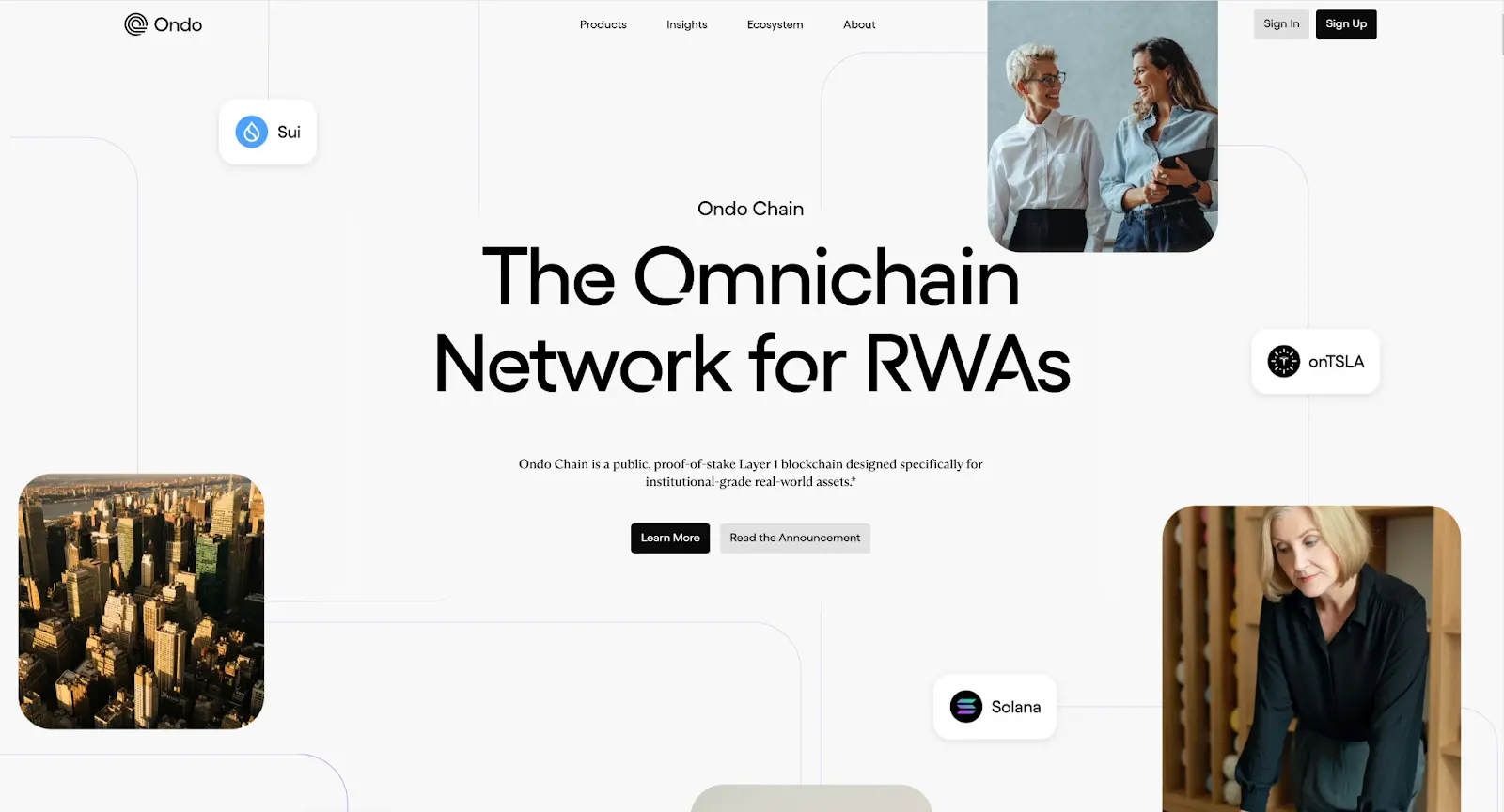
Image Source: Ondo official website
2.1 Representative Project Ondo Finance Relies on BlackRock
Recently, Ondo Finance has been very active. On February 5, they launched the Ondo Global Markets platform, primarily providing blockchain integration services for stocks, bonds, and ETFs. Shortly after, Ondo Finance announced their new Layer 1 public chain, Ondo Chain, aiming to create a more robust financial infrastructure to promote the tokenization of RWA.
Ondo Chain serves as the infrastructure for Ondo Global Markets (Ondo GM), focusing on the integration of RWA tokenization and blockchain. Ondo Chain allows global investors to access U.S. listed securities (such as stocks, bonds, ETFs) on-chain through a blockchain platform, breaking geographical limitations and providing 24/7 uninterrupted trading services.
Ondo Chain has introduced a solution that embeds institutional-level compliance into the public chain architecture, attempting to overcome the existing pain points of RWA on-chain through innovative means such as permissioned validation node mechanisms and native cross-chain protocols. By using traditional financial assets as collateral, Ondo Chain ensures network security and achieves interoperability with traditional clearing systems, further bridging on-chain and off-chain liquidity.
2.2 Competitiveness and Limitations of Ondo Finance Among Similar Projects
This is related to its unique architectural design and strong institutional resources, reflecting the power and interest games between blockchain and traditional finance.
- Competitiveness
By collaborating with top financial institutions like BlackRock, Ondo has built a blockchain financial infrastructure capable of supporting large-scale tokenization of real-world assets, ensuring a balance between compliance and decentralization.
Tokenization of RWA and Free Transfer: By pairing assets such as stocks, bonds, and ETFs with tokens 1:1, investors can freely transfer these tokenized assets outside the U.S. and integrate with DeFi to participate in lending, yield, and other financial activities.
Combination of Openness and Compliance: Ondo Chain combines the openness of public blockchains with the compliance of permissioned chains. Validators undergo permissioned reviews to ensure compliance, while any developer and user can issue tokens and develop applications on the chain, ensuring innovative vitality.
Institutional Participation and Ecosystem Development: The design advisory team of Ondo Chain includes financial institutions such as Franklin Templeton, Wellington Management, and WisdomTree, promoting its institutional-level applications in TradFi and DeFi.
Oracle Mechanism and Data Security: The built-in oracle system ensures the accuracy and timeliness of on-chain data, reducing the risk of data manipulation. This design enhances the credibility of key data such as asset prices, interest rates, and market indices.
Cross-Chain Functionality and Security Assurance: Cross-chain asset transfers are achieved through Ondo Bridge, providing security for the decentralized validation network (DVN) and supporting institutional asset and liquidity management, accommodating large transactions.
- Limitations
Heavy reliance on institutions limits the participation of ordinary users and decentralized communities, and there is a higher degree of centralization, with major power still held by a few institutions.
High Dependence on Institutions, Lack of Community Drive
Ondo Finance's architecture heavily relies on the participation of traditional financial institutions, with the credibility and liquidity of its tokenized assets primarily stemming from the endorsement of these institutions. While this model ensures the quality and compliance of tokenized assets, it also brings a core issue: its ecosystem is mainly designed for institutions, with low participation from ordinary users. Compared to fully decentralized RWA projects, Ondo resembles an extension of the traditional financial world, where the circulation and trading of tokenized assets occur more among institutions, diminishing the influence of ordinary investors and decentralized communities.Power Distribution Issues Under Centralized Control
Although Ondo Chain retains some openness, its validators are permissioned, meaning core power is concentrated in a few institutions. This sharply contrasts with some fully decentralized RWA projects, which emphasize that any participant can become a key node in the network. Ondo's design somewhat reflects the power structure of traditional finance, where most control remains in the hands of a few large financial institutions. This concentration of power may lead to conflicts in future governance and resource allocation, especially when the interests of token holders conflict with those of institutions.Innovation Speed May Be Limited by Compliance and Traditional Institutions
Since Ondo Finance's core pillars are compliance and institutional participation, this may also limit its speed of innovation. Compared to fully decentralized projects, Ondo may need to undergo complex compliance processes and institutional approvals when introducing new financial products or technologies. This puts it at risk of slow response in the rapidly changing crypto space, especially when competing with more agile DeFi projects, where its compliance and institution-oriented architecture may become a burden.
III. Real Obstacles Faced by RWA Projects
Although blockchain technology provides the technical foundation for RWA on-chain, current public chains still struggle to meet the demands of traditional finance in high-frequency trading, real-time settlement, and other aspects. Meanwhile, the fragmentation of cross-chain ecosystems and security issues further complicate the deployment of RWA by institutions. The application of RWA in decentralized finance (DeFi) faces multiple real obstacles:
First, the trust and consistency issues between assets and on-chain data become the core challenge for RWA on-chain. The key to RWA on-chain lies in ensuring the consistency between real-world assets and on-chain data. For example, after tokenizing real estate, the ownership, value, and other information recorded on-chain must completely match the legal documents and asset status in reality. However, this involves two key issues: first, the authenticity of on-chain data, i.e., how to ensure that the source of on-chain data is trustworthy and immutable; second, data synchronization updates, i.e., how to ensure that on-chain information can reflect changes in the status of real assets in real-time. Solving these issues often requires the introduction of trusted third parties or authoritative institutions (such as governments or certification bodies), but this conflicts with the decentralized nature of blockchain, making trust issues an unavoidable core challenge for RWA on-chain.
Insufficient network security is also a significant issue. The security of blockchain networks typically relies on the economic incentive mechanisms of local tokens, but the volatility of RWA is usually lower than that of cryptocurrencies, especially during market downturns, which may lead to decreased network security. Additionally, the complexity of RWA demands higher security standards, which existing blockchain systems may not fully meet.
The compatibility issues between RWA and DeFi architectures remain unresolved. DeFi is primarily designed to serve crypto-native assets rather than traditional securities. RWA on-chain involves complex financial behaviors (such as stock splits and dividend distributions), which are challenging to manage effectively through existing DeFi systems. Notably, the oracle systems also exhibit significant shortcomings in handling the real-time and security aspects of large-scale traditional financial data.
The issues of fragmented cross-chain liquidity and security further complicate the RWA on-chain process. The cross-chain issuance of RWA leads to dispersed liquidity, increasing the complexity of asset management. While cross-chain bridging mechanisms provide solutions, they also introduce new security risks, such as double-spending attacks and protocol vulnerabilities.
Institutional regulation and compliance issues represent the largest non-technical barrier to RWA on-chain. Many regulated financial institutions cannot trade on public blockchains, primarily due to anonymity, lack of compliance frameworks, and differences in global regulatory standards. Compliance requirements such as KYC and anti-money laundering further complicate the RWA on-chain process, which, to some extent, limits capital inflow.
Market liquidity and institutional participation restrictions also constrain the development of RWA. Currently, the overall market value of RWA is mainly concentrated in low-risk assets (such as government bonds and funds), while the on-chain progress of major asset classes like stocks and real estate is slow. The liquidity of RWA still relies on crypto-native protocols, and the overall market remains in the early stages of development.
Finally, the conflict between DeFi and traditional financial trust mechanisms is also a problem that must be addressed for RWA on-chain. DeFi relies on code and cryptography to build trust, while traditional finance relies on legal contracts and centralized institutions. This difference in trust mechanisms leads traditional financial institutions to adopt a cautious attitude towards blockchain technology, especially in critical areas such as custody and risk control.
Although blockchain technology offers the possibility for RWA on-chain, numerous challenges remain in practical applications. From data consistency, network security, compatibility, liquidity, compliance, to the matching of technical and economic models, as well as conflicts in trust mechanisms, these issues need to be gradually resolved in development to promote the widespread application of RWA in DeFi.
IV. If RWA Succeeds, Ondo Chain May Become the Redistribution of Power Between the New and Old Financial Systems in the "Wall Street Game"
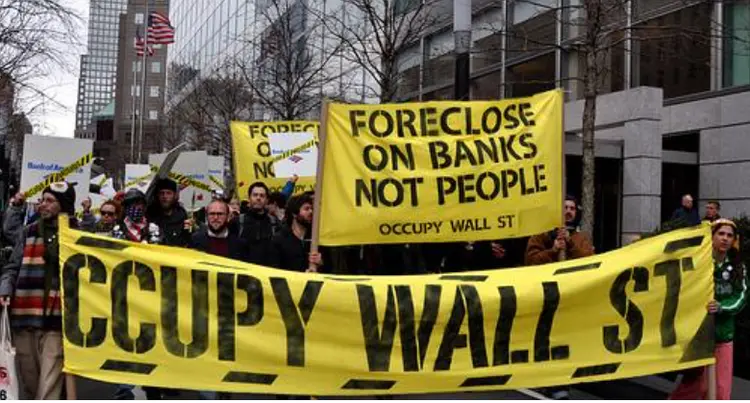
Image Source: Occupy Wall Street
In this section, when analyzing the core Wall Street interests involved behind Ondo Chain, I believe it is necessary to step outside the phenomenon of blockchain and real asset tokenization and consider the driving factors behind financial operation logic and interest competition. As mentioned earlier, the most critical challenge for RWA at a non-technical level lies in how to achieve compliance, which relies on the recognition of powerful centralized authority organizations.
The world's largest asset management company, BlackRock, after advancing Bitcoin ETFs, has participated in the investment and construction of RWA, essentially striving to be the first to reclaim the power redistribution between the traditional financial system and the emerging decentralized technology reliant on blockchain. This struggle is not merely a competition of technological transformation or financial innovation, but a contest for the global financial rule-making power, capital control, and future wealth distribution mechanisms.
Despite the hope for decentralization brought by blockchain technology, Wall Street is attempting to bring this technological revolution under its control, perpetuating its dominant position in the global financial system through new forms of market manipulation and asset securitization.
4.1 Rebalancing Power in the Global Financial System
Wall Street has long held a dominant position in the global financial system, controlling key nodes of capital flow, asset management, and financial services. Traditional financial institutions achieve control over global capital by monopolizing financial infrastructure (banks, stock exchanges, clearing systems, etc.). However, the rise of blockchain technology has disrupted this situation:
Decentralized finance (DeFi) weakens the traditional financial infrastructure that Wall Street has long controlled through disintermediation. DeFi allows key functions such as capital flow and asset management to operate on decentralized platforms, enabling users to manage assets, lend, and trade directly on the blockchain without intermediaries like banks or investment banks. But this poses a significant threat to Wall Street, as this transfer of power means that Wall Street may lose its dominance over the global financial system.
4.2 Asset Tokenization: Who Can Control the New Financial Infrastructure
The RWA tokenization promoted by platforms like Ondo Chain aims to enhance asset liquidity, but it hides a struggle for control over the new financial infrastructure. Blockchain networks are candidate platforms for the next generation of global financial infrastructure; whoever can dominate this infrastructure will hold a leading position in linking real-world assets to blockchain in the future.
Wall Street's interests are reflected in its intent to control these decentralized networks. They may not directly deny blockchain but instead seek to control these emerging blockchain platforms through investments, mergers, or partnerships, leading to a resurgence of capital centralization. Although blockchain aims for decentralization, a significant amount of capital and liquidity can still easily be concentrated in the hands of a few large financial institutions or hedge funds. Ultimately, this results in key resources on blockchain platforms (liquidity, protocol governance rights, etc.) returning to a few players, necessitating the involvement of centralized powers to drive the decentralized asset market.
4.3 Regulatory Arbitrage and Extralegal Power
According to a report by Cointelegraph on February 6, JPMorgan's latest electronic trading survey of institutional traders shows that 29% of institutional traders are about to or are currently trading cryptocurrencies this year, an increase of 7 percentage points from last year.
Arbitrage has always been a trading strategy that Wall Street elites excel at exploiting. In the face of the uncertain regulatory environment surrounding blockchain's decentralized characteristics, Wall Street institutions may leverage regulatory differences across countries and regions by establishing operational entities in jurisdictions with looser regulations to evade stricter oversight. For example:
In projects like Ondo Chain, certain RWA tokenizations may bypass traditional securities regulations or financial market regulations. Manipulating asset flows and capital structures in different regulatory environments further strengthens control over emerging markets. It is not excluded that such operations in the "gray area" are one of the means by which Wall Street seeks higher returns through blockchain.
4.4 Market Liquidity and Price Manipulation: The Struggle for Implicit Dominance
Liquidity is at the core of market manipulation, enabling implicit price manipulation in seemingly "decentralized" markets. Ondo Chain provides new investment opportunities for global investors through RWA tokenization, but its liquidity and trading depth still heavily depend on the injection of large capital, and liquidity control will continue to be a core weapon for Wall Street players. Even in a decentralized blockchain environment, institutions with more capital, trading technology, and market insights can still dominate market trends.
4.5 RWA Hedge Funds: Restructuring the Asset Securitization Game
Historically, Wall Street has achieved significant profits through asset securitization (such as subprime mortgage securitization). The RWA tokenization on blockchain provides an opportunity for a new generation of asset securitization. For example, Wall Street can issue new financial products by tokenizing a combination of assets, attracting global investors. These products can be generated based on RWA, such as real estate investment trust tokens and corporate bond tokens, providing more options for the market.
At the same time, the derivatives market may also expand through blockchain. Wall Street can design complex financial derivatives (such as options, futures, swaps) to repackage risks and sell them to global investors. The game of risk transfer and profit acquisition will continue to play out in the era of RWA tokenization.
V. The Path to Advancement in the Crypto World: The Industry's Development is Forced to Accelerate
Taking Bitcoin-led crypto asset ETF trading, events related to Trump, and the future of RWA as examples, all three are accelerating the industry's development process to varying degrees, directly impacting the difficulty of profitability in the industry. These factors influence the crypto industry through complex market dynamics, regulatory pressures, and the gradual infiltration of traditional financial ecosystems.
5.1 Market Maturation Brought by ETF Introduction
The launch of ETFs marks the gradual acceptance of the crypto industry by mainstream financial institutions and investors, but it does not necessarily benefit the overall growth of the crypto industry, akin to how gold experienced a prolonged increase after the introduction of ETFs:
Decrease in Market Liquidity and Volatility
The introduction of ETFs means that crypto assets enter traditional financial markets, attracting more conservative investment styles from institutions, while the increased financial derivatives also lead to reduced volatility of crypto assets. This means fewer arbitrage and high-frequency trading opportunities for traders reliant on high volatility (such as retail investors and crypto hedge funds), thereby reducing profit margins.
Concentration of Capital Flows
ETFs make the capital flow in the crypto market more concentrated, primarily focusing on a few large assets like Bitcoin. This may lead to small and medium-sized crypto assets facing risks of liquidity depletion and price declines, affecting the development opportunities of more small projects. The result is a reduction in profit opportunities for more emerging projects, increasing the overall difficulty of profitability in the industry.
Competitive Pressure from Traditional Finance
The introduction of ETFs means that crypto assets are being productized by traditional finance, bringing higher market transparency and competition. This also means that the crypto industry must compete more fiercely with traditional financial instruments such as stocks, bonds, and commodities, diverting capital and investor attention.
5.2 Market Uncertainty Brought by the Trump Effect
The actions of political figures like Trump may influence the crypto market through their policies, regulatory attitudes, and international relations, increasing uncertainty and complexity in the industry:
Increased Policy Uncertainty
Trump's policy positions and governing style are often filled with uncertainty, especially regarding economic and financial regulation. The regulatory policies he and his administration may implement (such as cracking down on or relaxing regulations on digital currencies) will directly affect market sentiment, increasing instability in the crypto market. This uncertainty poses greater policy risks for the crypto industry, impacting the stability of long-term profitability.
Strengthening of Anti-Money Laundering and KYC Requirements
Due to the possibility of Trump and other politicians implementing stricter anti-money laundering and KYC regulations in the future, exchanges and crypto projects will face higher compliance costs. This will significantly increase operational costs and compress profit margins, especially for crypto enterprises lacking compliance experience.
The "TRUMP" Coin Causes a "Siphoning Effect" in the Market
High volatility attracts speculative funds, and "TRUMP" has a natural marketing effect that can draw significant capital into this single asset. Limited liquidity and capital in the market can easily be "siphoned" by meme coins in the short term, creating a "capital concentration effect," but as prices later decline, liquidity is also difficult to disperse back to its original state.
5.3 The Development of RWA Will Bring Traditional Financial Infiltration
The development of RWA in the crypto space represents a trend of gradual integration between the crypto market and traditional financial assets, but this integration also brings increased difficulty in profitability:
Introduction of Traditional Financial Cost Structures and Competition
Once RWA projects are widely adopted on-chain, traditional financial assets such as bonds, stocks, and real estate will compete within the same ecosystem as crypto assets. The maturity, cost efficiency, and low-risk characteristics of traditional financial products will attract a large number of institutional investors, meaning that crypto assets will need to compete with these mature financial products.
Contradiction Between Decentralization and Compliance
The on-chain implementation of RWA involves complex regulatory requirements, especially regarding compliance and legal responsibilities. Compared to the currently decentralized crypto assets, the introduction of RWA may force more crypto projects towards compliance, leading to more projects exiting the market due to failure to meet regulatory requirements, thereby reducing profit opportunities.
Capital Easily Flows Towards Low-Risk Assets
The on-chain implementation of real-world assets, such as government bonds and corporate bonds, will attract a large number of conservative investors into the on-chain market. As more capital flows into low-risk RWA, high-risk, high-return projects in the crypto market (such as DeFi protocols or emerging tokens) may lose some funding support. This phenomenon of capital shifting towards low-risk assets will further compress profit margins in the crypto market.
VI. Conclusion: Is RWA a Narrative Bubble or a Market Shift?
Based on the above personal views, the rise of ETFs, the Trump effect, and the future of RWA will increase the difficulty of profitability in the crypto industry through different paths and intensities. The market maturation and institutionalization brought by ETFs reduce market volatility and high-profit opportunities; Trump's policies may increase market uncertainty, bringing policy risks to the industry; while the introduction of RWA signifies that the crypto market will compete with traditional financial markets. In this increasingly complex evolutionary process, as crypto assets become more "conventional," the market will become more "bottlenecked," presenting more severe new challenges for the future crypto market.
Therefore, whether RWA is a "narrative bubble" or a "market shift" depends on the maturity of its technological foundation, market demand, and realization path. If we only look at the progress and challenges at this early stage, RWA has certain elements of a "narrative bubble," but with the deep participation of well-known institutions, RWA is expected to become a new catalyst for change in the crypto market.
免责声明:本文章仅代表作者个人观点,不代表本平台的立场和观点。本文章仅供信息分享,不构成对任何人的任何投资建议。用户与作者之间的任何争议,与本平台无关。如网页中刊载的文章或图片涉及侵权,请提供相关的权利证明和身份证明发送邮件到support@aicoin.com,本平台相关工作人员将会进行核查。


