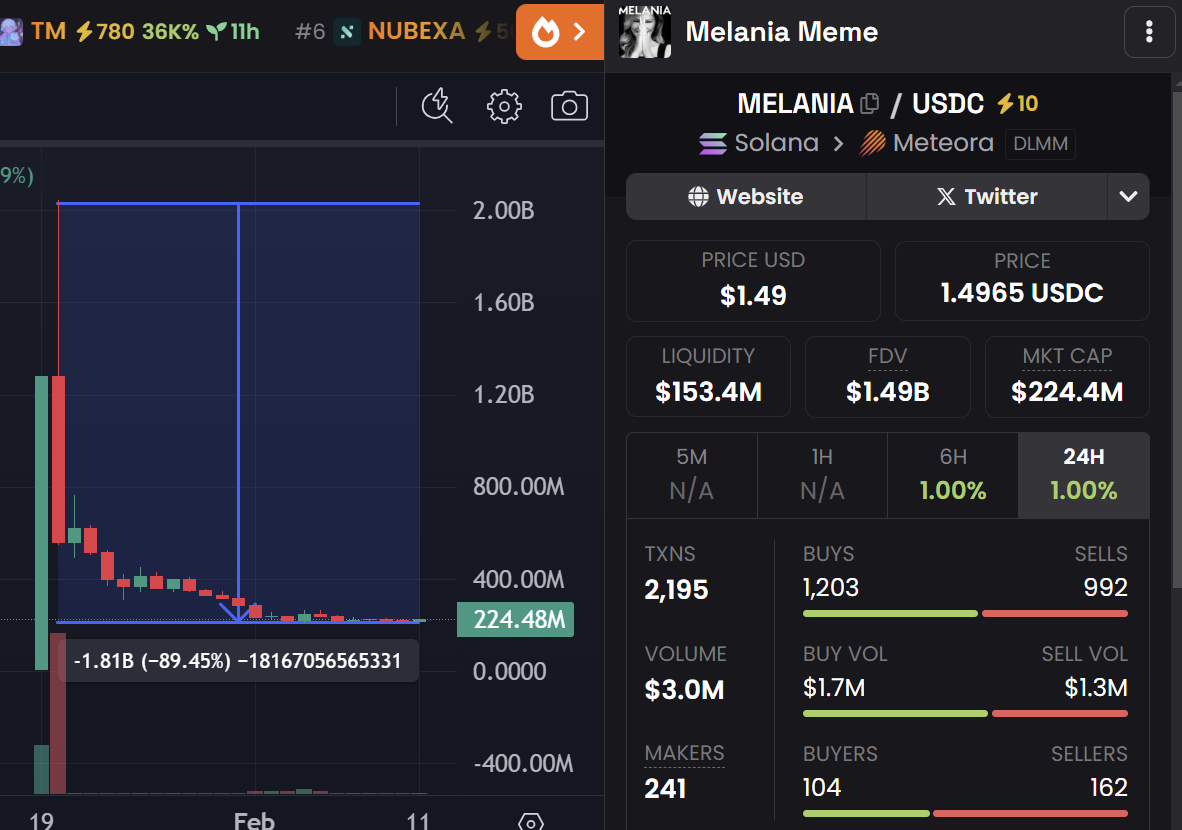
In hindsight, Melania's token issuance marked a short-term peak.
Recently, Bitcoin has been hovering around 100,000, while most altcoins have been halved, with declines of 70% to 80% becoming the norm. The Bitcoin Dominance (BTCD) has quickly risen from a low of 54% in early December 2024 to 61%, providing data to support the fact that amidst Bitcoin's price fluctuations, the widespread decline of altcoins has become an undeniable reality.
So, what events have occurred recently in the market that have led the crypto space into a deep freeze?
- Trump and his family continuously issuing tokens, the release of Deepseek R1, and the U.S. tariff war.
Trump's token issuance captured significant market attention, seen as a bullish signal, while his wife Melania's token issuance was viewed as a "money-grabbing" tactic, not only splitting attention and market liquidity but also undermining overall industry confidence.
The release of Deepseek R1 announced to the world that for just 5.5 million dollars, one could benchmark or even surpass the most advanced LLMs currently on the market, raising concerns about excess computing power. On the same day, NVDA's stock price plummeted by 17%. However, concerns about excess computing power are unfounded, as more efficient training models mean that more advanced chips and stronger computing power can be used to create more robust models, which is essentially a short-term bearish and long-term bullish scenario. In the context of Web 3, this situation prompted the market to consider: if a product can be created with a cost of 5.5 million that is already functional and effective, why should we invest in AI agents with market caps exceeding 100 million but with products that are still fragmented?
On February 1, 2025, Trump signed an executive order announcing tariffs of 25% and 10% on imported goods from Canada, Mexico, and China, respectively. Reflecting on the trade war from 2018 to 2020, it had a "short-term volatility, long-term bullish" effect on the cryptocurrency market, especially with the tariffs on Mexico and Canada being delayed by a month. The correlation between tariffs and the crypto market is indirect and secondary; the primary impact of tariffs is on the overall U.S. economy, which in turn affects the crypto market.
What narrative shifts have occurred in the crypto space?
- Trump as the first celebrity to issue tokens, the burst of the AI agent bubble, the resurgence of SocialFi, and the revival of the BNB Chain ecosystem?
Celebrities typically refrain from issuing tokens due to regulatory and reputational concerns, but with even U.S. President Trump issuing tokens, it has alleviated various worries for other celebrities considering token issuance. However, since subsequent celebrities cannot match Trump's fame and influence, this narrative resembles PVP speculation, with very short sustainability.
The rise of celebrity tokens, combined with the release of Deepseek R1, has also diverted attention from the AI agent sector, causing the overall market cap of the sector to drop by over 60% from its peak, with leading projects like Virtual and AI16Z falling about 70% from their highs. New AI projects have generally faced a fate of going to zero.
Continuing in the celebrity token space, aside from announcing token issuance on their Twitter, it is more likely that accounts are hacked to issue token contract addresses (though this could also be one of the token issuance methods). To verify personal token issuance, two SocialFi products, Clout and Tribe, emerged in the market, allowing direct connection to Twitter for verification, similar to the earlier Friend Tech. The overall market cooled down, and projects faced severe issues like insider trading, leading to SocialFi only creating a ripple in the market for less than a week.
Rewinding to February, TST originated from Binance as a test token, quickly igniting market enthusiasm due to CZ's tweet, with the token's market cap soaring from under 10 million dollars to a peak of 500 million dollars. However, the token's market cap did not stabilize at the 500 million dollar mark and plummeted over 60% the next day, indicating that the market narrative led by the BNB Chain has come to an end.
Looking at the recent narratives in the crypto space, one characteristic stands out: they have very short sustainability, indicating that the market is currently in a zero-sum state. A surge in one sector means capital is fleeing another sector, with no truly sustainable quality investment tracks. Could this be a signal that the market has peaked? Below, we will use three data points to assess the current market position.
Reference: dexscreener
Top-escaping indicator: Not yet peaked
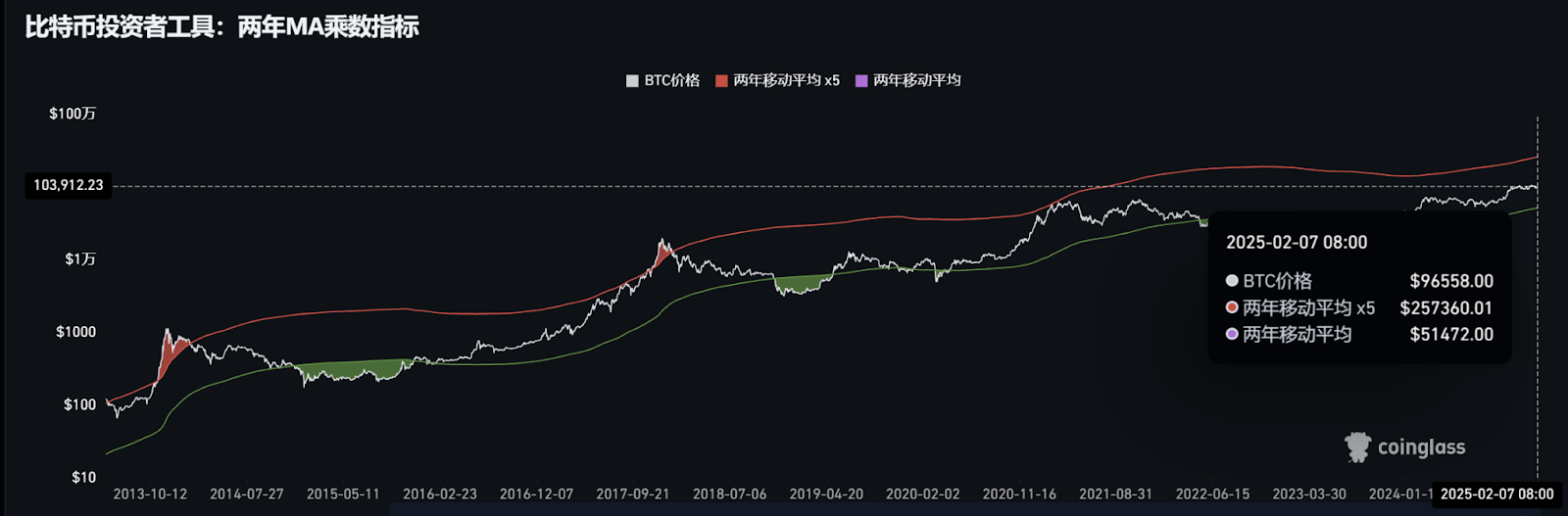
The two-year MA multiplier indicator is designed to serve as a long-term investment tool, highlighting periods when buying and selling Bitcoin can yield significant returns. It uses the 2-year moving average (equivalent to the 730-day line, green line) and five times that moving average (red line).
Historically: When the price falls below the 2-year moving average (green line), it signals a buying opportunity, and purchasing Bitcoin can yield excess returns. When the price exceeds five times the 2-year moving average (red line), it signals a selling opportunity, and selling Bitcoin can yield substantial profits.
Currently, the Bitcoin price is far from the five times two-year moving average (257,360), indicating that the overall crypto market has not yet peaked.
Reference: dexscreener
Ahr999 indicator: Slightly above the dollar-cost averaging range
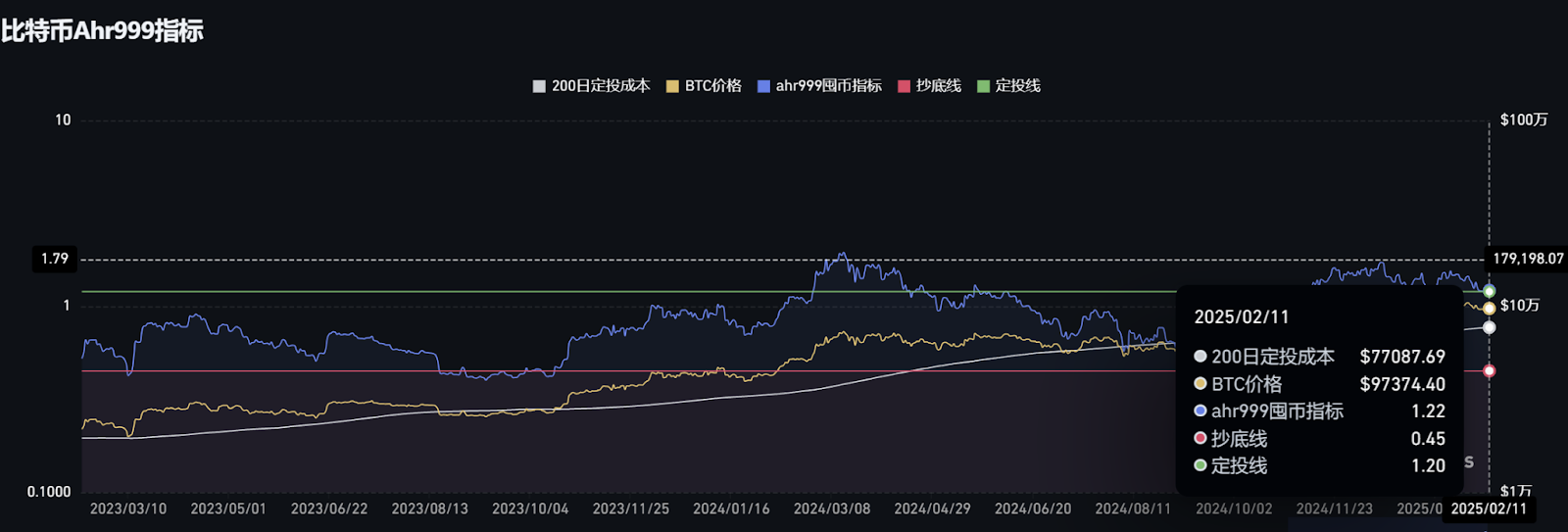
This indicator implies the short-term dollar-cost averaging yield of Bitcoin and the deviation of Bitcoin's price from its expected valuation.
When the AHR999 index is below 0.45, it signals a buying opportunity;
When the AHR999 index is between 0.45 and 1.2, it is suitable for dollar-cost averaging;
When the AHR999 index is above 1.2, the price is relatively high, making it unsuitable for action.
In the long term, Bitcoin's price shows a certain positive correlation with block height. By leveraging the advantages of dollar-cost averaging, users can control short-term investment costs, keeping them below Bitcoin's price most of the time.
Currently, the Ahr999 indicator is at 1.22, barely falling within the dollar-cost averaging range. Based on this indicator, it can only be said that the current price of Bitcoin is "not cheap enough," but there is still significant room before reaching a peak.
Reference: coinglass
Pi Cycle top indicator: Top at least 145,000 dollars
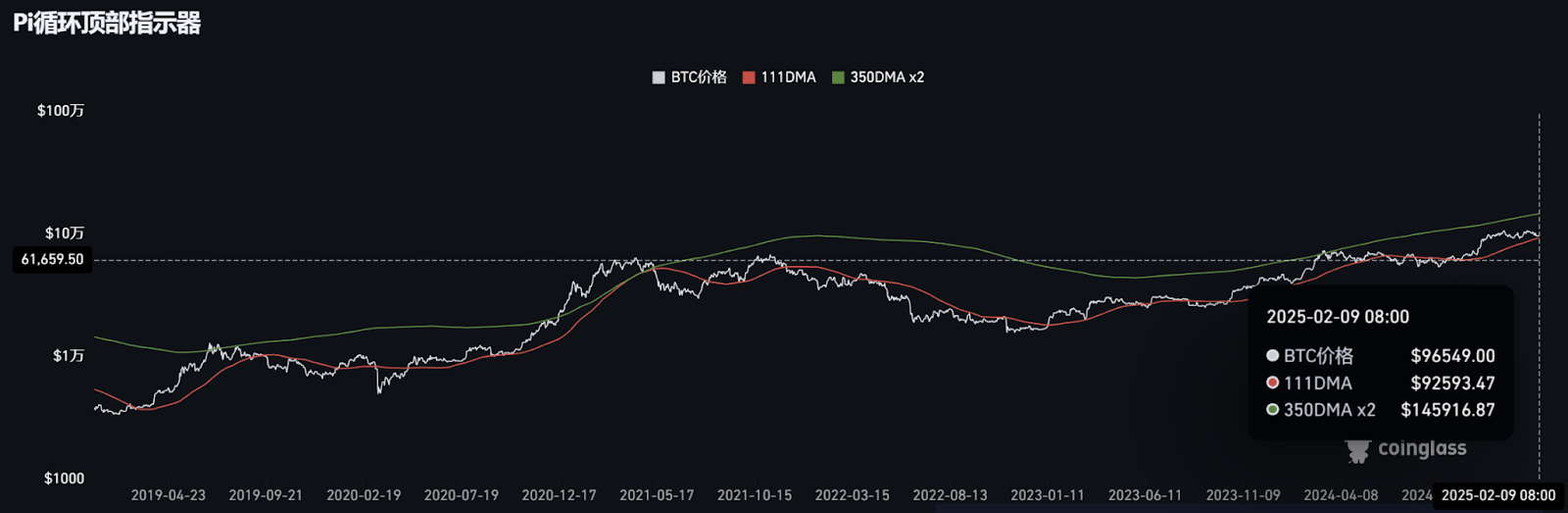
This indicator uses two sets of data to determine whether Bitcoin is in an overheated state:
111-day moving average (111DMA, red line)
Twice the 350-day moving average (350DMA x 2, green line)
The usage is as follows:
When the 111-day moving average rises and breaks through twice the 350-day moving average, it typically indicates that Bitcoin's price has reached a peak, signaling a sell.
How to interpret this indicator?
The Pi Cycle top indicator's significance lies in observing whether short-term prices have surpassed the average price of long-term holders, thereby assessing the market's overheating level. When the 111DMA (red line) breaks through the 350DMA x 2 (green line), it usually means the market is overly optimistic, exhibiting FOMO (fear of missing out) sentiment, which is often a signal of overheating, suitable for considering selling.
According to the latest chart information, on November 6, 2024, Bitcoin's price was approximately 96,549 dollars, while the price of 350DMA x 2 was about 145,916 dollars, indicating that the peak has not yet been reached.
Reference: coinglass
免责声明:本文章仅代表作者个人观点,不代表本平台的立场和观点。本文章仅供信息分享,不构成对任何人的任何投资建议。用户与作者之间的任何争议,与本平台无关。如网页中刊载的文章或图片涉及侵权,请提供相关的权利证明和身份证明发送邮件到support@aicoin.com,本平台相关工作人员将会进行核查。


