Shanzhai investment resembles a poker game, but there are too many tables and too few players.
Author: tzedonn
Translation: Deep Tide TechFlow
After experiencing a crazy fourth quarter, it's time to calm down and reflect. Many significant changes have occurred in the market within just three months.
This situation is different from before.
Everyone is looking forward to the arrival of "Shanzhai season" (the moment when the blue line surpasses the orange line), just like in 2021-2022 when all Shanzhai prices experienced explosive growth. However, since the launch of the Bitcoin ETF in January 2024, the gap between Bitcoin (BTC) and the TOTAL2 index (which represents the total market cap of Shanzhai) has been continuously widening.
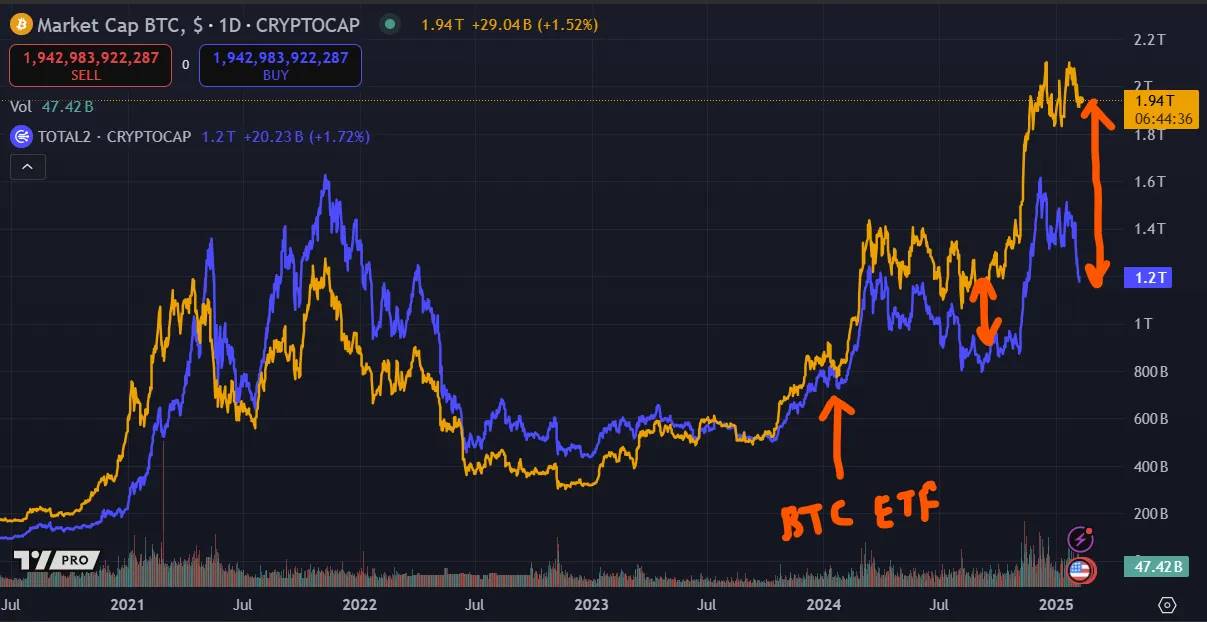
In past Shanzhai seasons, investors typically transferred their Bitcoin gains to higher-risk assets, driving a comprehensive rise in the Shanzhai market. This phenomenon formed a classic flow of funds pattern.
But now, Bitcoin's capital flow has completely decoupled from other cryptocurrencies, forming an independent ecosystem.
The inflow of Bitcoin capital is mainly driven by the following three factors:
ETF: Currently, ETF funds hold a total of 5.6% of the world's Bitcoin;
Microstrategy: This company holds 2.25% of Bitcoin and is a continuously buying institution;
Macroeconomic factors: Including interest rates and political situations (e.g., U.S. sovereign wealth funds or other countries potentially purchasing Bitcoin).
On the other hand, the outflow of Bitcoin capital mainly includes:
U.S. government: Currently holding about 1.0% of Bitcoin and indicating it may not sell;
Bitcoin miners: Miners regularly sell some Bitcoin for operational needs;
Bitcoin whales: These investors hold large amounts of Bitcoin, and since the market low in 2023, their asset value has increased by about 5 times.
Clearly, the driving factors behind these capital flows are completely different from those in the Shanzhai market.
Shanzhai Market: Are There Enough Players?
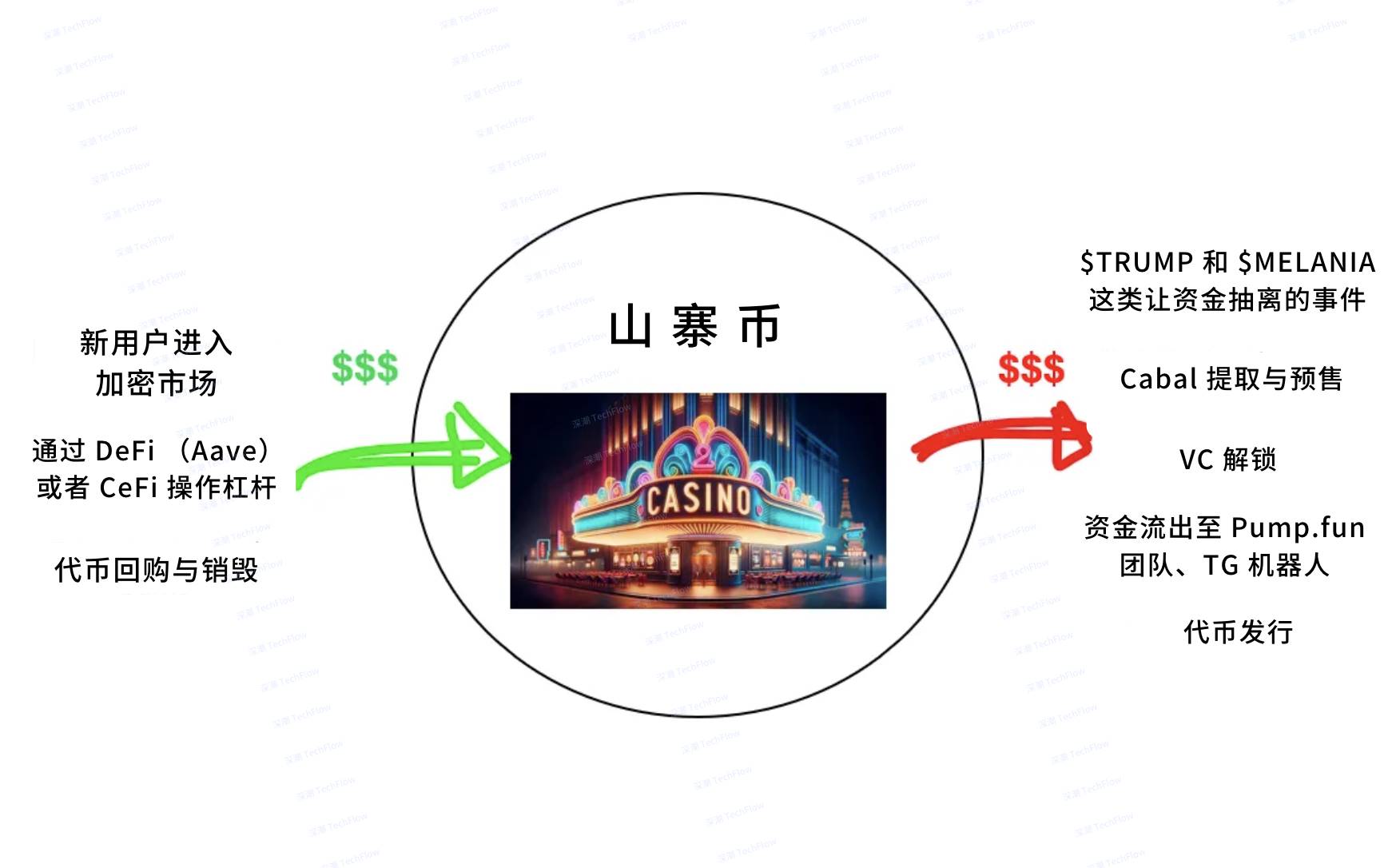
The Shanzhai market can be likened to a casino.
Only when there is ample capital flow in the casino (i.e., high net capital inflow) is it a good time to participate. Choosing the right poker table (i.e., investment target) is equally important.
The sources of capital inflow in the Shanzhai market are as follows:
New capital inflow:
For example, in 2021, a large number of retail investors entered the crypto market, bringing in new capital. However, currently, the capital inflow from Phantom/Moonshot or TRUMP token issuance, as well as the market cap growth of USDT/C, seems insufficient to support the market.
Additionally, certain specific assets may benefit from capital rotation. For instance, some investors who never invest in Memes may start paying attention to "AI Memes" because these investments are easier to rationalize.
Leverage funds obtained through decentralized finance (DeFi) platforms (like Aave, Maker/Sky) or centralized finance (CeFi) platforms (like BlockFi, Celsius). From an institutional perspective, the CeFi market has become less active after the collapse in 2021. In the DeFi space, the IPOR index (used to track USDT/C borrowing rates) shows that this rate has dropped from about 20% in December 2023 to around 8% now.
Token buybacks and burns: Making players' chips more valuable
The "buyback and burn" mechanism in crypto projects is similar to how the house in a poker game uses its income to enhance the value of players' chips.
A typical example is the HYPE insurance fund, which repurchased 14.6 million HYPE at a price of $24 each, worth about $350 million.
However, most crypto projects have not achieved sufficient product-market fit (PMF), making it difficult to conduct buybacks at a scale that significantly impacts token prices (e.g., the buyback case of JUP).
Casino Capital Outflow: Who is Cashing Out?
- Large capital withdrawal events
In January, there were two "once-in-a-lifetime" large capital withdrawal events in the market:
Trump event: Capital grew from $0 to $75B, then quickly dropped to $16B;
Melania event: Capital grew from $0 to $14B, then fell to $1.5B.
These two events conservatively estimated to have withdrawn over $1B in liquidity from the crypto market ecosystem. In other words, if someone made over $10M in a transaction, they are likely to transfer more than 50% of their profits to the over-the-counter market.
- Tool-driven continuous capital withdrawal
In addition to large events, some tools are continuously extracting market funds:
Pump.fun: Accumulated revenue reached $520M in about a year;
Photon: Accumulated revenue of about $350M;
Bonkbot, BullX, and Trojan: Each tool has accumulated revenue of about $150M.
These tools gradually remove large amounts of funds from the market through small, decentralized withdrawals.
- Cabal withdrawals and presale models
Cabal withdrawals and presale models often mark the end of a market cycle. This is because a few individuals extract large amounts of capital at this stage and transfer it to the over-the-counter market. As the cycle approaches its end, the duration of these events becomes shorter:
Pasternak: Lasted only about 10 hours;
Jellyjelly: Lasted about 4 hours;
Enron Pump: Lasted only 10 minutes.
This rapid capital outflow is vividly referred to as the “euthanasia rollercoaster”, as it causes the market to experience brief but intense fluctuations.
- VC fund unlocks
Venture capital firms unlock funds to convert crypto assets into dollars to return distributed investment profits (DPI) to their limited partners (LPs). For example, in the TIA project, VCs withdrew a large amount of capital from the crypto market in this manner.
- De-leveraging
There is also a phenomenon of de-leveraging in the market, such as lowering the borrowing rate of USDT (Tether). This behavior leads to a gradual reduction of leveraged funds in the market, further affecting liquidity.
(Original image from tzedonn, translated by Deep Tide TechFlow)
Choosing Shanzhai: How to Find Your Poker Table?
In the crypto market, choosing the right investment target is key to success. This process can be likened to selecting a suitable poker table.
When the market is active (i.e., with a large number of players participating), your potential returns will be higher, provided you choose the right token.
This type of investment is referred to as a "poker game" because it is essentially a zero-sum game.
In this game, projects either:
Fail to generate income or value;
Attribute the generated value to the token.
The only possible exceptions are the following two types of projects:
Frequently used L1s, such as SOL and ETH;
Products that can generate high income, such as HYPE.
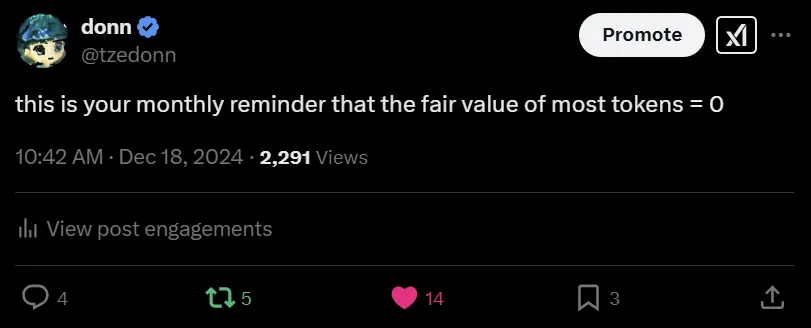
It is important to note that some investors bet on the team's ability to create sustainable income based on "fundamentals," but in the short term, I hold a more pessimistic view on this.
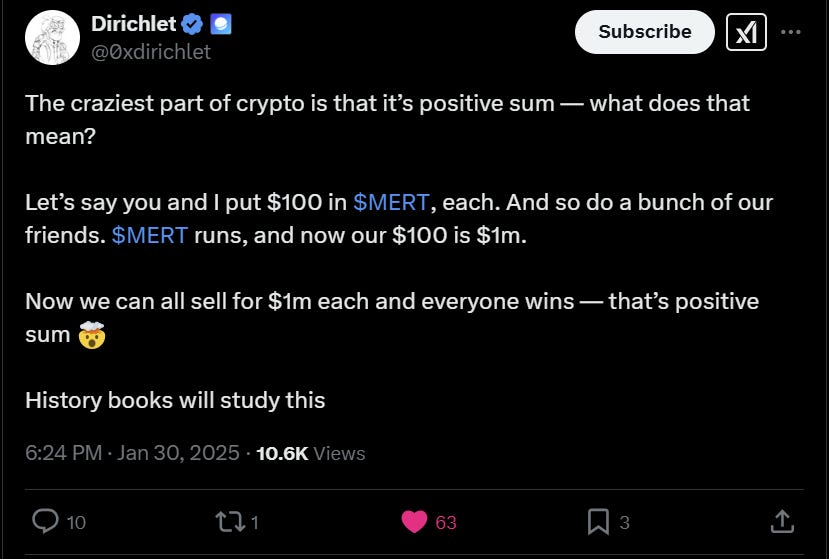
The situation in 2025: Too many tables, but too few players.
By 2025, competition in the crypto market has become more intense, making it more difficult to find suitable investment targets than ever before. This is because there are simply too many "poker tables" (i.e., token projects) existing simultaneously in the market.
Here are some data points:
About 50,000 new tokens are launched daily through Pump.fun;
Since the launch of Pump.fun, over 7 million tokens have been launched, of which about 100,000 eventually entered the Raydium platform.
Clearly, there are not enough investors in the market to support all these token projects. Therefore, the investment returns in the Shanzhai market show a strong trend of differentiation.
Choosing the right investment target has become an art, often requiring consideration of the following aspects:
The strength of the team and product;
The narrative behind the project;
Spreadability and marketing effectiveness.
Kel once wrote an excellent article that explored how to choose Shanzhai investment targets in detail.
What does this mean?
Shanzhai is no longer "high beta Bitcoin." The past investment theory suggested that "holding Shanzhai instead of Bitcoin" could yield higher returns, but this strategy may no longer apply today.
The importance of asset selection has increased. With the threshold for token issuance on the Pump.fun platform lowered to nearly zero, choosing the right Shanzhai has become more crucial than ever. The inflow of funds in the market can no longer uniformly drive up the prices of all tokens.
Shanzhai investment resembles a poker game more than ever. While likening Shanzhai investment to a poker game may sound somewhat pessimistic, it truly reflects the current state of the market. Perhaps in the future, I will write an article exploring the real long-term use cases of cryptocurrencies.
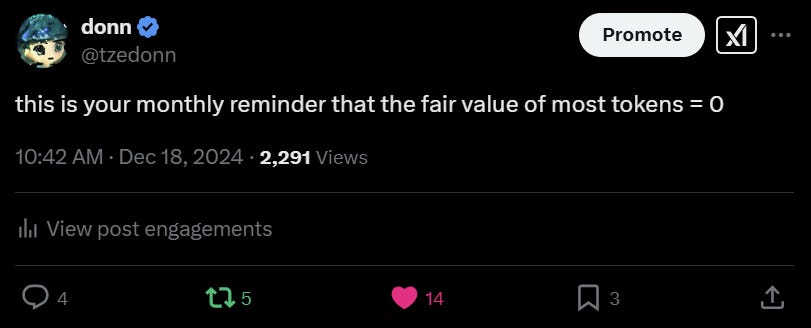
Have we reached the peak? Currently, the market may have reached a temporary peak, but the future trend remains to be seen.
When will the next Shanzhai season arrive?
The traditional "four-year cycle" theory may have become obsolete, as the trends of altcoins are gradually decoupling from Bitcoin (BTC).
In the future, the altcoin market may be triggered by some unexpected events, such as a phenomenon similar to "GOAT."
In the long term, the prospects for the crypto market remain very promising, especially under the influence of U.S. sovereign wealth funds (US SWF), governments supporting Bitcoin, and the introduction of stablecoin-related legislation.
The future is full of uncertainty, but also full of opportunities. Good luck and have fun!
免责声明:本文章仅代表作者个人观点,不代表本平台的立场和观点。本文章仅供信息分享,不构成对任何人的任何投资建议。用户与作者之间的任何争议,与本平台无关。如网页中刊载的文章或图片涉及侵权,请提供相关的权利证明和身份证明发送邮件到support@aicoin.com,本平台相关工作人员将会进行核查。


