DeSci has matured enough to influence the way scientific research is conducted today.
Written by: Will 阿望
Since ancient times, emperors and generals have had an endless yearning for immortality, and this remains true today. This pursuit of life extension and exploration of the frontiers of science has found new directions with the aid of blockchain technology. The rise of decentralized science (DeSci) offers new hope and possibilities for exploring the frontiers of science.
What first drew my attention to DeSci was Pfizer's investment in VitaDAO, which not only marked Pfizer's first investment in the Web3 space but also signified the recognition and support of traditional pharmaceutical giants for the DeSci field. Combining this with my background in digital healthcare entrepreneurship leads to reflections on how to reimagine business models through DeSci.
The DeSci research report published by Binance Research, titled "From Challenges to Opportunities: How DeSci Reimagines Science," first introduces the phenomenon of the "Valley of Death" in the scientific research process, then brings in DeSci, and responds to the "Valley of Death" with innovative solutions from DeSci. Finally, it summarizes the current landscape of DeSci in the market, indicating that DeSci has matured enough to influence the way scientific research is conducted today. Although there are some gaps and challenges in the current situation, addressing the "Valley of Death" in research is already a significant step forward.
Following the logic of the report, DeSci can actually integrate more with blockchain technology and Web3 throughout the entire process of transforming scientific research into commercialization. Taking medical research as an example:
Data Acquisition: Data from early-stage basic research and translational research can be obtained through DePIN, further enhanced by AI, which benefits from global coverage and incentives;
Data Storage: This data can be stored on-chain using encryption technology, maintaining data immutability and security, while also constructing a new publishing format that is open and accessible to all, addressing the issues of replicability and reproducibility in scientific discoveries to some extent;
Community of Interests: By implementing rules set by DAO organizations, a community of interests can be established between basic research and clinical treatment. These rules can be further expanded to cover various stages such as research, clinical, commercialization, and doctor-patient scenarios, achieving a win-win situation for multiple parties;
The future picture of DeSci will be: decentralized organizations (DAOs) composed of multiple communities of interest, sharing common goals and visions, no longer being driven by capital profits, deeply integrating blockchain technology and Web3, promoting scientific discoveries, accelerating the realization of substantial products, and advancing the development and progress of society as a whole.
Although DeSci is still in a very early stage, it is actively influencing the way scientific research is conducted today.
Below is the content from "From Challenges to Opportunities: How DeSci Reimagines Science," Enjoy:
01 Core Insights
The scientific research process faces significant challenges, especially in the translational research phase that transitions basic research to practical applications. The "Valley of Death" phenomenon leads to 80%-90% of research projects failing before human trials, with only 0.1% of candidate drugs becoming approved treatment options.
The misalignment of incentives between academia, funding agencies, and industry results in insufficient R&D funding, reduced collaboration between scientists and clinicians, and poor replicability and reproducibility of scientific discoveries, ultimately causing most research to stagnate in the "Valley of Death."
Decentralized science (DeSci) is a movement that utilizes the Web3 stack to create innovative scientific research models that can address the aforementioned challenges.
By using decentralized autonomous organizations (DAOs), blockchain, and smart contracts, DeSci can solve key coordination issues. This enables different stakeholder groups to align their capital interests, incentivizing them to advance research to the clinical stage.
The market has already identified four key innovation areas in the DeSci field:
Infrastructure, including sub-industries such as funding platforms and DAO tools, which form the cornerstone of DeSci DAOs.
Research, including grassroots DeSci communities hosting global events and DAOs with a unified vision from multiple stakeholders.
Data services, including publishing and peer review platforms. These platforms support open access to scientific publications and data management tools that provide robust data integrity and collaborative access control.
Memes, which directly fund scientific experiments or serve as investment tools for other DeSci projects.
While the existing stack can support basic and translational research, it is less suited for clinical research, which is the area where products have direct benefits for patients.
In summary, decentralized science has matured enough to influence the way scientific research is conducted today. Although there are some gaps and challenges in the current situation, addressing the "Valley of Death" in research is already a significant step forward.
02 Introduction
2.1 Background of Traditional Scientific Research
The process of generating new knowledge and inventions in the scientific industry can be divided into different stages, primarily into basic research and clinical research. These two main stages are connected through translational research. The key function of translational research is to convert the results of basic research into practical applications that can be tested through clinical research. The ultimate goal of this process is to commercialize research findings and create products that benefit society.
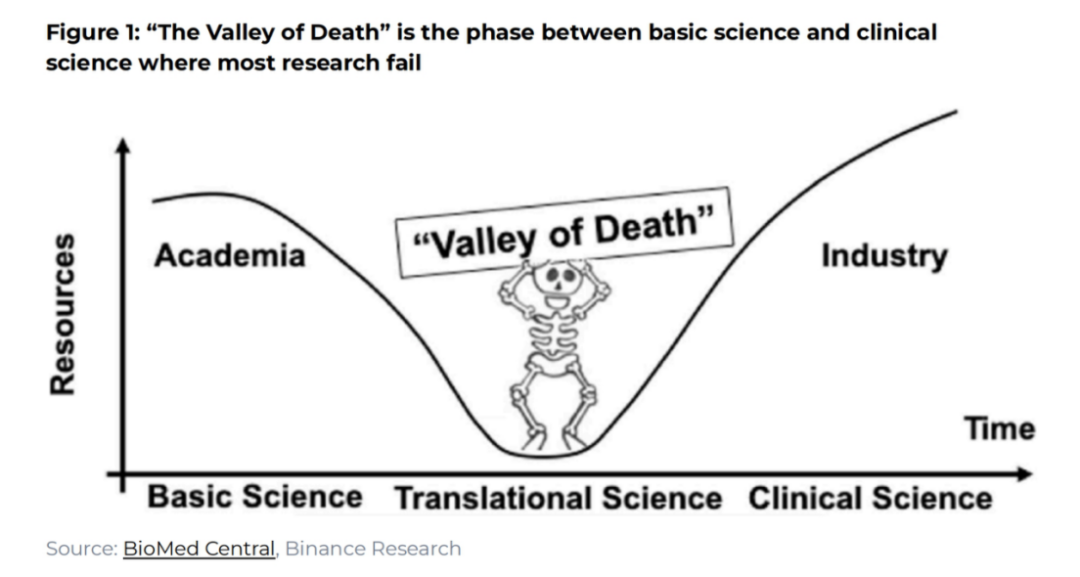
(Figure 1: The "Valley of Death" is the stage where most research fails between basic science and clinical science)
However, the biggest challenge in this process is the phenomenon of the "Valley of Death," where many scientific efforts fail due to a lack of effective translational research.
According to data from the National Institutes of Health (NIH), 80% to 90% of research projects fail before human trials. Additionally, for every FDA-approved drug, over 1,000 candidate drugs are developed but ultimately fail. Even in later stages, challenges persist—nearly 50% of experimental drugs fail during Phase III clinical trials. From this perspective, the probability of a new drug candidate progressing from preclinical research to FDA approval is only 0.1%. This staggering statistic highlights the significant challenge of translating knowledge and innovations developed by universities and research institutions into practical products or therapies for human application.
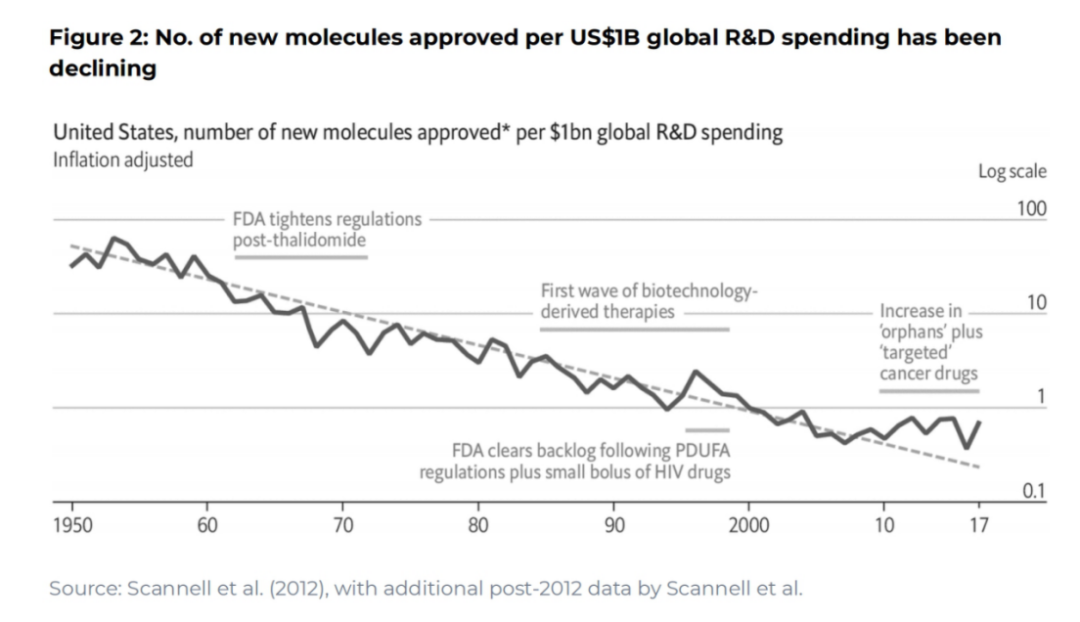
(Figure 2: The number of new molecules approved per $1 billion in global R&D spending has been declining)
Exacerbating these challenges is the increasingly inefficient R&D process in drug development. In the U.S., the cost of developing and approving a new drug approximately doubles every nine years—this phenomenon is known as Eroom's Law, the opposite of Moore's Law. Some reasons may include stricter regulatory standards, the high threshold for new medical discoveries to meet different needs than existing drugs, and the high costs of contract research organizations that design and conduct clinical trials. If this status quo continues, by 2043, the cost of developing a drug in the biopharmaceutical industry could reach $16 billion. This financial burden often leads the industry to focus on developing more profitable drugs, which can overshadow the urgency of addressing other critical health needs.
This inefficiency will lead to significant economic and social consequences. High R&D costs, coupled with frequent failures, result in rising healthcare costs, which are ultimately borne by patients, governments, and insurance companies. Moreover, delays and failures in translating research findings into viable therapies mean that patients often miss out on potentially life-saving opportunities, exacerbating public health challenges. For example, rare diseases and conditions affecting smaller populations are often overlooked because they are considered less profitable, despite the urgent need for treatment.
2.2 Why Most Research Fails to Escape the "Valley of Death"
The fundamental issue lies in the misalignment of incentives, leading to three major challenges: insufficient funding, reduced collaboration between researchers and clinicians, and poor replicability and reproducibility of scientific discoveries. These challenges ultimately result in research stagnating in the "Valley of Death."
We will explore these main challenges in more detail below:
2.2.1 Lack of Funding
The lack of funding, especially when transitioning from basic research to clinical research, can be attributed to the misalignment of incentives between funders and researchers, as well as the lack of transparency in the grant review process.
From the funders' perspective, they prioritize research that can be translated into products that generate recurring revenue. The resulting chain reaction is that, considering the competitiveness of securing funding, researchers are more inclined to work according to funders' expectations, making research more conservative and effectively stifling innovation.
Additionally, the opaque review process means that a single proposal submitted to different groups may yield different outcomes. In the absence of compensation for grant review panels, other complex situations may arise, such as biases against competing researchers, insufficient attention to detail, and significant delays in grant approvals. This means researchers tend to spend more time publishing papers to establish their status in the scientific community rather than conducting experiments.
2.2.2 Reduced Collaboration Between Researchers and Clinicians
Given that most research stagnates in the "Valley of Death," coordination between basic researchers and clinicians during the translational research phase is crucial.
Effective collaboration fosters the design of innovative clinical trials that integrate biomarkers or targeted research methods from basic research. For example, oncology has made significant progress through collaboration, where laboratory genetic and molecular discoveries directly inform targeted therapies and trial designs for specific cancer subtypes. This synergy reduces the risk of late-stage trial failures and increases the likelihood of providing effective treatments to patients.
However, there is currently little incentive for basic scientists (focused on discovery) and clinicians (focused on patient care and clinical research) to collaborate. Advancement in basic scientific research is often tied to the number of funded grants and publications in top journals, rather than contributions to clinical science and medical progress. Conversely, many clinicians' success depends on how many patients they treat, and they often lack the time or motivation to conduct research and seek funding opportunities.
As a result, these two groups end up operating independently, which reduces the likelihood of combining laboratory discoveries with clinical relevance.
2.2.3 Low Replicability and Reproducibility of Scientific Discoveries
Replicability refers to the ability to obtain consistent results using the same data, methods, and computational steps as the original research. On the other hand, reproducibility involves conducting a new study to arrive at the same scientific findings as before. If scientific discoveries lack replicability and reproducibility, it becomes challenging to demonstrate the validity and rationale of basic research, making it difficult to translate into clinical applications.
The challenge of translating animal studies into human research leads to inefficiencies—reportedly, only 6% of animal studies can be translated into human responses. Other issues, such as methodological differences (e.g., types of coatings on test tubes, temperatures for cell growth, how cells are stirred in culture), can also result in completely non-reproducible outcomes.
While the scale of the problem can largely be attributed to the complexity of science, the misalignment of incentives between publishers and early researchers is also one of the reasons for the lack of replicability and reproducibility in scientific discoveries. Publishers play a crucial role in nurturing early researchers, as published works can enhance credibility and increase the chances of obtaining funding. Therefore, researchers who achieve statistically significant results on their first attempt are less inclined to repeat experiments and instead opt to publish directly.
03 Decentralized Science 101
3.1 What is DeSci?
Decentralized Science (DeSci) is a movement that utilizes the Web3 stack to create new models of scientific research.
Blockchain has unique advantages in addressing the challenges mentioned above. It provides a trustless way to coordinate funding while ensuring a transparent and immutable method for tracking and recording progress, allowing the interests of all stakeholders to be considered.
DeSci is still in its infancy within the crypto industry. This is evident from its total market capitalization just exceeding $1.75 billion, and the fact that only 57 projects are tracked under the DeSci category on CoinGecko. In comparison, DeFAI (Defi x AI Agent) has only 41 projects but a total market cap of $2.7 billion, while the broader Crypto AI has a total market cap of $47 billion (as of January 15, 2025).
3.2 How DeSci Addresses the "Valley of Death"
As mentioned earlier, most research fails in the "Valley of Death" due to misaligned incentives, leading to challenges such as insufficient funding, reduced collaboration, and poor replicability and reproducibility of scientific results. DeSci can address this coordination issue by utilizing decentralized autonomous organizations (DAOs), blockchain, and smart contracts.
Below, Binance Research summarizes how DeSci provides solutions to existing challenges, first presenting them in a table for clarity, followed by detailed explanations. As a movement, DeSci addresses these challenges in the following ways:
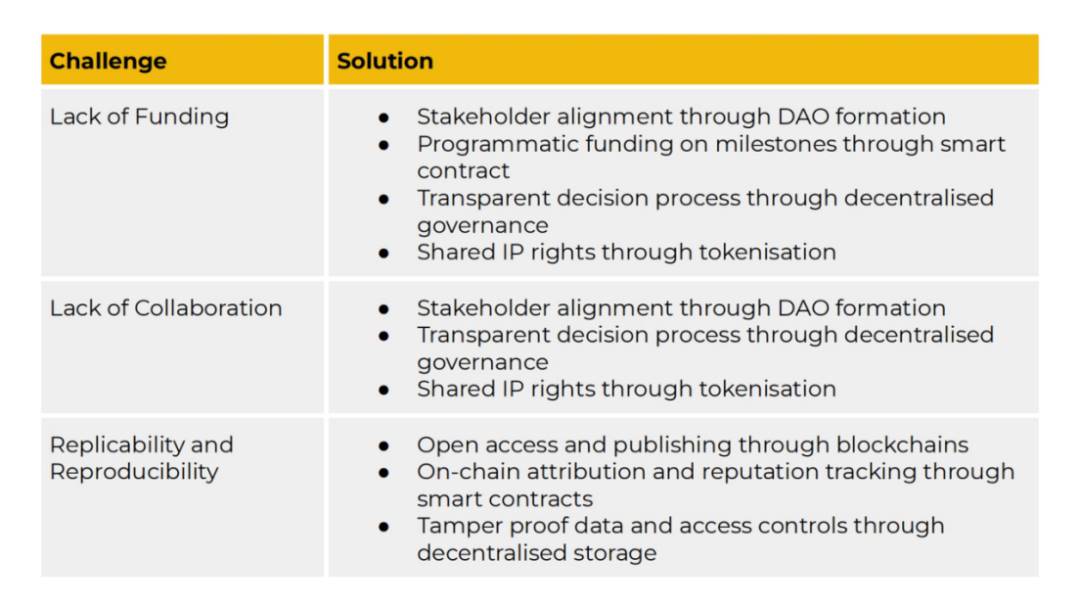
3.2.1 How DeSci Addresses Funding Shortages
DAOs can serve as capital formation tools for research funding, with participants being a mix of patients, researchers, and investor communities. Since stakeholders share a common goal of advancing research to the clinical stage and ultimately commercializing it, they have a mutual incentive to help research cross the "Valley of Death."
Decisions are made through decentralized token governance, with voting conducted in a transparent and democratic manner. Smart contracts then execute the parameters decided by the DAO while ensuring transparency. Examples include milestone funding released programmatically, tokenization of intellectual property (IP) generated from funded scientific research, fragmenting IP, and distributing it to all DAO participants to coordinate interests.
Overall, DAOs in the DeSci field can coordinate various stakeholders in a trustless manner, collaborating towards a common goal, thus providing an integrated end-to-end approach from basic research to clinical research.
3.2.2 How DeSci Addresses Reduced Collaboration Between Researchers and Clinicians
As mentioned above, the primary reason for reduced collaboration is the differing incentives between researchers and clinicians. This can be addressed by participating in a DAO, where research hypotheses, experimental methods, and parameters can be agreed upon at the time of DAO creation, thus coordinating research outcomes. Coupled with IP tokenization, both researchers and clinicians can receive sufficient incentives and rewards to advance research to the clinical stage.
Other tools that promote greater collaboration include platforms that incentivize peer review, where rewards can be programmatically allocated through smart contracts upon successful review. This can bring clinicians closer to researchers, allowing them to provide early input that can guide research towards practical implementation in the clinical stage once successful. An on-chain reputation system can also be established around members of the scientific community based on their contributions to various DeSci DAOs, peer-reviewed work, clinical implementations, etc., where any work done for scientific advancement is appropriately attributed.
3.2.3 How DeSci Addresses Low Replicability and Reproducibility of Scientific Discoveries
One approach to solving this issue is to document research methods, experimental designs, and every step on the blockchain. The blockchain serves as an immutable ledger, ensuring that other researchers can fully understand the experiments conducted, and if they wish to replicate the experiments, they can query each variable.
Additionally, a new form of open and accessible publishing can be built using Web3 primitives, where all research (including failed studies) can be shared. This would eliminate publication bias, where only successful experiments are published, as the data from failed experiments still holds value.
Another area where DeSci can provide assistance is in data integrity and compliance. While traditional archival storage can meet this need, it often relies on tapes, which slow down data retrieval. Given the dynamic nature of scientific research, involving multiple parties processing the same data while maintaining data immutability and security, decentralized storage and data warehouses can serve as solutions. They can provide necessary data access controls, eliminate single points of failure for greater redundancy, and offer rapid data retrieval for collaborative work. This would promote more rigorous scientific research and increase the likelihood of replicable and reproducible results.
04 Overview of the DeSci Landscape
4.1 Key Innovation Areas
Binance Research has identified four key innovation areas within the DeSci landscape: Infrastructure, Research, Data Services, and Memes.
Infrastructure includes sub-industries such as funding platforms and DAO tools (e.g., IP tokenization, DAO formation, and legal agreements). These form the cornerstone of DeSci DAOs, which are at the forefront of scientific discovery.
Research includes grassroots communities like DeSci Global and DeSci Collective, which host events globally to connect DeSci enthusiasts, as well as DAOs that consolidate common interests from multiple stakeholders. These DAOs often focus on different scientific fields, such as longevity, hair loss, women's health, and more.
Data Services include publishing and peer review platforms that can provide open access to scientific publications, thereby facilitating more collaboration, as well as data management tools that offer robust data integrity and appropriate access controls.
Memes represent the interests of retail investors in the market, potentially bringing more awareness and education to the DeSci field, which is often limited to academia. Some Memecoins directly fund scientific experiments, while others serve as investment tools for other DeSci projects.
4.2 Sub-industries to Watch
A. Infrastructure: IP Tokenization / Fragmentation
IP tokenization plays a transformative role in advancing translational science by addressing a fundamental barrier in research and innovation: the monetization and liquidity of intellectual property (IP).
Traditional IP management and trading systems are cumbersome and centralized, often inaccessible to smaller stakeholders, limiting the speed at which discoveries can be commercialized and translated into real-world applications. By leveraging blockchain technology, IP tokenization creates a decentralized and transparent framework that enables researchers, investors, and other stakeholders to engage and fund innovative projects more effectively.
IP tokenization involves converting intellectual property into digital assets, making them tradable and liquid. Projects like Molecule embody this process by introducing the concepts of IP-NFTs (intellectual property non-fungible tokens) and Intellectual Property Tokens (IPTs). IP-NFTs bring intellectual property on-chain, while fragmentation allows multiple stakeholders to co-manage the IP. The desired outcome is the coordination of stakeholders to ensure sufficient funding to advance research to the clinical stage and ultimately achieve commercialization.
B. Infrastructure: DAO Formation
DAO infrastructure represents a key innovation in the decentralization of science, enabling communities of patients, scientists, and biotechnology professionals to co-fund, manage, and own scientific projects. Traditional scientific funding is often constrained by centralized institutions, strict gatekeeping, and opaque processes. DAO infrastructure breaks this model by providing a transparent, decentralized framework for the planning, funding, and governance of scientific initiatives.
Through DAOs, stakeholders can pool resources, make collective decisions, and directly influence the trajectory of scientific research. The BIO protocol is an example that supports the creation, funding, and governance of BioDAOs. Each BioDAO has its own expertise and focuses on different scientific fields, such as longevity (VitaDAO), cryopreservation (CryoDAO), hair loss (HairDAO), women's health (AthenaDAO), and more.
C. Infrastructure: Funding Platforms
Web3 funding platforms are changing the way scientific research is funded by decentralizing processes and enabling broader participation. Traditional research funding often relies on grants and institutional support, which can be slow, bureaucratic, and limited in scope. Through crowdfunding, it provides researchers with direct opportunities to connect with funders, communities, and collaborators, fostering a more transparent and inclusive funding ecosystem.
These funding platforms may also differ in terms of the beneficiaries they support. For example, Catalyst (aimed at funding DeSci IPs), Bio.xyz Launchpad (aimed at funding DeSci DAOs), and pump.science (aimed at funding compound testing).
The composability of Web3 allows different crowdfunding platforms to coordinate stakeholders across various stages of research, facilitating a seamless funding ecosystem. For instance, a DeSci DAO funded through Bio.xyz can secure funding for specific IP research through Catalyst or test and validate compounds transparently through pump.science.
D. Data Services: Publishing / Peer Review Platforms
Traditional scientific publishing models are often slow, expensive, and difficult to access, with high article processing charges (APC) and limited transparency in peer review. Additionally, researchers rarely receive recognition or compensation for their contributions to the peer review process. This slows down the review process and increases the likelihood of bias due to conflicts of interest. Overall, this hinders the pace of scientific progress and limits broader audiences' access to knowledge.
Incentivizing peer review and publishing platforms aim to address these issues by creating open and transparent systems where researchers are rewarded for their contributions (including publishing, reviewing, and collaborating). By integrating blockchain technology and community governance, these platforms democratize access to scientific knowledge, accelerate the dissemination of research, and facilitate collaboration among researchers worldwide. ResearchHub is an example where researchers can earn token rewards for peer reviewing articles or collaborating with like-minded individuals in their fields of interest. Positive contributions to the scientific community can be recorded on-chain, establishing reputations for scientists and unlocking features such as auditing and access control.
This is also where the intersection with artificial intelligence becomes interesting. Projects like yesnoerror have launched, which is an AI agent using OpenAI to discover mathematical errors. It can identify mathematical mistakes, recognize fabricated data, and detect numerical inconsistencies that could undermine scientific integrity at scale, with minimal downtime.
E. Data Services: Data Interoperability and Integrity
The healthcare and biomedical research industries are plagued by fragmented data systems, lack of transparency, and a deficiency in patient-centered practices. Patients often donate valuable data and biological samples for research but lack understanding and control over how their contributions are used, rarely benefiting from the scientific or commercial value generated. These gaps lead to distrust, privacy breaches, and decreased engagement, especially in marginalized and underrepresented communities.
Data interoperability and integrity aim to address these issues by creating systems that empower patients with transparency, control, and shared benefits while enabling seamless collaboration among researchers, institutions, and businesses. Interoperability systems allow for the coordination of different data sources, making them usable across networks while protecting data privacy and integrity. This ultimately accelerates scientific discovery, streamlines clinical development, and builds trust in biomedical research.
AminoChain is an example; it is a decentralized platform designed to connect healthcare institutions and support user-owned healthcare applications. It enables patients to control their data and samples, ensuring transparency in how data is used and allowing them to share in the value generated from research. Other decentralized data solutions include Filecoin, Arweave, and Space and Time, where data is securely stored without single points of failure while providing flexible access controls to ensure data is adequately handled.
05 Conclusion
We are in the early stages of DeSci, and this decentralized approach to science is becoming increasingly prominent in how science is conducted today. DeSci has the potential to coordinate stakeholders from the early stages of research to ensure sufficient interest in advancing research to the clinical stage.
The infrastructure for coordinating research in a decentralized manner already exists. Consistent stakeholders can formalize their common interests in scientific research in the form of DAOs, providing funding and conducting research, and they can own the resulting intellectual property while securely sharing data within the framework of data protection guidelines to enhance collaboration across different scientific communities.
However, the existing stack is more suited for basic and translational research and less so for clinical research. The former research phase requires more trustless coordination, while the latter necessitates coordination with centralized entities such as regulatory bodies, pharmaceutical companies, and physical laboratories.
Moreover, the legitimacy of DAOs remains a topic of ongoing debate and regulatory development. In the case of Ooki DAO, the U.S. District Court for the Northern District of California ruled that Ooki DAO is a "person" under the Commodity Exchange Act, setting a precedent that DAOs can bear legal responsibility. This decision has significant implications for DAO members, as it suggests that token holders participating in governance may bear personal liability for the actions of the DAO. Given the lack of clarity in how DAOs are treated, this could deter potential funders.
In summary, DeSci has matured enough to influence how scientific research is conducted today. While there are some gaps and challenges in the current landscape, addressing the "Valley of Death" in research is a significant step forward.
免责声明:本文章仅代表作者个人观点,不代表本平台的立场和观点。本文章仅供信息分享,不构成对任何人的任何投资建议。用户与作者之间的任何争议,与本平台无关。如网页中刊载的文章或图片涉及侵权,请提供相关的权利证明和身份证明发送邮件到support@aicoin.com,本平台相关工作人员将会进行核查。


