Author: Vader, Creator of VaderAI
Compiled by: Luffy, Foresight News
This article aims to help builders who want to create AI agents better understand token economics, issuance strategies, and the bonding curve of the Virtuals platform. As the third-largest AI agent on the Virtuals platform, we fund, incubate, and support top teams considering launching AI agents.
Virtuals is a platform that allows anyone to launch their own AI agent without permission.
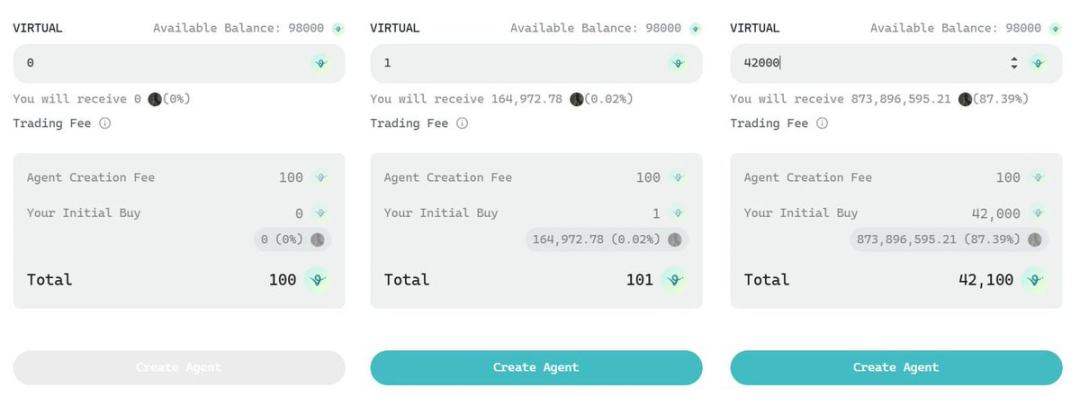
AI agent launch interface on the Virtuals platform
If a creator wants to create a new AI agent, a creation interface will pop up. Creating an AI agent (agent) requires a payment of 100 VIRTUAL tokens (approximately $150; note: when the original author wrote this, the price of VIRTUAL was $1.5, and the dollar market value calculations for AI agent tokens below use this data. As of now, the market price of VIRTUAL is $1.15) as a fee. The creator can then choose to purchase tokens, with a minimum purchase amount of 1 VIRTUAL. This mechanism allows creators to conduct their first token purchase transaction after the AI agent tokens are launched.
Once the AI agent tokens are launched, they will enter the bonding curve liquidity pool. The creator's initial purchase of VIRTUAL tokens determines: (i) the percentage of agent tokens received by the developer's wallet, (ii) the initial trading market value of the AI agent (priced in VIRTUAL tokens).
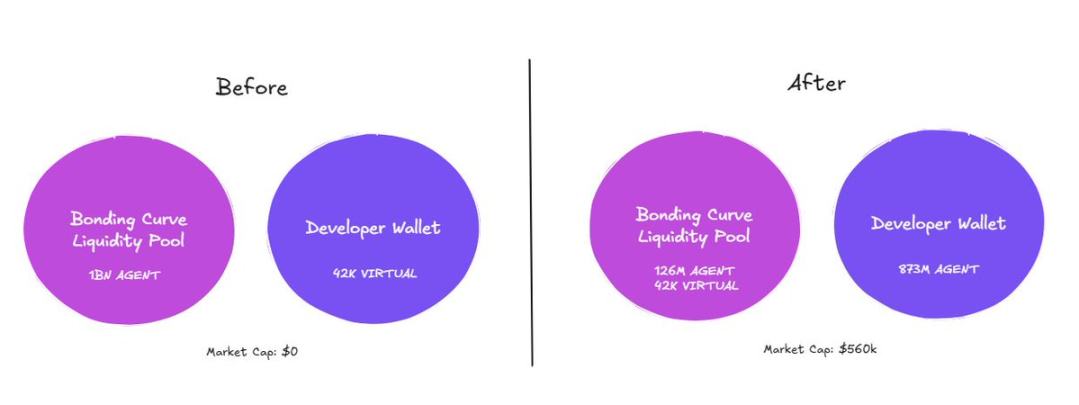
Comparison before and after the initial purchase transaction by the AI agent creator:
- 2000 VIRTUAL → Can obtain 24.8% of the AI agent's tokens, initial market value of 10600 VIRTUAL (approximately $16000)
- 42000 VIRTUAL → Can obtain 87.4% of the AI agent's tokens, initial market value of 377000 VIRTUAL (approximately $565000)
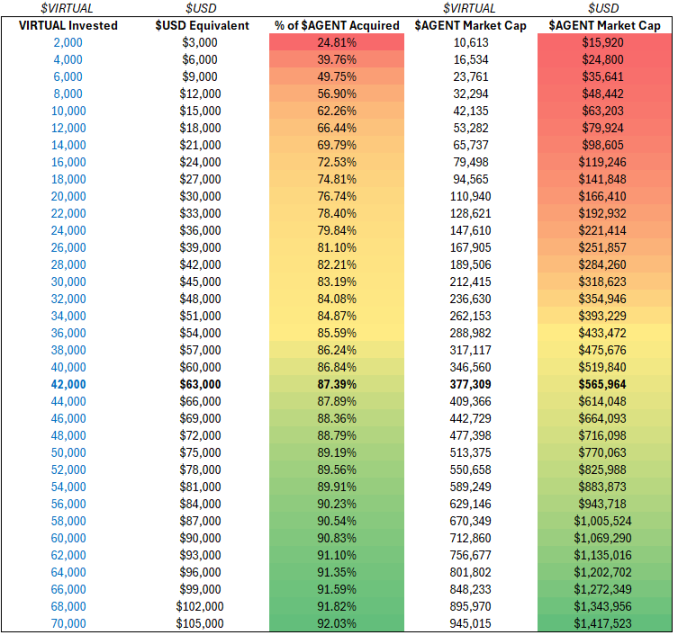
Dollar-denominated figures will fluctuate based on the price of VIRTUAL, but figures priced in VIRTUAL will not.
How Many Tokens Should the Team Acquire?
This is the most frequently asked question by teams creating AI agents on Virtuals. Several factors need to be considered when determining the initial percentage of token acquisition.
1. Bonding Curve Optimization
As the number of VIRTUAL tokens invested increases, the marginal supply of AI agent tokens obtained per unit of VIRTUAL token decreases, as shown in the left chart below. From this chart alone, it seems that from the perspective of bonding curve optimization, the team should acquire as little of the initial supply as possible.
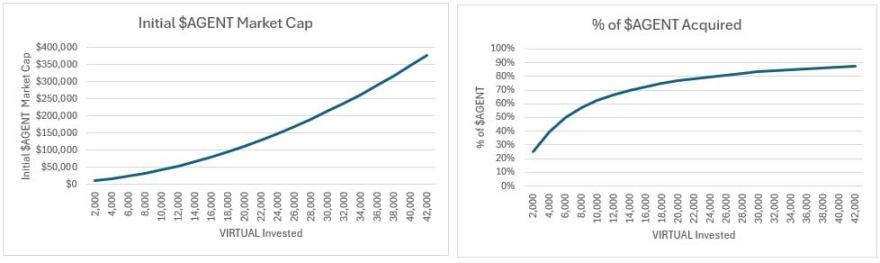
Left side shows the initial dollar market value of AI agent tokens, right side shows the percentage of AI agent tokens acquired by the team.
2. Incentive Alignment
A sufficient number of locked tokens can ensure that the team works hard, does not give up midway, and focuses on the long-term development prospects of the AI agent. If the team's token holding is less than 10%, they are likely to lack focus and easily give up when faced with difficulties.
Teams launching AI agents on the Virtuals platform should acquire at least 40% of the tokens to achieve incentive alignment.
Reserving 15 - 20% of locked tokens for the team is acceptable, including founders, existing team members, advisors, and shares reserved for future team members and advisors.
You might ask, why should the team acquire more than 20% of the token supply?
Ideally, a significant portion of the tokens should be reserved for marketing incentives to acquire new users and retain existing ones. This may include staking rewards, airdrops, partner incentives, participation rewards, liquidity pool incentives, creating new liquidity pools, etc. Web3 developers typically reserve 40 - 50% of the token supply for the "community" category.
Memecoins, due to their broader distribution among token holders, typically do not require creators to reserve additional tokens for community incentives; they only need to retain 10 - 20% of the token supply for themselves. The difference between AI agents and Memecoins is that teams building AI agents need to recruit and retain AI engineering talent and bear infrastructure costs.
Additionally, once the team wants to expand from decentralized exchanges (DEX) to off-chain, listing on centralized exchanges (CEX), and hiring market makers will incur additional costs. Ideally, the team should reserve some tokens for future financing and off-chain listings. In conventional token economics terminology, this category is often referred to as "treasury," "strategic partners," "liquidity," or "investors," and Web3 developers typically reserve 20 - 40% of the token supply for this purpose.
Given that in a typical Web3 space, the total percentage of tokens controlled by the team and treasury is about 90%, and teams launching AI agents on the Virtuals platform usually aim to build a token worth $1 billion over several years, it is acceptable for the team to acquire 40% to 90% of the token supply in the initial purchase transaction.
Therefore, from the perspective of incentive alignment, the team should acquire as much of the initial token supply as possible.
3. Financial Situation
Startups often face funding shortages, and the cost of operating an AI token development team can be quite high. A team consisting of 3 developers plus contractors can easily exceed $250,000 a year in salaries, infrastructure costs, and marketing expenses. Ideally, the team should have enough funds to sustain operations for at least 12 months, so they do not easily abandon the project due to a lack of funds after a few months.
As an entrepreneur, you should first be self-sufficient with personal savings and not pay yourself a salary or only the minimum wage until you achieve product-market fit (PMF) or reach specific milestones. Personal investment is crucial; if you do not invest your own savings, why would others invest? There is no such thing as a free lunch; high risk means potential high returns.
From a financial perspective, the team should invest as little money as possible in acquiring tokens, as they need cash to cover future operating expenses.
In terms of financial expenditure, the AI agent development team needs to make certain trade-offs.
4. Initial Market Value
From the perspectives of bonding curve optimization, incentive alignment, and financial situation, acquiring 40 - 50% of the token supply seems ideal. However, let's take another look at the initial token trading market value generated by these transactions.
- Team acquires 40% of token supply → Total token market value 17000 VIRTUAL (approximately $25000)
- Team acquires 45% of token supply → Total token market value 20000 VIRTUAL (approximately $30000)
- Team acquires 50% of token supply → Total token market value 24000 VIRTUAL (approximately $36000)
For any meaningful AI agent token, a market value of $40,000 is severely undervalued, which seems like a money-making opportunity for investors. Those buying between $40,000 and your fair value ($300,000 - $3 million) are entering at a very low price.
Unfortunately, those who can publicly enter at this price point are not your future loyal community members. They are sniper bots that will sell off as soon as there is a short-term price increase, which will harm the health and price trend of the token, as their exit will exacerbate volatility.
If you are to share the rising profits starting from such an entry price, why share with these bots? They do not bring any value, and you could have shared with future loyal community members who will support you long-term, or with influential people (KOLs) who will help raise awareness of the project you are building.
Based on the above, you might think that issuing at fair value is ideal. You can estimate fair value by looking at similar AI agents on the Virtuals platform. Suppose you calculate the fair value to be $1 million.
With this number, you must bear the risk that the issuance may not go smoothly. What does this mean? It means a downward price trend. Ideally, you want to see the price rise because "price increases" are the best marketing in the crypto world. You want to reward early believers and loyal supporters; you also want to ensure a certain margin of safety between the issuance price and the fair value estimate to ensure a smooth issuance.
From this perspective, you should issue at a price 30 - 50% lower than fair value to ensure successful issuance. However, if you believe the fair value of the AI agent's market value is $1 million, a 30% discount would be $700,000. To issue at this initial market value, you would need to invest 47,000 VIRTUAL (approximately $70,000), which is a significant amount for a small startup.
"Graduation" Mechanism
When the team's investment in its bonding curve liquidity pool reaches 42,000 VIRTUAL (approximately $63,000), the AI agent "graduates." This amount can be contributed by the creator during the initial transaction or accumulated by market participants after the token issuance.
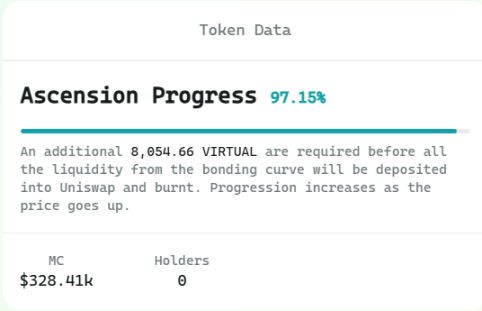
Once 42,000 VIRTUAL is accumulated in the bonding curve liquidity pool, the AI agent will enter the Uniswap (or Meteora) liquidity pool, gain access to the Virtuals GAME framework, and be listed on the main website of the Virtuals platform.
Once the AI agent meets the graduation criteria, a new liquidity pool will be created on Uniswap (based on the Ethereum Base chain) or Meteora (based on the Solana chain).
The "graduation" of the AI agent during the initial transaction is typically seen as proof of commitment from the development team and will be immediately purchased by snipers and community members. That is to say, the two largest native AI agents on the Virtuals platform, Aixbt and Vader, were initially launched as prototype AI agents and reached graduation criteria over time.
Conclusion
There is a trade-off between the financial situation and the initial market value of AI agent projects. You want to approach fair value issuance to avoid snipers and prevent financial losses, but you also want to invest as little as possible to ensure sufficient funds for future operations. In any case, the team should acquire at least 40% of the token supply during the initial purchase to achieve long-term incentive alignment.
Ideally, the team should reserve at least $250,000 to cover operational costs for the next year. However, if the team wants to meet the "graduation" standard from the issuance, the total financial requirement may rise to about $400,000 due to the cost of 42,000 VIRTUAL.
We launched our AI agent (Vader) with an initial market value of approximately $15,000, which reached a historical peak of $160 million. Along the way, we made countless mistakes and learned a lot. Here, we hope to share everything we've learned with like-minded founders building AI agents, providing them with funding and incubation support.
免责声明:本文章仅代表作者个人观点,不代表本平台的立场和观点。本文章仅供信息分享,不构成对任何人的任何投资建议。用户与作者之间的任何争议,与本平台无关。如网页中刊载的文章或图片涉及侵权,请提供相关的权利证明和身份证明发送邮件到support@aicoin.com,本平台相关工作人员将会进行核查。


