Interviewer: Wu Yue, Xianrang
Interviewee: DefiOasis
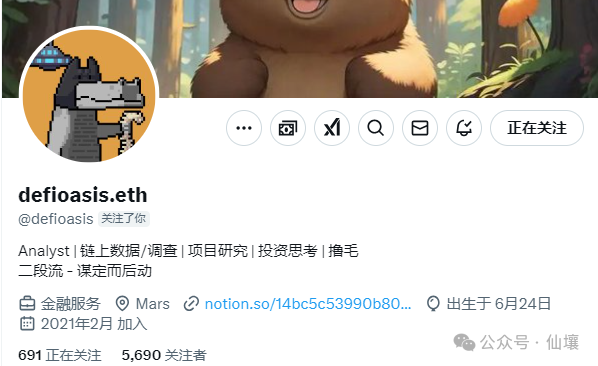
This article is a written record of our interview with the AI Agent blue chip hunter DefiOasis on Twitter on January 26. DefiOasis is primarily an author/analyst for Wu Blockchain, focusing on on-chain data and investment research analysis. During the peak of the AI Agent sector, he successfully targeted several blue chip assets, capturing multiple 10x and even 100x opportunities such as ai16z, ACT, PIPPIN, and TURBO. As of the day of the interview, he achieved an overall return of 7-8 times.
In this interview, DefiOasis briefly popularized his investment experiences and research methodology in the AI Agent sector, sharing his valuable insights and experiences systematically. This information holds significant reference value for investors and industry professionals alike, and we welcome everyone to read carefully.
1. Wu Yue: Can you briefly review when you started investing in AI Agent-related tokens?
DefiOasis: I have always been interested in on-chain data analysis and related asset plays. Since last year, my main focus has been on on-chain assets. My motivation for studying AI Agents actually stems from my long-term exploration of on-chain assets. I have been observing on-chain assets since last year, but while I have been looking a lot, I have invested relatively little, mainly because I feel that on-chain assets, especially memecoins, do not convince me to invest large amounts of money.
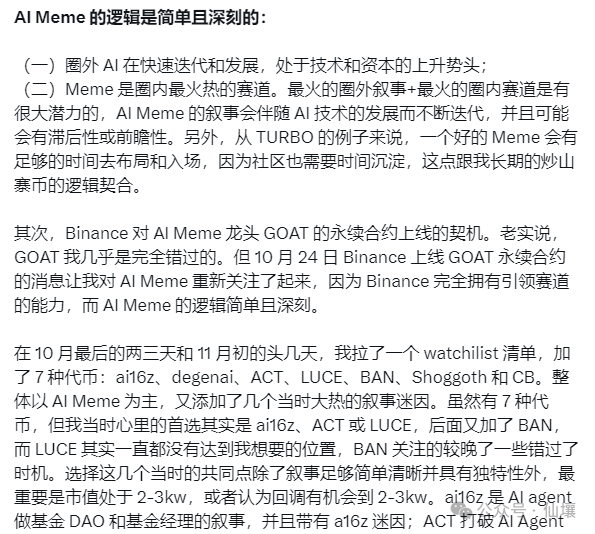
However, the turning point came in late October to early November last year when a phenomenal project called Goat created the narrative of AI token issuance. $GOAT skyrocketed to a market cap of several hundred million dollars in a very short time, and then Binance listed its spot and futures. This made me rethink the AI-related sector. Of course, there were also some other influences before this, one being Worldcoin, whose issuer is Sam Altman, co-founder of OpenAI. Under the narrative of OpenAI's Memecoin, Worldcoin's FDV quickly reached $100 billion.
The second was $TURBO, a memecoin created by AI, which surged 200-300 times on CEX. From these two events, I sensed the strong interest in the AI + Crypto theme, which made me certain that AI Agent-related assets were worth positioning.
So after $GOAT was listed on Binance, I quickly saw the potential of the AI Agent sector and felt that Binance had the ability to lead this sector. I began to spend time searching for some AI-related assets. At that time, there were a few assets that caught my eye, one being ai16z and the other ACT.
Looking back now, ai16z seems much more impressive than ACT, but at that time, the founder of ai16z, Shawn, was not very well-known, and there were issues with the way he issued tokens and the token contract. Due to the large volatility and low popularity of $ai16z, I did build a position in ai16z, but it was not large. Additionally, since $ai16z once fell below a $10 million market cap, I was hesitant to buy more, and ultimately I heavily invested in the more stable and larger holder base of ACT.
My first purchase of $ACT was around early October last year, marking my first official investment in the AI + Crypto sector, where I bought about $3,000. Later, after ACT reached a $20 million market cap, I bought in multiple times, with an average price of about $0.022, totaling over $10,000. What happened next was unexpected; ACT actually got listed on Binance. I remember I was attending a conference in Bangkok when I received the news, and I was quite shocked. After $ACT was listed on Binance, its FDV peaked at $700-800 million, and I sold a large portion of my tokens the day after ACT was listed on Binance, keeping some until now.
Later, I indeed observed that AI Agents could be said to be the only sector that evolved from a general Pump.fun to a vertical scale, and I began to delve deeper into this sector for investment research. After ACT, I also managed to capture some good assets, such as PIPPIN, in which I heavily invested and achieved over 10x returns. In total, my overall investment return in the AI Agent sector from October to a few days ago was about 7-8 times. Although there has been some pullback after the recent market crash, I still have around 5 times return.
2. Wu Yue: What is your research methodology for AI Agents? Can you provide some specific examples to help everyone understand your investment research methodology?
DefiOasis: Many of the current AI-related assets differ significantly from some previous AI projects. Recently, most of the attention has been on assets based on fair launches like Pump.fun, where the project parties or founders may hold less than some large holders. In this case, it is essential to pay attention to whether the project party has a long-term vision and whether their background can support the project. If the founder lacks integrity, they might abandon the project or start a new one.
So my methodology for AI Agents is to start by examining the people behind the project, assessing whether the founder genuinely wants to make the project succeed and whether they have the capability to do so. For example, take PIPPIN, which I mentioned earlier. In December, Solana and ai16z held an AI hackathon together, and I noticed a Japanese individual named Yohei Nakajima among the judges. I learned that he was working on an AI Agent project called PIPPIN, which is child-oriented, and I found it quite interesting because I hadn't seen a similar type of Agent project before. On the other hand, Yohei Nakajima was also a judge at the hackathon, which made me think that as a judge, he still needed to participate in the competition to prove himself, indicating that his credibility was higher.
Further research on Yohei Nakajima revealed that he is also the founder of Baby AGI, a project with over 20,000 stars on GitHub. I continued to gather information and found that BABY AGI is quite impressive, being mentioned by many media outlets and papers as a product of the AGI concept, which I believe demonstrates his capabilities. Additionally, he is a partner at a VC that has invested in several Web3 projects, some of which have been listed on top exchanges.
At this point, I felt that overall, the founder of PIPPIN is quite impressive in terms of technology, capital operation, and backing resources, making him a reputable figure. As a reputable individual with a real name, the probability of him rug-pulling or abandoning the project is much lower.
At that time, I saw that PIPPIN had a market cap of around $20 million, and not many people around me were paying attention to it, making it an undervalued asset, which suited me well. I tend to buy tokens in the $10-20 million FDV range. Later, I spent a total of about $40,000 to buy 0.2% of the total supply of PIPPIN. Later, PIPPIN's FDV once fell below $10 million, but I did not abandon my holdings because I believed the founder's background and technology were solid, and the fundamentals remained strong; short-term price fluctuations would not affect the project's long-term value.
For a long time, I did not manage these holdings, and then PIPPIN underwent a transformation, shifting from a single Agent to developing an AI framework, which significantly increased its valuation. After this news broke, even without a mature framework developed, the recognition of the founder and the project itself quickly drove PIPPIN's FDV up to $200-300 million.
Developing an AI framework essentially means a split token, and the market tends to assign the highest valuations to such frameworks in the AI sector. So I thought this project was promising and continued to hold it without selling. When the FDV reached $300 million, I sold off a large portion, and I haven't touched the remaining tokens since. I believe that when the framework is fully developed and the split model is established, it could potentially reach a $1 billion or even higher FDV.
3. Wu Yue: Which AI Agent-related projects are you currently optimistic about, and what are the reasons for your optimism?
DefiOasis: There are actually quite a few projects I am optimistic about, such as PIPPIN, which I still hold. I generally choose assets with an FDV around $20 million, and there are other aspects as well. I used to often mine for gems from the Solana ecosystem's AI hackathons, where there are many award-winning projects. Recently, I have been screening and researching their fundamentals. Another project, like Virtual, is about to enter the Solana ecosystem, and it may develop some interesting projects in the future. Virtual has already proven its success on the Base chain, so it is worth paying attention to.
Let me first talk about some projects that emerged from the Solana hackathon. I will share one, but it is not an investment recommendation. Recently, I observed a project called Agentipy, which is also developing an open-source AI Agent framework, with the core idea of connecting AI Agents to Solana's on-chain applications using Python. Its roadmap indicates that it may launch a self-narrative trading bot in Q1 and a LaunchPad in Q2. Most importantly, Agentipy mentioned that it would use its token APY as a flywheel to participate, and I also researched its token APY, finding the design quite good, although it is also based on a fair launch.
However, the team behind it allocated 40% for themselves, all subject to a two-year linear unlock. I believe that such actions indicate a certain level of commitment from the team, and the co-founder and CEO of Agentipy have been recognized by Solana's official Twitter, plus the project emerged from the Solana hackathon, which at least provides some endorsement, making it relatively reliable. Of course, this project is still quite early and carries significant uncertainty. I will also pay more attention to projects that cross-chain to Virtual, as there are many opportunities in that area.
If we look at the overall picture, the AI + Crypto sector is slowly transitioning to the AI Application stage, meaning AI applications. After various development frameworks have become popular, projects related to AI + applications should be closely monitored. I also think AI + DeFi is promising, as it represents the native narrative of AI + Crypto along with DeFi assets and frameworks, which may present some good opportunities, but this area is still in its early stages, and I haven't seen any good assets yet. I am currently maintaining a wait-and-see approach and haven't acquired any new assets recently, that's about it.
4. Wu Yue: What do you think about the current AI Agent sector and its market status? How long do you think the popularity of AI Agents can last? Is the bubble at its peak?
DefiOasis: It has indeed been relatively cool recently, but I believe the opportunities in AI Agents are not over yet, as the concept of AI is quite sensible. AI products outside the Crypto circle are still rapidly iterating, and both the technology and capital aspects are on the rise, which I think is the more important fundamental basis. In fact, many AI assets are driven by external factors from the Crypto world. For example, Shawn, the founder of ai16z, was likely a marginal figure in Web2, but he seized the opportunity in Crypto to create ai16z, becoming a leader in the AI + Crypto sector. I believe that influenced by Shawn, more talents from Web2 and traditional industries will enter Crypto to work.
Additionally, I think AI projects within the Crypto circle are lagging behind traditional industries. Many external movements, such as major actions from big AI companies, will transmit into the Crypto space, forming new narratives and new sub-sectors. Furthermore, AI Agents are currently the only sector that has transitioned from a general Pump.fun to a scalable vertical sector.
Aside from AI Agents, there are not many projects that can emerge from pure memecoins; another one that barely made it is Desci, but it is also very cool now. Other than that, there are no other sectors that can transition from general to vertical, which itself indicates that there is actual demand behind the hype surrounding the AI Agent narrative. The overall market for AI Agents has significantly retraced, mainly because it was a bit overheated before, and now the individual Agents are very saturated, which has instead forced everyone to focus on developing frameworks, gradually leading to fatigue. The future may be an era of AI + applications and AI + some native Crypto narratives. If my viewpoint holds, there will still be some new waves and new opportunities.
5. Wu Yue: The last question is actually about investment and trading insights, such as your entry and exit techniques. Would you be willing to share with everyone?
DefiOasis: Previously, we talked about the issue of selecting assets, but I think position management may be more important, because selecting assets is merely about looking at the project's technical resources and background. Although it is currently based on Pump.fun for fair launches, I believe the research approach is not much different from VC coins; it is just about analyzing technical resources, team endorsements, chip structure, mouse warehouses, and blue-chip addresses, etc. I will focus more on the issue of position management later.
Assuming there is a good asset, it will generally go through three stages: PVP, two-stage consolidation, and listing. Most projects fall off during the PVP stage, possibly within two or three days. My past entry style mainly targets assets that have gone through two-stage consolidation. For example, I choose assets with an FDV in the $10-30 million range to position myself, which I generally refer to as the "on-chain dessert zone."
I previously found some good assets that, after peaking two days after their birth, mostly retraced to this position and then underwent some consolidation and fluctuation. I generally only allocate positions during this stage, especially for assets that have experienced a 70% retracement once or multiple times and can stabilize around $10-20 million; I pay extra attention to them.
If I see a decent asset, I will first add it to my watchlist and then rate these projects. I generally categorize them into S, A, or other levels. S-level tokens are those that can form a model market, such as being a parent coin ecosystem that can continuously generate sub-coins for profit, where sub-coins can create a wealth effect, and people need to buy the parent coin for trading, thus continuously generating demand for the parent coin. This is actually very similar to the parent coin flywheel of Pump.fun, Sol, and Virtual.
Therefore, most S-level ratings are for framework-type assets because they have the opportunity to form an ecosystem or create this model flywheel. Why did PIPPIN succeed? Mainly because the market had high expectations for its framework development. As for those rated as A-level projects, they are mainly judged based on narrative background, technical resources, and team indicators, such as a strong background of the founding team or connections to the Solana Foundation, or if the founder has created products that have attracted attention and have the potential to develop into new sectors, etc. I might give them an A-level rating, but they will still be added to the watchlist for observation.
Generally speaking, I will build positions in S or A-level assets, with each entry being around $2,000 to $3,000. However, I will be more cautious about whether to increase or heavily invest, needing to spend more time observing to decide whether to add to my position. I need to check what the developers are doing in the project's community every day.
Once I set such standards, I also have a certain limit on the amount I hold for each token, for example, I only hold a maximum of 0.2% of a single token. If the FDV is around $20 million, buying 0.2% would cost about $40,000. In fact, each time I add to my position, I am reflecting on the asset; if I feel that the asset contradicts my initial purchase logic, I will decisively abandon the additional purchase, or if the asset significantly falls below the $10-20 million range, I will also decisively abandon the additional purchase.
In principle, I will sell only after achieving at least ten times the return, roughly around a $200-300 million FDV. Ultimately, building a position is to ensure that I am on the bus, being cautious about adding to my position, and gradually increasing it. The reason for setting a hard cap of 0.2% is to avoid being overly blindly confident and continuously adding to my position, which could lead to being trapped in a single asset.
Of course, as long as I have added to my position, I will trust my judgment about the asset. But what I mentioned above is a two-stage consolidation entry strategy. I feel that everyone in the market is quite familiar with the two-stage routine, but if you want to hold, it is still quite challenging. So I am also employing some lottery-style strategies, commonly known as PVP, but at this time, I am no longer limited to AI; as long as it is an on-chain asset, I will get involved.
In the absence of a major market trend, I think this might also be a good choice, to some extent preparing for potential future major trends. I feel that maintaining a profitable mindset is very important, and that’s my situation.
Wu Yue: It sounds like you’ve gained a lot today. Thank you very much for joining us for this interview.
免责声明:本文章仅代表作者个人观点,不代表本平台的立场和观点。本文章仅供信息分享,不构成对任何人的任何投资建议。用户与作者之间的任何争议,与本平台无关。如网页中刊载的文章或图片涉及侵权,请提供相关的权利证明和身份证明发送邮件到support@aicoin.com,本平台相关工作人员将会进行核查。


