On the morning of February 3, Washington time, the headquarters of the U.S. Agency for International Development (USAID) was closed, and the once bustling office area fell silent. Just the night before, officials from the Department of Government Efficiency (DOGE), led by Elon Musk, officially took over this international aid agency with a history of over 60 years and announced plans for a complete shutdown. USAID employees received an email stating that all personnel, except for key positions, would transition to remote work. Meanwhile, the USAID official website was taken offline, and official social media accounts were deleted, bringing the agency's operations to a standstill.
Musk stated on social media that he had discussed the matter with President Trump and received full authorization to close USAID. He claimed that the agency was a "far-left criminal organization" that needed to be completely dismantled.
Musk collaborated with Trump to establish the Department of Government Efficiency (DOGE) to promote radical reforms under the guise of "streamlining the government." The core objectives mainly include cutting government spending, digitizing the bureaucratic system, and replacing human decision-making with algorithms. This bold move to shut down USAID has also revealed the true nature of the previously enigmatic DOGE team, and this may just be the beginning, as the power landscape of the U.S. federal government is being rapidly reshaped.
Composition of the Team: The "Tech Six" Averages 22 Years Old
The DOGE team consists of six tech elites aged 19 to 25, all without government experience but closely associated with Musk's companies (such as SpaceX and Neuralink) or Silicon Valley capital (like Peter Thiel).

Source: Internet
Gavin Krieger (25): Krieger graduated from the University of California, Berkeley, with a degree in Electrical Engineering and Computer Science. He previously worked as a senior software engineer at the American AI data analytics company Databricks and is an expert in artificial intelligence and big data analysis. Krieger's task is to draft executive orders and ensure they can be quickly implemented within the government. The email sent to all USAID employees on Monday, stating they do not need to return to headquarters, was authored by him. He also directly drafted a funding review order for the U.S. Department of the Treasury, participated in the large-scale layoff plan at OPM, and was responsible for establishing "rehiring standards" for civil servants, requiring future government employees to be approved by DOGE before being hired.
Luke Farito (23): Farito dropped out of the University of Nebraska-Lincoln and later worked for Nat Friedman, the Silicon Valley entrepreneur behind GitHub. He interned at SpaceX, writing software for pumps, valves, and other components that help fuel rockets. Farito is currently listed as an "executive engineer" in the Office of the Secretary of the U.S. Department of Health and Human Services (HHS), personally overseeing the digital lockdown of USAID, with the next target aimed at the systems of the Centers for Medicare & Medicaid Services responsible for contracts.
Edward Coristine (19): The youngest member, Coristine, just graduated from high school and is studying Mechanical Engineering and Physics at Northeastern University in Boston. He worked for three months at Musk's brain-computer interface company Neuralink last summer, but his specific responsibilities are not yet clear. Coristine once joined a call with employees of the U.S. General Services Administration using a non-government Google Gmail account, asking them to check the code he wrote and prove the validity of his work, which caused dissatisfaction among federal employees.
Akash Boba (21): Boba comes from the University of California, Berkeley, and was an investment engineering intern at Bridgewater Associates. He previously interned at Meta and Palantir, a software service provider founded by MAGA donor Peter Thiel, specializing in artificial intelligence, data analysis, and financial modeling. He is responsible for designing algorithms to monitor government funding flows, leading the "Real-Time Monitoring System for Fiscal Expenditures," which allows for the real-time freezing of federal "inefficient expenditures" without congressional review.
Ethan Shautlan (22): Shautlan is a senior computer science student at Harvard University and the only team member with experience in AI startups. His AI company, Energize AI, received a $100,000 grant from OpenAI and he was a runner-up in a hackathon organized by Musk's AI company xAI. Shautlan is responsible for DOGE's AI government program, aiming to replace traditional human decision-making mechanisms in government with algorithms, automating most administrative approvals, budget assessments, and even congressional reports.
Gautier Cole Killian (24): Killian is tasked with breaching the Treasury's security system to gain access to the payment network. He graduated from McGill University and has strong capabilities in financial data processing, having worked as an engineer at Jump Trading, a company specializing in high-frequency financial trading and algorithms. Killian's main task is to help the DOGE team breach the Treasury's security defenses, allowing them to access the government payment network and bypass security checks to directly read millions of transaction records. He is also one of the few young individuals granted senior access to the White House, earning Musk's high trust.
With the joint efforts of these six individuals, DOGE completed an administrative restructuring that had not been achieved by the U.S. government in decades in just two weeks. Their actions are extremely efficient, with each person responsible for multiple tasks, working day and night. Some team members work 24/7, sleeping in the office when tired, conducting a comprehensive audit of the deep and complex U.S. federal agencies. Musk has highly praised them, calling them "the future of the new government" on social media.
White House Launches "Silicon Valley-style Blitzkrieg"
Since Trump took office on January 20, the Department of Government Efficiency (DOGE) led by Musk has begun a rapid dismantling process. According to DOGE's official Twitter, as of now, the following agencies, projects, and savings have been shut down:
January 20: Closed the Chief Diversity Officer Executive Council (CDOEC);
January 25: Canceled approximately $420 million in existing/upcoming contracts;
January 27: The Departments of Labor, Transportation, Agriculture, Commerce, Health and Human Services, and Treasury canceled 16 DEIA contracts, saving $145 million;
January 28: The General Services Administration (GSA) terminated three nearly vacant office space leases and closed 17 DEIA websites, saving $1.6 million;
January 29: Canceled a $45 million DEI scholarship for Myanmar;
(As of January 29, 2025, 26 departments, including the Department of Education and the GSA, have terminated 85 DEIA-related contracts, totaling approximately $1 billion;);
February 3: The number of terminated leases for underutilized buildings increased to 22, with savings rising from $1.6 million to $44.6 million;
February 3: Closed the U.S. Agency for International Development (USAID);
February 4: A total of six agencies terminated 36 contracts, saving approximately $165 million, including the Department of Homeland Security's "Humanitarian Investigation and Climate Support Services" contract;
February 5: Terminated 12 consulting contracts (at GSA and the Department of Education), saving approximately $30 million;
February 6: The Social Security Administration terminated its "Gender X Initiative Mark" contract, saving over $1 million; NASA canceled its subscription to Politico, saving $500,000; 78 contracts in the categories of DEI, distressed assets, media, and consulting were terminated, with total savings of approximately $110 million;
February 8: Announced that in the past 48 hours, the Department of Health and Human Services canceled 62 contracts worth $182 million; the Department of Education terminated three DEI training grants totaling $15 million.
Under Trump's directive, Musk's team is systematically taking over U.S. federal agencies using unconventional means, and the most controversial shutdown of USAID had already shown signs. In the past half month, over 70% of USAID's departments have been gradually dismantled, with over a thousand formal employees and contract workers forcibly laid off or indefinitely suspended, its digital portal completely paralyzed, social media updates halted, and even the agency's headquarters signage quietly removed. 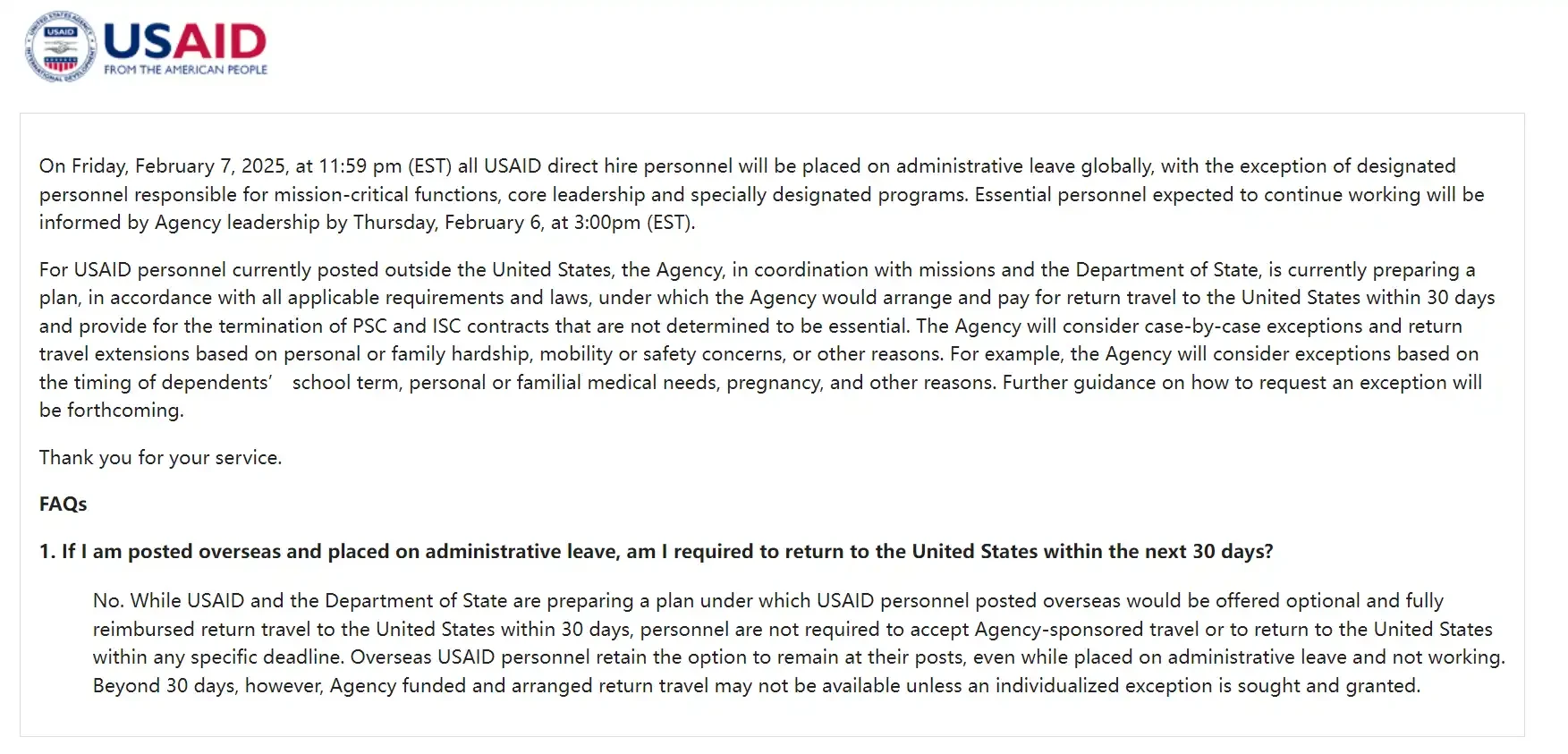
Source: USAID official website, stating that all directly hired personnel of USAID will be on administrative leave as of 11:59 PM EST on February 7.
This systematic takeover is spreading at an astonishing speed. The DOGE team under Musk not only quickly took control of the operational hub of USAID but also simultaneously penetrated core departments such as the Treasury, the Office of Personnel Management (OPM), and the General Services Administration (GSA). Several chief security officers, chief financial officers, and executive officials from multiple key departments have been concentratedly dismissed, and a large number of senior civil servants have been stripped of their powers. In stark contrast, hundreds of tech newcomers lacking government work experience but mysteriously connected to Musk are entering key government positions through special channels, bypassing regular security checks to directly access confidential databases.
Particularly controversial is DOGE's penetration into the financial payment hub. This financial lifeline, which manages social security disbursements, Medicaid, civil servant salaries, and corporate subsidies across the U.S., has traditionally been operated by career financial officials. However, the DOGE team has recently broken through traditional constraints, not only gaining real-time monitoring access to the financial payment system but also working to establish a "non-essential expenditure" screening mechanism, preparing to implement intelligent cuts to federal welfare programs.
Musk claimed on social media that a large amount of "illegal payments" exists in the federal government's daily expenditures, including foreign aid, social welfare, and academic research funding, and DOGE's goal is to cut $4 billion in spending daily. On February 6, DOGE announced that 78 contracts in the categories of DEI, distressed assets, media, and consulting were terminated, including a contract for "Groundwater Exploration and Assessment in the Islamic Republic of Mauritania." Total savings amounted to approximately $110 million. 
Of course, there are also some changes that are quite amusing, especially regarding gender issues that are generally hard for Chinese people to understand. On February 6, DOGE's official Twitter stated, "The Social Security Administration has terminated the 'Gender X Initiative Mark' contract and removed all content related to gender ideology from public-facing applications. This saved over $1 million and complies with the President's executive order" (see image below).
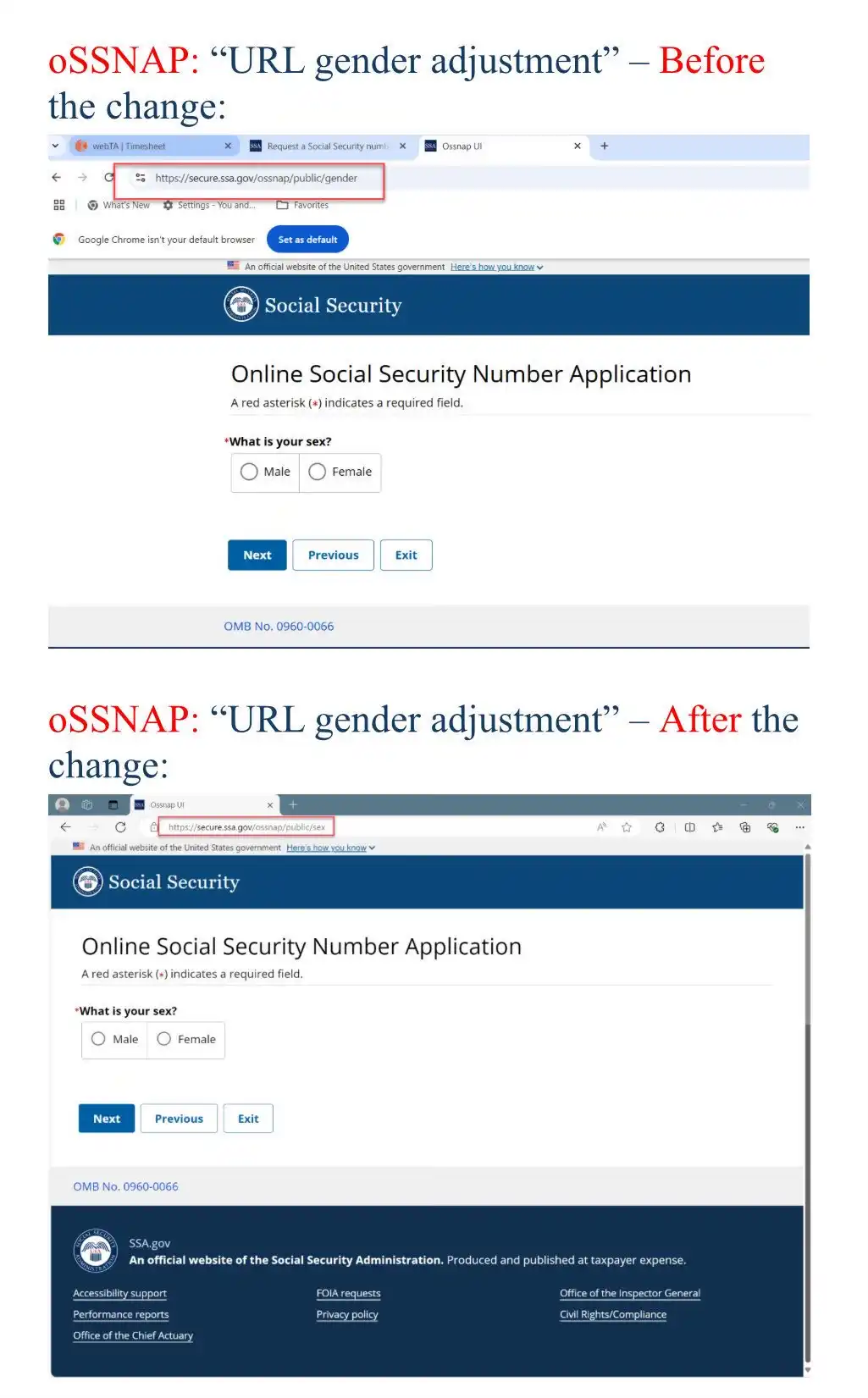
In the image, the change involves the URL modification of the Social Security online application page, adjusted to "/sex" instead of "/gender." Although the wording of the application form itself has not changed, still asking "What is your gender?" and providing options for "Male" and "Female," the official terminology has shifted from "gender" to "sex," not recognizing psychological gender identity. This aligns with the executive order signed by Trump on January 20, 2025, titled "Defending Women from the Extremism of Gender Ideology and Restoring Biological Truth in the Federal Government." The order defines gender as a binary of male and female, requiring federal agencies to use "sex" rather than "gender identity," halting funding for gender-affirming care, and prohibiting transgender individuals from using facilities corresponding to their gender identity in federally funded single-sex facilities.
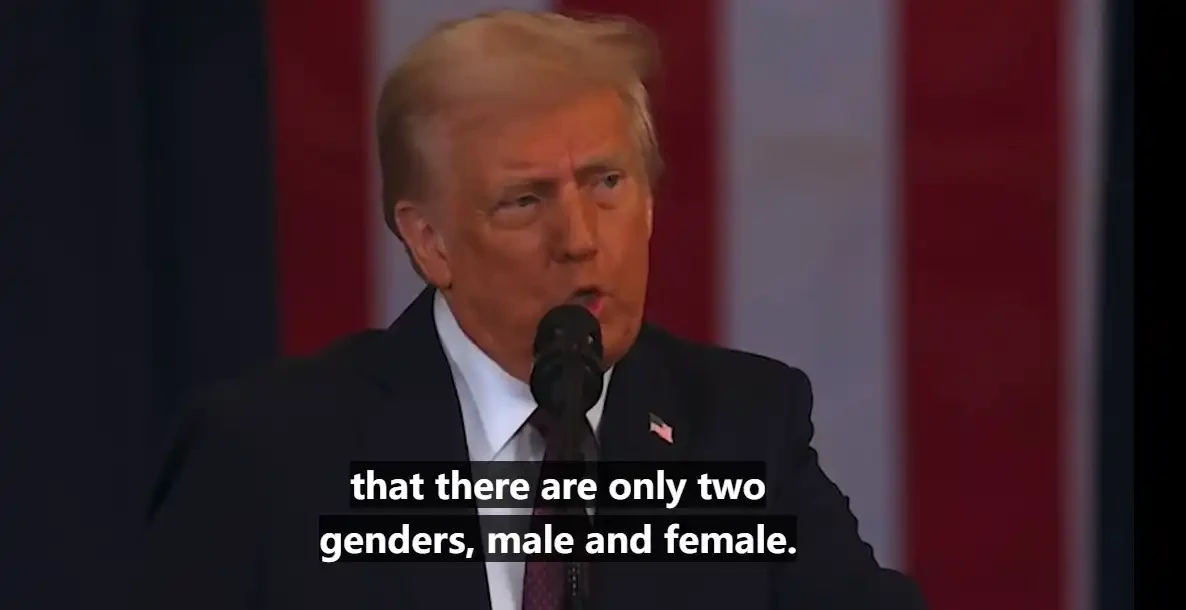
Image source: NEW YORK POST, Trump stated he only supports two genders: male and female.
As DOGE gradually penetrates the core of government agencies, the balance of power is increasingly tilting. In internal communications, civil servants were informed that they must accept "government efficiency reforms," or they risk being fired or reassigned to marginal positions. Some employees at the Treasury even received warning emails suggesting that their positions might be eliminated. Meanwhile, Musk mocked government workers on social media, calling them "lazy" and encouraging them to resign voluntarily, implying that only those "willing to adapt to the new system" could remain.
Musk's plans go far beyond cutting spending and purging officials. His goal is to establish a completely new model of government—a governance system led by tech entrepreneurs, with administrative decisions assisted by algorithms and artificial intelligence. He has assigned a team composed of former Tesla, xAI, and SpaceX employees to begin developing government management AI to automatically review budgets, approve projects, and analyze policy implementation effectiveness in the future.
In the next steps, DOGE is considering dissolving the U.S. Department of Education through executive means. Relevant officials have begun discussions around an executive order that would revoke all functions of the Department of Education not explicitly listed in regulations or transfer certain functions to other departments. Notably, Trump mentioned in an interview with Musk last August that if he were re-elected as President, he would close the Department of Education.
A Power Crisis Torn in American Politics?
As DOGE's influence sweeps through the political arena like a gale, the voices of opposition are also rising.
The sudden closure of USAID has not only stirred waves domestically but has also raised widespread concerns in the international community. This agency manages approximately $40 billion annually, involving over 100 countries globally, covering various fields such as humanitarian aid, development support, and health programs. Its abrupt halt has left many countries and aid organizations without assistance, with some emergency aid projects even facing the risk of interruption.
Meanwhile, Treasury Secretary Scott Bentsen, upon taking office, handed over access to payment system data to Musk and his DOGE team. This move has sparked widespread controversy, with critics pointing out that it could expose sensitive information of millions of citizens and businesses, jeopardizing the financial security of Americans and even threatening the stability of national infrastructure and personal privacy.
DOGE has taken control of the Office of Personnel Management (OPM) and the General Services Administration (GSA) without proper review or authorization, and the legitimacy and qualifications of its series of personnel appointments have quickly drawn external scrutiny and criticism. Generally, the formulation of federal policies requires multiple layers of approval within government agencies, ultimately decided by cabinet members and the president. However, Musk and his core team have bypassed this process, forming an informal decision-making group led by tech elites, entrepreneurs, and young engineers.
In response, Democratic Senator Chuck Schumer announced he would collaborate with House Democratic Leader Hakeem Jeffries to propose legislation to counter DOGE's "illegal interference." Meanwhile, multiple lawsuits against Musk have been filed in federal court, alleging that DOGE officials accessed confidential information without approval, violated government procurement regulations, and abused executive orders to cut federal spending.
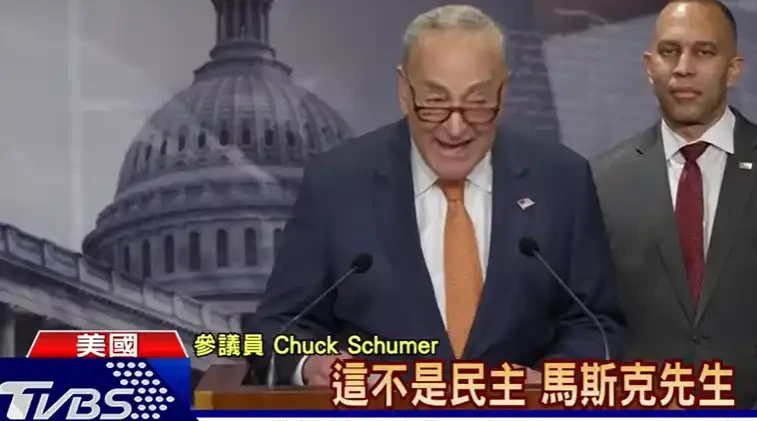
Image source: TVBS NEWS, Democrats oppose Musk's reforms.
On February 6, local time, the Department of Government Efficiency (DOGE) led by Musk faced a setback—Federal Judge Colleen Kollar-Kotelly issued a temporary injunction prohibiting the Treasury from providing data from its payment system to outside parties. As a result, Musk himself would be unable to review data retrieved from the payment system.
As if that weren't enough, just hours after the judge's ruling, a 25-year-old DOGE programmer, Marko Elez, suddenly resigned after it was discovered that he had posted racist comments on his dormant social media account.
Musk's aggressive actions are backed by President Trump's strong support and trust. In the White House, Musk not only has an independent office but also frequently attends meetings with senior officials, and Trump has publicly expressed "full confidence in Musk's decisions" multiple times. In terms of government operations, Musk is attempting to discard the traditional bureaucratic system in favor of a more efficient model akin to Silicon Valley companies. Many senior government officials are concerned that such reforms could lead to an excessive concentration of power in private capital, undermining government transparency and accountability mechanisms. However, under Trump's protection, despite facing some obstacles, Musk's reform efforts continue to advance rapidly.

Bold reforms are always a war without gunpowder, potentially establishing a disruptive global government management model or becoming a casualty of power struggles. If the opposition forces within the Democratic Party continue to grow, or if the judicial system sees a strong opposing force emerge, DOGE's reforms may slow down. However, based on current efficiency, Musk's actions are far outpacing the cumbersome traditional administrative system, and a "corporate-style" government led by technology and prioritizing efficiency is being shaped. This adventure by Musk and six young individuals raises the question: is it genius innovation or a dangerous game? The answer can only be validated by time.
免责声明:本文章仅代表作者个人观点,不代表本平台的立场和观点。本文章仅供信息分享,不构成对任何人的任何投资建议。用户与作者之间的任何争议,与本平台无关。如网页中刊载的文章或图片涉及侵权,请提供相关的权利证明和身份证明发送邮件到support@aicoin.com,本平台相关工作人员将会进行核查。