Original Author: BUBBLE
In January 2025, the launch of DeepSeek R1 shook the AI community and truly transformed the Crypto AI ecosystem. In the past cycle, Crypto AI primarily revolved around AI Agents, but DeepSeek R1 and its open-source strategies fundamentally changed the game: extremely low training costs and groundbreaking adaptive training methods made the vision of a decentralized AI industry no longer a mere talk, but an achievable reality. This transformation had far-reaching effects, with the total market capitalization of the Crypto AI market significantly shrinking, and many AI tokens experiencing a 70% pullback. But is this really a crisis? Or does it signify a complete reshuffling of Crypto AI? Is DeepSeek the "terminator" that shatters the Crypto AI narrative, or the "disruptor" that accelerates its entry into a practical era?
The Wild Growth of DeepSeek
The development of DeepSeek can be traced back to 2021. At that time, the quantitative trading hedge fund, Huanfang, began to recruit AI talent on a large scale. It was uncommon for quantitative firms to pivot to AI, and most of the recruits were AI researchers exploring cutting-edge directions, including large models (LLM) and text-to-image models. Although there were rumors that Huanfang was making this transition to better utilize the idle GPU resources within the company, the primary reason was likely to seize the high ground in cutting-edge AI technologies like large models.
By the end of 2022, Huanfang had attracted an increasing number of top AI talents, mainly from Tsinghua and Peking University. Stimulated by ChatGPT, Huanfang's CEO, Liang Wenfeng, was determined to enter the field of general artificial intelligence and established DeepSeek in early 2023. However, the rapid rise of AI companies like Zhipu, Dark Side of the Moon, and Baichuan Intelligence posed significant challenges for DeepSeek, which was a pure research institution lacking a star founder and faced enormous difficulties in independent financing. Therefore, Huanfang chose to spin off DeepSeek and fully fund its development. Although this decision was highly risky, it allowed DeepSeek to operate without the profit commitments or valuation pressures from investors. At the same time, it had relatively ample GPU resource reserves, enabling the team to focus on technological breakthroughs. A group of innovative young people could thrive in a fertile environment, making DeepSeek feel more like a research institute than a company.
Just like in the early days of OpenAI, no one would have imagined that a company researching robotic hands to solve Rubik's cubes would eventually develop ChatGPT, nor could anyone foresee how Huanfang, a quantitative firm, would use DeepSeek to penetrate the current AI bubble. The former took seven years, while the latter took only two. In November 2023, DeepSeek launched the DeepSeek LLM with 67 billion parameters, achieving performance close to GPT-4. In May 2024, DeepSeek-V2 went live, and in December of the same year, DeepSeek-V3 was released, performing on par with GPT-4o and Claude 3.5 Sonnet in benchmark tests. The rapid technological leap of DeepSeek was not due to the company's financial strength or high academic qualifications, but rather a technological singularity occurring after "ChatGPT impacted the global AI industry," with various singularities accelerating in any fertile ground that could satisfy imagination until the next critical singularity emerged.
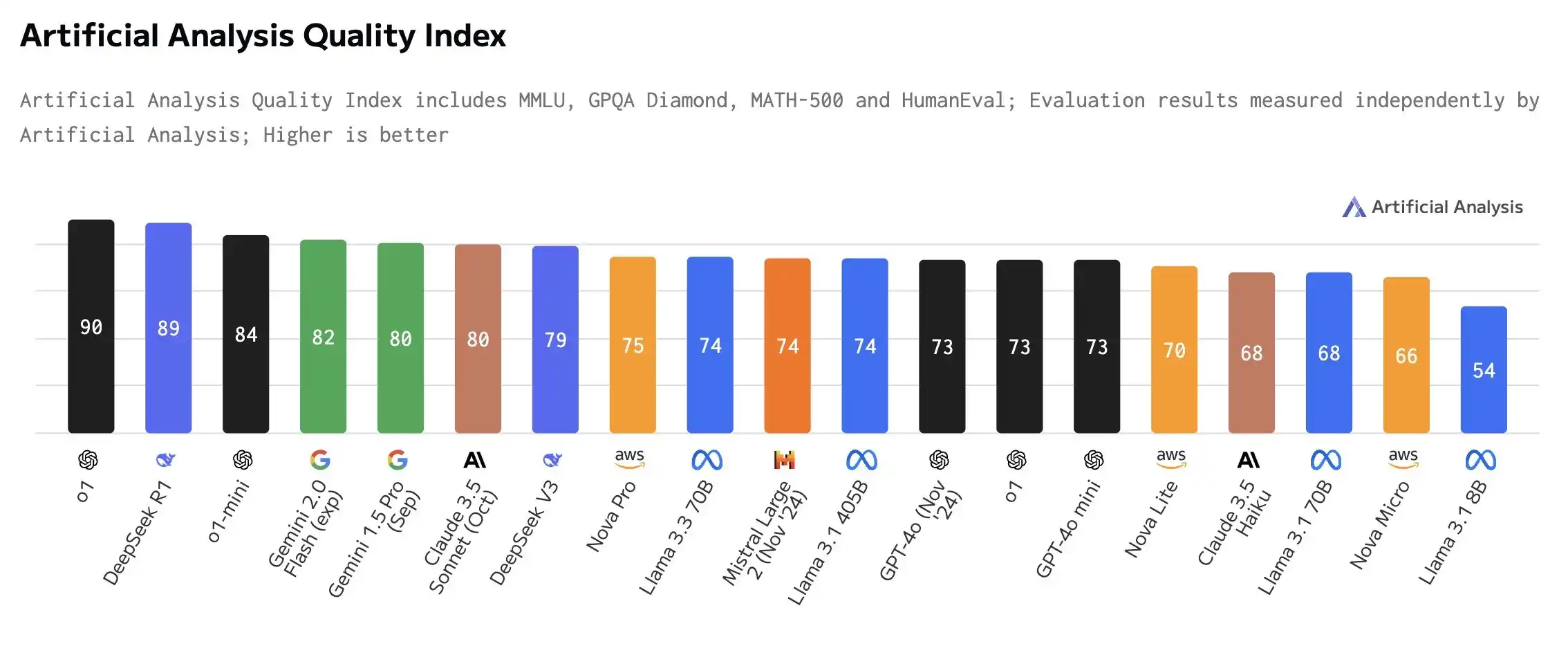
Finally, in January 2025, DeepSeek accelerated through the singularity, using their cultivated first-generation reasoning-capable large model, DeepSeek-R1, to open that door at a training cost far lower than ChatGPT-O1 while delivering outstanding performance.
Distributing the Key to the Interstellar Gate to the World through Open Source
Just one day after the release of DeepSeek R1 and the announcement of the open-source model, U.S. President Trump officially announced a $500 billion mega-scale investment "Stargate" plan at a White House press conference. A joint venture named Stargate was established by OpenAI, SoftBank, Oracle, and investment firm MGX to build new AI infrastructure for OpenAI in the United States.
This level of investment is comparable to the "Manhattan Project," aiming to use national power to stack algorithms and push closed-source AI to its peak, monopolizing the AI market to ensure the leading position of the U.S. domestic AI industry. However, at the time of the plan's announcement, it was unlikely anyone anticipated that just days later, this open-source model from across the ocean would not only not open the door but would also bring hammers to smash the walls while distributing hammers to others.
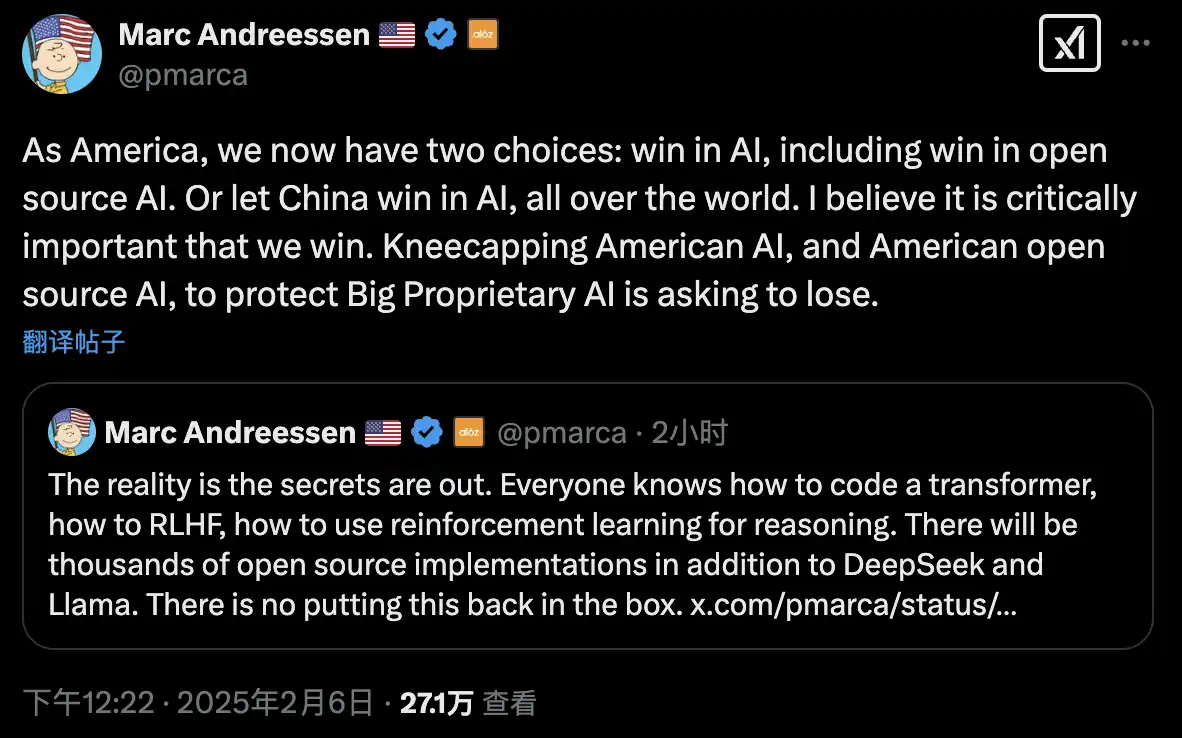
As an open-source model that can rival top closed-source models, DeepSeek's new training architecture triggered a chain reaction, making it difficult for closed-source AI to compete. Closed-source models that cannot keep up with DeepSeek R1 will be directly eliminated by the capital market. Even Marc Andreessen, the founder of A16z, "the investor in OpenAI," publicly stated that more attention should be paid to open-source AI rather than focusing on closed-source AI. In the industry, whether supporting the potential emergence of AGI or viewing AI merely as an upgraded version of the SaaS industry, there is a consensus that the harms of closed-source far outweigh those of open-source, whether it be black box issues, industrial monopolies, information security, or capital manipulation of attention—any of these are dangerous developmental directions.
Despite some industry insiders questioning the "MoE" hybrid expert technology of V3, which requires a massive dataset and is suspected of using OpenAI's model for distillation, and concerns that the reinforcement learning "RL" methods in R1 require substantial hardware resources, leading to suspicions of inflated chip usage, these do not affect the structural reforms it brings to the industry.
The open-sourcing of DeepSeek R1 broke the commercial logic of OpenAI's closed-source large models in its training architecture, using a self-evolving logic for models to avoid the traditional paradigm's massive investments in computing power and data labeling. Although training models still feel like opening a blind box, the cost of that blind box has been significantly reduced.
At the AI hardware level, DeepSeek's V3 open-source directly challenges NVIDIA's market dominance. The moat of NVIDIA GPUs largely lies in its underlying parallel computing platform and programming model, CUDA. Its extensive ecosystem and sufficient number of developers make the learning costs of using non-NVIDIA chips for training prohibitively high, while high barriers to purchase and political restrictions have caused a rift in global AI development.
For us, in the short term, the U.S. stock market's AI sector has significantly shrunk, and the total market capitalization of Crypto AI has nearly been slashed, with the market entering a bear phase. However, in the long term, the most recognized AI industry is moving towards an open-source, transparent, and decentralized development path. From any perspective, the combination of Crypto and AI will become more harmonious.
The Redemption of Crypto AI, Forward! Forward! Relentlessly Forward
During this round of the Crypto AI bubble burst, many AI concept tokens have experienced a 70% pullback, and the Crypto AI market has significantly shrunk. Some jokingly remarked, "With $5.5 million, you can train a large model; why buy any Crypto AI when these AI tokens are worth more?" Indeed, Crypto is a market dominated by capital rather than products, and 90% of AI tokens lack practical significance.
However, with the improvement of regulatory frameworks in the crypto market, it remains the most suitable soil for small and medium-sized AI companies to start their ventures. The cost of large models brought by DeepSeek, which is 1/100 that of ChatGPT O1, along with its model training methods, will lead to ecological growth that is thousands of times greater than the current market.
In direct terms, what DeepSeek brings to crypto is a decentralized training model, making Depin-type projects more rationalized, allowing for more transparency in training processes and information feeding, and establishing a more reasonable value reward mechanism for dataset contributors, making it easier for both sides of model training to settle. The surrounding ecological development of the AI industry, which is thousands of times larger, has enriched the downstream industries of Crypto AI. When enough competitive and creative product narratives appear in the market, as long as one truly breaks through, external capital will naturally flow back into Crypto. The market has long suffered from PVP, and a series of celebrity coins following TrumpCoin have disrupted the originally abundant liquidity and positive feedback balance in the AI market. Therefore, the bubble burst by DeepSeek is actually a greater boon.
Currently, many Crypto AI projects are either quickly integrating DeepSeek or updating their architecture based on it, including ElizaOS, Argo, Myshell, Build, Hyperbolic, Nillion Network, infraX, and more. Some of these projects have directly optimized their products through DeepSeek.
Myshell
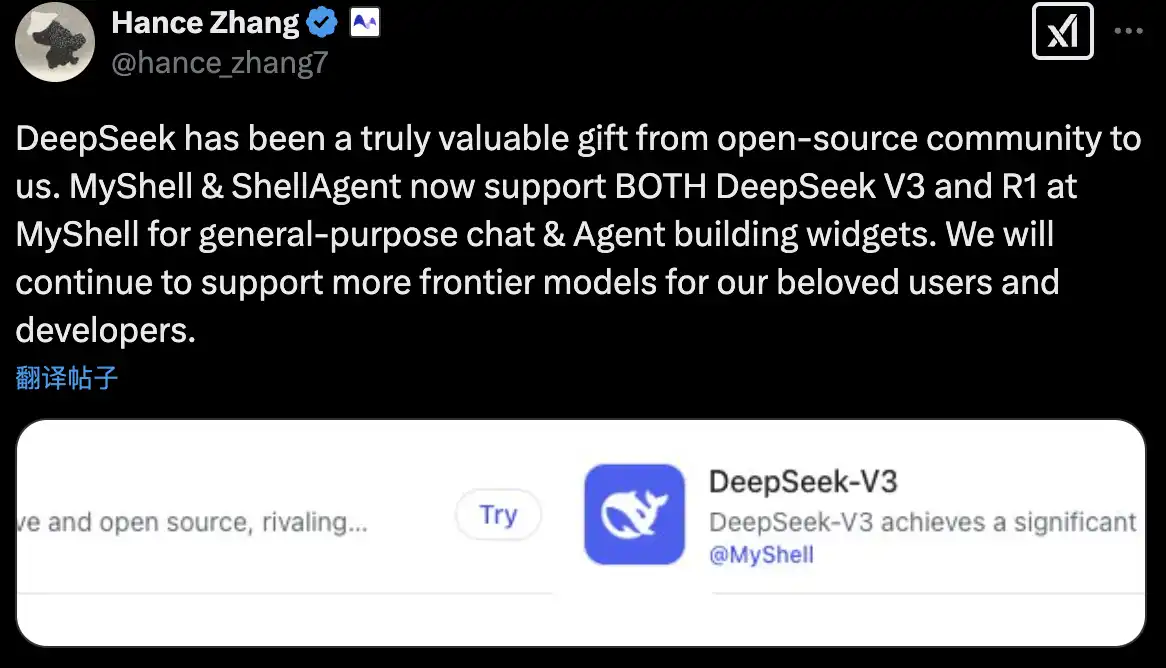
In the production flow of chatbots and application plugins, V3 and R1, as well as the image generation model Janus-Pro, have been integrated into Myshell. The technical team completed the model integration in just half a day. As one of the few projects in the blockchain space that has consistently focused on refining its product, even gaining recognition in Web2AI products while hesitating to issue tokens, the open-sourcing of DeepSeek will bring good news to Myshell's users in terms of cost, allowing for more agent developers to contribute to the already well-developed product.
Argo
The developer of Argo, Sam Gao, integrated the important features of Argo with DeepSeek from the early stages of product design. As a workflow system, Argo has built-in LLM as the standard DeepSeek R1 and delegates the generation of the original workflow tasks to DeepSeek R1. Due to the nature of the workflow, the token consumption and context information will be substantial, with an "average >= 10k tokens." Additionally, Argo incorporates Chain-of-Thought (CoT) into its workflow thinking process. After the open-sourcing of DeepSeek, not only has the cost of workflow products decreased, but LLM can also be deployed locally within Argo, ensuring user privacy and security.
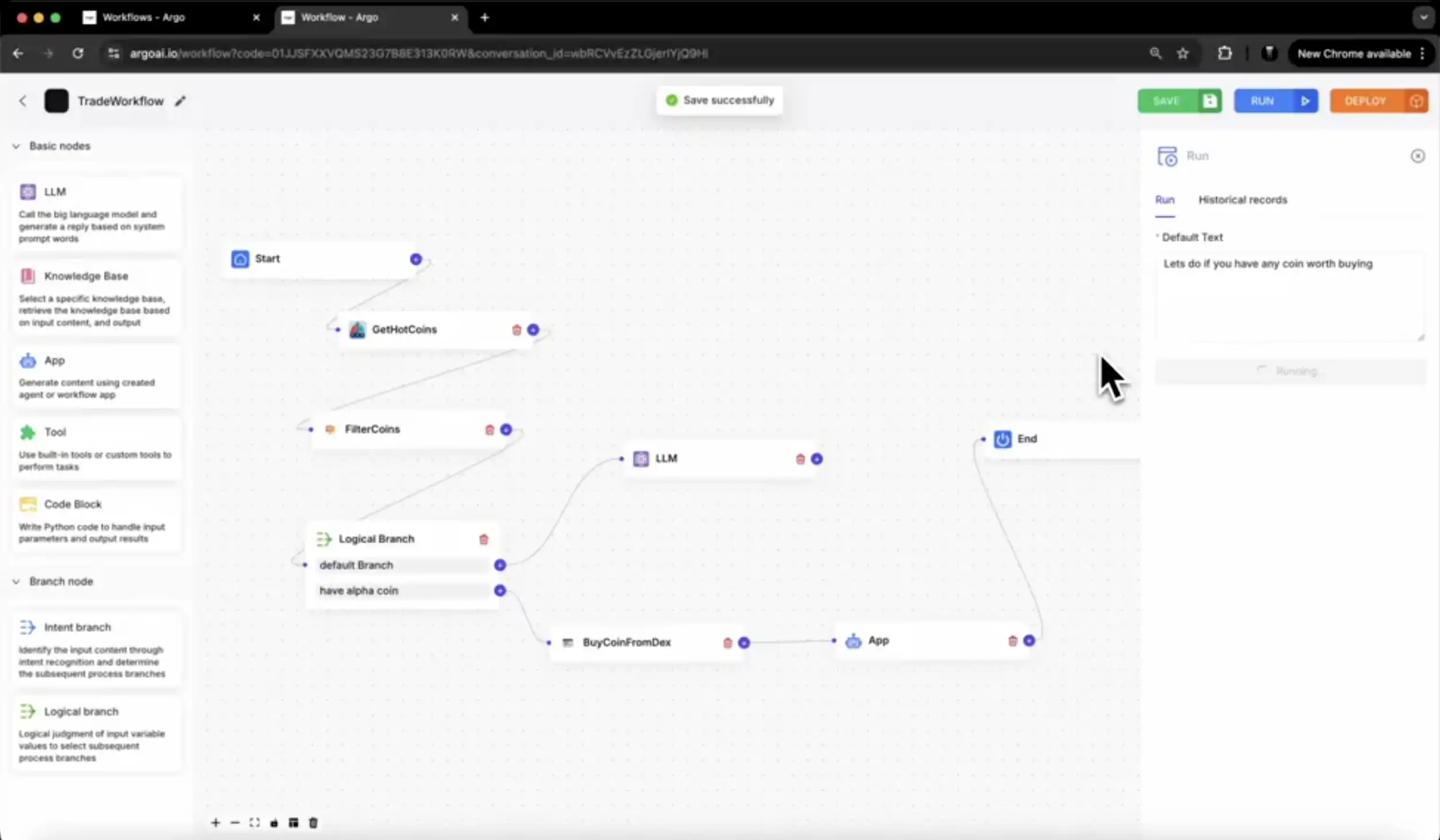
Before the launch of DeepSeek R1, Argo had already integrated its preliminary training logic, Chain-of-Thought (CoT), into the production process of Argo's Agent Workflow. Particularly for tasks such as meme trading and market trend analysis, Argo customized its workflow using Graph-of-Thought (GoT), a novel approach that constructs reasoning as a graph, where nodes represent "LLM thoughts" and edges indicate the dependencies between these thoughts.
Given that Argo chose GoT (the only Crypto AI Workflow currently using this model), it achieved a more reliable and transparent process. This innovative approach directly impacts the security and trustworthiness of transactions on the Argo platform. Integrating the Graph-of-Thought (GoT) into Web3 AI agents places Argo at the forefront of AI crypto trading. The structured reasoning of CoT not only enhances the security of financial transactions but also ensures transparent and reliable decision-making, which is crucial in decentralized finance (DeFi).
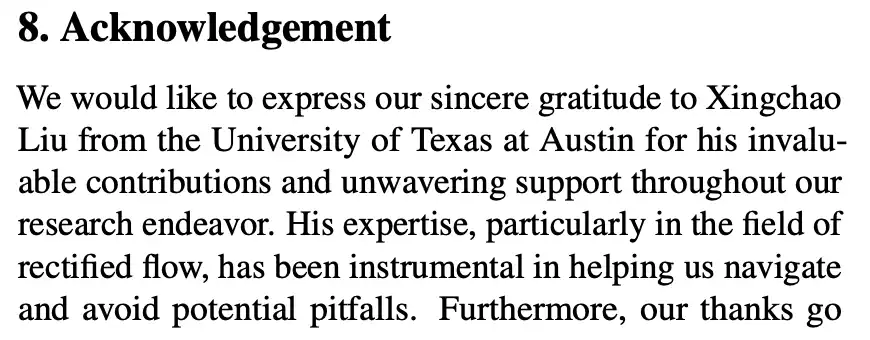
It is noteworthy that Sam, the core developer of Argo, collaborated with Shaw on a paper titled "EraseAnything: Enabling Concept Erasure in Rectified Flow Transformers," which discusses how to remove unwanted concepts from large-scale text-to-image diffusion models without compromising the overall generative performance of the model, with assistance from DeepSeek researcher Xingchao Liu.
Hyperbolic
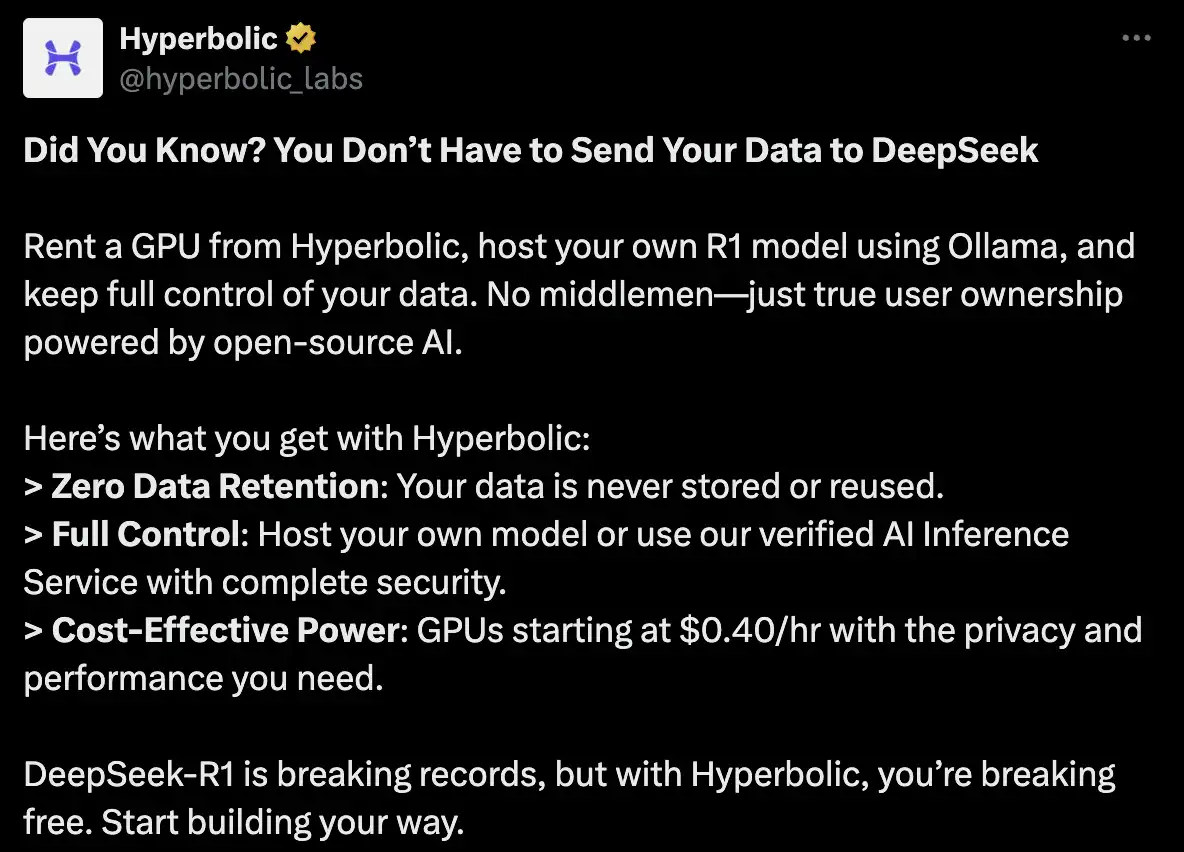
Hyperbolic Labs also announced that it would host the DeepSeek-R1 model on its GPU platform, allowing users to rent Hyperbolic GPU resources to run the DeepSeek-R1 model locally or in designated data centers without sending sensitive data to DeepSeek's servers. This approach not only ensures data privacy but also leverages the excellent reasoning capabilities of the DeepSeek model. Through Hyperbolic's decentralized computing network, users can access the efficient reasoning power of the DeepSeek model at a lower cost, making it a highly competitive solution for startups, super individual entrepreneurs, or simply efficient AI users.
This round of bubble bursting has indeed dealt a heavy blow to the Crypto AI market, with many AI tokens losing their speculative value. However, fundamentally, DeepSeek is not eliminating Crypto AI but rather forcing the market to evolve more rapidly. After DeepSeek R1, the future of Crypto AI will no longer rely solely on speculation but will need to be reconstructed around decentralized AI computing, economic incentive mechanisms for model training, fair distribution of AI resources, and practical products. The real challenge is whether Crypto can leverage the technological revolution brought by DeepSeek to establish a truly valuable AI ecosystem, rather than merely creating concepts and speculation.
This is not an end, but an evolution. Crypto AI needs to move forward faster and more aggressively. / Accelerate
免责声明:本文章仅代表作者个人观点,不代表本平台的立场和观点。本文章仅供信息分享,不构成对任何人的任何投资建议。用户与作者之间的任何争议,与本平台无关。如网页中刊载的文章或图片涉及侵权,请提供相关的权利证明和身份证明发送邮件到support@aicoin.com,本平台相关工作人员将会进行核查。


