On February 5, 2025, Beijing Youth Daily prominently featured a full-page report on "digital assets" on the front page and A4 page. From the perspective of young people, the report discussed the development of the "digital assets" industry, investment stories, and the participation of social forces.
The article explored whether "digital assets" have the potential to become a major asset class like houses, stocks, funds, and gold. It also mentioned that China's "digital asset" market is starting from the level of industry collaboration and autonomy, gradually building a circulation environment, and is expected to form a standardized market. Banks and large enterprises, such as Industrial and Commercial Bank of China, Ant Group, and Xiexin Group, have begun to venture into the digital asset field, releasing digital collectibles or launching RWA projects.
The various measures extensively mentioned by domestic media signify that the application of digital assets is gradually expanding, penetrating into broader industries and fields. It also suggests that the "wind direction" of domestic regulation may accelerate changes, and in the near future, more noteworthy opportunities are likely to emerge in China.
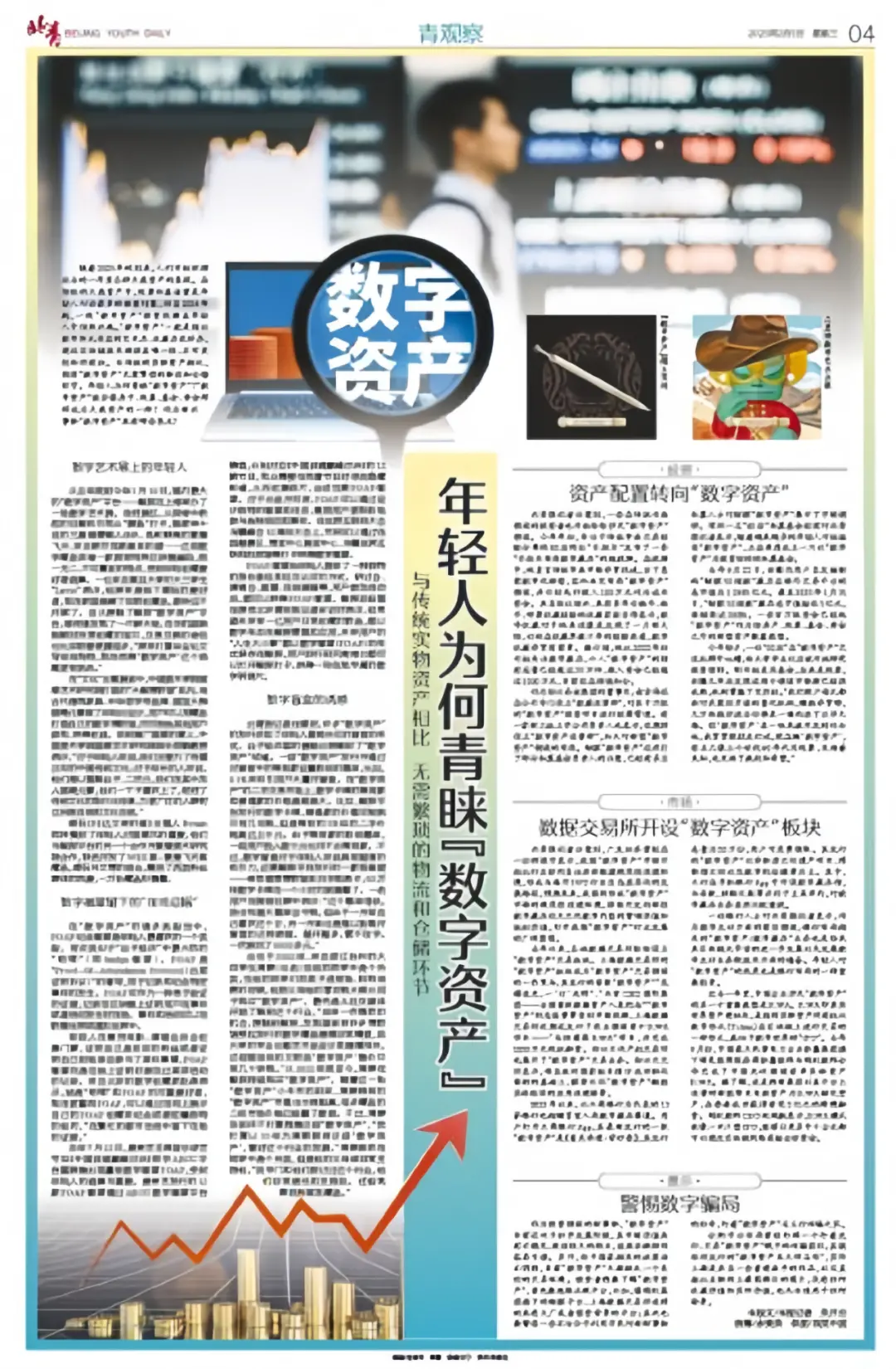
Below is the full report
With the arrival of 2025, people began to reflect on the performance of various major asset classes over the past year. Among traditional major assets, stocks and funds were once the most discussed investment objects among young people. However, since 2024, a wave of "digital asset" investment has quietly emerged among the youth. "Digital assets" generally refer to artworks, collectibles, or treasures that exist in digital form, secured by blockchain technology to ensure their uniqueness, immutability, and ownership. Compared to traditional physical assets, owning "digital assets" does not require cumbersome logistics and storage processes.
Why do young people favor "digital assets"? Can "digital assets" become a major asset class like houses, stocks, funds, and gold? What highlights does the emerging phenomenon of "digital assets" possess?

Young People at the Digital Art Exhibition
From the end of last year to January 10 this year, the largest "digital asset" platform in China, Whale Exploration, held a digital art exhibition in Shanghai. Upon entering the exhibition area, a giant whale leaping from the deep sea attracted visitors to "fish" and take photos. The rock band of bronze figures from the Sanxingdui site, the brightly colored Dunhuang flying apsaras, and cats from the Sphinx galaxy… These digital collectibles, each possessing a unique blockchain code, are sought after by young collectors due to their uniqueness and immutability.
A junior student from Fudan University, "Lavis," stated that he was originally a fan of offline trendy toys, but now his home is filled with physical collectibles, making it hard to move. Since discovering the Whale Exploration "digital asset" platform, he feels like he has found a new world, where he can appreciate his collection anytime on his phone, and the trading and exchange methods are much more convenient than with physical items. "I originally planned to write my graduation thesis on Pop Mart, but now I think the topic of 'digital assets' is more challenging."
In the "Cultural" themed exhibition, the "Great Whale Museum" series created by the National Trend Art Research Institute of the China Academy of Art has modernized elements such as ancient architectural furniture, time-honored Chinese brands, and the national treasure giant panda. Users can create their own digital museum with their collectibles and open it for other users to visit and earn income.
Regarding the significance of promoting national trends, Professor Ni Bin, director of the National Trend Art Research Institute of the China Academy of Art, stated, "For young people, we mainly aim to spread positive traditional Chinese culture; for older people, they find it hard to understand the trends and the two-dimensional world. By incorporating national trend elements, they suddenly like it, promoting the modernization of traditional culture and establishing national and cultural confidence for a broader audience."
The person in charge of the trendy toy IP "Da Vinci's Egg," Bonan, also sensed young people's love for national trends. They collaborated with another partner of Whale Exploration, the Dunhuang Art Research Institute, to co-develop the WEE Baby - Dunhuang Flying Apsara collectible. The combination of trendy toys and cultural heritage activated the passion of two fan groups, and ten thousand collectibles sold out in seconds.

The "Proof of Presence" Left by Digital Badges
Among the many types of "digital assets," POAP commemorative badges are the most favored by young people. They are somewhat similar to the hottest "badges" in the "trendy economy." POAP stands for "Proof-Of-Attendance Protocol," used to record and commemorate specific events. POAP can serve as easily verifiable evidence, recorded on the blockchain to prove that users were present at an event or activity. Events and activities can occur in the physical or virtual world.
Some people collect tickets after watching movies or concerts to prove they are loyal fans or to show they personally participated in something. POAP badges serve as online records proving participation in an activity. Zhao Yan, a digital collector from Beijing, stated that she is a dual enthusiast of "badges" and POAP, and now places more importance on POAP, as she can showcase her POAP collection online to commemorate or flaunt unique experiences, "leaving proof of presence in the busy urban life."
On July 22 last year, iQIYI's flagship music variety show "China Rap Peak Showdown" teamed up with the ARCC platform to launch limited edition digital badges POAP, which were highly sought after and loved by young people. The 12 POAP badges issued by iQIYI were minted through the ARCC digital badge platform, corresponding to the 12 episodes of "China Rap Peak Showdown." Viewers needed to search for hidden Easter eggs while watching the show to collect fragments and synthesize the POAP badge for that episode.
For producers, POAP can encourage users to participate more actively in various activities and events by designing unique badges and tasks. At the 10th anniversary conference of the World Internet Conference in Wuzhen, citizens could earn digital badges by checking in at scenic spots like Xizha, the Exhibition Center, and the Wuzhen World Internet Technology Museum.
POAP badges provide young people with a unique way to symbolize identity and social recognition. After participating in events such as seminars, concerts, live broadcasts, and online courses, users can receive POAP badges. The general manager of Whale Exploration stated in an interview with Beijing Youth Daily that he hopes that in the future, one hundred million items collected by users will be managed and applied in digital form on Whale Exploration, and that users' "life events" will be preserved in the form of digital badges (POAP) on Whale Exploration, allowing users to check in and receive a location-specific digital postcard wherever they travel.

The Allure of Digital Blind Boxes
Beijing Youth Daily reporters noticed that many "digital assets" are issued in the form of blind boxes, which are popular among young people. The tricks from the trendy economy have also been applied to the "digital asset" field. Some issuers of "digital assets" set extremely low probabilities for rare items in blind boxes, such as 0.1%, to attract users to open blind boxes in large quantities. In the second-hand trading market for "digital assets," there is a significant price difference between rare and common digital cards. For example, digital cards issued by the Whale Exploration platform may have a common version worth only a few cents, while the rare UR-level second-hand price can reach thousands of yuan. Due to the extremely low probability of rare items, some users invest thousands of yuan without obtaining a rare item.
However, digital blind boxes have a strong appeal for young people. Recently, a digital card from the Whale Exploration platform, the "Wuhuang Cat - Qisi Miaoxiang Museum Series," sold out 500,000 digital cards within an hour. A user in a WeChat group stated, "The probability is very low, and I know I will likely lose money, but on one hand, I like this IP, and on the other hand, I find it hard to resist the temptation of opening blind boxes. The more I open, the more I can't stop. I spent over 5,000 yuan in one go."
Zhou Qun (a pseudonym), a senior student born in 2002 from Taizhou, Zhejiang, is an outlier among his classmates. While his classmates are keen on shopping malls and online shopping, he spends most of his pocket money from his parents on purchasing "digital assets." He first learned about this industry through social media, "Later, by chance, I came across Whale Exploration and found many beautifully modeled digital collectibles authorized by museums. My university major is also related to art design and modeling, and these national treasure-level cultural relics are priced at only a few dozen yuan." Since the end of 2022, Zhou Qun has continuously purchased "digital assets" on Whale Exploration. With the arrival of this round of "digital asset" mini bull market, the market value of the "digital assets" he holds has also risen significantly, with many collectibles' secondary market prices having multiplied.
However, Zhou Qun currently does not plan to sell these "digital assets." "I plan to hold these 'digital assets' for a period of ten years, as I am optimistic about the development of this industry." Although Zhou Qun is an outlier among his classmates, his parents fully support him. "I specifically discussed this industry with them, and they trust and support me very much. They often help me grab first-release collectibles."

Asset Allocation Shifts to "Digital Assets"
Beijing Youth Daily reporters noticed that some investors in the traditional calligraphy and painting field have also begun to venture into the "digital asset" field. At the beginning of this year, "Principal Le," an internet celebrity born in the 1980s who focuses on sharing experiences in traditional calligraphy and painting trading, released a short video titled "Principal Le Layouts Digital Collectibles." In the video, he candidly stated that the traditional calligraphy and painting market is very sluggish and urgently needs digital transformation, so he decided to enter the "digital asset" field and plans to invest 1 million yuan as trial capital.
Yu Jiwei, a collector from Shaoxing, Zhejiang, with years of experience in ancient coins, paper money, and stamps, stated that digital collectibles feel like discovering a new world to him. Based on his decades of experience in the collecting community, he believes digital collectibles have great prospects. He began paying attention to digital collectibles in early 2022, and his personal holdings of "digital assets" have exceeded 350,000 items, with investments exceeding 10 million yuan, and he is still continuously increasing his holdings.
As the chairman of Zhejiang Yijin Group, Yu Jiwei has also established a "Digital Collection Operations Department" in the company to manage its multi-million "digital asset" investment projects. A person in charge of a newly listed company on the New Third Board also stated that they will soon establish a "Digital Asset Operations Department" to increase their layout in the new "digital asset" field. Whale Exploration's "digital assets" have also attracted the attention of some private equity fund managers, and several private equity individuals have conducted market research on Whale Exploration's "digital assets." A private equity fund manager born in the 1980s from Shenzhen told Beijing Youth Daily that as more and more young people begin to accept "digital assets," he is considering establishing a private equity fund with "digital assets" as the investment target.
On September 22 last year, the "Whale Exploration 50 Index" collectible, spontaneously compiled by users within the community, had a total market value of 129.85 million yuan on the over-the-counter trading platform. As of January 31, 2025, the total market value of the "Whale Exploration 50 Index" collectibles approached 500 million yuan, with an increase of 280%. Some investors with millions in funds have already regarded "digital assets" as a new type of asset allocation, alongside real estate, stocks, funds, and gold.
This New Year's Eve, a "post-00s" individual complained in a "digital asset" exchange community that after graduating from university, he began researching investment and financial management. Initially, he bought funds, then stocks, and after several years of trial and error, he found that both markets had matured, with institutions holding the pricing power. "As retail investors, we face quant funds armed to the teeth every day, making it very difficult to make money. Throwing tens of thousands of yuan in feels like a drop in the ocean. But 'digital assets' are an undeveloped virgin land. I often tell my friends that getting into 'digital assets' now is a bit like buying stocks in the 1990s—full of unknowns, challenges, and hopes."

Establishment of Data Exchange "Digital Asset" Sector
Beijing Youth Daily reporters noted that GF Securities once stated in a research report that China's "digital asset" market is beginning to build a normative circulation environment from the perspective of industry collaboration and autonomy, forming a differentiated development path compared to the overseas NFT industry ecosystem. It is expected that in the future, China will establish a normative circulation environment for the "digital asset" market, continuously developing innovative digital collectibles to amplify the marketing and copyright value of cultural digital content, opening up a broad blueprint for the development of China's "digital asset" industry.
Since last year, various local data exchanges have successively established "digital asset" trading sectors. The "digital asset" sector of the Shanghai Data Exchange has become a dark horse in the field of "digital asset" trading, with its first issued "digital asset" "Dragon Glory, One 'Ding' Bright" and the "Beijing CBD International Group - National First Batch of Data Asset Entry Commemorative" digital asset commemorative medals being highly sought after in the market. Recently, the Shanghai Data Exchange also issued the first RWA project in the agricultural sector— the "Malus Grapes RWA" project, completing 10 million yuan in equity financing. The Zhejiang Cultural Property Exchange has also launched "digital asset" trading business. The Zhejiang Cultural Exchange stated that it will explore the application and circulation scenarios of cultural "digital assets" empowering the real economy based on successful transformation cases at the National Version Museum in Hangzhou.
Since 2022, 13 banks, represented by the Industrial and Commercial Bank of China, have also officially announced their entry into the digital collectible track. Users opening the ICBC App will find its latest issued "digital asset" is "Seeing Intangible Cultural Heritage: Purple Clay Teapot," with a total issuance of 200,000 copies available for free. The issued "digital assets" mainly focus on intangible cultural heritage projects, museum cultural creations, and digital commemorative badges. Among them, ICBC has set up a digital collectible museum in its mobile banking app, placing it alongside deposits, transfers, and remittances in the main menu, clearly showing its emphasis on the digital collectible business.
A bank representative told Beijing Youth Daily that as a frontier field in digital payments, banks' layout of related "digital asset/digital collectible" businesses is also a technical reserve for the further development of the blockchain metaverse and the development of digital payment services. The enthusiasm of young people for "digital assets" is also an important factor in the banks' layout.
In the past year, another important type of "digital asset" that Chinese enterprises have ventured into is RWA. RWA, or Real World Asset tokenization, refers to a form of trading physical asset ownership in digital form (Token) on the blockchain, similar to an "IPO" in the digital world. In September last year, China's largest private power company, Xiexin Group, through its green energy service provider Xiexin Nengke, collaborated with Ant Group to complete China's first RWA of physical assets in the photovoltaic field. It is understood that this was anchored by the new energy charging pile assets operated by Langxin Group on its platform, successfully obtaining the first cross-border financing of 200 million yuan in Hong Kong. Ant Group CEO Zhao Wenbiao stated that the RWA model is like a small IPO, allowing more small and medium-sized enterprises to connect with global funds through the blockchain network.
Related content can be referenced: Ant Group and Xiexin Nengke Complete Over 200 Million Yuan Photovoltaic Physical Asset RWA Issuance

Beware of Digital Scams
As a new phenomenon in the investment field, "digital assets" are currently still in the early stages of development, characterized by unstable market value and high volatility, making it particularly easy to incur losses through chasing prices. Additionally, due to the unclear national policies, most "digital assets" currently lack a good trading environment. Investors wanting to understand "digital assets" should first choose legitimate platforms, such as Whale Exploration under Ant Group or the Shanghai Data Exchange, which have large corporate or state-owned backgrounds; secondly, they should also be wary of some criminals taking advantage of the public's curiosity about new things, using the name of "digital assets" to commit fraud.
The Hefei Public Security Bureau once dismantled a fraud gang that posed as issuers and traders of "digital assets," falsely claiming that the "digital assets" they issued were masterpieces by masters, when in fact they were works from ordinary artists and images directly copied from the internet, lacking any collectible or actual value and unsuitable for any scenario.
免责声明:本文章仅代表作者个人观点,不代表本平台的立场和观点。本文章仅供信息分享,不构成对任何人的任何投资建议。用户与作者之间的任何争议,与本平台无关。如网页中刊载的文章或图片涉及侵权,请提供相关的权利证明和身份证明发送邮件到support@aicoin.com,本平台相关工作人员将会进行核查。


