Hooks is the most anticipated development in V4, allowing anyone to create custom logic and insert it as a module plugin into Uniswap.
Written by: Francesco, member of Castle Labs
Compiled by: Ashley, BlockBeats
Editor's note: This article introduces the innovative features of Uniswap V4, focusing on the modular characteristics of Hooks that enable developers to customize liquidity pool logic. Additionally, the article discusses the technological advancements brought by V4, such as the Singleton structure, flash accounting, and native ETH support, as well as several innovative projects built on the V4 platform, showcasing the new opportunities Uniswap V4 brings to the DeFi ecosystem.
The following is the original content (reorganized for better readability):
About Uniswap V4
Uniswap V4 officially launched on January 30, 2025, marking a historic moment in the future development of DEX and AMM. With the introduction of Hooks, Uniswap has become more modular.
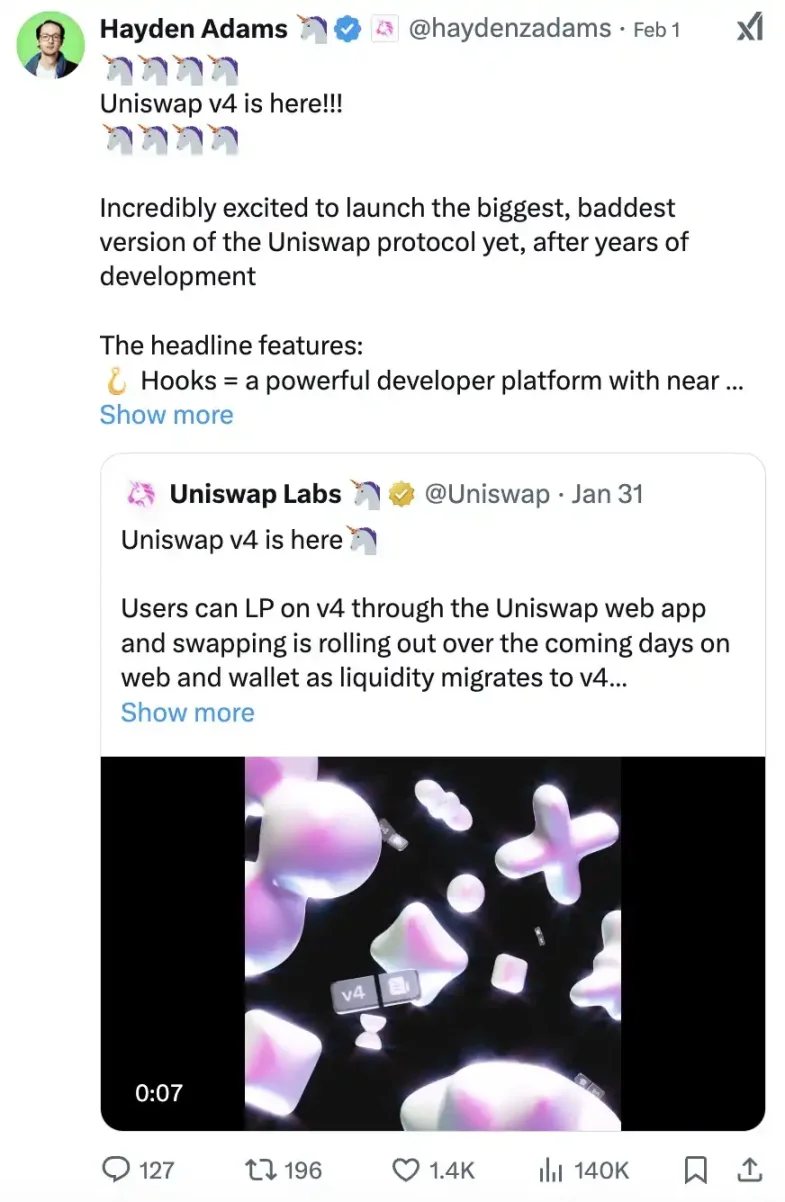
Hooks is the most anticipated development in V4, allowing anyone to create custom logic and insert it as a module plugin into Uniswap. Before we dive into Hooks, let's take a look at the key concepts introduced in Uni V4:
Singleton structure
Flash accounting
Native ETH support
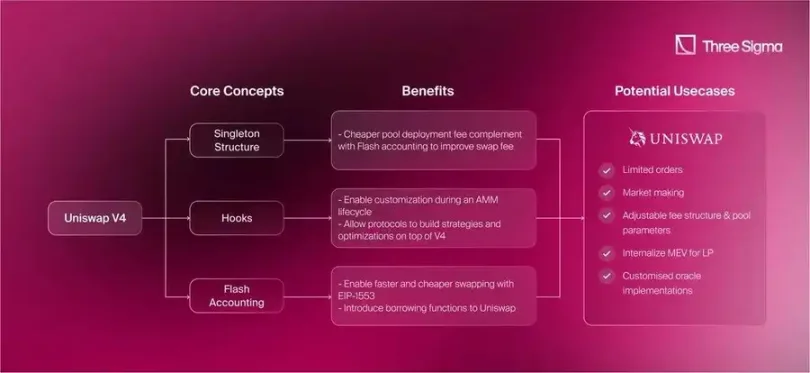
Singleton Contract for Pool Deployment
The Singleton structure affects the deployment cost of liquidity pools, reducing this cost by 99.99% in Uniswap V4. Singleton also serves as the immutable settlement layer for all pools.
Previously: Each pool had its own smart contract (factory model)
V4: All pools are created within the same contract, thereby reducing costs
Flash Accounting
With flash accounting, anyone can lock tokens in a pool as long as they do not owe any tokens at the end of the lock. Using the EIP-1153 standard, users can stack multiple operations in a single transaction, enjoying faster and cheaper transactions. EIP-1153 refers to "transient storage," where the data is erased at the end of each transaction. This allows for more information to be added to transactions without increasing storage burdens.
Previously (factory model): Pools with multiple contracts would settle token balances after each operation.
V4: Singleton and flash accounting mean that one contract ensures balance correspondence. Each operation updates internal balances, and external transfers occur at the end of the lock.
New take() and settle() functions can be used to borrow or deposit funds into the pool, ensuring the pool's solvency by requiring that no tokens are owed to the pool manager or caller at the end of the call.
Hooks

With Hooks, anyone can launch a liquidity pool with customized and flexible execution features or new functionalities. Hooks are suitable for everyone:
Chains: Promote ecosystem development through new features
Protocols: Improve user experience and stand out
Developers: Provide new ways to integrate applications into Uniswap's liquidity
The Uniswap Foundation has already facilitated the creation of over 150 new Hooks through direct grants and investments. Ensuring a sufficient number of Hooks, especially those that are open-source, production-ready, and adaptable to various use cases, is one of the core missions of the foundation. Hooks can also autonomously manage generated fees. They can be set as static or dynamic fees, or even redistribute all fees to incentivize their use (for example, allocating to liquidity providers, users making trades, integrated applications, etc.).
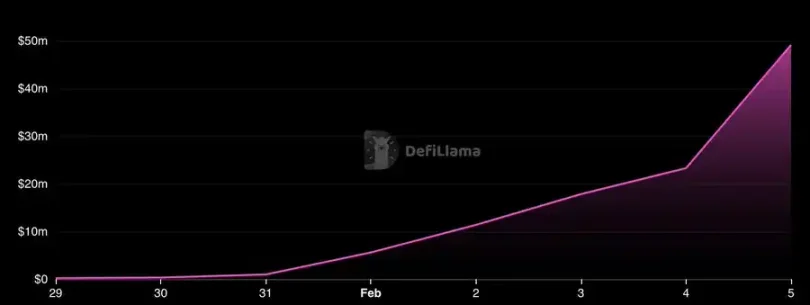
The TVL of Uniswap V4 has already approached $50 million.
More Features
1. Native ETH support returns, reducing the exchange cost of ETH trading pairs by 15%.
V1: Only ETH trading pairs
V2: ETH was removed due to integration complexity and liquidity fragmentation caused by WETH
V3: WETH
V4: ETH, WETH
2. Custom settlement: Developers can introduce new settlement logic using Hooks. Here are some examples:
(1) Introduce custom fee models: Add fees on LP positions
(2) Create custom curves different from concentrated liquidity (for example, Hooks can replicate Uniswap V2's constant product market maker)
(3) Interface composability: Hooks adapt to the exchange parameters defined by each integrated smart contract
(4) Use ERC-6909 for token settlement, keeping tokens within the contract instead of transferring them
3. Governance does not control fee levels or tick spacing but can extract a certain percentage from the pool's exchange fees
4. Reduced Gas costs: The Singleton and flash accounting model reduces the Gas fees for liquidity pool deployment and introduces other optimizations. For example, the price oracle built into Uni V2-V3 is now redundant (saving oracle fees).
5. Users can also use the donate() function to tip liquidity providers directly from tokens in the pool
The combination of these features means that Uniswap V4 is a more customizable integration with multiple optimization mechanisms, bringing real benefits to developers and users:
Cheaper multi-route swaps
Simpler integration and customization
Secure and audited codebase
Star Projects on Uniswap V4
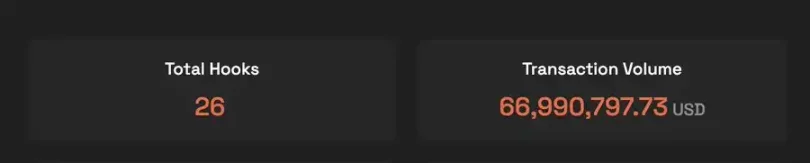
The appeal of Hooks lies in their ability to enable permissionless development on Uniswap V4. In just a few days, over 25 external Hooks have been launched, with trading volumes exceeding $66 million.
Some of the most interesting projects built on V4 include:
Bunni
Flaunch
Sorella
Doppler
Bunni @bunny_xyz

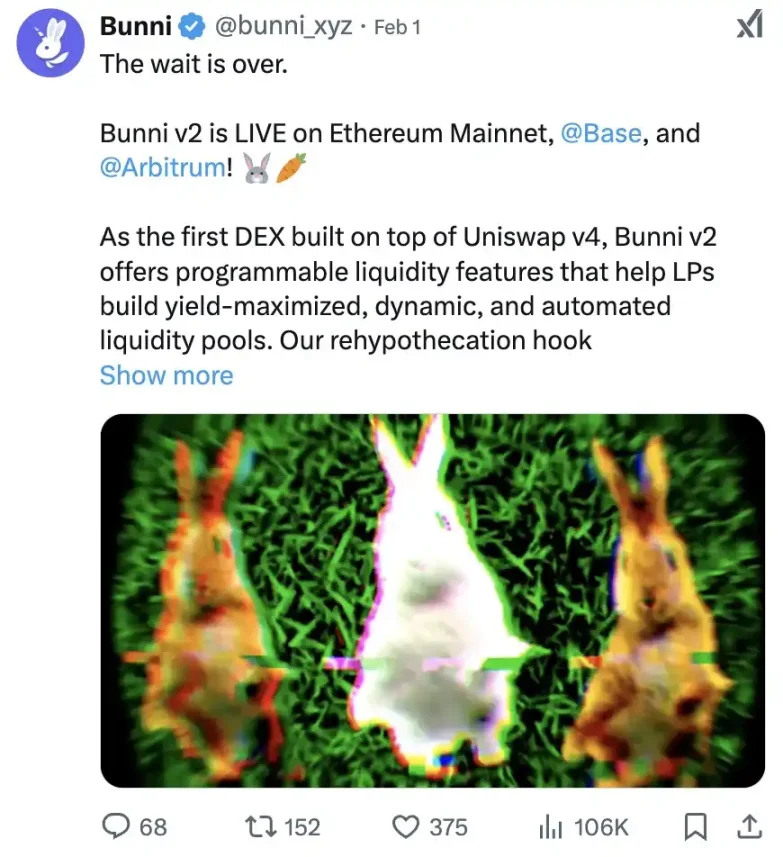
Bunni focuses on enhancing LP returns through the following unique features:
1. Liquidity Density Function (LDF), creating complex liquidity distributions based on market conditions or strategies
2. Liquidity shape transformation: Modify liquidity shapes at any time without removing positions
3. Automatic position rebalancing and automatic compounding backflow
4. Improved swapping: Always maintain the same Gas fee when crossing "ticks," enhancing efficiency for large trades
5. Re-mortgaging Hook: Pools can deposit idle assets into external protocols to earn additional yields
These features cover most important DeFi protocols:
6. Auction mechanisms allow for MEV recovery and optimize fee income
7. Volatility-based exchange fees
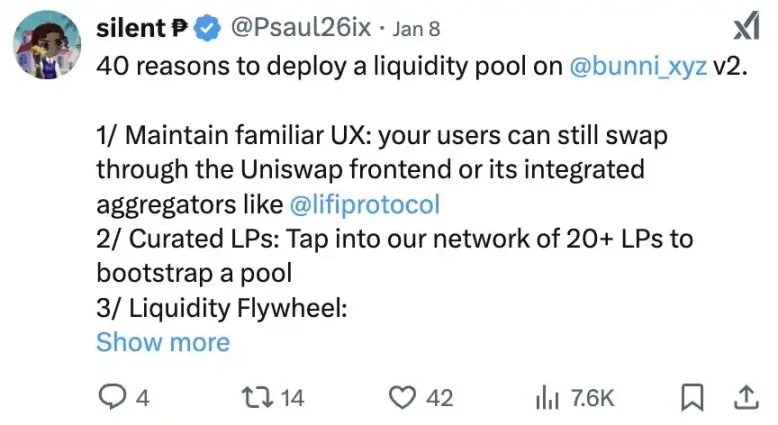
Why choose to deploy on Bunni?
Flaunch @flaunchgg

Flaunch is a launch platform focused on memecoins, integrating multiple sustainability mechanisms:
1. 100% of the revenue is returned to developers, who can decide the proportion to reward holders. Unwithdrawn fees will be used for buybacks.
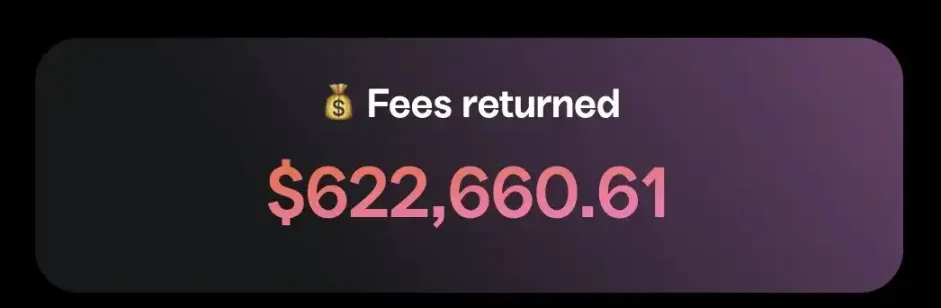
2. Native integration of an automatic token buyback mechanism (a buyback is activated for every 0.1 ETH in fees generated).
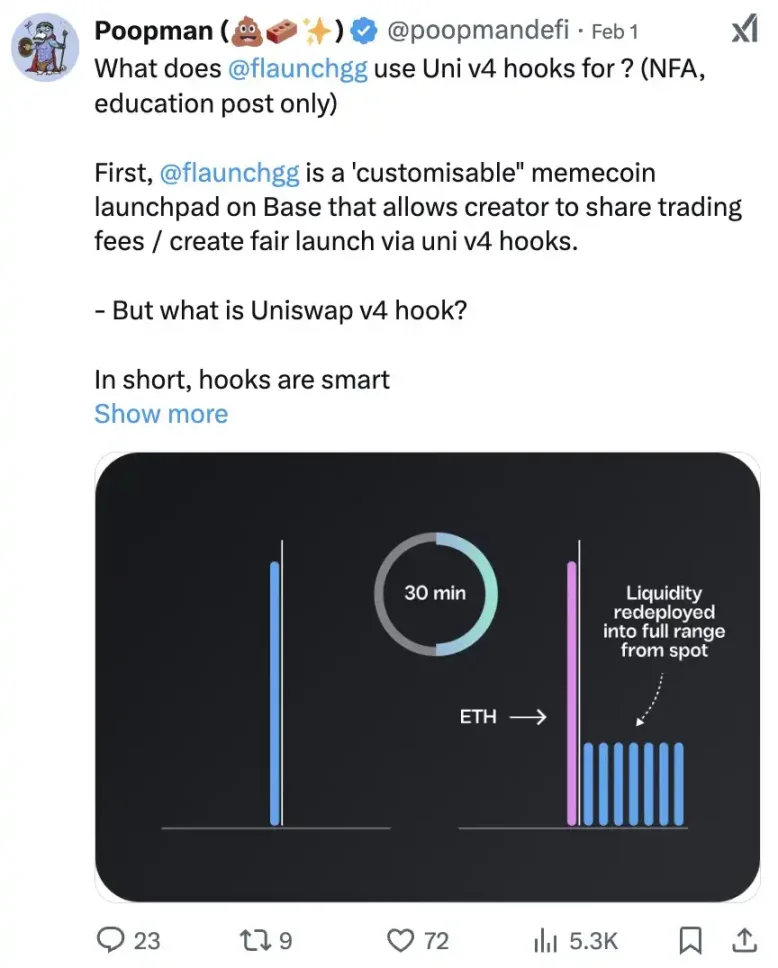
3. Privacy launch: After the launch, the token price remains fixed for 30 minutes, ensuring everyone has the same entry point.
4. Memestream: Creators can assign the rights to transaction fees to any wallet of their choice via NFTs, creating a secondary market for token transaction fees.
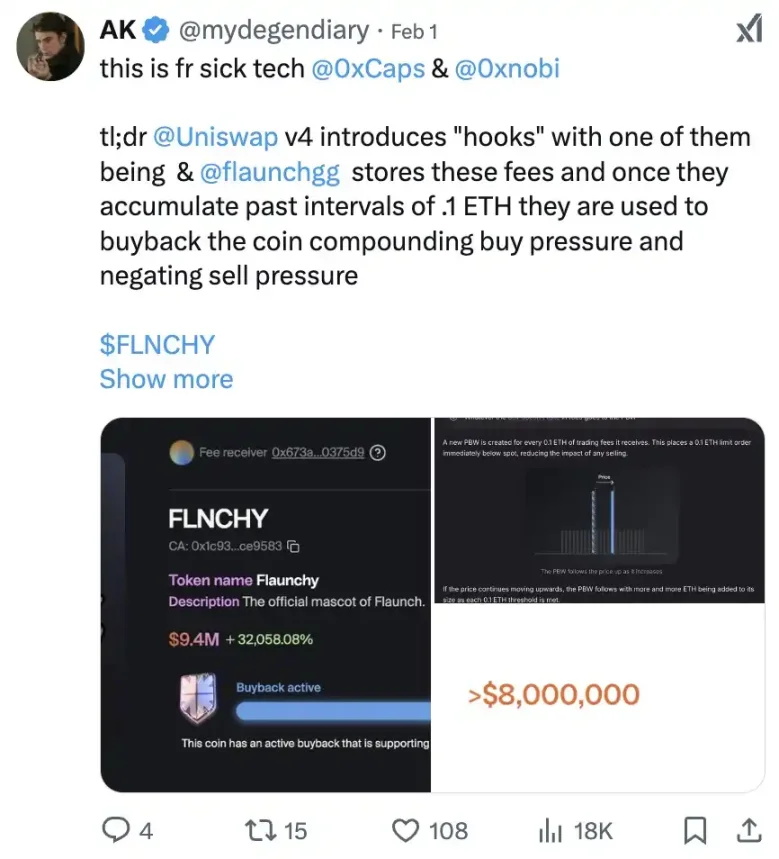
Since its launch about a week ago, Flaunch has returned over $622,000 in fees.
How to use Hooks in Uniswap V4? Poopman has explained it clearly here.
Sorella Labs @SorellaLabs

Sorella Labs focuses on providing tools for LPs to address MEV issues:
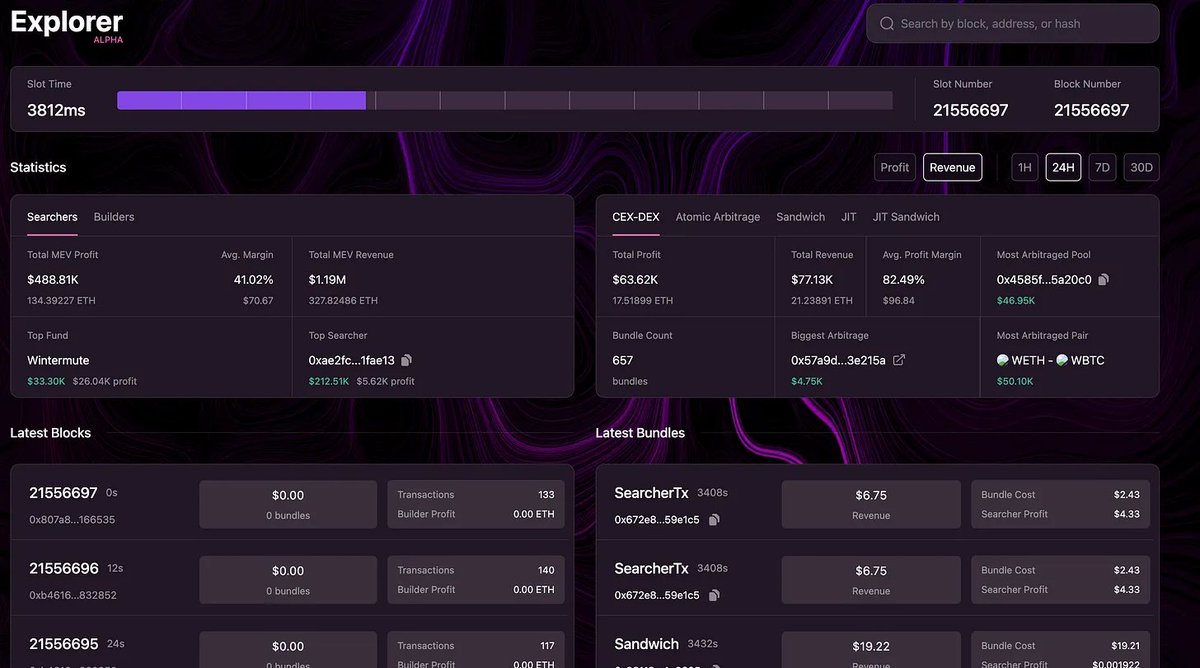
1. A blockchain explorer provides MEV information and statistics on the latest blocks, including: statistics for seekers and builders: MEV revenue and profits, top funds, top seekers MEV events: CEX-DEX arbitrage, atomic arbitrage, sandwich attacks, instant trades.
2. A dashboard for real-time monitoring of MEV events: displays mempool and bids from all builders.
3. MEV statistics that change over time, with data segmented by category.
Sorella Labs also launched Angstrom, a new DEX iteration focused on reducing MEV losses for LP users. Angstrom's proposed solution enables applications to:
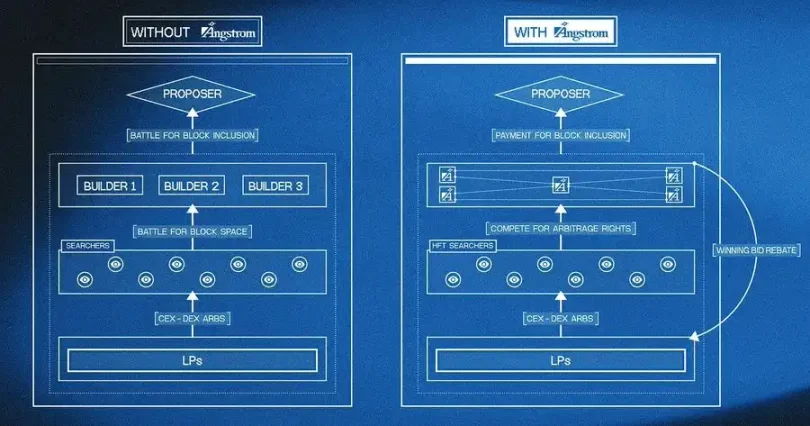
Ensure fair pricing for transactions: all transactions within a block are executed at the same price, eliminating priority fees.
Allocate rebates from winning bids to LPs to include transactions in the block.
How does Angstrom work?
MEV auctions occur in the application's mempool.
Unlike paying for priority, arbitrageurs "must bid directly to LPs to gain the right to arbitrage."
All transactions are executed equally within the same block, thereby reducing sandwich attacks. Gas fees can be paid using any token.
Angstrom uses a network of "staking validators" to enforce specific rules of ordering through consensus: validators stake ETH using EigenLayer and ensure compliance with rules by facing penalties for violations (slash penalties).
The returns provided by LPs are reflected in reduced transaction fees and lower costs for incentivizing liquidity.
Doppler @whetstonedotcc

Doppler is a protocol focused on enhancing liquidity guidance and price discovery. It introduces the concept of "liquidity auctions," executing liquidity guidance within Hook contracts. These complex operations are fully abstracted through the UI.
Auctions can be:
Successful: If they end according to user parameters, liquidity will be sent to the AMM.
Failed: All contributions will be refunded.
Auctions aim to help projects price liquidity more accurately and minimize the chances of initializing liquidity at incorrect prices. This process also greatly simplifies the challenges for integrators, removing the burden of thinking about liquidity, allowing teams to focus on other priorities. Meanwhile, "integrator fees" incentivize decentralized integrators, allowing them to set fees that can be captured after successfully guiding liquidity.
Doppler also launched a second product, Pure Markets, a front end based on Doppler.
Other Projects
There are also several protocols built on Uniswap V4, including:
@ArrakisFinance
@Corkprotocol
@SemanticLayer
Uniswap V4 is expected to inject a new wave of vitality into DeFi, bringing many new use cases to the Ethereum ecosystem. This is just the beginning, and as Uniswap V4 goes live, we can continue to expect more innovative Hooks in the coming weeks.
免责声明:本文章仅代表作者个人观点,不代表本平台的立场和观点。本文章仅供信息分享,不构成对任何人的任何投资建议。用户与作者之间的任何争议,与本平台无关。如网页中刊载的文章或图片涉及侵权,请提供相关的权利证明和身份证明发送邮件到support@aicoin.com,本平台相关工作人员将会进行核查。


