Produced by | OKG Research
Authors | Wang Lele, Bi Lianghuan, Jiang Zhaosheng
In the past year, the "de-globalization" disputes in the physical world have been incessant. Meanwhile, in the digital world, a new model of globalization is gradually emerging.
In 2024, countries and regions representing over half of the global population held elections. The Russia-Ukraine war entered its third year, and the conflict between Israel and Hamas continued to spread. Israeli historian Yuval Noah Harari, in his new book Nexus, attributes the mystery of human civilization to the ability to tell stories. Globalization, as the dominant narrative, experienced a peak from the late 20th century to the early 21st century; however, the narrative of win-win globalization led by developed countries has been questioned by those very countries: the benefits brought by globalization have not been shared equitably, highlighting issues such as widening income gaps and asset price bubbles amid slowing economic growth, further deepening the divide between the rich and the poor.
At the same time, a quietly rising wave of digitalization is presenting a completely different direction. According to statistics from OKLink Research Institute, as of now, crypto assets have been legalized in over half of the countries and regions (119 countries and 4 British territories). Since El Salvador became the first country in the world to adopt Bitcoin as legal tender in 2021, several third-world countries, including Cuba and the Central African Republic, have followed suit. In early 2024, the United States approved 11 Bitcoin spot ETFs, bringing Bitcoin into the mainstream financial market. Coupled with Trump's ten commitments regarding crypto assets, including establishing a national strategic reserve for Bitcoin during the election year, a new wave of sovereign nations adopting crypto assets has emerged, further promoting the globalization of crypto assets.
"Self-Opposition" of Developed Countries
Globalization was once seen by developed countries as a tool to shape the global economic order; however, those who initially advocated for globalization have now become the first to question this system. The cross-border flow of capital and industry has driven improvements in global production efficiency, helping developed countries transition from manufacturing to high-value-added technology and financial services, while promoting consumption upgrades with lower-cost goods.
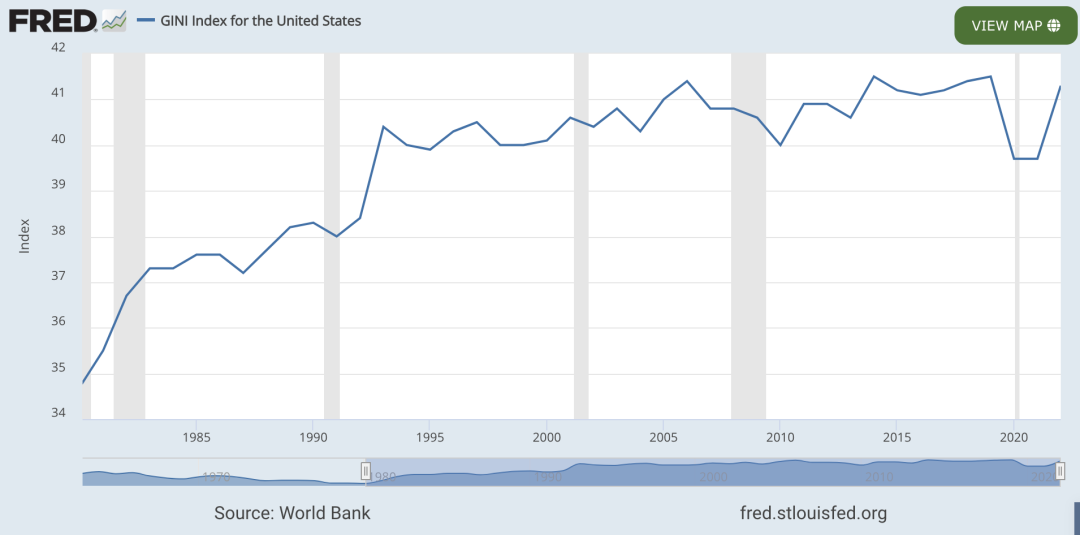
However, this process has also sown deep structural contradictions, prompting the original beneficiaries to reflect on the costs of globalization. The most significant of these is the uneven distribution of wealth. Taking the United States as an example, its Gini coefficient rose from 34.7% in 1980 to 41.3% in 2019, an increase of 19% in income inequality. Although it fell back in 2020, it subsequently rose again to high levels, with income distribution issues remaining severe, ringing alarm bells for the globalization model.
Moreover, the production dominance of developed countries is declining: the global GDP share of BRICS countries surged from 7.7% in 2000 to 37.4% in 2023, while the U.S. share fell from 30.5% in 2000 to 24.2% in 2023, and the EU's share dropped from 26.6% to 17.5%. In manufacturing alone, the share of developed countries in global manufacturing fell from over 70% in 2000 to about 45% in 2023, while the manufacturing value added share of East Asia and the Pacific rose from 31.9% in 2007 to 46.5% in 2021. This imbalance has exacerbated global competition and distribution inequalities, becoming a microcosm of the deep-seated contradictions of the globalization model.
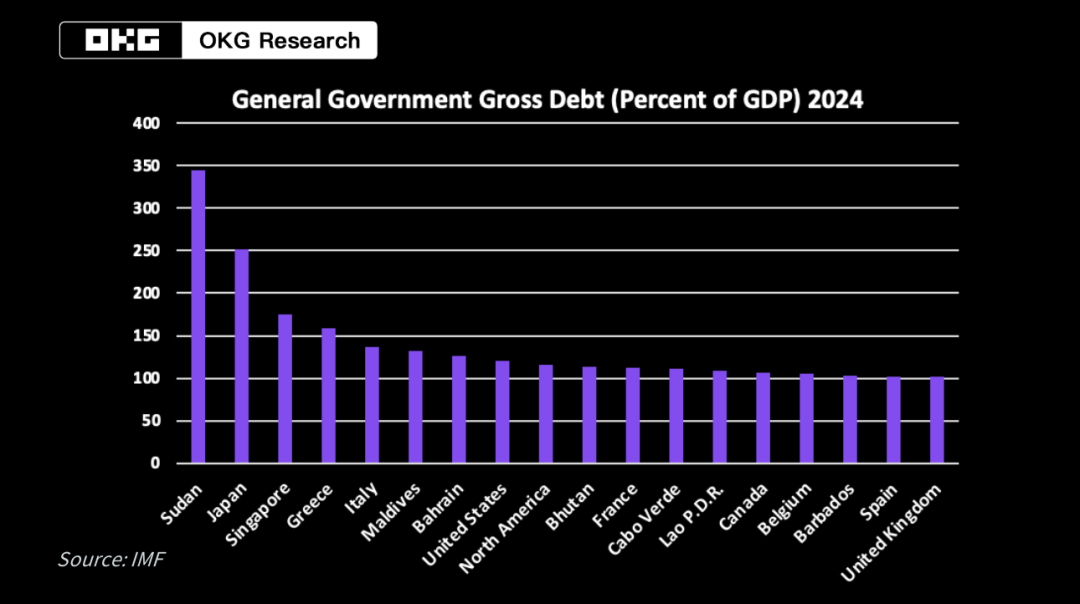
At the same time, the public debt issue in developed countries is also intensifying, with high public debt further exacerbating concerns about globalization. The U.S. government debt as a percentage of GDP rose from 58% in 2000 to 98% in 2023, while Japan has long maintained levels above 200%, nearing 260% in 2023. Accompanied by surging fiscal deficits and interest expenditures, debt pressure has weakened policy flexibility. These structural economic issues highlight the imbalance in the distribution of benefits and risk transfer brought by globalization, forcing developed countries to re-examine the sustainability of the globalization system they lead.
As the deep-seated contradictions of globalization become increasingly apparent, the uneven flow of capital and wealth distribution has deepened social rifts. Historically, wars have often been the extreme means of resolving economic contradictions and political disputes, especially when the international system is unbalanced or the economic structure faces significant crises. The Marshall Plan after World War I promoted the reconstruction of Europe, becoming the starting point for post-war economic globalization; during the Cold War after World War II, the arms race and technological innovations between the East and West accelerated revolutionary transformations in technology and industry. Although wars bring tremendous destruction, they often give rise to new orders and the reconstruction of global systems.
Today, as we stand on the wave of digital transformation, we see that technological innovation is gradually replacing traditional armed confrontations, becoming one of the new driving forces for economic and social development. In this new context, the way globalization occurs is also undergoing profound changes: it is no longer merely expansion but a process of continuous self-correction and evolution. Innovation is opening up an unprecedented "new continent" for the global economy.
The "New Continent" of Globalization
At the end of the 15th century, Columbus intended to find the Asian continent rich in gold and spices but unexpectedly discovered a new continent in the Americas filled with opportunities.
Bitcoin was born 16 years ago, defined in its white paper as "a peer-to-peer electronic cash system" to address systemic issues arising from reliance on traditional financial credit intermediaries. However, this initially "disruptive" concept has long since transformed; Bitcoin is no longer merely "electronic cash" but is regarded as "digital gold," even rising to discussions of national strategic reserves. The crypto market, represented by Bitcoin, is gradually permeating the global financial landscape: from a niche experimental ground for geek punks, it is evolving into the "new continent" of the financial world.
This "new continent" differs from traditional globalization; it not only breaks through geographical boundaries but also transcends the inherent model dominated by a single power center. It does not rely on a single economic entity or political power but establishes a new trust system through global consensus mechanisms and technological means, which is the foundation of this new type of globalization.
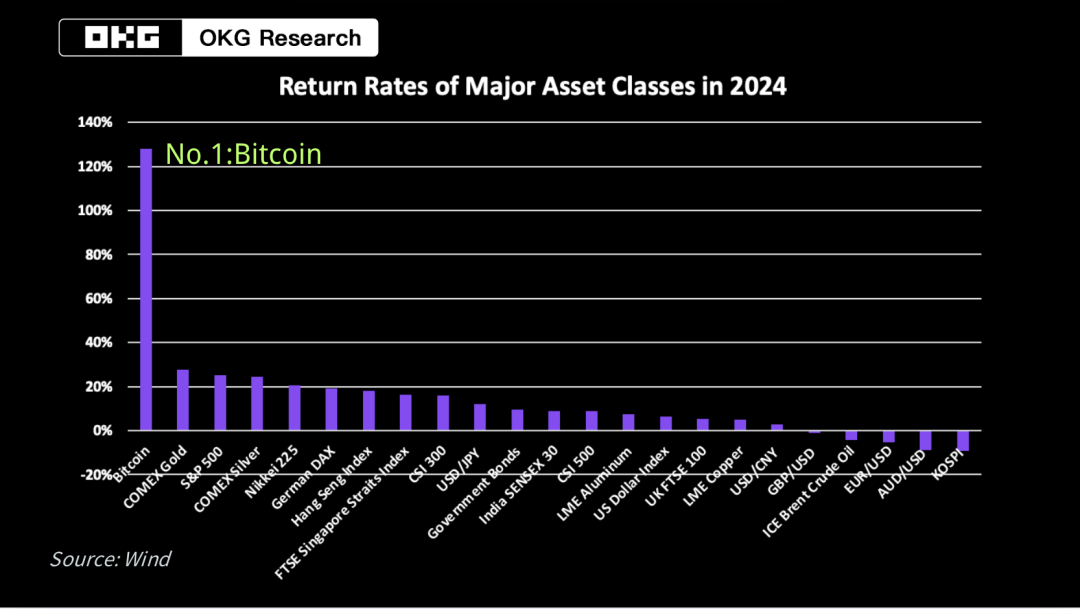
Against the backdrop of intensified trends of "de-globalization" in the real economy and escalating geopolitical tensions, the global economy is under pressure, and the crypto market is gradually becoming a new "pressure relief valve." For example, in the ranking of major asset performances in 2024, Bitcoin topped the list with an annual return of 128%. From a market capitalization perspective, as of November 12, 2024, Bitcoin's asset market value has surpassed that of silver, ranking as the eighth largest asset globally. This not only highlights the new status of crypto assets within the traditional financial system but also reflects their potential for risk aversion and value appreciation in a complex economic environment.
This is not only the result of capital chasing returns but also a manifestation of the borderless nature of crypto assets driving the formation of a new type of globalization market. In the context of geopolitical conflicts and restricted capital flows, cryptocurrencies have demonstrated their unique economic function of "depoliticization." Traditional economic systems are often deeply influenced by geopolitical factors. For instance, the SWIFT system (a global interbank communication protocol) is often used as a tool for inter-state games during sanctions. After Russia faced SWIFT sanctions, some economic activities shifted to crypto assets, showcasing the flexibility and depoliticized characteristics of crypto assets in responding to international conflicts. Russian President Putin subsequently signed a law recognizing crypto assets as "property" and established a tax framework for their trading and mining, thus granting them legal status. For example, in 2022, the Ukrainian government raised over $150 million in donations through crypto assets, proving their rapid response and cross-border capital flow capabilities in times of crisis.
On a deeper level, crypto assets are driving a new economic model that does not rely on a power center. This system, based on technological trust, replaces traditional institutional trust. Unlike the vulnerabilities of traditional financial systems—where financial crises, bank failures, and currency devaluations often expose the shortcomings of power centers—crypto assets fundamentally reduce these risks through technological means. In this algorithm-driven world of trust, true power no longer comes from a single authority but from the collective participation and assurance of countless nodes globally. Just as the Bitcoin network has around 15,000 nodes that change with the network's activity and user participation, this decentralization significantly reduces the risk of "single point failure."
This trust mechanism also provides a new foundation for global collaboration. The 24/7 uninterrupted trading and borderless nature of crypto assets break through the limitations of religion, holidays, and national borders. In a world fragmented by de-globalization, crypto assets are providing possibilities for bridging divides and reconstructing order.
As the saying goes, those who seek to earn the last penny will never achieve their wishes. The "globalization" of the physical world is like yesterday's flowers; attempts to extract the last bit of profit often lead to systemic imbalance and rupture. However, the current crypto market seems to offer a brand new answer.
免责声明:本文章仅代表作者个人观点,不代表本平台的立场和观点。本文章仅供信息分享,不构成对任何人的任何投资建议。用户与作者之间的任何争议,与本平台无关。如网页中刊载的文章或图片涉及侵权,请提供相关的权利证明和身份证明发送邮件到support@aicoin.com,本平台相关工作人员将会进行核查。


