The so-called "occupational crime" in our country's criminal law system is not a single crime but refers to the general term for crimes that should be criminally punished according to the law, committed by staff of state organs, state-owned companies, enterprises, public institutions, and people's organizations, who use their existing powers to embezzle, accept bribes, engage in favoritism and malpractice, abuse their powers, neglect their duties, infringe upon citizens' personal rights and democratic rights, and violate the regulations governing public activities.
The Sa Jie team has found in practice that currently, the crimes of embezzlement and bribery involving state organ staff, as well as the crimes of occupational embezzlement and bribery involving non-state organ staff, are increasingly related to cryptocurrency—more and more people are using cryptocurrency as a covert tool for transferring benefits.
Today, the Sa Jie team will discuss some key information revealed by recent cases of occupational crimes involving cryptocurrency.
01. Overview of Recent Major Occupational Crimes Involving Cryptocurrency
What are the characteristics of cryptocurrency? An old and fundamentalist narrative describes it as follows: cryptocurrency is characterized by decentralization, anonymity, immutability, fast transaction speeds, low transaction costs, and global peer-to-peer transactions.
Looking at it today, the above understanding of cryptocurrency is both correct and incorrect. At least, with the development and advancement of technology, the anonymity of cryptocurrency has become increasingly low; the so-called "anonymity" is becoming a general means for ordinary people to protect their transaction privacy. In other words, if judicial authorities, technology companies, and other powerful technical entities want to investigate, most transaction information is not hidden.
Case of Senior Official from the Securities Regulatory Commission Involved in Occupational Crime Related to Cryptocurrency
Recently, the disciplinary inspection and supervision team of the Securities Regulatory Commission and the Guangdong Supervisory Commission jointly announced that the former director of the Technology Supervision Department of the China Securities Regulatory Commission seriously violated discipline and law, abused regulatory powers such as policy recommendation, formulation, and execution, neglected technology supervision responsibilities, and sought improper benefits for others in areas such as expanding business for information technology service agencies and hardware and software procurement, using virtual currency for power-money transactions.
From the announcement, it appears that this official may be suspected of multiple crimes, with a high likelihood of bribery.
According to Article 385 of China's Criminal Law, the crime of bribery refers to state staff who, by taking advantage of their position, solicit or illegally accept property from others to seek benefits for others. State staff who violate national regulations in economic exchanges and accept various forms of kickbacks or fees for personal gain are subject to bribery charges.
Generally, the threshold for filing a bribery case is set at 30,000 yuan. In terms of sentencing, for amounts between 30,000 and 200,000 yuan, the penalty is imprisonment for up to three years or detention, along with a fine; for amounts between 200,000 and 3 million yuan, the penalty is imprisonment for three to ten years, along with a fine or confiscation of property; for amounts exceeding 3 million yuan, the penalty is imprisonment for more than ten years or life imprisonment, along with a fine or confiscation of property.
Beijing 140 Million Yuan Virtual Currency Occupational Embezzlement Case, 89 Million Yuan Recovered
On December 20 of this year, the Beijing People's Procuratorate released a case from a "Protect Enterprises" special action: an employee of a certain company used their position to defraud the company of property and utilized multiple overseas cryptocurrency trading platforms and "mixers" to transfer the criminal proceeds.
From 2020 to 2021, Feng, taking advantage of his position at a technology service provider and regional operations growth department, conspired with Tang and Yang to defraud the company of service provider rewards totaling over 140 million yuan.
Subsequently, Feng directed Tang and Yang to use eight overseas virtual currency trading platforms to convert the involved funds from yuan to virtual currency, obfuscating the source and nature of the funds through overseas "mixing" platforms, transferring them in virtual currency through multiple layers, with some of the involved funds flowing into accounts controlled by Feng and others in yuan, while some were hidden in virtual currency.
After the case was discovered, Feng voluntarily returned 92 bitcoins (if the BTC price is calculated at 100,000 USD each, approximately 66.9 million yuan), recovering over 89 million yuan in total, maximizing the economic loss recovery for the victimized unit.
Since Feng is not a staff member of a state organ, and the victimized company is also not a state organ or enterprise, Feng's act of defrauding the company's finances is suspected of "occupational embezzlement." Article 271 of China's Criminal Law states: Staff of companies, enterprises, or other units who take advantage of their position to illegally occupy property of their unit in large amounts shall be sentenced to imprisonment for up to three years or detention, along with a fine; for huge amounts, imprisonment for three to ten years, along with a fine; for particularly huge amounts, imprisonment for more than ten years or life imprisonment, along with a fine.
It is important to note that on April 29 of this year, the Supreme People's Procuratorate and the Ministry of Public Security jointly released the revised "Regulations on the Standards for Filing and Prosecution of Criminal Cases under the Jurisdiction of Public Security Organs (II)," which adopted the same standards for filing and prosecution for five types of occupational crimes involving non-state staff, including bribery. The new regulations clearly state that personnel of companies, enterprises, or other units who illegally occupy property of their unit in amounts exceeding 30,000 yuan (the original standard was 60,000 yuan) should be prosecuted.
Regarding the sentencing for occupational embezzlement, the 11th amendment to the criminal law in 2020 adjusted the sentencing range from two levels to three levels, but the judicial interpretation has not yet been synchronized, so in practice, the sentencing for this crime generally follows the following regulations and judicial practices:
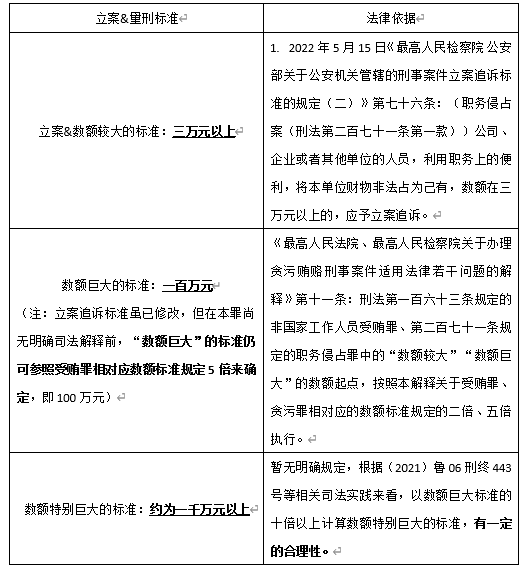
02. What Key Information Do Occupational Crimes Involving Cryptocurrency Reveal?
Why do we say that using cryptocurrency for bribery is nothing or everything? This is due to the immutable and transparent nature of blockchain technology—cryptocurrency itself is very concealed, but once the criminal facts are verified, they become irrefutable evidence.
In the occupational crime cases previously handled by the Sa Jie team, clarifying the funding chain and flow of the criminal suspects is often the key focus of such cases. Many criminal suspects use their social connections to hide and disperse their crimes through various covert measures, establishing layers of risk isolation.
However, in cases of occupational crimes involving cryptocurrency, the flow of funds is often complete and traceable, with authenticity guaranteed. Once it is verified that the flow of funds is related to the occupational crime of the suspect (which is often a difficulty in investigating such cases), the relevant on-chain data will become irrefutable evidence of the crime.
From recent cases of occupational crimes involving cryptocurrency, China's judicial authorities have revealed several key pieces of information:
1. Significant Improvement in Investigation Technology, Mixers No Longer Serve as Tools for Money Laundering/Concealing Criminal Proceeds
From the occupational embezzlement case publicly disclosed by the Beijing People's Procuratorate, it can be seen that even if the suspects used multiple cryptocurrency trading platforms and mixers to obfuscate the funding chain, the criminal facts were still grasped by the judicial authorities. Therefore, the Sa Jie team believes that for China's (and reasonably speculating that other major economically developed countries and jurisdictions have similar levels of technology) judicial authorities, the mainstream mixers currently available can only increase the workload of investigations; if they want to investigate, they can definitely do so.
2. Recovery of Funds in Occupational Crimes Involving Cryptocurrency Still Primarily Relies on the Suspects' Initiative
This point can be seen from the recent cases handled by the Sa Jie team regarding the unfreezing of overseas cryptocurrency assets—cryptocurrency indeed has a uniqueness that distinguishes it from other assets—recovering losses largely depends on the cooperation of the suspects.
For example, if a suspect converts the criminal proceeds into USDT or other stablecoins and hides that portion of the assets, even if the flow of funds can be traced, if those funds are actually controlled by overseas individuals, China's judicial authorities can only issue a judicial freezing document to the issuer, Tether, requesting the freezing of those funds. The actual consequence is that the overseas suspect cannot use the involved funds, but China's judicial authorities cannot directly recover them.
If the funds are converted into BTC, ETH, or other cryptocurrencies and hidden in cold wallets or controlled by overseas individuals, then China's judicial authorities may not even be able to effectively freeze them, making recovery even more difficult.
03. Final Thoughts
With the arrival of a bull market for cryptocurrencies led by BTC and the integration and cooperation between traditional financial systems and cryptocurrencies, the scale of the entire industry is continuously expanding. The Sa Jie team believes that cryptocurrency will increasingly become a common means in occupational crimes in the future.
On one hand, this requires China's disciplinary inspection and supervisory authorities and public security organs to quickly enhance their understanding and knowledge of cryptocurrency and upgrade their investigative techniques accordingly; on the other hand, staff of state organs and corporate executives should also recognize that cryptocurrency is not a panacea for transferring benefits and should not take chances by recklessly crossing criminal lines.
免责声明:本文章仅代表作者个人观点,不代表本平台的立场和观点。本文章仅供信息分享,不构成对任何人的任何投资建议。用户与作者之间的任何争议,与本平台无关。如网页中刊载的文章或图片涉及侵权,请提供相关的权利证明和身份证明发送邮件到support@aicoin.com,本平台相关工作人员将会进行核查。


