Author: Roland Roventa
Translation: Vernacular Blockchain
Trump's recent victory has sparked a DeFi renaissance, positioning Ethereum favorably as the platform holds 63% of the global DeFi TVL, allowing it to capitalize on this momentum. Ethereum may have found the long-awaited catalyst that places it in an ideal position to benefit from the regime change. Since the announcement of the U.S. presidential election results, the Ethereum ecosystem has consistently exceeded expectations.
However, Ethereum's Rollup-centric roadmap, while crucial for scalability, also presents a significant challenge: fragmentation. The current Rollup ecosystem operates in an environment where champions take the lion's share, dispersing liquidity, attention, and users across isolated L2s. To fully leverage this resurgence of interest in DeFi, Ethereum must address these divisive dynamics to create a more unified and accessible network.
1. Bridging the Divide: Addressing Ethereum's Fragmentation and Liquidity Challenges
Puffer Finance's innovative solution, UniFi, directly confronts Ethereum's fragmentation challenge. We believe that once the market views it as an innovative new infrastructure solution rather than just another Liquid Restaking Token (LRT), Puffer will excel.
What was Puffer initially? Initially, Puffer was a leading LRT protocol focused on providing decentralized staking solutions.
What is Puffer now? Puffer has evolved into a unified Ethereum-centric solution.
Puffer has transformed from the first native Liquid Restaking Protocol into a comprehensive Ethereum-integrated scaling ecosystem, consisting of three main components that this article will explore:
1) Decentralized Liquid Restaking Token (LRT)
Puffer's flagship anti-slashing LRT offers enhanced yields and security, supporting decentralized staking within the Ethereum ecosystem.
2) UniFi-based Rollup Stack
A Layer 2-based ordering solution that achieves seamless interoperability for L2>L2 and L2>L1 transactions, providing efficient atomic composability for cross-chain interactions.
3) UniFi Preconf AVS
The industry's first pre-confirmation AVS, providing near-instant transaction finality for L1 and L2, significantly enhancing the speed and reliability of the Ethereum network.
Puffer Finance's UniFi-based Rollup Stack transforms Ethereum's fragmentation into a positive-sum ecosystem.
2. What is the UniFi-based Rollup Stack? How does it work?
1) What is an L1-based Rollup?
An L1-based Rollup is an advanced scaling approach that directly integrates Ethereum's shared sequencer, avoiding reliance on centralized sequencers (a common practice in other optimistic and zero-knowledge L2s). This concept was first introduced in a research paper by Justin Drake in March 2023, where he defined it as follows:
"When the ordering of a Rollup is driven by the underlying L1, we refer to it as an L1-based or L1-ordered Rollup. More specifically, an L1-based Rollup means that the next L1 block producer can collaborate with L1 seekers and builders to include the next Rollup block as part of the next L1 block without permission." — Justin Drake
For non-technical individuals, this statement may be difficult to grasp. In simple terms, an L1-based Rollup verifies transactions directly on L1, fully leveraging the existing mechanisms of Ethereum. In contrast, other mainstream Rollup solutions (such as optimistic and zero-knowledge) require transactions to be verified on L2 before being sent to L1.
By utilizing L1 ordering (executed by Ethereum validators), the following advantages can be achieved:
Inherits the liveliness and decentralization characteristics of the Ethereum network, ensuring reliability without relying on single points of failure.
Simpler infrastructure, as there is no need to run dedicated sequencers.
Faster execution, thanks to the pre-confirmation mechanism, achieving quicker transaction finality (which will be discussed in detail later).
Economic alignment with L1, creating new revenue opportunities for existing validators through non-extractive MEV (Maximum Extractable Value).
Lower operational costs, as transaction ordering is handled by L1.
The main disadvantage is that L1-based Rollups cede MEV revenue to L1, with their own income limited to base transaction fees.
2) L1-based Rollups outperform optimistic Rollups
In short:
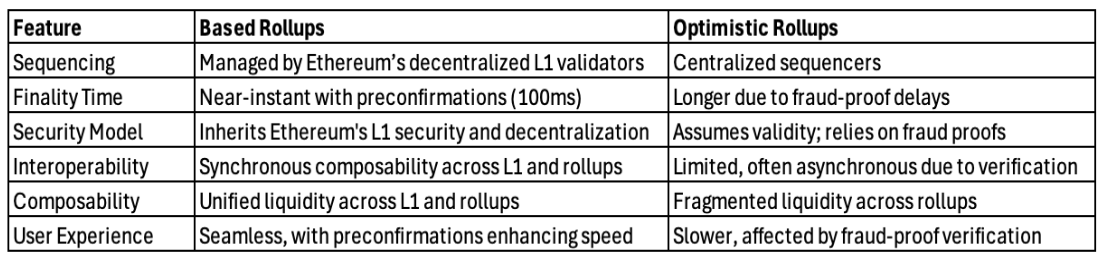
By optimizing the transaction ordering process at the base layer, costs can be reduced, speeds increased, while maintaining the inherent security and decentralization of the Ethereum network.
3. Puffer is an L1-based solution
UniFi is an Ethereum-based Rollup that allows the creation of application chains (App Chains) through its technology stack.
They address the issue of liquidity fragmentation in Ethereum by implementing synchronous composability. Transactions on UniFi can interact directly with other L1-based Rollups without the need for cross-chain bridges, creating a unified liquidity and application layer. Developers can easily launch their own application chains, capture transaction fees, and leverage shared liquidity.
Their goal is to bring atomic composability to Ethereum, redefining the functionalities that can be achieved on-chain. Through atomic composability, UniFi will allow L1 and L2 to achieve smooth and integrated interactions within a single Ethereum block. Imagine a user or protocol depositing assets from L1 to UniFi, completing complex operations on-chain (such as trading or yield farming), and then withdrawing back to L1 within the same 12-second Ethereum block. This not only offers incredible speed but also represents a significant advancement in blockchain interoperability.
Puffer does not compete with L1 but rather expands L1's capabilities in an integrated manner.
1) How does it work?
Inspired by collaborative research with Justin Drake, Puffer UniFi employs Trusted Execution Environments (TEEs) in its processing stack. To achieve real-time proofs, Puffer uses TEEs as an initial "training wheel." Real-time proofs can enhance interoperability. When zero-knowledge provers become fast enough, they can evolve from relying on trusted hardware to a fully zero-knowledge-based solution.
2) Analysis of Puffer's architecture
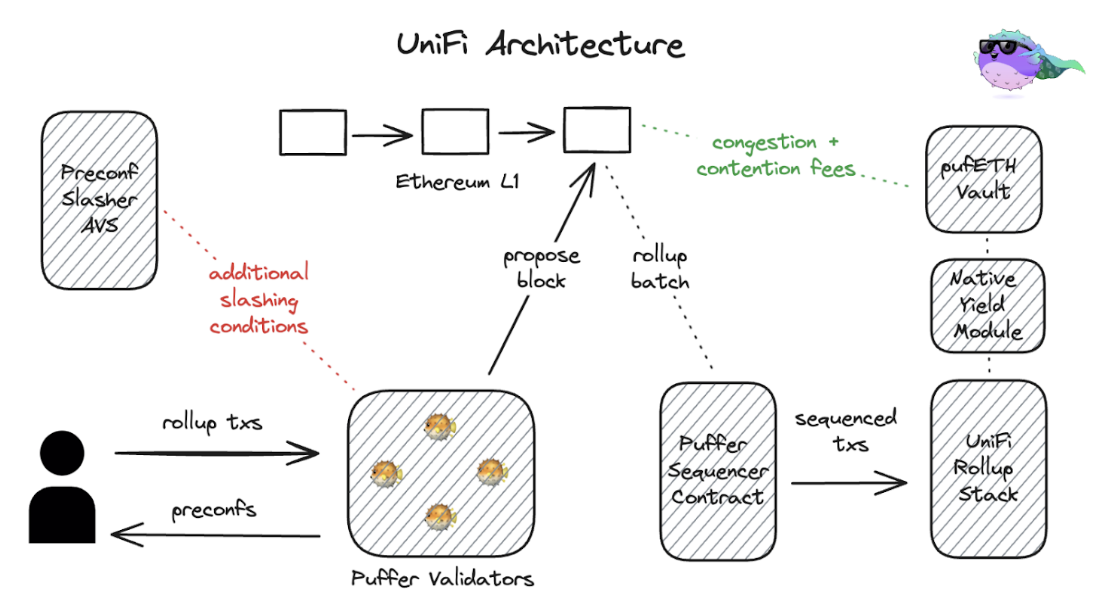
3) Overview of the architecture
Puffer's UniFi Preconf AVS provides users with L2 execution confirmations, allowing them to experience sub-second transaction speeds when interacting with UniFi. In UniFi's universal Rollup, native yield tokens can be used as Gas Tokens.
The consensus layer, data availability layer, and settlement layer are all components of the underlying Layer 1 (in this case, Ethereum). The Rollup is solely responsible for the execution layer.
This is precisely what makes Puffer's application chain unique.
4) Why is this important?
Puffer has built its application chain through L1-based Rollups, enabling EVM protocols to integrate seamlessly. This provides every participant in the ecosystem, from individual validators to large-scale decentralized applications (dApps), with an opportunity to participate and benefit, driving a faster, more efficient, and more decentralized evolution of Ethereum. The fragmentation issue in Ethereum has persisted for too long; now is the time for change.
5) Ecosystem Overview:
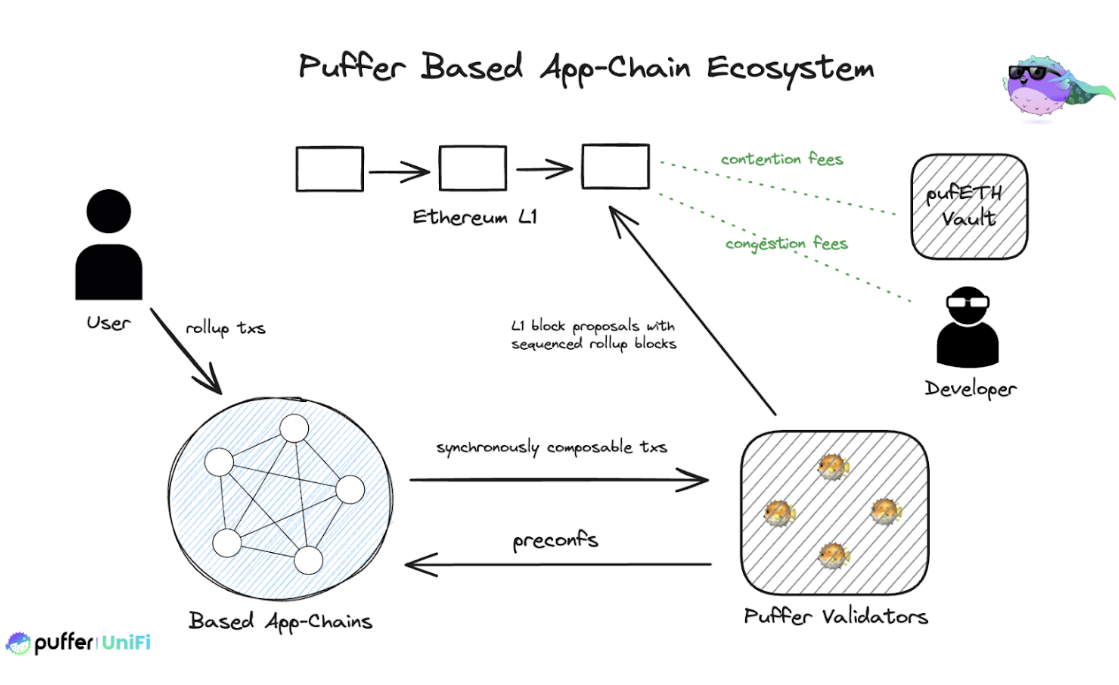
6) Growth Phases
Growth will occur in phases:
Phase One: They will introduce L1-based Rollups to users and developers. Protocols not yet ready to run their own application chains can be directly deployed on UniFi.
Phase Two: The UniFi SDK will launch, enabling any dApp developer to create their own application chains in a more streamlined manner.
4. UniFi Preconf AVS
UniFi offers near-instant execution confirmations through "pre-confirmation" (Preconf). This is not just a speed enhancement but a completely new way to scale Ethereum. Pre-confirmation is a solution to Ethereum's fragmentation problem, providing ultra-fast confirmations.
1) How is it achieved?
Due to Ethereum's 12-second block time limiting the rapid finality of transactions, pre-confirmation (Preconf) becomes key to enhancing user experience. To this end, Puffer has developed a proprietary Preconf AVS that can provide instant confirmation that a transaction will be included in the next block within approximately 100 milliseconds. This significantly enhances the speed and reliability of the L1 Rollup ecosystem.
2) How it works
Pre-confirmation is divided into two types: execution pre-confirmation and inclusion pre-confirmation. Both can be used to provide faster confirmations for L1 or L2 users. The advantage of execution pre-confirmation is that it can provide users with final and guaranteed commitments, including the state at the time of transaction execution. For example, it can confirm the execution price of a transaction, thereby improving the user experience.
Implementing execution pre-confirmation on L1 is more complex, but L2's execution pre-confirmation can effectively address this issue. Puffer's UniFi AVS leverages this feature to significantly enhance user experience.
Pre-confirmation requires reliable guarantees. Since pre-confirmation is a commitment made by the proposer (validator or delegated proposer), failure to fulfill it will result in penalties, such as slashing. Re-staking protocols like EigenLayer play a key role in providing slashing guarantees for pre-confirmation. Notably, Puffer's UniFi Preconf AVS is the first of its kind to operate on EigenLayer.
3) UniFi: The Catalyst for a Unified Ethereum Ecosystem
UniFi's Synchronous Composability is revolutionary. Cross-Rollup interactions can occur as if on a single chain, eliminating the need for L2 bridges (no one likes using bridges), reducing costs, and alleviating the security risks associated with asset transfers. UniFi's approach unifies liquidity, enabling developers and users to seamlessly interact across chains, significantly enhancing the user experience on Ethereum.
For developers, UniFi offers a unique opportunity to scale applications in a unified, low-friction environment. By eliminating the need for centralized ordering, UniFi drastically reduces operational costs, allowing developers to focus on their products without worrying about the complexities of managing isolated L2s. The setup of UniFi makes launching an L1-based Rollup almost as simple as deploying a smart contract, significantly lowering the entry barrier for developers and encouraging innovation.
4) Unlocking Revenue: How Puffer's Rollup and Preconfirmation Create Value for the Ethereum Ecosystem
All revenue streams will generate treasury rewards and be governed by the $PUFFER Token.
Puffer's upgraded revenue model (not just LRT) leverages Rollup and preconfirmation to create sustainable value within the Ethereum ecosystem. Through Rollup, Puffer generates ordering fees by allowing Ethereum validators to manage transaction ordering. This approach supports seamless interoperability between Ethereum L1 and L2, as well as between L2s, creating unified liquidity and composability. By integrating ordering fees with the Ethereum validator network, Puffer captures transaction-based revenue while enhancing Ethereum's native economic value.
Users can prioritize their transactions by paying preconfirmation tips, providing Puffer with an additional revenue source beyond transaction inclusion fees. These fees and tips are funneled back into the Puffer ecosystem, enriching its native tokens pufETH and unifiETH, and providing yields for token holders.
As Puffer contributor Amir explained:
“If every user pays an extra fee for preconfirmation to ensure faster and more reliable transactions on Ethereum, then the AVS is tied to every transaction a user makes on Ethereum. This creates a very powerful revenue-generating AVS that can continuously provide organic yields without the need for additional tokens or secondary mechanisms.”
5) Launching vePuffer
A key to a protocol achieving sustainable long-term price performance lies in its tokenomics design. An excellent protocol must have a well-thought-out token model that focuses on value delivery for long-term holders. Mechanism Capital focuses on tokenomics design, supporting teams that innovate and maximize their token value capture.
Puffer Finance has launched vePuffer as an update to its tokenomics, aiming to pass value to holders and align incentives throughout the ecosystem.
Key features include:
Decentralized Governance: Through vePUFFER, the community can vote on the allocation of PUFFER points, aligning with Puffer's decentralization goals.
Tradable Points: The ERC20 PUFFER points from the second season can be traded, providing flexibility for early profits or additional purchases.
Flexible Strategies: Tradable points allow users to choose to hold, sell, or buy based on personal strategies and market sentiment, enhancing risk management.
Bribery Market: Protocols can offer rewards to vePUFFER holders, incentivizing them to vote for their own liquidity pools, thereby increasing annual percentage rates (APR) and liquidity.
Competitive Protocols: The bribery system allows protocols to attract votes to increase APR, driving participation and aligning incentives.
Community-Driven Rewards: The vePUFFER model promotes governance, speculation, and diverse strategies, empowering users to shape ecosystem incentives.
6) How Puffer's UniFi Stands Out: Innovating the Ethereum Rollup Ecosystem
With the launch of UniFi, Puffer creates an opportunity for Ethereum to transition from a fragmented Rollup environment to a unified positive-sum ecosystem, bringing together developers, users, and liquidity in unprecedented ways. The result is a stronger, more resilient Ethereum capable of meeting the needs of billions.
免责声明:本文章仅代表作者个人观点,不代表本平台的立场和观点。本文章仅供信息分享,不构成对任何人的任何投资建议。用户与作者之间的任何争议,与本平台无关。如网页中刊载的文章或图片涉及侵权,请提供相关的权利证明和身份证明发送邮件到support@aicoin.com,本平台相关工作人员将会进行核查。


