Show Yourself, Not Just Your Company
Author: Omri Drory
Translated by: Deep Tide TechFlow

You just finished a presentation and feel like you did exceptionally well. You feel good.
As you exit Zoom or leave the conference room, you might wonder: What are the investors thinking at this moment?
Let’s unveil this mystery. The investors you just presented to exchanged glances for a moment. In that instant, there was an indescribable atmosphere. This atmosphere usually develops into one of two scenarios:
Scenario 1: Full of enthusiasm, unstoppable. We can’t wait to start due diligence and are even ready to call our partners to recommend your situation to them.
Scenario 2: A quiet atmosphere, everyone just shrugs and looks at each other, with a gut feeling rising—this might not be what we want.
We strive for option 1; that energetic feeling makes us love this job and willing to listen to countless pitches. Unfortunately, this situation is not common. If your pitch falls into the atmosphere of option 2, it will be very difficult to turn the tide and enter the state of option 1.
The importance of first impressions is far greater than people imagine.
Worse still, if you belong to “Scenario 2,” most venture capitalists won’t even tell you the real reason. The worst VCs will stall, waiting to see if other “top VCs” will make a decision first while giving you the runaround.
We once wrote about the core focus points in our investment decisions. The hardest feedback to articulate is not about the uniqueness of the technology or the market potential, but about the founder themselves.
Sometimes, the reason investors don’t invest is you, more specifically, their impression of you.
This phenomenon exists even in the biotech field, where science and intellectual property are key elements. In the software field, this phenomenon is particularly pronounced because transformation is almost inevitable.
Seed funding is essentially an investment in people. Investors need to be convinced that you are the one who can take the company from seed stage to a successful exit. This feedback is the hardest to accept because it seems unchangeable.
I write this article because I believe that if you can see the big picture, you have the opportunity to take action. Even if you have excellent technology and a sufficiently large market, it would be a huge regret if you don’t realize that many VCs expect to see certain “intangible qualities” in a presentation.
The Best Case
When investors feel excited about a founder, they often describe that person with one word: “compelling.”
This is a very critical word.
Of course, this is of no help to you. After all, how could you possibly know what qualities a VC finds attractive?
When most VCs find someone attractive, they mean: I have to invest in this person—it's an indescribable feeling that we only know when we see and feel it.
A fitting analogy might be the so-called “intangibles” in football. When evaluating potential NFL quarterbacks, scouts typically score based on specific metrics like accuracy, footwork, and strength, but there’s also an unquantifiable quality. This “intangible quality” is an instinctive judgment about whether the scout believes someone is a natural winner. This feeling is familiar to us… just like when Tom Brady or Patrick Mahomes are trailing in the last few minutes of a game, we have a certainty that they will lead the team to a comeback victory.
Once you succeed, everyone will say you had that ability from the start. But the real key is how to make others believe you have that potential when you are just starting out.
While no one can draw a perfectly accurate blueprint of “founder qualities,” the following elements might come close to the answer.
Quality 1: You have unwavering perseverance.
Starting a company is a worthy endeavor, but most of the time, it is not easy.
To sum up a founder's work in one sentence: silently endure hardships.
Your health may be affected.
Your close relationships may be strained.
You will feel endless “fear of missing out” (FOMO) and “imposter syndrome”—wondering why others are raising funds, hiring, and growing while you seem to be standing still.
Half the time, you will feel like you have no idea what you are doing.
You will face some predictable difficulties and encounter some completely unexpected challenges.
When I was a CEO, during those toughest moments, I felt a “deathly tightness” deep within.
Please read these words again and think about your current life. Perhaps you are pursuing a postdoc or have a stable job at Google or OpenAI, with a generous salary, a clear career path, and widely recognized social status.
Even so, do you still want to start a company?
Many first-time founders start without fully understanding what entrepreneurship truly means. Jensen Huang, the founder of NVIDIA, recently stated that if he could do it all over again, he might not choose to start a company.
Once you start a company, you will think more carefully about whether to dive into entrepreneurship again—this is why second-time founders usually only embark on a new venture when they have a truly special idea.
For second-time founders, the biggest risk is “calling in rich.” When things get tough, they might think: If I don’t need to do this anymore, why should I put myself through this pain?
Successful entrepreneurs often possess a special “charisma” that convinces investors they are strong enough to endure the various hardships of the entrepreneurial journey. Therefore, before you decide to pitch to venture capitalists (VCs), take a look in the mirror and ask yourself: Do I really want to go down this path?
If you can truly understand this, then convincing yourself to start a company should be more difficult than convincing investors. But if you are completely determined, your investors will definitely feel it.
When you deeply desire to do this, that determination will naturally come through. This leads us to the second point…
Quality 2: You have an undeniable determination to do it.
Most outstanding founders start companies not because they “want” to, but because they “have to.” It’s an inner impulse, not a rational choice.
The term “wantrapreneur” exists to describe this opposite. Wantrapreneurs are those who choose to start a business because they think it looks glamorous.
This inner impulse will manifest in your daily habits and emotions. You will find that even during “breaks,” you are thinking about the details of your startup. Your browser history may be filled with searches related to your company. Your friends and family may start to find you annoying (see above about silently enduring hardships). You will be trapped in the “idea maze” and even live in the future—those future visions feel almost as real as the present.
When I started my first company, Genome Compiler, I had this experience. At that time, I was a postdoc at Stanford, as biology was gradually moving towards digitization. The thought of staying in academia and doing pipetting experiments in the lab made me feel like I was about to break down. I had to be part of driving the future of synthetic biology, and I had an idea to help achieve that goal.
Later, a postdoc from the neighboring lab actually quit to start a company—that was when I first realized that entrepreneurship was something I could truly pursue. From that moment on, I knew I had to do it.
The best founders can see the possibilities of the future. They feel anxious when reality does not match the beautiful vision of the future in their minds. In their minds, they have already constructed a path—sometimes several paths—leading to that future.
That’s why I like to say that entrepreneurship is like a “wormhole” to different realities. You must follow that wormhole to the future you create for yourself and others.
If your desire for something is so strong, you will know it, and your investors will feel it too.
Quality 3: You genuinely care about others and the mission.
Most founders have heard of “founder-market fit,” which refers to whether your expertise and skills align with the market you are in. But I believe there is a deeper layer: you not only understand this market but also genuinely care about it.
Some people can perform well in a job they don’t care about, which is unfortunate but true. However, if you want to start a company, you cannot be that person. You must deeply understand and care about the “why” behind what you are doing. This is particularly evident in the biotech field, where we often see people getting involved to cure diseases affecting their family or friends.
If you genuinely care, you will be willing to put in the extra effort to surpass your competitors. You will discern what constitutes a true breakthrough versus what is merely incremental improvement. And frankly, if you really care, you will find it interesting.
This is actually the first step in building a company with competitive barriers. If you care more than others, you will defeat them.
Naval Ravikant once said: You can stand out from the competition through your authentic self.
But on this point, many people often lie to themselves or to investors. Perhaps you can convince yourself (and your investors) that you care about something for a few years. But in a partnership with venture capitalists lasting 7 to 10 years, you cannot keep pretending.
This obsession will not fade over time. You can accept that your company occupies 100% of your attention because… it has taken up all your mental space.
Don’t “fake it until you make it”—instead, become the person who deserves to succeed.
Quality 4: You Are the Core of the Team
One of the keys to attracting venture capitalists is to demonstrate that you can be an excellent leader. We need to feel that you are the person we must invest in. We want to confidently recommend you to other investors and feel proud to connect with your company.
This appeal is very subjective and difficult to define clearly in a manual. But I believe this intangible quality stems from a deep and multifaceted capability. You not only grasp the big picture but also manage the details, showcasing a comprehensive ability.
You can effectively control the overall situation. You can examine your pitch from a macro perspective, strategically plan fundraising, develop business plans, maintain company operations, and drive product development.
You can also handle the details well. If someone emails you, you can respond quickly, provide in-depth insights, and be comprehensive in the details without getting bogged down in trivialities.
If you can do both of these things, you not only have a grand vision but also prove that you possess practical execution capabilities.
It’s like the quarterback in a football game. The quarterback is the core figure of the team; they not only need to know where the ball should go but also have the ability to deliver the ball accurately at critical moments—even if there are only a few seconds left to score.
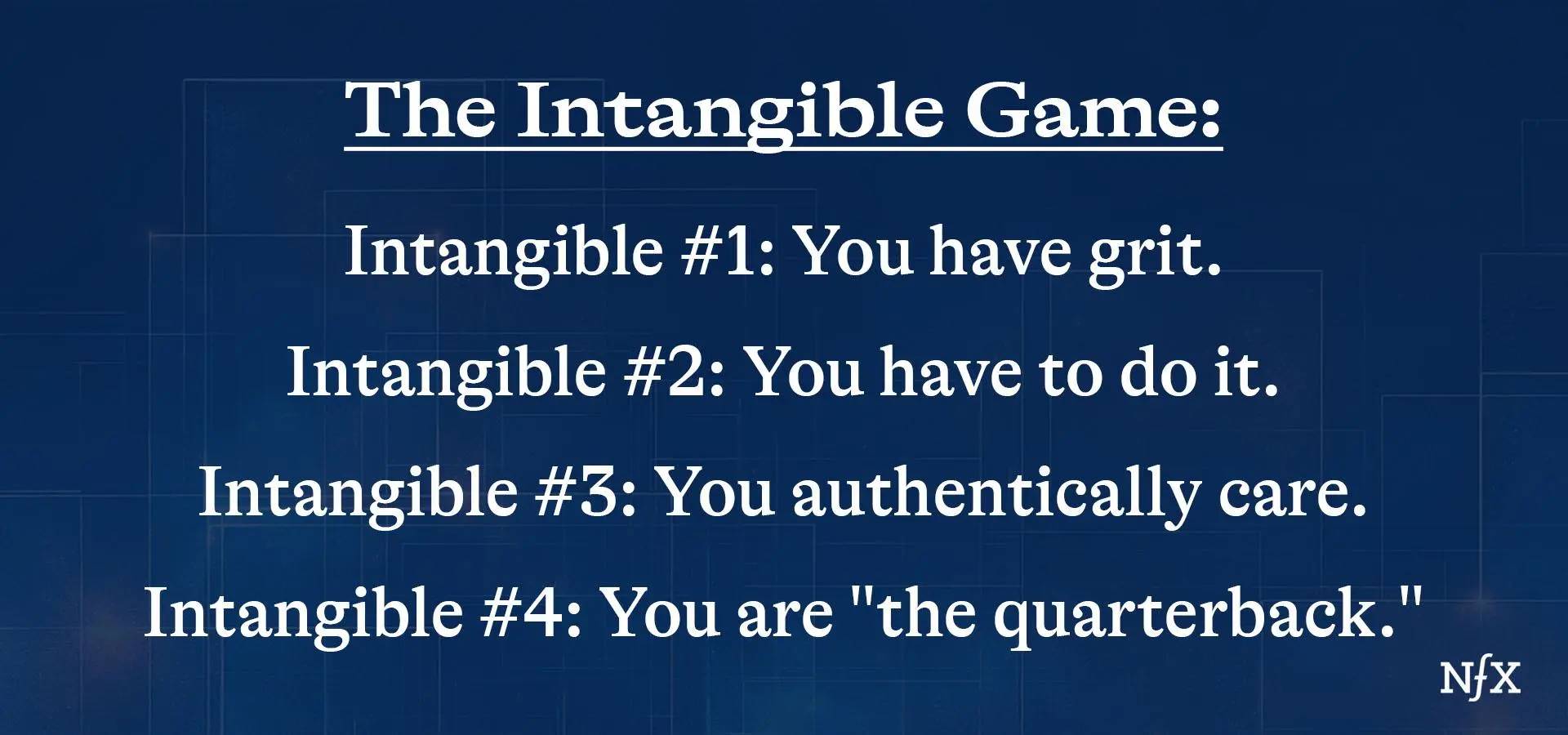
Intangible Qualities:
Quality 1: You have unwavering perseverance.
Quality 2: You have an undeniable determination to do it.
Quality 3: You genuinely care about others and the mission.
Quality 4: You are the “core quarterback” of the team (symbolizing leadership and overall control).
Show Yourself, Not Just Your Company
If you have clear goals, an excellent team, and outstanding technology… you will be surprised to find that raising funds is not as difficult as you might think. But if you overlook your core role in this story, you may encounter many obstacles.
Many founders do not realize that in a pitch meeting, you are not just pitching the company; you are also showcasing yourself.
If you are repeatedly rejected—the problem may not lie in your idea, but rather in the investors' perception of you. This feedback is often hard to accept, so usually, no one will tell you directly. Moreover, not every investor's judgment is necessarily correct. Different investors will have different views of you. You cannot please everyone, and that’s okay. Find the investors that suit you, and keep pushing forward.
But if you can take some time to re-examine from a different perspective, it’s really just a new way to look at your pitching process.
Possess those intangible qualities and become the indispensable person. Then show us these qualities and make us believe that you are the best candidate.
免责声明:本文章仅代表作者个人观点,不代表本平台的立场和观点。本文章仅供信息分享,不构成对任何人的任何投资建议。用户与作者之间的任何争议,与本平台无关。如网页中刊载的文章或图片涉及侵权,请提供相关的权利证明和身份证明发送邮件到support@aicoin.com,本平台相关工作人员将会进行核查。


