Recently, with the surge of "antique coins" like XRP, the news of "Korean aunties rushing into the crypto market" has spread again in the community. Meanwhile, the trading volume of related tokens like XRP and APT on Korean trading platforms such as Upbit and Bithumb even surpassed that of Binance at one point. This means that the trading volume in just the Korean market for these tokens is enough to rival the total trading volume of the rest of the world.
For a long time, the crypto community has viewed listing on Upbit as a significant boon for projects. After a token is listed on these Korean exchanges, its price often skyrockets in a short period. This strong purchasing power has made the world curious about the "kimchi premium" and how the Korean cryptocurrency market operates. What kind of speculation logic do investors here have?
Andy, a member of Frax Finance who has been engaged in crypto development and education in Korea for many years, was interviewed to delve into the investment logic and real situation of the Korean crypto market.
Koreans' "Another Stock Market"
BlockBeats: You have a very strong presence in the Korean market, such as large-scale buying, etc. How do people enter the cryptocurrency market, and how do they choose their coins?
Andy: Frankly speaking, this is still a puzzle that everyone is trying to solve. One thing I am sure of is that DeFi is quite weak here because the deposit and withdrawal processes on trading platforms are very convenient. I am a Canadian citizen and have lived in Korea for 10 years. In the early days, I could trade on Upbit and Bithumb, and I remember that it only took me five minutes to open a bank account and connect it to Upbit or Bithumb, easily trading and withdrawing in Korean won.
So in Korea, people can easily enter the crypto market and invest; it’s not difficult, although they must open an account at a specific bank. Secondly, I think the act of trading cryptocurrencies carries a sense of "hope" among Korean investors, especially among the younger group aged 20 to 30.
Moreover, the media in Korea is discussing this topic, and you can see participation from groups ranging from their 20s to even 60s or 70s in the crypto market. I don’t know if you’ve heard, but the front of Bithumb’s office was once crowded with elderly people aged 50 to 70 trying to open accounts, especially when the new bull market began.
BlockBeats: Was this happening in the last bull market or this one?
Andy: It’s happening in this bull market, just in the last week or two; it has been reported in the news.
Retired elderly people aged 50 to 70 were queuing to open accounts, and the line even exceeded 3,000 people; it’s really crazy. Mainstream media and social networks are also discussing the secondary market for cryptocurrencies. Although mainstream media often tends to portray its dangers, as Bitcoin hits new all-time highs, more and more people are starting to pay attention.
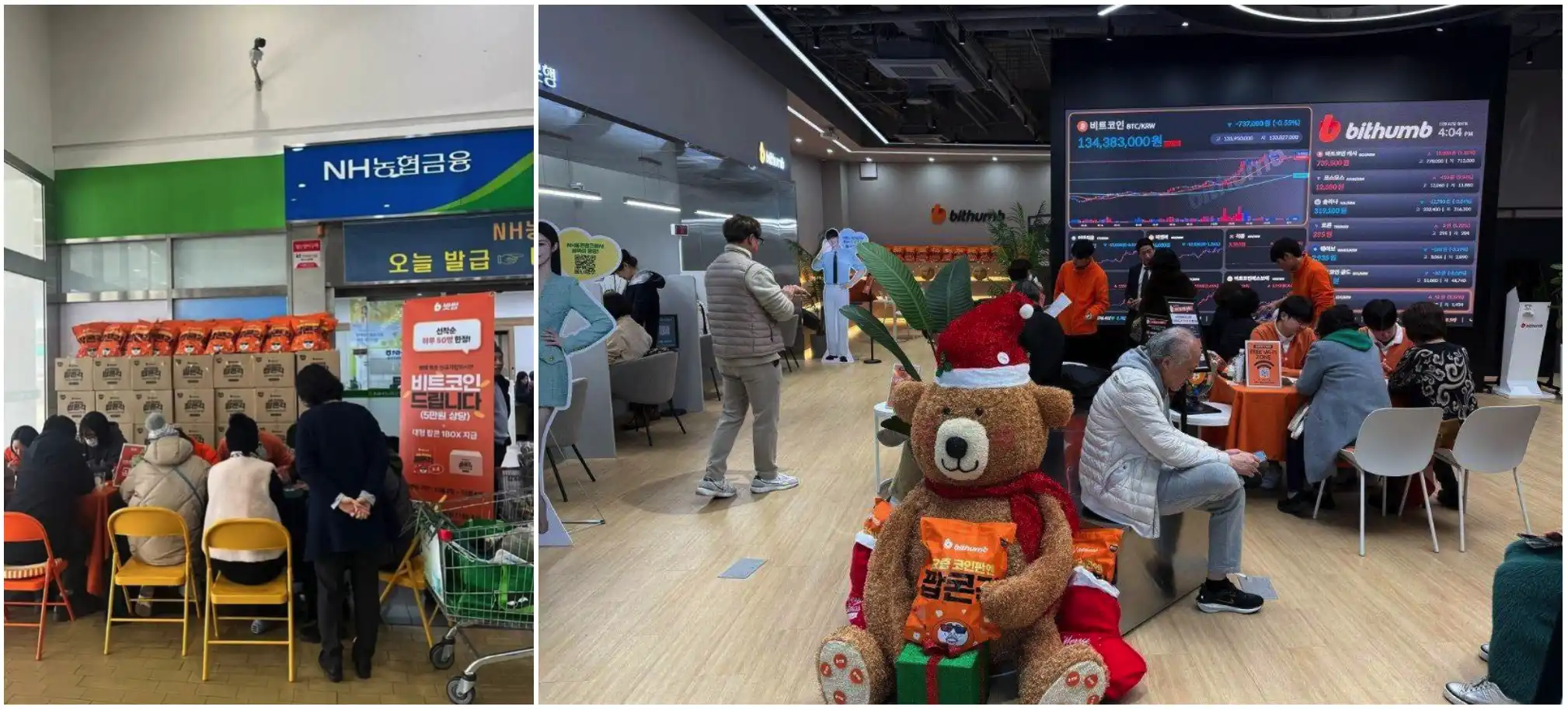
According to media reports, a nearly 60-year-old housewife said while queuing to open an account: "It feels wasteful to keep retirement funds in a bank account, so I’m trying to invest in Bitcoin and Dogecoin"; image source from the internet.
Back to the younger crowd, I think many people in their early 20s see this as a chance similar to buying a lottery ticket. I don’t want to say it’s gambling, but they do view cryptocurrencies as a way to make quick money because the media reports they encounter often highlight how some people have made a lot of money through cryptocurrencies, which is more appealing than news about losses. Many people in their 30s tend to be a bit more strategic, trying to understand the projects behind the tokens, but even so, many of my friends still buy tokens first and then ask in the community what the project is, so most people actually don’t understand the real situation of the projects.
This mindset may stem from a strong FOMO (Fear of Missing Out), which is also quite common in Korean culture; the following-the-crowd culture is very extreme. Whether in entertainment or investment, many people feel that if they don’t participate, they will fall behind the trend, even feeling disconnected from the entire culture. So if you don’t know what you’re investing in, it might be due to the fear of missing out on opportunities or friends suggesting you get involved.
Having lived in Canada, where everything is relatively more relaxed, I never felt the pressure to chase trends. But after coming to Korea, I felt the prevalence of a fast-paced lifestyle, such as needing to graduate, serve in the military, get married, find a job, and invest by a certain age. So when the people around you are trading cryptocurrencies on Upbit or Bithumb, you feel like you can’t fall behind. I think many people are driven by FOMO, fearing they will lag behind others in investment, especially when they see friends starting to make money; this feeling becomes even stronger.
BlockBeats: Has the DYOR (Do Your Own Research) culture developed in the Korean crypto market over the past few years?
Andy: I have been working in the crypto field for seven years and have lived in Korea, and I have indeed seen more and more educational and research platforms emerging. Many offline events and Web2 projects are also getting involved, genuinely starting to help people understand and learn about cryptocurrencies. More and more investors are indeed doing their own research before buying tokens; many KOLs are also discussing different areas of cryptocurrencies, including NFTs and other projects, and teaching people how to transfer funds from centralized exchanges to use for airdrops or staking.
However, the reason why the huge trading volume on Korean trading platforms can often rival Binance is mainly because most of the funds remain on the trading platforms. For example, when I tell others about a pool with a 100% annual yield, where they just need to transfer tokens from the platform to wallets like MetaMask and then stake on another blockchain, many people give up trying because the process is very complicated. I think this is an area where we need to improve significantly in education. Compared to the U.S. and other places, Korea is still far behind in DeFi and wallet usage.
Here, most traders are just trading on the platform, and funds do not leave centralized exchanges to enter personal wallets. Of course, younger groups, like those in their 20s to 30s, do tend to do some research themselves and are willing to try these projects, but compared to the overall number of market participants, this group is still relatively small.
BlockBeats: So in Korea, can we view the crypto market as being as large as, or at least comparable to, the stock market?
Andy: I think that comparison is reasonable. I believe that at least in terms of media attention, cryptocurrencies do occupy a significant portion. The frequency of discussions about cryptocurrencies is similar to that of the stock market. But the difference is that cryptocurrencies are not seen as the best choice; compared to the stock market, their image is not as glamorous.
If the stock market declines, media reports might say "government policies are ineffective" or "Korea's financial and economic situation is poor." But if Bitcoin suddenly drops by 40%, the media usually says, "Look, this situation has happened again; this is why cryptocurrencies are so dangerous; they have ruined many people's lives," so the public sentiment around the two is different.
But in reality, we know that as long as you do enough research, cryptocurrencies are relatively safe. Although their volatility is greater than that of the stock market, if you understand what you are doing, it is not as dangerous as it seems. If I know nothing about a token and just follow the trend to buy a meme coin, and then it suddenly drops by 80%, I would obviously feel it’s a scam. But if I know in advance what I am investing in and haven’t done my homework, then losses are to be expected; that’s the difference.
BlockBeats: In your opinion, how significant is the impact of negative media coverage on Korean crypto investors?
Andy: This is an interesting thing. Many media outlets have been promoting the dangers of cryptocurrencies, advising people not to participate, but in fact, this may have attracted more people to try it. Because many people are just following the trend, not because they truly understand cryptocurrencies.
Korea is a country that pays great attention to trends, whether in music, fashion, or other fields; people always chase the latest trends, and the same goes for cryptocurrencies: "Everyone is investing in cryptocurrency trading, so I have to participate," or "Everyone is discussing Bitcoin, so I have to join." When I get into a taxi and the driver starts asking, "Have you heard of Bitcoin?" that’s usually a signal for me to sell some tokens.
But during bear markets, the general public stops discussing Bitcoin, yet the market's trading volume remains high. If you observe those who are genuinely focused on the crypto market and do their own research, they are actually very smart, keeping up with market trends, and sometimes their information is even faster than mine, especially regarding new projects. In Korea, there are some "crypto enthusiasts" who are very smart and are well aware of all the latest developments in the crypto market.
The Logic of Korean Retail Investors in Trading Coins: Why Are APT and XRP the Hottest?
BlockBeats: Are meme coins a popular track in the Korean market?
Andy: Based on my personal experience, they don’t trade meme coins very often. This is not hard to understand; think about it, these coins are basically not on the listing of centralized exchanges, and people usually trade existing tokens on the platform using Korean won. Moodeng was recently listed on Bithumb, and I think this might bring some changes.
However, Dogecoin is quite popular in Korea, but I bet many people may not know that Dogecoin actually has no supply limit. Recently, people just think of Dogecoin as being associated with Musk, and Musk has a good relationship with Trump, who is about to become president, so there’s a bullish sentiment around Dogecoin.
But overall, once the price of a token starts to soar in Korea, it leads to a massive influx of funds, pushing the price further up because people will sell other assets to invest in Dogecoin or other rapidly rising tokens. This is another manifestation of the FOMO effect; I even think many people are trading Solana in Korea, but they don’t use SOL to buy meme coins in the on-chain ecosystem.
BlockBeats: Since it’s not to participate in the ecosystem, why buy Solana? What other assets are popular in Korea?
Andy: I think this is mainly because Solana is a globally popular token; you will see many globally popular tokens like Solana that Koreans like to buy. But you will also see some tokens that are not very popular in other regions or haven’t been heard of much still have significant trading volume in Korea, such as Aptos, whose token APT has the highest trading volume in Korea globally.
In the Korean crypto market, there are some peculiar phenomena, such as many people buying tokens like SEI and SUI simply because they sound like girls' names. There’s even a meme circulating that "buying SEI and SUI will help you find a beautiful girlfriend." A similar situation exists with APT, which means "apartment," leading people to say, "If you buy APT, you can buy an apartment; if you buy ONDO, you can buy a suite." Such internet memes actually have a significant impact on the market, which is why we see some tokens that are not well-known outside of Korea having huge trading volumes here, simply because many people don’t understand them but still follow the trend, which is quite crazy.
BlockBeats: Is the recent popularity of Roise's hit song "APT" also one of the influencing factors?
Andy: Aptos was already quite popular before that. In fact, this is a case I’m studying to see what the Aptos team did right, and how projects like IQ or Frax can enter the Korean market and successfully establish a foothold like Ondo or Aptos. I think this is also why the founder of Aptos frequently visits Korea; I see him often now and am no longer surprised, so the way the Korean market operates is indeed a bit strange.
But one thing is certain: first, a lot of trading happens on centralized exchanges; second, people haven’t done much in-depth research. I think it can be summarized this way: meme coin traders in other parts of the world trade meme coins, while in Korea, people don’t trade meme coins but trade other cryptocurrencies in a manner similar to trading meme coins.
BlockBeats: Recently, the price of XRP surged, and its trading volume on Upbit even surpassed that of Binance at one point. Why is XRP so popular in Korea?
Andy: XRP has actually been popular in Korea for five, six, or seven years. I remember the first cryptocurrency I bought was XRP; at that time, I had no idea what I was buying. I hadn’t entered the industry yet; I was just a college student. It was because a relative told me, "Buy this coin called XRP; it will rise to $10," so I bought some. Then the SEC lawsuit happened, but even so, its popularity in Korea didn’t wane.
It’s a bit like EOS; not many people talk about it now, but there is still an active EOS community in Korea, and occasionally the price can surge due to Korean influence. As for why EOS was so popular, I can’t really say.
As for Ripple's popularity, I think it’s because people believe it is "the next big event," especially when it fights against the government and wins; this narrative becomes particularly strong, especially in the U.S. I don’t have a definitive answer, but I can say for sure that Ripple is indeed very hot in Korea. Especially after the news of them defeating the SEC came out, its popularity surged again.
So I believe that for a token to become popular in Korea, it first needs to gain some recognition globally before it can enter the Korean market. But this isn’t the case for every token; Aptos seems to have risen in Korea first.
However, I also know that most traders, including myself, do not deeply engage with the XRP ecosystem. I don’t know much about their technology and specific developments. Moreover, many people have learned that they are going to launch their own stablecoin, which I think could also be a factor driving the market. In Korea, due to the impact of the Terra/Luna incident, the image of stablecoins isn’t particularly good.
BlockBeats: The Luna incident had a significant impact on Korea, right? Many institutions invested a lot of money.
Andy: Yes, the situation was very dire. I remember there were many news reports saying that some people committed suicide because of this; it was truly tragic. I also know that some large venture capital firms in Korea invested a lot of money and suffered huge losses, with many institutions being severely impacted. So, aside from stablecoins like USDT and USDC, the narrative around stablecoins in Korea is still not very good.
BlockBeats: Another interesting phenomenon is the high premium issue on Korean trading platforms. Are Korean investors aware of this, or what is their attitude towards it?
Andy: Yes, they are definitely aware of the "kimchi premium." A few years ago, some people would buy on one platform using a credit card and then sell on another platform, easily making a 10% profit. However, this system has now been banned, but they certainly know about this phenomenon.
For example, during a recent curfew, Bitcoin plummeted 40% on Upbit and Bithumb within 10 minutes. I’m sure many people tried to buy low and then sell on Binance or wait for it to rebound, but based on my conversations with some people, this arbitrage strategy was very difficult to execute at that time because both Upbit and Bithumb were frozen, and deposits and withdrawals were not possible.
I even heard that due to the current unstable situation in the Korean government, some people would place orders in advance so that when the market experiences extreme drops again, they can automatically execute and acquire chips at extremely low prices.
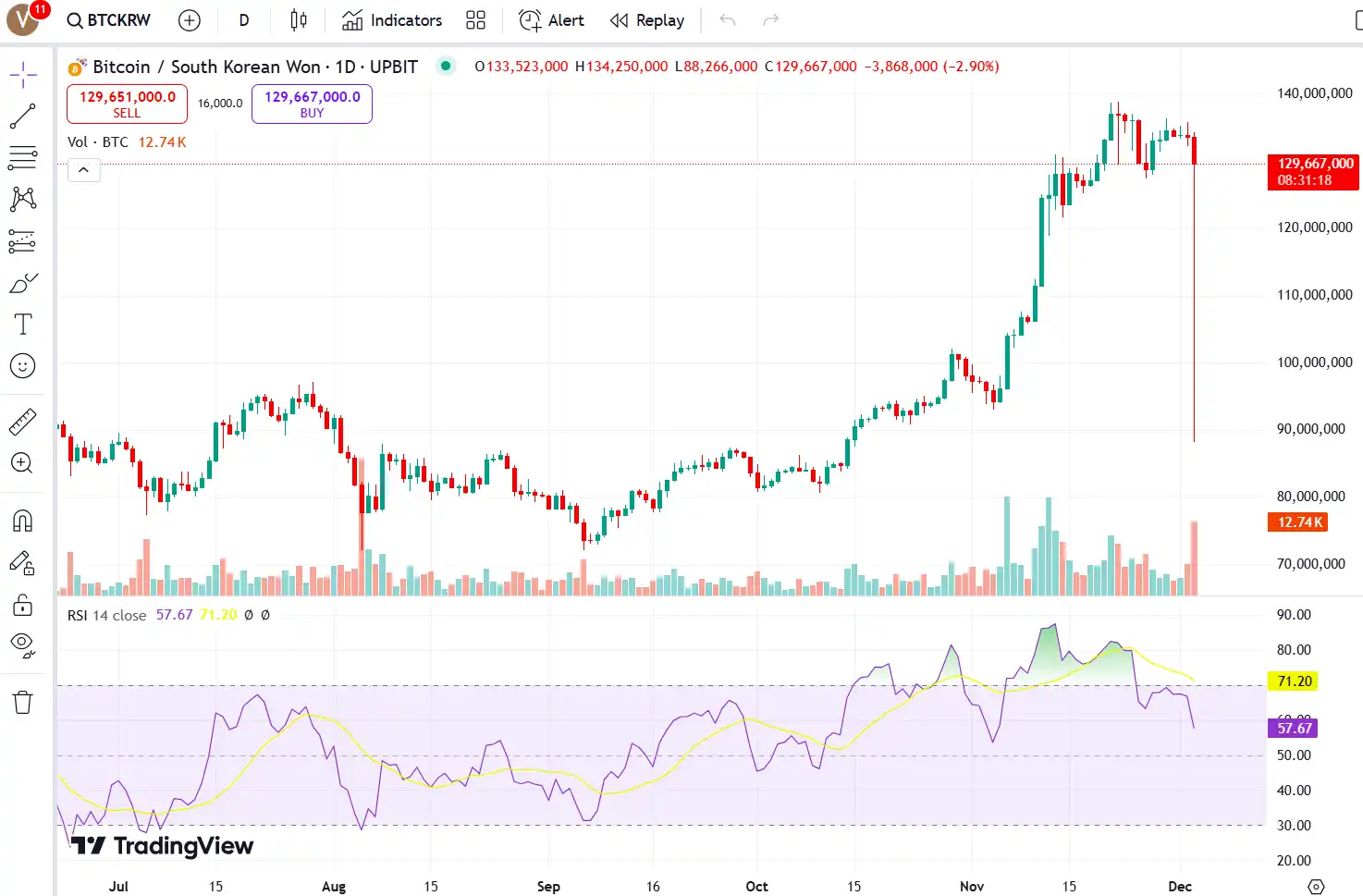
On December 3, due to the imposition of a curfew, BTC experienced a severe negative premium of 40% on Korean trading platforms like Upbit and Bithumb; image source from the internet.
BlockBeats: The cryptocurrency tax policy in Korea seems to have been postponed repeatedly. Are people concerned about this?
Andy: They are very concerned about it. Every time it comes to a critical moment, the politicians running for election include postponing taxes or further researching related policies as part of their campaign platform. Korea has already experienced three tax postponements, each time delaying for two years, and now it’s another two years. However, as far as I know, the new president is not very optimistic about cryptocurrencies, which has caused some concern among people. But in any case, the issue of cryptocurrency taxation is a topic of great concern, and everyone is paying close attention to it.
免责声明:本文章仅代表作者个人观点,不代表本平台的立场和观点。本文章仅供信息分享,不构成对任何人的任何投资建议。用户与作者之间的任何争议,与本平台无关。如网页中刊载的文章或图片涉及侵权,请提供相关的权利证明和身份证明发送邮件到support@aicoin.com,本平台相关工作人员将会进行核查。


