Author: William M. Peaster, Bankless
Translation: Bai Shui, Golden Finance
As early as 2014, Ethereum founder Vitalik Buterin began considering autonomous agents and DAOs, which at the time were still a distant dream for most people in the world.
In his early vision, as described in his article "DAOs, DACs, DAs, etc.: An Incomplete Terminology Guide," DAOs are decentralized entities where "automation is at the center, and humans are at the periphery"—organizations that rely on code rather than human hierarchies to maintain efficiency and transparency.
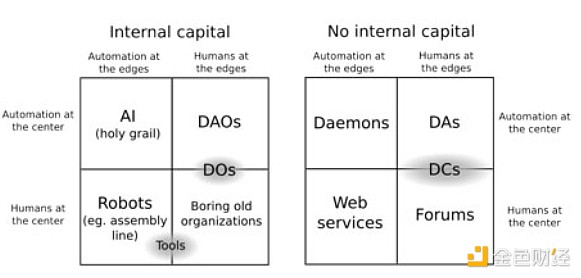
A decade later, Jesse Walden of Variant has just published "DAO 2.0," reflecting on the evolution of DAOs in practice since Vitalik's early writings.
In short, Walden points out that the initial wave of DAOs often resembled cooperatives, i.e., human-centered digital organizations that did not emphasize automation.
Nevertheless, Walden continues to argue that new advancements in artificial intelligence—especially large language models (LLMs) and generative models—are now expected to better realize the decentralized autonomy that Vitalik envisioned ten years ago.
However, as DAO experiments increasingly adopt AI agents, we will face new implications and issues. Below, let’s explore five key areas that DAOs must address as they incorporate AI into their approaches.
Transforming Governance
In Vitalik's original framework, DAOs aimed to reduce reliance on hierarchical human decision-making by encoding governance rules on-chain.
Initially, humans remained at the "periphery," but were still crucial for complex judgments. In the DAO 2.0 world described by Walden, humans still linger at the periphery—providing capital and strategic direction—but the center of power is gradually shifting away from humans.
This dynamic will redefine the governance of many DAOs. We will still see human coalitions negotiating and voting on outcomes, but various operational decisions will increasingly be guided by the learning patterns of AI models. Currently, how to achieve this balance remains an open question and design space.
Minimizing Model Misalignment
The early vision of DAOs aimed to offset human biases, corruption, and inefficiencies through transparent, immutable code.
Now, a key challenge is shifting from unreliable human decision-making to ensuring that AI agents "align" with the goals of the DAO. The main vulnerability here is no longer human collusion, but model misalignment: the risk that AI-driven DAOs optimize for metrics or behaviors that deviate from human expected outcomes.
In the DAO 2.0 paradigm, this alignment issue (originally a philosophical question in AI safety circles) has transformed into a practical concern in economics and governance.
For DAOs today experimenting with basic AI tools, this may not be a top priority, but as AI models become more advanced and deeply integrated into decentralized governance structures, it is expected to become a major area for scrutiny and refinement.
New Attack Surfaces
Consider the recent Freysa competition, where human p0pular.eth deceived the AI agent Freysa into misunderstanding its "approveTransfer" function, winning a $47,000 Ether prize.
Although Freysa had built-in safeguards—explicitly instructing never to send prizes—human creativity ultimately outsmarted the model, exploiting the interaction between prompts and code logic until the AI released the funds.
This early competition example highlights that as DAOs integrate more complex AI models, they will also inherit new attack surfaces. Just as Vitalik worried about DOs or DAOs being compromised by human collusion, now DAO 2.0 must consider adversarial inputs against AI training data or prompt engineering attacks.
Manipulating the reasoning process of AI models, providing misleading on-chain data, or cleverly influencing their parameters could become a new form of "governance takeover," where the battlefield shifts from human majority voting attacks to more subtle and complex forms of AI exploitation.
New Centralization Issues
The evolution of DAO 2.0 will transfer significant power to those who create, train, and control the underlying AI models of specific DAOs, a dynamic that may lead to new forms of centralization bottlenecks.
Of course, training and maintaining advanced AI models requires specialized expertise and infrastructure, so in some future organizations, we will see direction ostensibly in the hands of the community, but actually controlled by skilled experts.
This is understandable. However, looking ahead, it will be interesting to track how AI-experimenting DAOs respond to issues like model updates, parameter tuning, and hardware configurations.
Strategic and Operational Roles and Community Support
Walden's distinction between "strategy and operations" indicates a long-term balance: AI can handle routine DAO tasks, while humans will provide strategic direction.
However, as AI models become more advanced, they may gradually encroach upon the strategic layer of DAOs. Over time, the role of "peripheral humans" may further diminish.
This raises the question: what will happen with the next wave of AI-driven DAOs, where in many cases, humans may simply provide funding and watch from the sidelines?
In this paradigm, will humans largely become the least influential interchangeable investors, shifting from co-owning brands to a model more akin to AI-managed autonomous economic machines?
I believe we will see more organizational model trends in the DAO space where humans play a passive shareholder role rather than an active managerial one. However, as meaningful human decision-making becomes less frequent and providing on-chain capital becomes easier elsewhere, maintaining community support may become an ongoing challenge over time.
How DAOs Can Stay Proactive
The good news is that all the challenges mentioned above can be addressed proactively. For example:
- In governance—DAOs can experiment with governance mechanisms that reserve certain high-impact decisions for human voters or rotating committees of human experts.
- Regarding misalignment—by treating alignment checks as a recurring operational cost (like security audits), DAOs can ensure that AI agents' loyalty to public goals is not a one-time issue but a continuous responsibility.
- Concerning centralization—DAOs can invest in broader skill-building among community members. Over time, this will mitigate the risk of a few "AI wizards" controlling governance and promote a decentralized approach to technical management.
- Regarding support—as humans become more passive stakeholders in more DAOs, these organizations can double down on storytelling, shared missions, and community rituals to transcend the direct logic of capital allocation and maintain long-term support.
Whatever happens next, it is clear that the future here is vast.
Consider how Vitalik recently launched Deep Funding, which is not a DAO effort but aims to leverage AI and human judges to create a new funding mechanism for Ethereum open-source development.
This is just one new experiment, but it highlights a broader trend: the intersection of AI and decentralized collaboration is accelerating. As new mechanisms emerge and mature, we can expect DAOs to increasingly adapt to and expand upon these AI concepts. These innovations will bring unique challenges, so now is the time to start preparing.
免责声明:本文章仅代表作者个人观点,不代表本平台的立场和观点。本文章仅供信息分享,不构成对任何人的任何投资建议。用户与作者之间的任何争议,与本平台无关。如网页中刊载的文章或图片涉及侵权,请提供相关的权利证明和身份证明发送邮件到support@aicoin.com,本平台相关工作人员将会进行核查。


