The attitudes of technology companies towards Bitcoin are becoming polarized.
Written by: Tuo Luo Finance
Last week, the market experienced ups and downs.
On the policy front, everything seemed to be flourishing, with increased expectations for interest rate cuts and continued goodwill from Trump. However, on the news front, some were happy while others were worried. First, Google's quantum computer sparked panic, followed by Microsoft's vote to reject a Bitcoin investment proposal, which briefly cooled the market's FOMO, causing mainstream currencies to dip and altcoins to suffer significant losses. On the other hand, MicroStrategy successfully joined the Nasdaq 100 index last weekend, reigniting enthusiasm in the market.
Currently, with the anticipated interest rate cuts in December, market sentiment remains high, and price support levels are gradually rising. However, among technology companies, the divergence in attitudes towards Bitcoin continues.
On December 14, Nasdaq officially announced that MicroStrategy (MSTR) has been formally included in the Nasdaq 100 index, becoming the 40th largest company in the index with a market capitalization exceeding $98 billion. Other companies added include data analytics firm Palantir Technologies and gun manufacturer Axon Enterprise, while gene sequencing equipment maker Illumina, AI server manufacturer Super Micro Computer, and vaccine manufacturer Moderna were removed. The new index will take effect before the market opens on December 23.
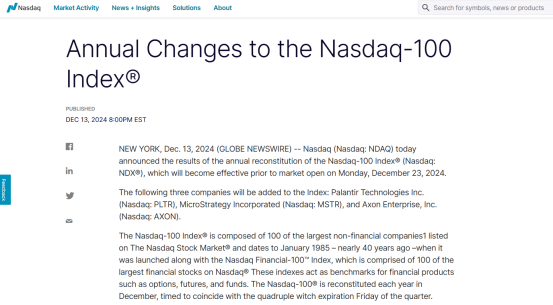
In fact, a few days before the official announcement, Crypto Briefing reported on this news, which subsequently led to a poll on Polymarket regarding whether the index would be officially included. Because of this, when the news was first confirmed, the market did not see a significant rise; instead, mainstream currencies experienced slight fluctuations due to profit-taking.
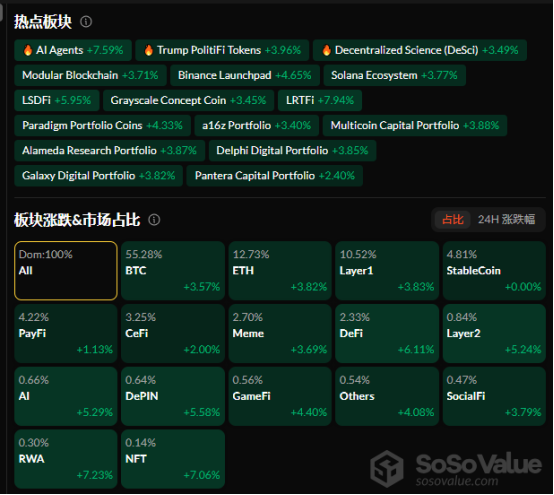
However, as of today, in conjunction with the strong likelihood of interest rate cuts, the market has begun to rally, with Bitcoin briefly breaking through $10,600 to reach new highs, and Ethereum also surpassing $4,000. The crypto sector is experiencing a broad increase, with the RWA sector leading with a 7.23% rise, and the long-dormant NFT sector also rising by 7.06%.
What makes the Nasdaq 100 index so attractive? According to its introduction, the Nasdaq 100 index was established in 1985 and has a long history. It consists of the 100 largest stocks by market capitalization and influence listed on the Nasdaq exchange, primarily focusing on technology, consumer, healthcare, industrial, and communication sectors. Unlike the S&P 500 and the Nasdaq Composite Index, the Nasdaq 100 index only includes non-financial companies, with no financial institutions among its constituents.
Currently, the index covers many well-known technology companies, such as Apple, Microsoft, Google, Amazon, Tesla, Meta, Nvidia, and Intel. In terms of performance, the Nasdaq 100 index has doubled the growth of the S&P 500 index over the past decade, exhibiting significant high returns and high volatility characteristics. This year, influenced by the rise of the technology sector, the Nasdaq 100 index has increased by over 30%.
Over time, many large investors have shown a strong preference for this index. Notably, the Invesco QQQ Trust Fund tracks the Nasdaq 100 index, and its scale has reached $320 billion. According to Bloomberg analyst James Seyffart's report, approximately $451 billion in ETFs directly track the Nasdaq 100 index. When the index reaches new highs, global ETFs are expected to buy at least $22 billion, purchasing 19 different stocks. By this standard, about $2.1 billion in new funds will flow into MicroStrategy.
It is evident that while the Nasdaq 100 index may not be as well-known as the S&P 500 and other composite indices, it still holds a high level of recognition and credibility in the traditional financial world. As the first crypto component stock to be included in the index, MicroStrategy undoubtedly reflects the growing influence of the crypto sector, broadening investor channels and marking a watershed moment for crypto companies entering the traditional financial world. The inclusion of the index has profound significance for both individual stocks and the crypto sector.
As for why it was included in the index, the reason is quite straightforward: market capitalization trumps all. The inclusion mechanism for the Nasdaq 100 index is relatively lenient, requiring companies to rank in the top 100 by market capitalization and have an average daily trading volume of at least 200,000 shares, but there are no explicit requirements regarding profitability.
From MicroStrategy's perspective, since it began purchasing Bitcoin in 2020, driven by its founder and ardent crypto supporter Michael Saylor, it has become a star representative of crypto companies on Wall Street. In terms of business model, MicroStrategy, which initially started with BI software, has now completely centered its business around Bitcoin. The company's valuation model relies on market capitalization premium rates, using equity dilution financing to increase BTC holdings and enhance per-share BTC holdings, thereby boosting the company's market value. In simple terms, it designs the distribution ratio between equity and Bitcoin, purchasing Bitcoin through bonds and stock sales, and realizing capital operations through Bitcoin appreciation.
This year, MicroStrategy has issued over $6 billion in convertible notes to raise funds for Bitcoin purchases. As of December 8, 2024, MicroStrategy has acquired 423,650 BTC at an approximate price of $25.6 billion, averaging about $60,324 per Bitcoin, making it the publicly traded company with the largest Bitcoin holdings globally.
In the context of rising Bitcoin values, MicroStrategy's stock has soared, increasing by over 500% this year alone, peaking at $543, with trading volumes even surpassing those of Nvidia and Tesla, two leading tech companies. Currently, MicroStrategy's market capitalization is close to $98 billion, placing it among the top 100 publicly traded companies in the U.S.
The soaring returns have stirred significant waves in the market, with well-known short-selling firm Citron targeting the company, arguing that its stock price is already too high. However, MicroStrategy continues to ignite a following strategy in the market. This year, Bitcoin mining companies such as Marathon Digital, Riot Platforms, Core Scientific, Terawulf, and Bitdeer have also emulated MicroStrategy by financing Bitcoin purchases through similar convertible bonds.
In this context, it is not surprising that the influential, high-earning, high-valuation MicroStrategy was included in the Nasdaq 100 index. With increased exposure to traditional investors, its stock price still has the potential for further increases, which also means it has more capital to purchase Bitcoin. On December 13, the founder even hinted at buying more Bitcoin.
It is worth noting that being included in the index has also brought more controversy to the company. For example, Nasdaq explicitly requires non-financial companies, and while MicroStrategy carries the title of a tech company, it is essentially a Bitcoin investment firm that hoards and trades Bitcoin, or more akin to a Bitcoin ETF. The founder even claimed that MicroStrategy would become a "Bitcoin bank."
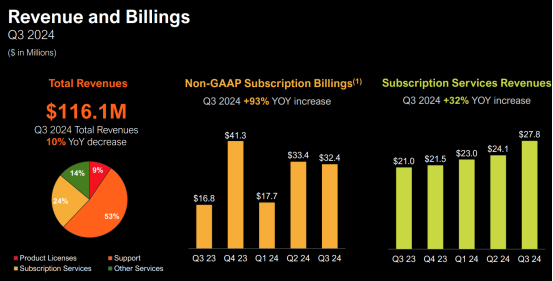
In this regard, Michael Lebowitz, a portfolio manager at RIA Advisors, bluntly stated, "This is essentially a company that would die without Bitcoin." The financial reports indeed reflect this; according to its Q3 financial report, MicroStrategy's cumulative revenue for the first three quarters of fiscal 2024 was $343 million, down 7.81% from $372 million in the same period last year, with a cumulative net loss of $496 million. From the software business perspective, Q3 software revenue was only $116.1 million, a 10.3% year-on-year decline.
On a positive note, the FASB's fair value accounting rules officially took effect today. Under the new accounting rules, companies can account for Bitcoin at its total appreciated value rather than its purchase price, providing more operational space for crypto companies like MicroStrategy. It is foreseeable that in the financial reporting season in February next year, the vast majority of crypto companies will have more impressive performance.
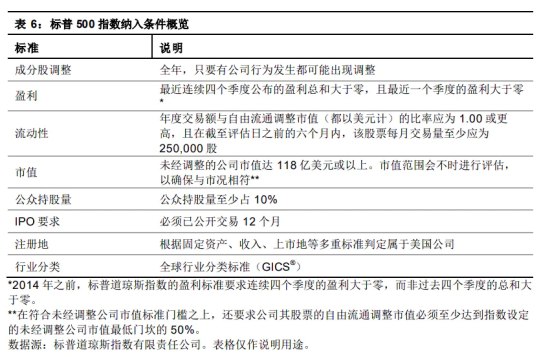
Despite the doubts, the market's expectations extend further. Due to the nature of the company, MicroStrategy's journey in the Nasdaq 100 index may not be long-lasting. Bloomberg analyst James Seyffart indicated that ICB might choose to reclassify MicroStrategy as a financial stock during the next change period in March. However, after achieving its small goal with Nasdaq, the broader S&P 500 has become the next milestone that the market hopes MicroStrategy will reach. The S&P 500 is more lenient regarding company attributes but sets higher thresholds for profitability, requiring the total profit over the last four consecutive quarters to be greater than zero. Although there is a divergence with MicroStrategy, the market still holds some hope based on the new government and new accounting standards.
While this side resolves the high premium issue, Microsoft has doused the market with cold water.
Before the news of MicroStrategy's inclusion in the index, on December 11, Microsoft made a final vote on the proposal to "include Bitcoin in the company's balance sheet." Similar to previous predictions, despite Michael Saylor's impassioned three-minute speech attempting to persuade Microsoft shareholders to support the decision, experts still believed that investing in cryptocurrencies could not guarantee improved returns for the portfolio. Ultimately, as the board had previously indicated, Microsoft's Deputy General Counsel Keith Dolliver stated during the live stream of the shareholder meeting that the proposal was officially rejected.
Based on this case, Amazon's similar proposal in April is also likely to be rejected. As a result, Bitcoin briefly fell below $95,000 at that time. In fact, it is often said that for well-known tech giants holding large amounts of cash, volatility is a key factor to consider. Most tech giants adopt conservative and prudent financial strategies when investing, rather than pursuing the high-risk, high-reward nature of volatile assets. Compared to such returns, strategic acquisitions and ongoing R&D investments clearly align better with the long-term values of tech giants. Additionally, tech giants place greater emphasis on social impact, while the high energy consumption associated with cryptocurrencies like Bitcoin contradicts the green ideals they promote and may even pose regulatory risks, which is one of the reasons these giants are reluctant to experiment.
It is undeniable that holding Bitcoin has become a trend among tech companies. According to data from DL News, approximately 144 companies currently hold Bitcoin on their balance sheets. However, the attitudes of tech companies towards Bitcoin show a clear divergence, primarily divided into three paths: one is the aggressive representative MicroStrategy, which builds its business directly around Bitcoin, with many imitators being crypto companies; another is conservative giants like Microsoft and Amazon, which pursue stability and safety, maintaining a wait-and-see attitude and are unlikely to venture into the space; and the third group is in the middle ground, choosing to hold Bitcoin while focusing on their core business, but their attitudes also vary, either viewing Bitcoin as part of asset allocation, such as Tesla and SpaceX led by Musk, which currently holds 9,720 BTC, or using it to influence business growth, primarily among companies with limited business expansion.
However, at present, the divergence in attitudes among tech companies does not affect the market's exuberant sentiment. Although the giants remain cautious, other companies seeking returns are clearly not slowing down; after all, Bitcoin's strategy is simple and easy to implement, and it can yield rare growth returns. Broadly speaking, during the tenure of the crypto-supporting government led by Trump, Bitcoin is likely to have speculative potential comparable to AI in the U.S. stock market, representing a new direction for value appreciation. Whether for brand marketing, asset allocation, or stabilizing stock prices, many companies, especially publicly traded firms facing bottlenecks in their core business, are unlikely to easily abandon it. Therefore, as the mainstreaming of crypto evolves, corporate involvement will only increase, even if they are not giants, they still represent a vast pool of cash flow.
On the other hand, the Trump effect continues. On December 15, Trump stated in an interview that he would establish a Bitcoin strategic reserve similar to the oil reserve and would "do great things in the cryptocurrency space." As expected, with strong support from the policy front, the bullish sentiment in the crypto market remains quite strong. The market has already cast its vote, with the concentrated price range for Bitcoin holders rising from $95,000 towards $100,500.
免责声明:本文章仅代表作者个人观点,不代表本平台的立场和观点。本文章仅供信息分享,不构成对任何人的任何投资建议。用户与作者之间的任何争议,与本平台无关。如网页中刊载的文章或图片涉及侵权,请提供相关的权利证明和身份证明发送邮件到support@aicoin.com,本平台相关工作人员将会进行核查。


