Macroeconomic Interpretation: Today, I saw a report from Reuters on BlackRock's official views and investment recommendations, which are relatively objective. It mainly mentioned that institutional investment in Bitcoin may suppress some volatility of BTC and also reduce the investment returns of Bitcoin. It also suggested that if investors are going to invest in Bitcoin, they should not exceed 2% of their total investment! Many people in our crypto circle may have exceeded this limit. BlackRock's suggestion is based on the concept of asset allocation, considering the risk characteristics of BTC, and combining stocks and bonds for diversified investment.
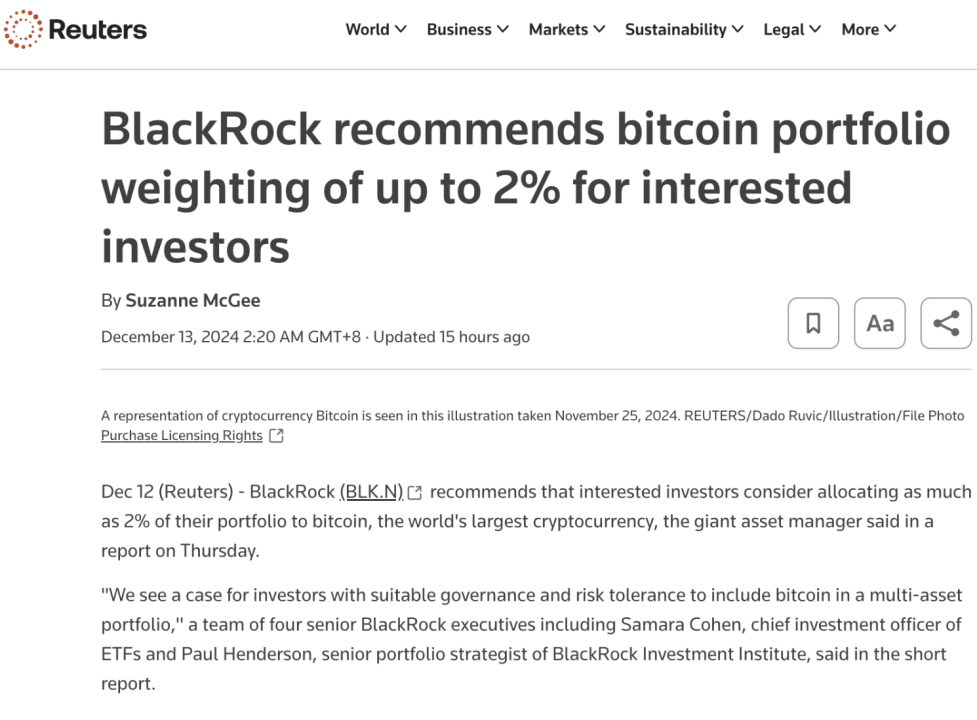
As the cryptocurrency market continues to attract global investors' attention, the report on Bitcoin investment released by BlackRock's investment research institute is like a stone thrown into a lake, creating ripples that provide us with a unique and valuable perspective on the future direction of Bitcoin investment.
The core of BlackRock's official viewpoint lies in the potential impact of institutional investors on Bitcoin market volatility and return rates. The broader participation of institutional investors in Bitcoin investment is expected to suppress some of its volatility. The logic behind this viewpoint is based on the scale of institutional funds and the characteristics of their investment strategies. Compared to retail investors, institutional investors typically have stronger financial capabilities and more long-term, stable investment plans. A large influx of institutional funds into the Bitcoin market will, to some extent, balance the market supply and demand relationship, reducing significant price fluctuations caused by retail investor sentiment, thereby suppressing some volatility. For example, in traditional financial markets, when large institutions gradually allocate to a new asset class, the price trend of that asset often stabilizes. Although trading activity is high, the price volatility tends to narrow, and the Bitcoin market may exhibit a similar trend.
This suppression of volatility brought about by institutional participation may reduce the extremely high return rates that Bitcoin has shown since its inception. In its early days, Bitcoin experienced explosive growth due to a smaller number of market participants, relatively loose regulation, and its unique innovation, resulting in astonishing return rates. However, with the entry of institutions, the market gradually matures, and the price discovery mechanism becomes more effective, leading its price growth pattern to resemble that of traditional assets, with return rates stabilizing and declining. This is similar to how emerging tech companies may achieve rapid growth in performance due to unique technologies or business models in their early development, but as industry competition intensifies and giants enter the market, their growth rate gradually returns to the industry average.
Looking ahead to the future of Bitcoin, if it achieves widespread adoption, BlackRock believes that investing in it may become less risky. Widespread adoption means that Bitcoin gains broader recognition and application in payments, value storage, etc., leading to a more solid market foundation and enhanced price stability, similar to how gold transitioned from a common metal to a globally recognized safe-haven asset. However, at the same time, Bitcoin may lose the structural catalysts for further significant price increases. In its early development, Bitcoin had strong upward momentum due to technological innovation, rapid market awareness, and regulatory arbitrage opportunities. Once widely accepted, these special factors driving its significant price increases will gradually disappear, and price growth will rely more on asset allocation demand in the macroeconomic environment and the natural inflation level of the market.
BlackRock advises investors not to exceed 2% of their total investment in Bitcoin, a recommendation stemming from its mature asset allocation philosophy. From the perspective of modern portfolio theory, Bitcoin, as a high-risk, high-volatility asset, should occupy an appropriate proportion in a portfolio to balance overall risk and return. For many investors in the crypto market, exceeding this proportion reflects the risk preference characteristics of the crypto investor group and the irrational exuberance of the early stages of market development. In emerging markets, investors are often easily attracted by high return expectations, over-allocating to a popular asset while neglecting potential risks. BlackRock's advice is aimed at helping investors build a more robust and diversified investment portfolio from a macro asset allocation perspective, avoiding significant losses due to excessive volatility of a single asset.
Bitcoin investment stands at a critical crossroads. On one hand, the entry of institutional investors signifies a move towards market maturity and regulation, with volatility expected to be somewhat controlled; on the other hand, this may also mean the gradual end of the high-return era for Bitcoin investments. For investors, BlackRock's viewpoint provides a rational framework for examining Bitcoin investments, suggesting that they should not only focus on its past high-return myth but also consider the profound impacts of market structural changes. Investment decisions should emphasize the scientific and rational nature of asset allocation, incorporating Bitcoin as part of a diversified investment portfolio rather than relying solely on it for excess returns, thereby navigating the ever-changing financial market landscape while effectively managing risks and seizing investment opportunities.
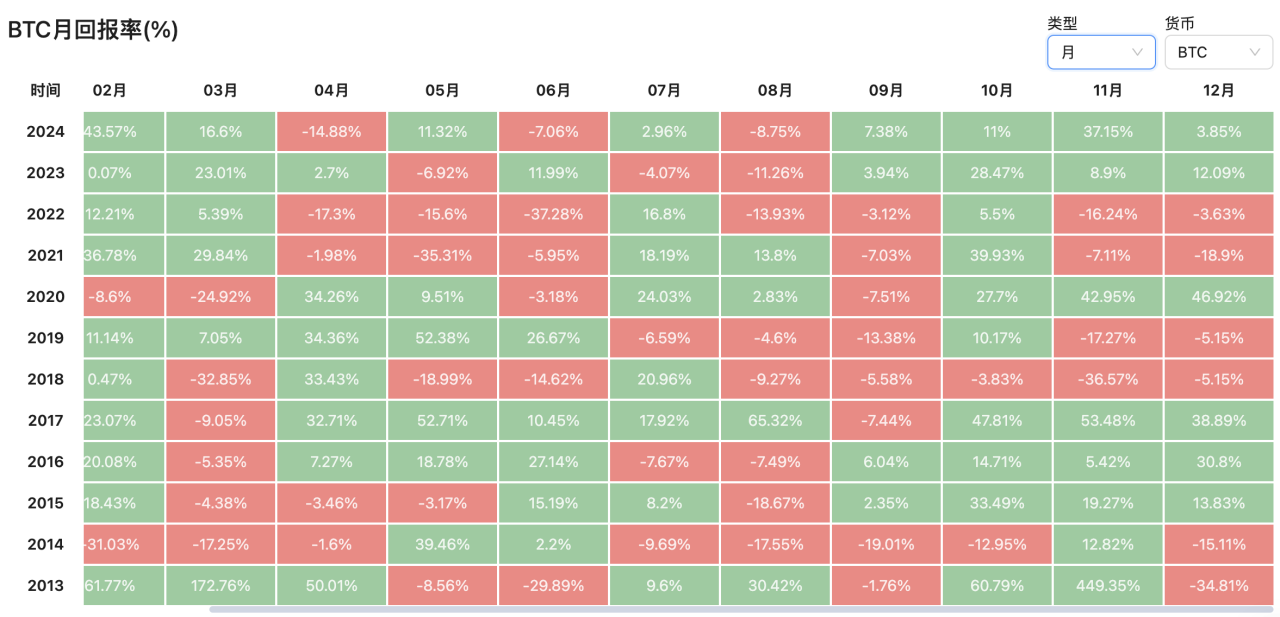
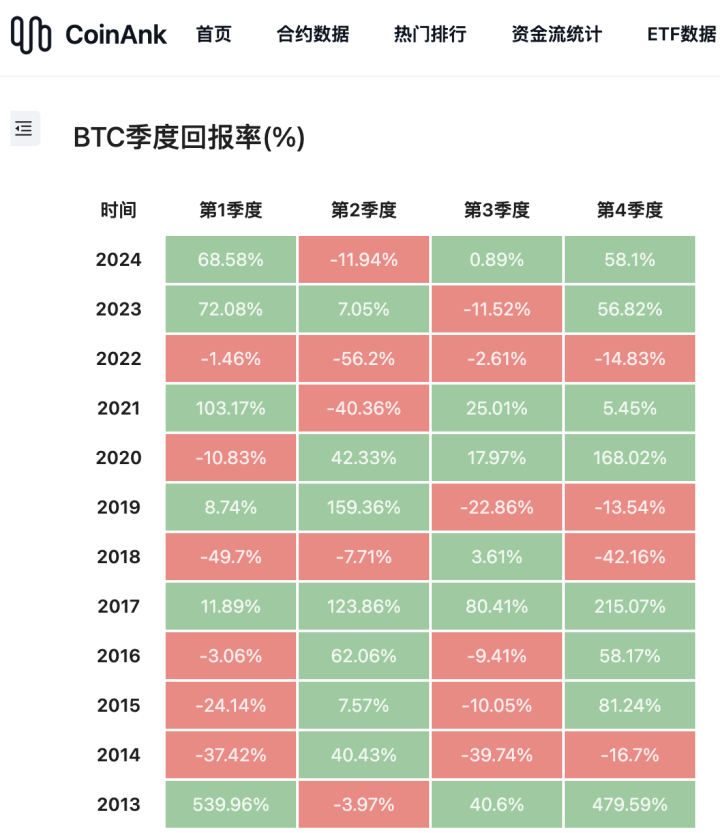
BTC Historical Return Rate Data: According to data statistics, BTC's monthly and quarterly historical return rates from 2013 to this year over the past twelve years are shown above, which can serve as a reference for medium to long-term asset allocation.
免责声明:本文章仅代表作者个人观点,不代表本平台的立场和观点。本文章仅供信息分享,不构成对任何人的任何投资建议。用户与作者之间的任何争议,与本平台无关。如网页中刊载的文章或图片涉及侵权,请提供相关的权利证明和身份证明发送邮件到support@aicoin.com,本平台相关工作人员将会进行核查。


