Macroeconomic Interpretation: Looking at the global financial markets, the simultaneous decline of the three major U.S. stock indices last night became the focus. The Dow Jones Industrial Average, the Nasdaq Composite, and the S&P 500 fell by 0.53%, 0.66%, and 0.54%, respectively. This downward trend reflects the market's uncertainty under the current economic data and global political and economic situation, especially after Trump's remarks about the stock market, which is quite interesting.
The yield on the U.S. ten-year Treasury bond rose to 4.33%, narrowing the gap with the two-year Treasury yield to 13.5 basis points, possibly reflecting the market's expectations for future inflation. Meanwhile, the VIX, or fear index, increased by 2.5% to 13.92, indicating a rise in market volatility. The VIX index, as a barometer of market volatility, often signals increased concerns about future uncertainties. Additionally, Brent crude oil prices fell by 0.29%, spot gold prices dropped by 1.38%, while the U.S. dollar index rose by 0.34%. These price fluctuations in commodities and currencies also reflect the tense market sentiment.
The number of initial jobless claims in the U.S. reached 242,000 this week, exceeding the expected 220,000, indicating potential pressure on the labor market. Furthermore, the U.S. PPI for November increased by 3% year-on-year and 0.4% month-on-month, suggesting that inflationary pressures remain. The release of this data undoubtedly adds uncertainty to the market's expectations for future economic growth and inflation, thereby affecting stock market performance.
In terms of international trade, Canada is considering imposing export taxes on goods exported to the U.S. in response to U.S. tariff threats, which may exacerbate trade tensions between the two countries. The Swiss National Bank unexpectedly cut interest rates by 50 basis points and indicated readiness to intervene in the foreign exchange market if necessary, a decision that could impact global monetary policy.
U.S. household net worth reached a record $168.8 trillion in the third quarter, indicating growth in household wealth. At the same time, a Texas lawmaker proposed a bill to establish a strategic Bitcoin reserve, indicating the increasing status of cryptocurrency in U.S. politics and economics. Trump's remarks and BlackRock's suggestions for Bitcoin investment also show mainstream financial institutions' recognition of cryptocurrency.
Regarding energy demand, the IEA raised its forecast for global oil demand next year and expects a sufficient supply in the oil market by 2025. This expectation may impact the energy market, especially against the backdrop of a global economic recovery.
In terms of monetary policy, the European Central Bank cut interest rates by 25 basis points as expected and removed the language about maintaining restrictive interest rates. Traders expect the ECB to lower rates by less than 125 basis points by 2025. The Japanese House of Representatives passed a supplementary budget for fiscal year 2024, while the Bank of Japan is inclined to maintain stable interest rates next week.
Overall, the simultaneous decline of the three major U.S. stock indices last night is the result of multiple factors. The fluctuations in macroeconomic data, adjustments in monetary policy, changes in market sentiment, and uncertainties in the global economic and political situation have all influenced market performance to some extent.
BTC Data Analysis:
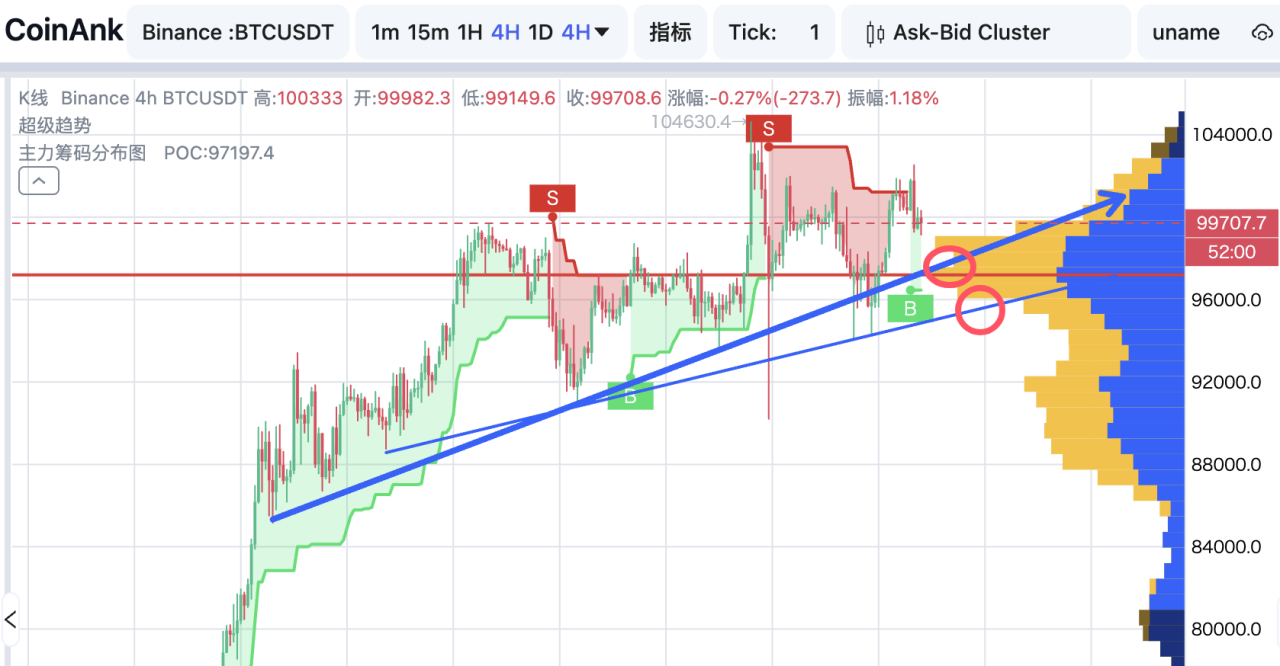
BTC exhibited a volatile trend yesterday, peaking around $102,540 before retreating, currently dropping to around $99,200. The overall rhythm overnight was relatively consistent with the Nasdaq, showing a corrective trend. Trump rang the opening bell at the New York Stock Exchange, attributing the recent stock market rise to himself, stating that the stock market is crucial to everything he does. However, all three major indices closed lower, with the S&P 500 experiencing a decline after opening, and the Dow has now fallen for six consecutive trading days.
In terms of Bitcoin ETF fund flows, there was a net inflow of approximately $600 million. According to data, this has continued for 12 consecutive trading days since November 26.
The daily chart closed with a small bearish candle, retreating after testing previous highs. The overall analysis remains unchanged, with short-term gains and losses continuing to reference the upward trend line around $97,000, which is also a concentrated position for major players. Another upward trend line is around $95,000. Additionally, there are the recent two tests around $90,800. Mid-term support continues to reference around $87,000 and $85,000. Short-term resistance continues to reference recent highs of $102,540 and $104,088, as well as the historical all-time high.
免责声明:本文章仅代表作者个人观点,不代表本平台的立场和观点。本文章仅供信息分享,不构成对任何人的任何投资建议。用户与作者之间的任何争议,与本平台无关。如网页中刊载的文章或图片涉及侵权,请提供相关的权利证明和身份证明发送邮件到support@aicoin.com,本平台相关工作人员将会进行核查。