In a recent amicus brief, doctors wrote that due to Sam Bankman-Fried's autism and attention deficit disorder, the court and jury may have misunderstood his behavior during the criminal trial.
Author: Jesse Coghlan, CoinTelegraph
Translation: Wuzhu, Golden Finance
A group of doctors stated in an amicus brief supporting his appeal that Sam Bankman-Fried's criminal trial may have been compromised by his neurodivergent disorders, leading to "lengthy answers" frustrating the court.
Eight doctors specializing in neurodivergence told the Second Circuit Court of Appeals on September 20 in a statement supporting Bankman-Fried that the FTX co-founder was diagnosed with autism spectrum disorder (ASD) and attention deficit hyperactivity disorder (ADHD), which "presented serious challenges in the handling of this case."
They claimed that due to Bankman-Fried's neurodivergent disorders, several rulings were unfavorable to him, particularly the ruling by the Manhattan District Court that allowed government prosecutors to question him without the jury present.
This ruling "may have far-reaching implications" because "the judge repeatedly admonished Mr. Bankman-Fried for lengthy answers and attempts to clarify or rephrase questions" - the doctors said this is characteristic of individuals with autism, as they understand language in a literal sense.
They also claimed that the judge's sanctions later led Bankman-Fried to change his answers in front of the jury.
"Mr. Bankman-Fried made significant corrections in front of the jury, possibly over-correcting," they wrote.
"Unlike the answers he gave during cross-examination when the jury was not present, Mr. Bankman-Fried's answers in front of the jury were often very brief, even very brief - often a simple 'yes'."
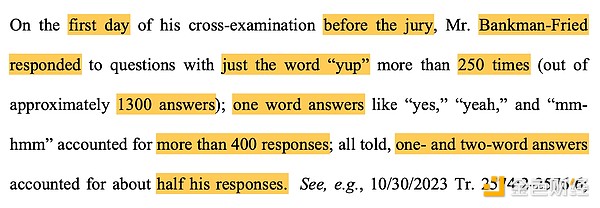
The highlighted excerpt analysis shows that when facing the jury on the first day, Bankman-Fried's answers were only one or two words half the time. Source: CourtListener
The brief pointed out: "These brief answers can easily be misunderstood as arrogant or indifferent."
In March of this year, Bankman-Fried was sentenced to 25 years in prison for defrauding FTX clients of $11 billion, with Judge Lewis Kaplan stating that Bankman-Fried "equivocated, nitpicked, and attempted to have the prosecutor rephrase questions."
Lack of documents and medication is a "serious impediment"
The doctors added that Bankman-Fried was unable to access "a series of FTX documents" and appropriate ADHD medication, which was also a disadvantage.
"For individuals with ASD, the lack of specific documents can be a serious impediment," they said, adding that during the first three weeks of the trial, Bankman-Fried was also "denied access to ADHD medication, which is necessary for him to maintain focus."

In December 2023, Bankman-Fried (second from the right) at the Brooklyn Metropolitan Detention Center for trial. Source: Tiffany Fong
The doctors wrote that if autistic individuals had access to "specific documents and precise wording of company policies, recommendations, emails, etc.," they "could find specific bases for their answers."
The doctors said that without these documents, the answers of autistic individuals "often appear uncertain" and may seem "uncooperative or evasive."
The brief noted that during the initial stages of the trial, when the government presented evidence, Bankman-Fried was also "deprived of the ability to concentrate" because he did not receive the proper dosage of ADHD medication - his lawyer mentioned this during the trial.
The doctors said that Bankman-Fried needed to take sustained-release medication in the morning and at noon to maintain focus throughout the day, but he only took half the previous dose and "did not take sustained-release medication until very late in the trial."
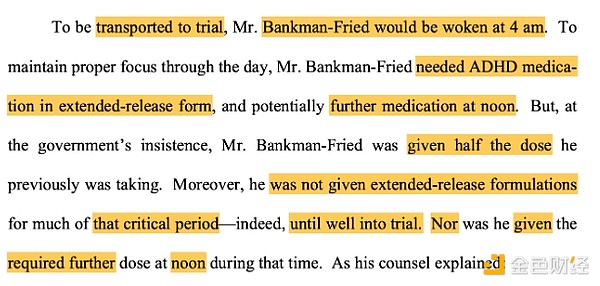
A brief excerpt from the doctors in court about Bankman-Fried's medication situation. Source: CourtListener
They added that "failing to provide an effective dose of ADHD medication can severely impact functioning," and changing the dosage could even "lead to withdrawal symptoms."
Criminal and bankruptcy case crossover issues: filed
Meanwhile, a group of bankruptcy law professors submitted an amicus brief on the same day, neither supporting Bankman-Fried nor the government - raising concerns about the crossover between the FTX bankruptcy case and Bankman-Fried's trial.
They believe that FTX's bankruptcy proceedings providing assistance to Bankman-Fried's prosecutors "set a dangerous precedent, encouraging the active use of Chapter 11 procedures to support parallel criminal prosecutions."
The organization stated that the contribution of FTX's bankruptcy estate to Bankman-Fried's criminal trial "is unusual compared to previous cases," citing the cases of Enron and WorldCom in the early 21st century.
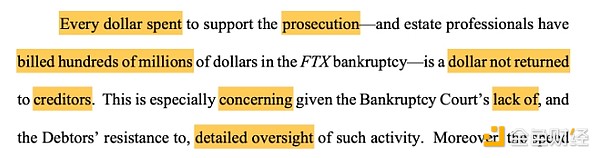
Key excerpts from the law professors' brief, claiming that FTX's bankruptcy lawyers supported the prosecution of Bankman-Fried. Source: CourtListener
They added that the speed of Bankman-Fried's trial meant that the jury was informed repeatedly and inaccurately that clients would not recover any funds from FTX.
"However, the defendant had no opportunity to present evidence to prove that the debtor was never found bankrupt, or that FTX clients may actually receive nearly 150% of their claims," they said.
In May, FTX Asset Management stated that it had enough funds to repay creditors, plus "billions of dollars in compensation" - but the value of these funds is equivalent to the asset value at the time of the bankruptcy in November 2022.
免责声明:本文章仅代表作者个人观点,不代表本平台的立场和观点。本文章仅供信息分享,不构成对任何人的任何投资建议。用户与作者之间的任何争议,与本平台无关。如网页中刊载的文章或图片涉及侵权,请提供相关的权利证明和身份证明发送邮件到support@aicoin.com,本平台相关工作人员将会进行核查。


