B3 has performed well in the Asian market due to its multi-chain compatibility and scalability, while XAI has achieved low latency and high throughput global expansion relying on Arbitrum technology and Binance Launchpool.
By HAMSTER
L3 is a blockchain architecture level after L1 and L2, designed for specific application scenarios such as games, social networks, etc., aiming to further optimize performance, reduce costs, and improve scalability. Compared to L2, the uniqueness of L3 lies in its ability to focus on specific areas to optimize the blockchain user experience while maintaining compatibility with the underlying L1 and L2. Especially in the gaming field, L3 provides a more flexible development environment and optimized performance for blockchain games, allowing game developers to create more interactive game experiences while reducing user transaction costs and improving game performance.
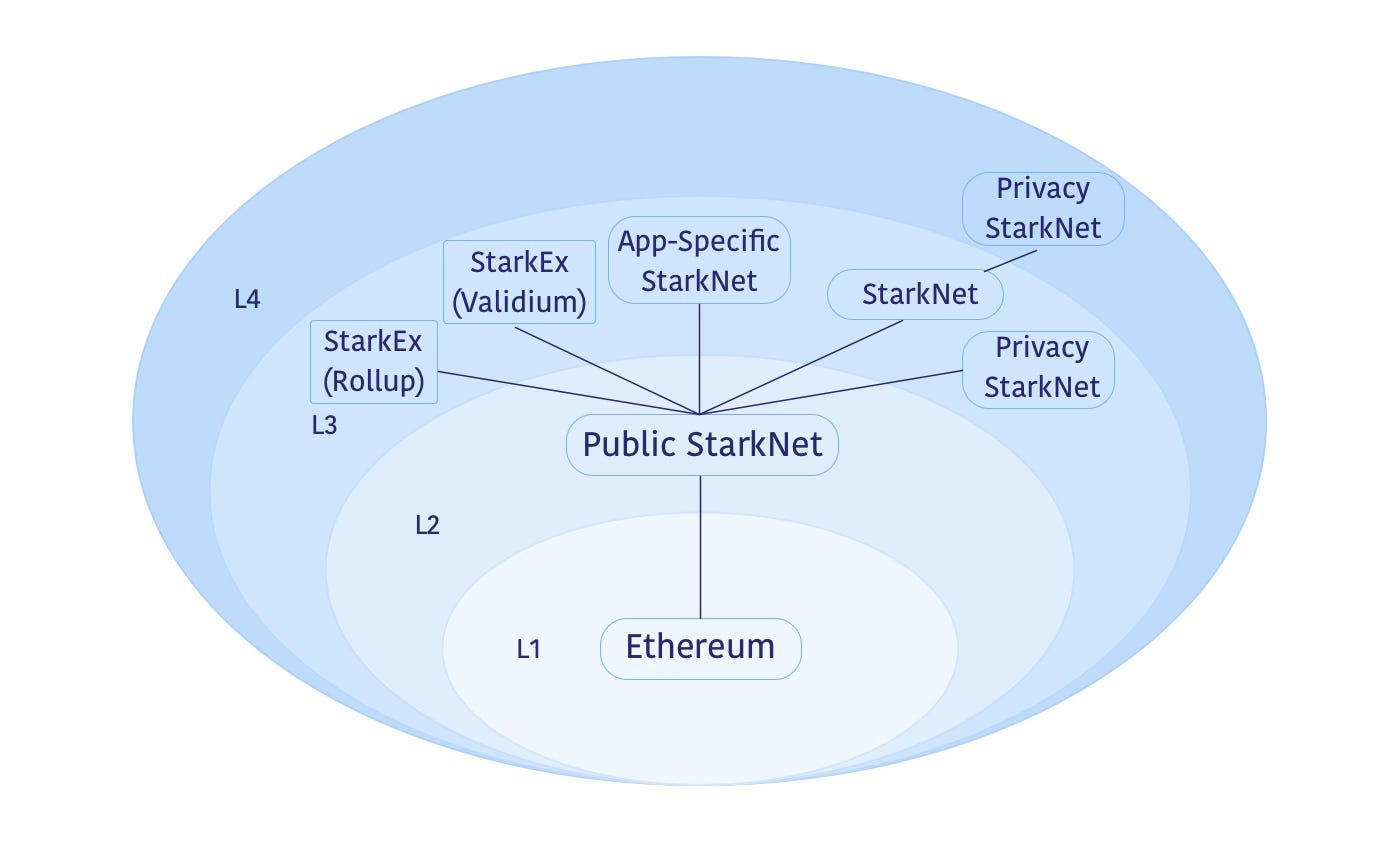
Image Source: Starkware
In the Layer 3 field of blockchain games, B3 and XAI are two platforms that have attracted much attention. Although they are both committed to improving the performance and user experience of on-chain games, they have different focuses in their implementation.
B3's architecture focuses on scalability and multi-chain compatibility, suitable for cross-chain game development, but it relies on the Base ecosystem and may be limited in non-EVM compatible scenarios. XAI, based on Arbitrum's Layer 3 architecture, focuses on increasing transaction throughput and reducing latency, suitable for on-chain games that require fast transaction confirmation. XAI is not as flexible as B3 in terms of multi-chain compatibility, but its transaction processing efficiency is higher, suitable for high-performance games. In terms of market expansion, B3 has shown strong performance in the Asian market, while XAI has quickly gained global attention through its cooperation with Binance Launchpool, but may not be as competitive as B3 in some local markets.
How does L3 drive innovation and development in blockchain games?
The application of L3 networks in blockchain games mainly improves transaction processing capacity by optimizing consensus mechanisms and introducing data sharding technology, ensuring the rapid transfer and trading of in-game assets. This improvement effectively reduces transaction latency, allowing players to receive more timely feedback in the game and improve the overall gaming experience.
In terms of costs, L3 reduces transaction fees and alleviates the burden on players and developers through optimized consensus mechanisms and economic model design. By using more efficient smart contracts and virtual machine technology, L3 improves the utilization of computing and storage resources, further reducing operating costs while enhancing system performance. L3 also provides highly customizable features, allowing developers to adjust smart contracts and application logic according to game requirements, supporting complex game mechanisms and interactions. This flexibility is also reflected in L3's support for various digital assets (such as NFTs and tokens), providing more options for asset management and trading within the game's economy.
In addition, L3's strong compatibility allows it to interface with other blockchain networks, helping existing game projects smoothly migrate to the L3 platform and achieve interoperability with other blockchain ecosystems. This feature enables the expansion of the gaming ecosystem. In practical applications, L3 can be used to build decentralized in-game economic systems, supporting the circulation and trading of assets, increasing the transparency and security of the game economy.
However, the application of L3 in blockchain games still faces some challenges. Although L3 improves scalability, there may still be performance bottlenecks in high-frequency trading game scenarios, leading to extended transaction confirmation times and affecting player experience. In terms of development, while L3's modular and highly customizable architecture provides flexibility, it also increases development complexity. Developers need to master multi-layer blockchain architecture, smart contracts, and encryption technology, which is a barrier for traditional game developers. In addition, L3's user experience also faces obstacles. Due to reliance on decentralized wallets and gas fees, ordinary players may encounter technical challenges during operations. This complexity limits the widespread popularity of blockchain games.
Overall, L3 provides a new technological path for the development of blockchain games, but before large-scale application, issues such as on-chain performance, development complexity, and user experience need to be addressed.
B3 and XAI: The Battle of L3 in Gaming
B3 and XAI are two highly anticipated L3 projects in the current blockchain gaming field. They aim to drive the development of blockchain games by providing high-performance, low-cost, and customizable blockchain infrastructure.
B3: Base-based Layer3 Gaming Chain
B3 is an L3 blockchain ecosystem designed for crypto games, built on Base, developed by NPC Labs, with team members from Coinbase and the Ethereum community. The ecosystem aims to improve performance through horizontal scalability, reduce transaction costs, and provide a smoother experience for game developers and players. B3 has received support from Pantera Capital and successfully raised $18 million for its development and ecosystem expansion.
B3's technical architecture provides the following solutions for the performance challenges in blockchain games:
- Horizontal scalability: B3 adopts a horizontally scalable architecture, supporting multiple game instances running on different chains, increasing transaction processing capacity and throughput to meet the needs of large-scale users.
- Efficient transactions and low costs: As a Layer 2 network based on Base, B3 reduces transaction costs for in-game asset transfers and interactions, lowering operating costs.
- Multi-chain compatibility: B3 supports interoperability of multiple EVM chains, allowing game developers to flexibly integrate different blockchain functionalities, running as an independent game chain or interfacing with existing blockchain ecosystems for functional and asset interoperability.
- Optimized smart contract execution: B3 optimizes smart contract architecture, reducing the latency of game logic execution, supporting complex game mechanisms and interactions, while ensuring blockchain security and transparency.
In addition, B3 has launched the BSMNT.fun platform, integrating a game discovery engine and social interaction features, allowing players to participate in game decisions and interactions through blockchain. Currently, more than 20 game studios have joined the platform, including Mighty Bear Games and Infinigods. B3 provides development tools and documentation to help game developers easily build and deploy on-chain games, simplifying the use of blockchain infrastructure.
B3 is actively expanding its business in the Asian market, especially in South Korea and Japan, focusing on casual and hyper-casual games, attracting numerous developers and players. Some on-chain game projects such as DEAR and Dino Runner 3D have utilized B3's high-performance architecture and low transaction costs to provide rich gaming experiences. With the mainnet launch of B3, the number of users and developers continues to grow, demonstrating its expansion potential in the on-chain gaming field.
XAI: Arbitrum-supported L3 Gaming Chain
XAI is a Layer 3 blockchain platform based on Arbitrum, designed for game development, aiming to provide high-performance, low-cost on-chain infrastructure for Web3 games. Through its XAI token drive, XAI aims to simplify user experience, especially reducing the complexity of traditional game players interacting with cryptocurrency wallets. XAI has completed three rounds of financing, raising a total of $10 million, with funds to be used for infrastructure construction, ecosystem expansion, and the promotion of developer incentive programs. In addition, XAI has become the 43rd project on Binance Launchpool, leveraging this cooperation to gain more attention globally.
XAI's technical architecture:
- Arbitrum Technology Stack: XAI is built on Arbitrum Nitro technology and adopts Arbitrum's AnyTrust architecture to ensure high security and low-latency transaction capabilities on the platform.
- Low Cost and Fast Transactions: XAI supports 10,000 transactions per second, almost instant final confirmation, and is optimized for high-frequency transactions in on-chain games, maintaining extremely low transaction costs. This allows XAI to handle asset transfers between a large number of players, especially suitable for games that require frequent trading, such as role-playing or PvP games.
- Smart Contract Support: XAI provides an SDK that supports Unity and Unreal game engines, allowing developers to easily integrate Web3 functionality into games and deploy directly on the XAI network. The toolkit also provides simplified API interfaces.
The XAI platform supports users to trade assets in the game and simplifies the transaction process, eliminating the need for cryptocurrency wallets, thereby simplifying the item trading and collection process. To lower the barrier for Web3 games, XAI introduces account abstraction and social login functionality, allowing players to log into the game through social accounts without directly using a crypto wallet. This design makes it easier for traditional gamers to participate in blockchain games. XAI has also established a $100 million game incentive fund to support innovative game project development. In addition, XAI supports multi-chain interoperability, allowing cross-chain transfer and trading of digital assets, building an open trading market and promoting the development of on-chain game economies.
XAI's market vision is to establish an open game asset trading ecosystem to attract more users by lowering the barrier to entry. Currently, several games are being developed or have been launched on the platform, such as "Crypto Unicorns," "Planet X," "Final Form," and "Valeria," covering PvP battles and role-playing games. The XAI platform has successfully attracted a group of developers and has entered the mainnet operation phase, with plans to further expand its ecosystem to support more Web3 game projects and attract mainstream gamers to join.
In summary
As two major Layer 3 projects in the blockchain gaming field, B3 and XAI each provide important support for the development of on-chain games through their unique technical architectures and market strategies. B3 has performed well in the Asian market, especially in terms of multi-chain compatibility and high scalability, and has shown significant advantages in community interaction and social gameplay. In contrast, XAI, relying on the Arbitrum technology stack, provides a low-latency, high-throughput gaming experience and has expanded its global market through cooperation with Binance Launchpool.
免责声明:本文章仅代表作者个人观点,不代表本平台的立场和观点。本文章仅供信息分享,不构成对任何人的任何投资建议。用户与作者之间的任何争议,与本平台无关。如网页中刊载的文章或图片涉及侵权,请提供相关的权利证明和身份证明发送邮件到support@aicoin.com,本平台相关工作人员将会进行核查。


