On September 16, the "FAT Awards 2024" annual ceremony grandly opened at the Conrad Hotel in Singapore. "FAT" is a list ceremony and summit forum brand founded by Odaily Planet Daily in 2020, aiming to commend the leaders and innovators in the Web3 and crypto industry, focusing on value paradigms and consensus moments. In 2024, as the crypto industry is rapidly changing and the narrative becomes mainstream, with fresh narratives emerging, diverse ecosystems flourishing, and high-quality projects launching one after another, Odaily Planet Daily once again initiated the FAT list selection and held an offline ceremony.
At the event, Aethir co-founder Mark delivered a speech on the theme "Aethir: Future Artificial Intelligence and Game Infrastructure."
Mark stated that the shortage of GPU resources is a global core issue, and Aethir is committed to solving this problem by building decentralized cloud infrastructure. Aethir effectively integrates dispersed GPU resources and reallocates them to the market in need. This innovative model not only improves resource utilization efficiency but also provides enterprises with a flexible, efficient, and cost-effective solution.
Aethir's products and services aim to meet the high-performance computing needs of enterprise clients in the AI and gaming fields. By providing customized computing power purchase options, customers can choose the number of GPUs, regions, and usage duration according to their specific needs, thereby achieving optimal resource allocation.
In addition, Aethir also focuses on transferring the computing demands of games from local devices to the cloud through technological innovation. By using streaming technology, even low-end users can enjoy high-quality gaming experiences. This approach not only expands the potential user base for gaming companies but also provides a new solution for the 2.8 billion users worldwide who cannot access large-scale games.
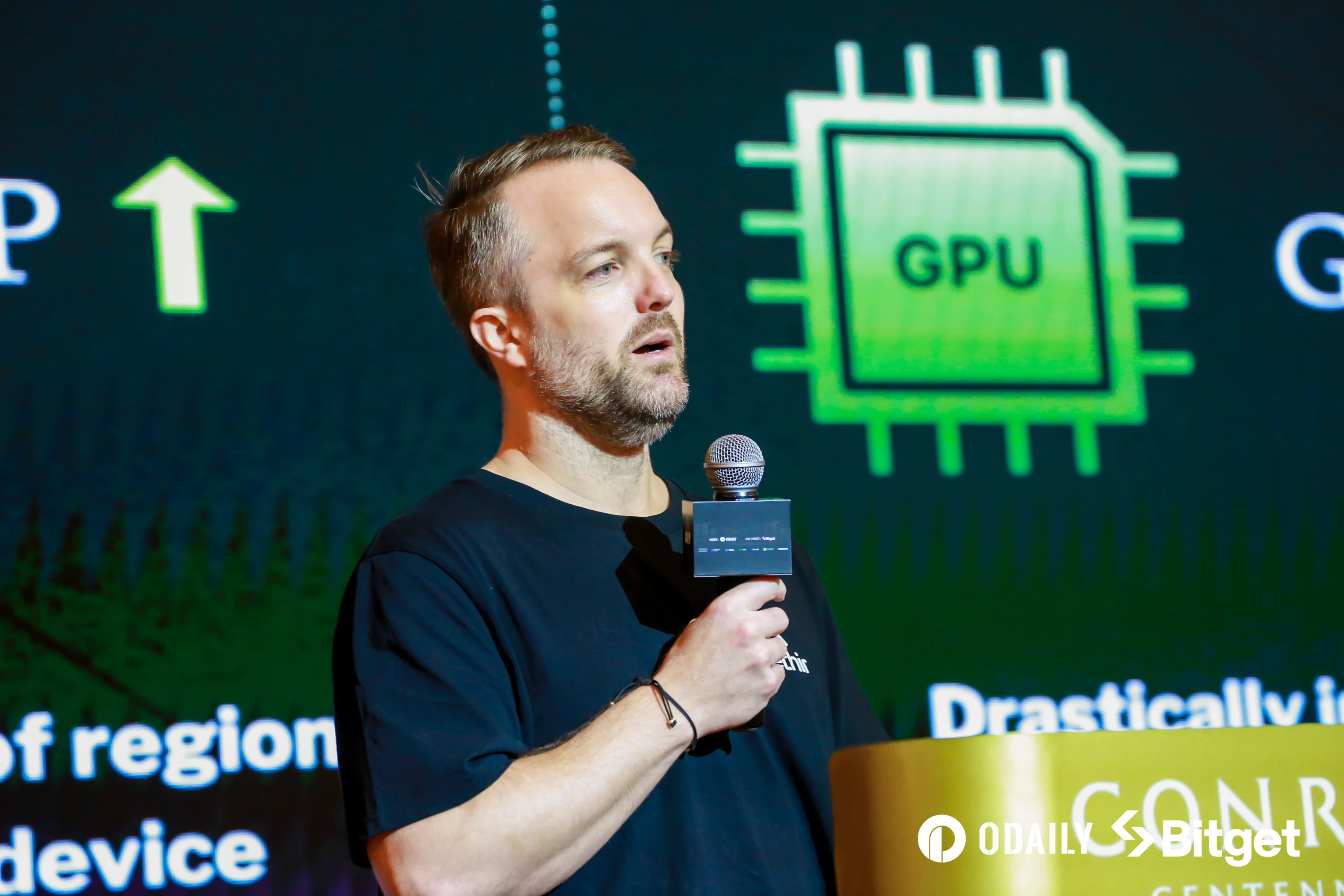
The following is the full text of Mark's on-site speech, edited and organized by Odaily Planet Daily, enjoy~
Thank you very much for inviting me to participate in this event, and I would like to thank Odaily for hosting this grand event. First, let me briefly introduce myself. I am Mark, the co-founder of Aethir. We founded this company in Beijing, and I am very fond of the crypto community in China. I am delighted to share the work we have done at Aethir here.
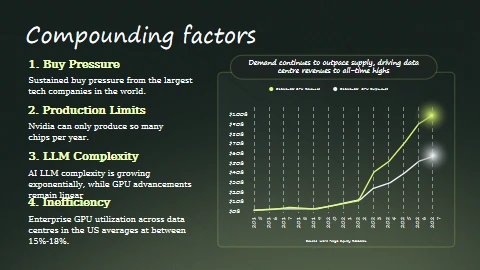
I believe you may have seen reports in the media about the global shortage of GPU resources. Musk once mentioned that GPUs are harder to buy than drugs; Zuckerberg has invested heavily in GPUs; Musk has also launched massive data centers, which are absolutely necessary for AI, as AI systems cannot be built without GPUs. However, the problem is not just a simple scarcity of resources. We have broken down this problem into four key parts.
First is the supply pressure, as there is a huge demand for GPU purchases in the market. The high demand for GPUs from large companies puts tremendous pressure on the supply side, leading to the second problem—production limitations.
NVIDIA can only produce a certain number of chips each year, and their manufacturing is limited by the supply of raw materials. These chips are usually allocated to large tech companies, making it difficult for startups to obtain these resources.
The third problem is the complexity of large language models (LLMs), such as ChatGPT 3, 4, and the recently released GPT-4o. As the performance of these models improves, their training costs also increase exponentially. The training cost of ChatGPT 4 is much higher than that of ChatGPT 3, and this cost increase is due to the additional computing resources and data requirements. However, despite the exponential growth in demand, the performance improvement of the models is not exponential but linear. Therefore, the current processing power and demand are increasing, but the performance improvement is not proportional.
The last point, which is also the most relevant to Aethir, is the efficiency issue. The GPU utilization in data centers around the world is very low, with the chip utilization rate being only about 15%.
So, what have we built? We have built a decentralized cloud infrastructure and a foundational layer that allows decentralized GPUs to connect and be reallocated to the demand side of the market, utilizing those "lost supplies."
Companies like AWS, Google, and Azure have the ability to aggregate your assets and reallocate them to external users. It operates like Airbnb, but without the support of infrastructure, you cannot push these resources to the market, and this is exactly how we approach GPUs. We aggregate from data centers, enterprises, and anywhere with high-performance GPUs to meet the needs of our customers.
What does our product look like? Its operation is very simple. Users can purchase computing power according to their needs, choosing specific GPU quantities, regions, and durations. Decentralization does not mean there is no centralized hosting. In fact, large-scale training requires centralized hosting of GPUs, which has tremendous advantages. This is why billions of dollars are invested in these data centers. There are many high-quality clusters in the entire network that can support large-scale training in the deployment structure.
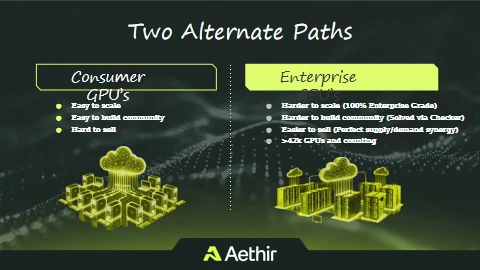
So, what sets Aethir apart? From a deep perspective, the purpose of a decentralized physical infrastructure network is to build a network goal and be managed by a centralized organization. We provide services to customers by aggregating GPU networks and only aggregate enterprise-level GPUs, so all our GPUs are enterprise-level infrastructure. This means that our network can meet the needs of any enterprise customer in the Web3 field.
The traditional challenge is that aggregating consumer hardware may be a better choice. Usually, this hardware comes from ordinary users who become part of the network and contribute to it. It is common to build a network around consumer hardware, but there is a challenge in selling these hardware, as they come from personal computers (PCs) within the community, and establishing trust is a challenge. It is very difficult to build an enterprise-level network based on consumer devices, while our solution has a higher revenue ceiling from an income perspective.
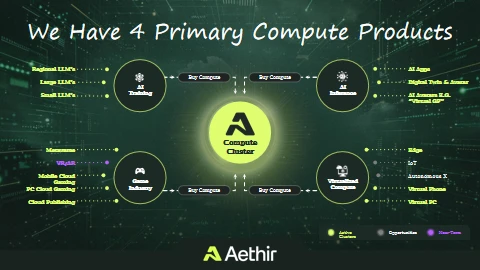
Here are our computing products. First is the H100 GPU, which is currently one of the top GPUs. In the upper right corner is AI inference, which is the technical term for the execution of AI tasks, such as the operation process of ChatGPT, which is called inference. AI applications mainly rely on this part. Below is the gaming industry, including PC cloud gaming, cloud publishing, and virtual computing, and we also support innovative cloud mobile virtualization services, such as serving Chinese mobile users.
Many people know Aethir because of our achievements in the AI field, but I would like to talk about our work in the gaming sector. The vast majority of gamers worldwide use low-end devices, and many of the most popular games globally are inaccessible to these users because their devices lack the performance to run these computationally intensive games. This means that 2.8 billion users worldwide are unreachable for large game companies, which is a difficult problem to solve.
So, how do we solve this problem? There are three scenarios:
- Give users more funds so they can afford high-performance devices, but this possibility is unlikely.
- Improve technology to democratize hardware, but this is also not very practical.
- Use existing technology to transfer the computing demands of games from local devices to the cloud and allow users to play games without high-performance hardware through streaming. The challenge is how to effectively scale this solution. This is where DePIN excels, as it is far superior in scalability and cost-effectiveness compared to expensive centralized computing solutions. Aethir has been building this system from the beginning, and we have already expanded it in the Asian region. I believe this will enable everyone to participate in gaming.
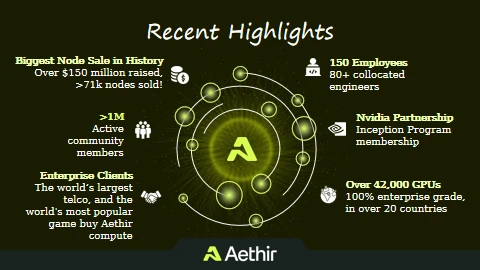
Here are some recent important achievements. We currently have 190 employees, with 100 of them being engineers responsible for centralized hosting. A few weeks ago, we were listed on a Korean exchange.
Next, let me introduce Aethir Edge, which is our physical mining equipment. This device is produced in collaboration with world-class semiconductor companies such as Qualcomm. It connects to your WiFi and passively operates as an edge computing node, allowing us to process enterprise tasks for users, and can even run some mobile games. As the application of small language models increases, these devices will become more popular. It can not only run Aethir's token mining but also provide computing resources for other projects, allowing more projects to access Aethir's computing power. Currently, 25,000 units of this device have been sold, and we are expanding distribution channels, having obtained permission to enter the US market. You can visit myedge.io for more information. We have also leased Mandala, which can be accessed and experienced in the next three days.
You can join as an Aethir computing power supplier through the official application link.
免责声明:本文章仅代表作者个人观点,不代表本平台的立场和观点。本文章仅供信息分享,不构成对任何人的任何投资建议。用户与作者之间的任何争议,与本平台无关。如网页中刊载的文章或图片涉及侵权,请提供相关的权利证明和身份证明发送邮件到support@aicoin.com,本平台相关工作人员将会进行核查。