TL;DR
The AI Agent project is a popular and mature type of enterprise service in the Web2 entrepreneurship, while in the Web3 field, model training and platform aggregation projects have become mainstream due to their key role in building ecosystems.
Currently, the number of Web3 AI Agent projects is small, accounting for 8%, but their market value share in the AI track is as high as 23%, demonstrating strong market competitiveness. It is expected that with the maturity of technology and increasing market recognition, there will be multiple projects with a valuation exceeding 1 billion USD in the future.
For Web3 projects, introducing AI technology for non-core application products may become a strategic advantage. The combination of AI Agent projects should focus on the construction of the entire ecosystem and the design of token economic models to promote decentralization and network effects.
AI Wave: The Current Situation of Project Iteration and Valuation Rise
Since the launch of ChatGPT in November 2022, it has attracted over 100 million users in just two months. By May 2024, ChatGPT's monthly revenue had reached an astonishing $20.3 million. After releasing ChatGPT, OpenAI quickly launched iterations such as GPT-4 and GP4-4o. This rapid trend has made major traditional tech giants realize the importance of cutting-edge AI model applications, leading them to launch their own AI models and applications. For example, Google released the large language model PaLM2, Meta introduced Llama3, and Chinese companies launched Wenxin Yiyuan and Zhipu Qingyan, among other large models. It is evident that the AI field has become a battleground for competition.
The competition among major tech giants has not only driven the development of commercial applications, but also led to a significant increase in the number of AI-related projects on GitHub, reaching approximately 1.8 million in 2023, reflecting the enthusiasm of the global developer community for AI research. The investment market for AI has shown strong growth, with a total of 16 AI-related investments exceeding $150 million globally in the second quarter of 2024, doubling from the first quarter. The total financing amount for AI startups soared to $24 billion, doubling year-on-year. Among them, Musk's xAI raised $6 billion, with a valuation of $24 billion, becoming the second highest valued AI startup after OpenAI.

2024 Q2 AI Track Financing TOP10, Source: EO Company, https://www.iyiou.com/data/202407171072366
The rapid development of AI technology is reshaping the landscape of the technology sector at an unprecedented speed. From the fierce competition among tech giants to the flourishing development of open-source community projects, and the enthusiastic pursuit of AI concepts in the capital market, projects are emerging continuously, investment amounts are reaching new highs, and valuations are soaring. Overall, the AI market is in a period of rapid development, with significant progress in large language models and retrieval-enhanced generation technology in the field of language processing. However, these models still face challenges when translating technological advantages into practical products, such as model output uncertainty, the illusion risk of generating inaccurate information, and model transparency issues, which become particularly important in applications with high reliability requirements.
In this context, we began to research AI Agent, as it emphasizes the comprehensive solution to practical problems and interaction with the environment. This shift signifies the evolution of AI technology from pure language models to intelligent systems that can truly understand, learn, and solve real-world problems. Therefore, we see hope in the development of AI Agent, as it is gradually bridging the gap between AI technology and practical problem-solving. The evolution of AI technology continues to reshape the architecture of productivity, while Web3 technology is reconstructing the production relations of the digital economy. When the three major elements of AI—data, models, and computing power—merge with the core concepts of Web3, such as decentralization, token economics, and smart contracts, we foresee the emergence of a series of innovative applications. In this promising intersection, we believe that AI Agent, with its ability to autonomously execute tasks, demonstrates tremendous potential for large-scale applications. Therefore, we have begun in-depth research on the diverse applications of AI Agent in Web3, covering multiple dimensions such as Web3 infrastructure, middleware, application layers, data, and model markets, aiming to identify and evaluate the most promising project types and application scenarios, in order to gain a deep understanding of the deep integration of AI and Web3.
Concept Clarification: Introduction and Classification Overview of AI Agent
Basic Introduction
Before introducing AI Agent, in order to help readers better understand its definition and the difference of the model itself, we use a practical scenario as an example: Suppose you are planning a trip. Traditional large language models provide destination information and travel advice. Retrieval-enhanced generation technology can provide richer, more specific destination content. AI Agent is like J.A.R.V.I.S. in the Iron Man movie, able to understand your needs, actively search for flights and hotels based on your input, execute booking operations, and add the itinerary to your calendar.
The industry generally defines AI Agent as an intelligent system that can perceive the environment and take corresponding actions, acquire environmental information through sensors, process it, and influence the environment through actuators (Stuart Russell & Peter Norvig, 2020). We believe that AI Agent is an assistant with the ability to integrate LLM, RAG, memory, task planning, and tool usage. It can not only provide information, but also plan, decompose tasks, and truly execute them.
Based on this definition and characteristics, we can see that AI Agent has long been integrated into our lives and applied in different scenarios, such as AlphaGo, Siri, and Tesla's L5-level and above autonomous driving. The common feature of these systems is their ability to perceive user input and make corresponding impacts on the real environment.
Using ChatGPT as an example for concept clarification, we should clearly point out that Transformer is the technical architecture that constitutes AI models, GPT is a model series developed based on this architecture, and GPT-1, GPT-4, and GPT-4o represent different versions of the model at different stages of development. ChatGPT is an AI Agent evolved from the GPT model.
Classification Overview
The current AI Agent market has not yet formed a unified classification standard. We have categorized 204 AI Agent projects in the Web2+Web3 market into primary and secondary classifications based on the significant labels corresponding to each project. The primary classification includes infrastructure, content generation, and user interaction, and is further subdivided based on their actual use cases:
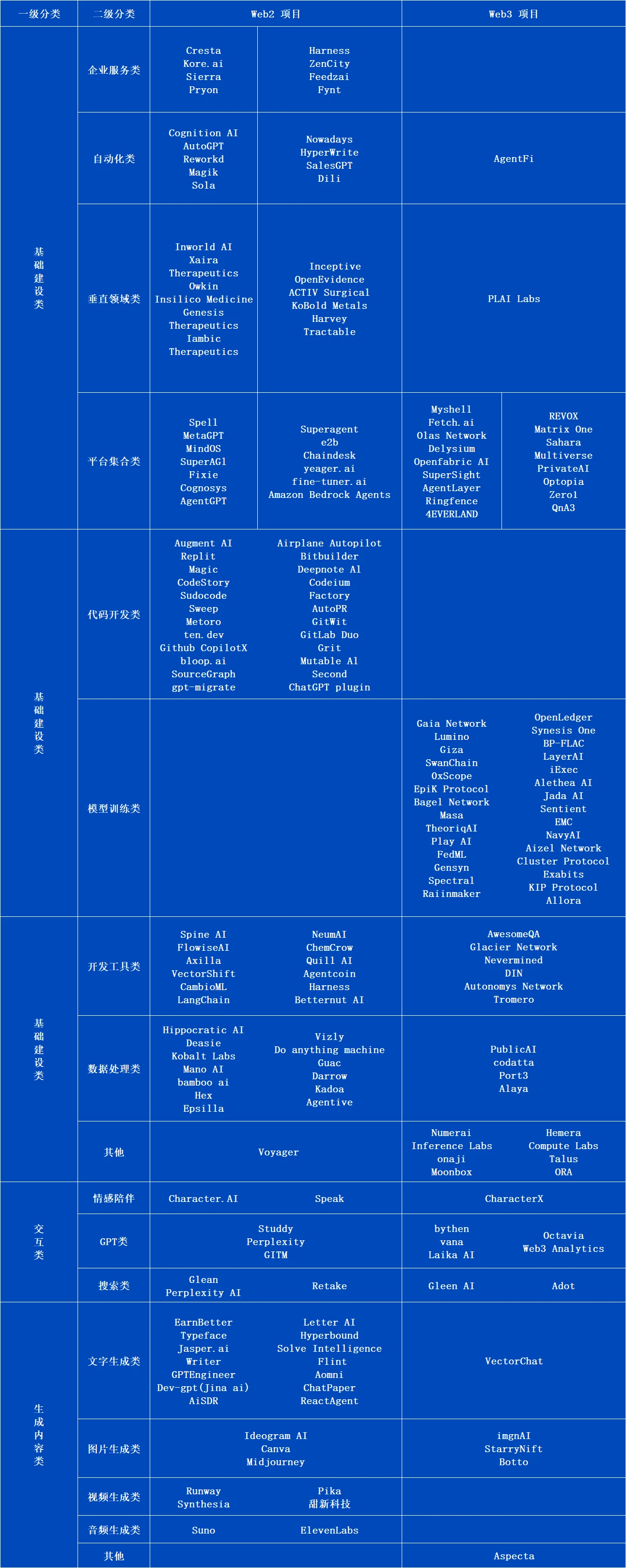
Infrastructure category: This category focuses on building relatively low-level content in the Agent field, including platforms, models, data, development tools, and relatively mature low-level B-end service applications.
Development Tools: Provide developers with auxiliary tools and frameworks for building AI Agents.
Data Processing: Process and analyze data in different formats, mainly used to assist decision-making and provide sources for training.
Model Training: Provide model training services for AI, including inference, model establishment, and configuration.
B-end Services: Mainly targeting enterprise users, providing enterprise services, vertical solutions, and automated solutions.
Platform Aggregation: Integrating multiple AI Agent services and tools on a platform.
Interaction: Similar to content generation, but with continuous two-way interaction. Interaction-type Agents not only accept and understand user requests, but also provide feedback through natural language processing (NLP) and other technologies, enabling two-way interaction with users.
Emotional Support: Provides emotional support and companionship through AI Agent.
GPT-based: AI Agent based on the Generative Pre-trained Transformer (GPT) model.
Search: Focuses on search functionality, providing primarily information retrieval-based Agent.
Content Generation: These projects focus on creating content using large model technology to generate various forms of content based on user commands, including text, image, video, and audio generation.
Analysis of the Development Status of Web2 AI Agents
According to our statistics, the development of AI Agents in the traditional Web2 internet shows a clear trend of concentration in specific categories. Specifically, about two-thirds of the projects are concentrated in the infrastructure category, with a majority being B-end services and development tools. We have also conducted some analysis on this phenomenon.
Impact of Technological Maturity: The dominance of infrastructure projects is due to their technological maturity. These projects are usually built on time-tested technologies and frameworks, reducing development difficulty and risk. They serve as the "shovels" in the AI field, providing a solid foundation for the development and application of AI Agents.
Market Demand Driving: Another key factor is market demand. Compared to the consumer market, the enterprise market has a more urgent demand for AI technology, especially in seeking solutions to improve operational efficiency and reduce costs. Additionally, for developers, stable cash flow from enterprises is advantageous for their development of subsequent projects.
Limitations of Application Scenarios: At the same time, we have noticed that the application scenarios of content generation AI in the B-end market are relatively limited. Due to the instability of its output, enterprises tend to favor applications that can reliably improve productivity. This has resulted in a smaller proportion of content generation AI in the project repository.
This trend reflects practical considerations of technological maturity, market demand, and application scenarios. With the continuous advancement of AI technology and further clarification of market demand, we expect that this landscape may be adjusted, but infrastructure projects will remain the solid foundation for the development of AI Agents.
Analysis of Leading Web2 AI Agent Projects

Compilation of leading Web2 AI Agent projects, Source: ArkStream Project Database
We have conducted in-depth exploration of some current Web2 AI Agent projects and analyzed them, using Character AI, Perplexity AI, and Midjourney as examples.
Character AI:
Product Introduction: Character.AI provides AI-based conversational systems and tools for creating virtual characters. Its platform allows users to create, train, and interact with virtual characters capable of natural language conversations and specific tasks.
Data Analysis: Character.AI had 277 million visits in May, with over 3.5 million daily active users, the majority of whom are between the ages of 18 and 34, indicating a youthful user base. Character AI has performed well in the capital market, completing a $150 million financing round, with a valuation of $1 billion, led by a16z.
Technical Analysis: Character AI has signed a non-exclusive license agreement with Alphabet, Google's parent company, for the use of its large language model, indicating that Character AI uses proprietary technology. It is worth noting that the company's founders, Noam Shazeer and Daniel De Freitas, were involved in the development of Google's conversational language model, Llama.
Perplexity AI:
Product Introduction: Perplexity can fetch and provide detailed answers from the internet. By citing and referencing links, it ensures the reliability and accuracy of information, while also educating and guiding users to ask follow-up questions and search for keywords, meeting diverse user query needs.
Data Analysis: Perplexity has reached 10 million monthly active users, with an 8.6% increase in the visitation of its mobile and desktop applications in February, attracting approximately 50 million users. In the capital market, Perplexity AI recently announced a $62.7 million financing, with a valuation of $1.04 billion, led by Daniel Gross, with participants including Stan Druckenmiller and NVIDIA.
Technical Analysis: Perplexity primarily uses fine-tuned GPT-3.5, as well as two large models based on open-source large models: pplx-7b-online and pplx-70b-online. The models are suitable for professional academic research and vertical domain queries, ensuring the authenticity and reliability of information.
Midjourney:
Product Introduction: Users can create various styles and themes of images through Prompts on Midjourney, covering a wide range of creative needs from realistic to abstract. The platform also provides image blending and editing, allowing users to overlay and style transfer images, with real-time generation ensuring users receive generated images within seconds to minutes.
Data Analysis: The platform has 15 million registered users, with 1.5 to 2.5 million active users. According to public market information, Midjourney has not taken money from investment institutions, relying on the reputation and resources of its founder, David, who has had multiple successful entrepreneurial ventures, achieving self-sustained development.
Technical Analysis: Midjourney uses its own proprietary model, and since the release of Midjourney V4 in August 2022, the platform has been using diffusion-based generative AI models. It is claimed that the training parameters of the model range from 300 to 400 billion, providing a solid foundation for the diversity and accuracy of the generated images.
Commercialization Challenges
After experiencing multiple Web2 AI Agents, we observed a common path of product iteration: from initially focusing on single refined tasks to later expanding capabilities to handle more complex multi-task scenarios. This trend not only reflects the potential of AI Agents in improving work efficiency and innovation, but also indicates that they will play a more critical role in the future. Through preliminary statistics of 125 AI Agent projects in Web2, we found that projects are mainly concentrated in content generation (such as Jasper AI), development tools (such as Replit), and the largest number in B-end services (such as Cresta). This finding contradicts our initial expectations, as we initially anticipated an explosive growth of AI Agents in the C-end market with the increasing maturity of AI model technology. However, through analysis, we realized that the commercialization path of C-end AI Agents is far more rugged and complex than expected.
Taking Character.AI as an example, on the one hand, Character.AI has the best traffic performance. However, due to its single business model relying on a $9.9 USD subscription fee, it ultimately faced difficulties in monetizing traffic and funding issues, leading to the entire team being acquired by Google. This case reflects the significant challenges in commercializing C-end AI Agent applications, even with good traffic and financing. It indicates that the majority of products have not yet reached the standard of replacing or effectively assisting human work, resulting in a lack of strong willingness from C-end users to pay for current products. In our actual research, we found that many startups have encountered similar problems to Character.AI, indicating that the development of C-end AI Agents is not smooth and requires deeper exploration in technological maturity, product value, and business model innovation to realize their potential and value in the C-end market.
By analyzing the valuations of most AI Agent projects, there is still a potential for the valuations of representative projects in the Web3 market to increase by nearly 10-50 times compared to ceiling projects such as OpenAI and xAI. Undeniably, the ceiling for C-end Agent applications is still high, proving that it is still a promising track. However, based on the comprehensive analysis, we believe that compared to the C-end, the B-end market may be the ultimate destination for AI Agents. By building platforms, enterprises can integrate AI Agents into vertical domains, CRM, and office management software, not only improving operational efficiency for enterprises but also providing a broader application space for AI Agents. Therefore, we have reason to believe that B-end services will be the main direction for the short-term development of AI Agents within the traditional Web2 internet.
Analysis of the Current Development Status and Prospects of Web3 AI Agents
Project Overview
Based on the previous analysis, even AI Agent applications with top financing and good user traffic face challenges in commercial monetization. Next, we will delve into the current development of AI Agent projects in Web3. By evaluating a series of representative projects, including their technological innovation, market performance, user feedback, and development potential, we aim to uncover insightful recommendations. The following image shows several representative projects with high market value and issued tokens:
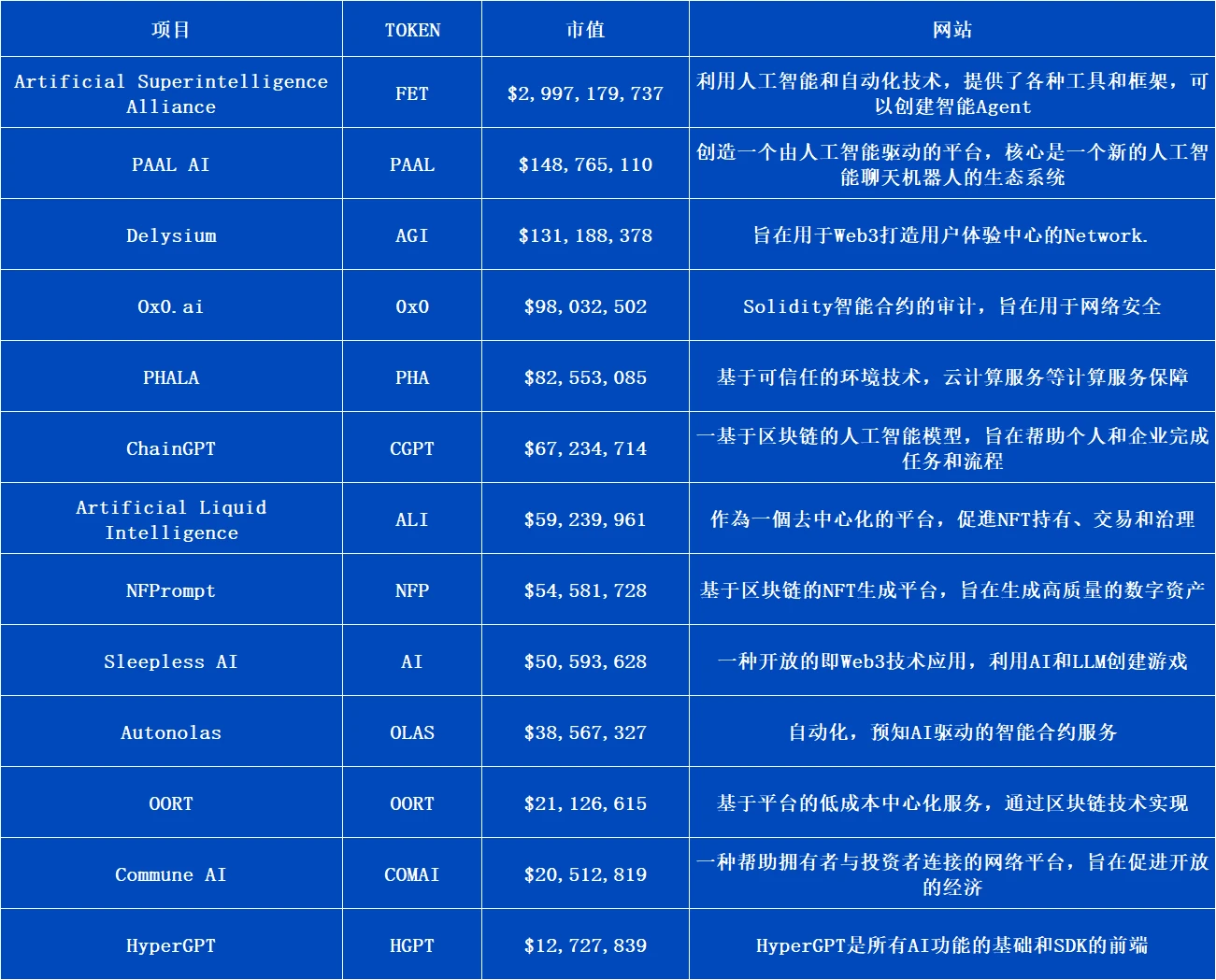
Compilation of leading Web2 AI Agent projects, Source: ArkStream Project Database
According to our statistics on Web3 AI Agent projects, the types of projects being developed also show a clear trend of concentration in specific categories. The majority of projects are categorized as infrastructure, with a relatively small number of content generation projects. Most projects attempt to address the model training needs of project parties by having users provide distributed data and computing power, or by creating an all-in-one platform embedded with various AI Agent application services and tools. These range from development tools to front-end interactive applications and generative applications. The traditional AI Agent industry is currently mainly limited to adjusting open-source parameters or using existing models to build applications, a method that has not yet formed significant network effects at the enterprise and individual user levels.
Current Analysis
We believe that this phenomenon at the current stage may be driven by the following factors:
Mismatch between Market and Technology: The combination of Web3 and AI Agents currently does not have a clear advantage compared to the traditional market. Its real advantage lies in improving production relations and optimizing resources and collaboration in a decentralized manner. This may result in some interactive and generative applications lacking competitiveness in the face of strong traditional competitors in terms of technology and financial strength.
Limitations of Application Scenarios: In the Web3 environment, there may not be as much practical demand for generating images, videos, or text content. Instead, the decentralized and distributed nature of Web3 is more often used to achieve cost reduction and efficiency improvement in the traditional AI field, rather than expanding new application scenarios.
We believe the root of this phenomenon can be traced back to the current development status of the AI industry and its future direction. It may be because current AI technology is still in its early stages, similar to the transition period when the steam engine was replaced by the electric motor in the early stages of the industrial revolution, and has not yet reached the electrification era of widespread application.
We have reason to believe that the future development trend of AI may follow a similar path. General models will gradually solidify, while fine-tuned models will show diversified development. AI applications will be widely dispersed among various enterprises and individual users, with a focus on interconnection and interaction between models. This trend aligns well with the concept of Web3, as its composability and permissionless nature coincide with the decentralized model fine-tuning concept. Developers are allowed greater freedom to combine and adjust various models. Additionally, the decentralized nature provides unique advantages in data privacy protection, computing resource allocation, and other aspects for model training.
With technological advancements, especially the emergence of new technologies such as Low-Rank Adaptation (LoRA), the cost and technical barriers of model fine-tuning have been significantly reduced. This makes it easier for Web3 AI Agent projects to fully utilize this technological progress, exploring novel training methods, innovative incentive mechanisms, and new modes of model sharing and collaboration in the field of model training and fine-tuning, which are often difficult to achieve in traditional centralized systems.
Furthermore, the concentration of Web3 projects in model training also reflects its strategic consideration of occupying an important position in the entire AI ecosystem. Therefore, the concentration of AI Agent projects in the field of model training within the Web3 industry is a natural convergence of technological development trends, market demand, and the advantages of the Web3 industry. Next, we will list a few model training projects in the Web2 & 3 industries and compare them.
Model Training Projects
Humans.ai
Project Introduction: Humans.ai is a diversified AI algorithm model library and training deployment environment, covering multiple domains such as images, videos, audio, and text. The platform not only supports developers to further train and optimize models but also allows them to share and trade their own models. A notable innovation is that Humans.ai uses NFTs as a medium for storing AI models and user biometric data, making the process of AI content creation more personalized and secure.
Data Analysis: The market value of its token, Heart, is approximately $68 million. It has 56k followers on Twitter, and its user data has not been disclosed.
Technical Analysis: Humans.ai does not develop its own models but adopts a modular approach, encapsulating all provided models into NFTs, providing users with a flexible and scalable AI solution.
FLock.io
Project Introduction: FLock.io is an AI co-creation platform based on federated learning technology (emphasizing decentralized machine learning methods with a focus on data privacy). It aims to address pain points in the AI track, such as low public participation, inadequate privacy protection, and the monopolization of AI technology by large companies. The platform allows users to contribute data while protecting privacy, promoting the democratization and decentralization of AI technology.
Data Analysis: It completed a $6 million seed round of financing in early 2024, led by Lightspeed Faction and Tagus Capital, with participation from DCG, OKX Ventures, and other institutions.
Technical Analysis: FLock.io's technical architecture is based on federated learning, which is a method that promotes decentralization while protecting data privacy. In addition, FLock.io also uses technologies such as zkFL, homomorphic encryption, and secure multi-party computation (SMPC) to provide additional protection for data privacy.
This is a model training project of AI Agents in the Web3 industry, and there are similar platforms in Web2 that provide model training services, such as Predibase.
Project Introduction: Predibase focuses on AI and large language model optimization, allowing users to fine-tune and deploy open-source large language models such as Llama, CodeLlama, and Phi. The platform supports various optimization techniques such as quantization, low-rank adaptation, and memory-efficient distributed training.
Data Analysis: Predibase announced the completion of a $12.2 million Series A financing led by Felicis, with large enterprises such as Uber, Apple, Meta, as well as startups like Paradigm and Koble.ai, being users of the platform.
Technical Analysis: Predibase users have trained over 250 models. The platform currently adopts the LoRAX architecture and Ludwig framework: LoRAX allows users to serve thousands of fine-tuned LLMs on a single GPU, significantly reducing costs without affecting throughput or latency. Ludwig is a declarative framework used by Predibase for developing, training, fine-tuning, and deploying state-of-the-art deep learning and large language models.
Project Analysis: Predibase platform features user-friendly characteristics, providing customized AI application building services for users at different levels. For beginners, the platform's one-click automation simplifies the model building and training process, automatically completing complex construction and deployment steps. For experienced users, it provides more in-depth customization options, allowing access to and adjustment of more professional parameter settings. When comparing traditional AI model training platforms with AI projects in the Web3 domain, although they may be similar in overall framework and logic, we found significant differences in technological architecture and business models.
Depth of Technology and Innovation: Traditional AI model training platforms often have deeper technological barriers, such as using self-developed technologies like the LoRAX architecture and Ludwig framework. These frameworks provide powerful functionality, enabling the platform to handle complex AI model training tasks. However, Web3 projects may focus more on decentralization and openness, without delving into deep technology.
Flexibility of Business Models: In the traditional AI model training field, we noticed a common bottleneck in the lack of flexibility in business models. Platforms require users to pay for model training, limiting the sustainable development space of the project, especially in the early stages requiring extensive user participation and data collection. In contrast, Web3 projects may have more flexible business models, such as token economics driven by the community.
Privacy Protection Challenges: Privacy protection is another key issue. Taking Predibase as an example, although it provides virtual private cloud services on AWS, this third-party reliance architecture always carries the potential risk of data leakage.
These differentiated points have become bottlenecks in the traditional AI industry without exception. Due to the characteristics of the internet, these problems are destined to be difficult to solve efficiently. At the same time, this also brings opportunities and challenges to Web3, as projects that first solve these problems are likely to become industry pioneers.
Other Categories of Agent Projects in Web3
After discussing model training AI Agent projects, we will now expand our focus to other types of AI Agent projects in the Web3 industry. These projects may not only focus on model training, but they demonstrate distinctiveness in terms of financing data, performance, and token market value.
Here are several influential and impactful AI Agent projects in their respective fields:
Myshell
Product Introduction: Myshell provides a comprehensive AI Agent platform where users can create, share, and personalize AI agents. These agents can provide companionship and assist in improving work efficiency. The platform covers diverse AI agent styles, including anime and traditional styles, with interaction forms encompassing audio, video, and text. MyShell's uniqueness lies in aggregating various cutting-edge models, including GPT4o, GPT4, and Claude, to provide users with an advanced experience of traditional paid AI agents. Additionally, the platform introduces a trading system similar to an FT bonding curve, incentivizing creators to develop high-value AI models while allowing users to invest and share profits.
Data Analysis: MyShell's last round of financing valued it at approximately $80 million, with Dragonfly leading the investment, and other well-known investors such as Binance, Hashkey, and Folius also participating. Although specific user access data is not available, MyShell has nearly 180k Twitter followers and, while the Discord online user count usually does not exceed one-tenth of the total followers, it demonstrates a loyal user and developer base.
Technical Analysis: MyShell does not independently develop AI models but serves as an integrated platform, bringing together cutting-edge models such as Claude, GPT-4, 4o, and claims to support other closed-source models. This strategy allows MyShell to leverage existing technological resources to provide users with a unified and advanced AI experience.
User Experience: MyShell allows users to freely create and customize AI agents according to their needs, suitable for various scenarios such as personal companionship or professional assistants in audio, video, and other contexts. Even if users do not use MyShell's agents, they can enjoy integrated Web2 paid models at a lower cost. Additionally, the platform combines the concept of FT economics, allowing users not only to use AI services but also to invest in AI agents they favor, increasing wealth through the bonding curve mechanism.
Delysium
Product Introduction: Delysium provides an intent-centric AI Agent network to better collaborate with users and bring a friendly Web3 experience. Currently, Delysium has launched two AI agents: Lucy and Jerry. Lucy is a connected AI agent with the vision of providing tool-assisted functions, such as querying the top 10 holding addresses, but the functionality of executing on-chain intents is not yet open, only being able to execute some basic commands, such as staking AGI or exchanging it for USDT within the ecosystem. Jerry is similar to GPT within the Delysium ecosystem, mainly responsible for answering ecosystem-related questions, such as token distribution.
Data Analysis: It raised $4 million in its first round of funding in 2022 and announced a strategic financing of $10 million in the same year. Its token AGI currently has a fully diluted valuation of around $130 million. There is no latest user data, but according to Delysium's official statistics, as of June 2023, Lucy has accumulated over 1.4 million unique wallet connections.
Sleepless AI
Product Introduction: A emotional companionship game platform that combines Web3 and AI Agent technology, offering virtual companion games HIM and HER, using AIGC and LLM to immerse users in interaction with virtual characters. Through continuous dialogue, users can modify the character's attributes, clothing, etc. The compatible large language model ensures that the character iterates and becomes more understanding of the user in each conversation.
Data Analysis: The project has raised a total of $3.7 million, with investors including Binance Labs, Foresight Ventures, and Folius Ventures. The current total token market value has reached approximately $400 million. It has 116K Twitter followers, with an official statistic of 190K registered reservations and 43K active users. Its user stickiness is quite strong.
Technical Analysis: Although the official source has not disclosed which existing large language model their product is based on, Sleepless AI ensures that users feel the character's increasing understanding during the chat process. Therefore, they individually train a model for each character in LLM training, combined with a vector database and personality parameter system to give characters memory.
User Experience: Sleepless AI approaches through AI Boyfriend, AI Girlfriend, and a Free to Play perspective, not just integrating chatbots. The project greatly enhances the authenticity of virtual characters through high-cost art, continuous iteration of language models, high-quality complete voice-overs, and a range of functions such as alarms, sleep assistance, menstrual cycle tracking, and study companionship. This emotional value is not felt in other applications on the market. Additionally, Sleepless AI has created a longer-term, balanced content payment mechanism, allowing users to choose to sell NFTs without falling into the trap of P2E or Ponzi schemes, considering both player profits and gaming experience.
Outlook Analysis
In the Web3 industry, AI Agent projects cover multiple directions such as public chains, data management, privacy protection, social networks, platform services, and computing capabilities. In terms of token market value, the total token market value of AI Agent projects has reached close to $3.8 billion, while the total market value of the entire AI track is close to $16.2 billion. The market value proportion of AI Agent projects in the AI track is approximately 23%.
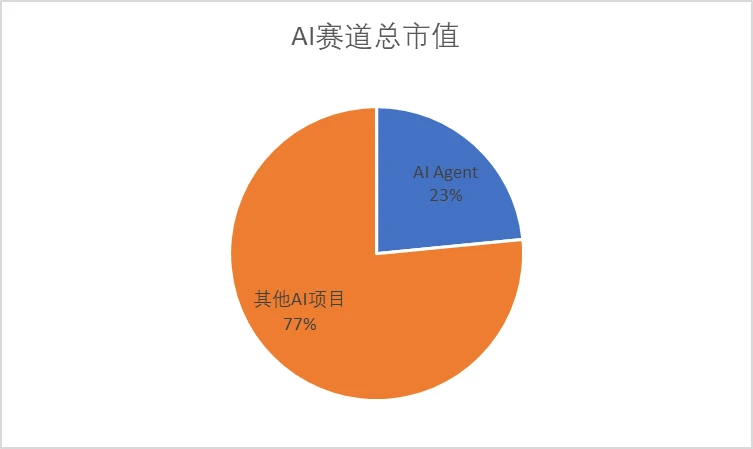
Although the number of AI Agent projects is relatively small, with only about a dozen projects compared to the entire AI track, they account for nearly a quarter of the market value. The market value proportion in the AI track once again confirms the significant growth potential we see in this niche track.
After conducting the statistics, we have raised a core question: What traits do Agent projects need to attract excellent financing and be listed on top exchanges? To answer this question, we explored projects that have achieved results in the Agent industry, such as Fetch.ai, Olas Network, SingularityNET, and Myshell.
It is not difficult to notice that these projects share some significant characteristics: they all belong to the platform aggregation projects in the infrastructure construction category, building a bridge that connects users with Agent demand on the B-side or C-side, and serving developers and validators - those responsible for model debugging and training. Regardless of the application layer, they have established a complete closed-loop ecosystem.
We noticed that whether the products they provide are related to on-chain or off-chain, this does not seem to be the most critical factor. This leads us to a preliminary conclusion: in the Web3 domain, the logic of focusing on practical applications in the Web2 era may not be entirely applicable. For the top AI Agent products in Web3, building a complete ecosystem and providing diverse functions may be more critical than the quality and performance of a single product. In other words, the success of a project depends not only on what it offers but also on how it integrates resources, promotes collaboration, and creates network effects within the ecosystem. The ability to build such an ecosystem may be a crucial factor for AI Agent projects to stand out in the Web3 track.
The correct integration of AI Agent projects in Web3 is not about focusing on the deep development of a single application but should take an inclusive approach. This involves migrating and integrating diverse product frameworks and types from the Web2 era into the Web3 environment to build a self-circulating ecosystem. This is also evident in OpenAI's strategic shift, as they chose to launch an application platform this year instead of just updating models.
In summary, we believe AI Agent projects should focus on the following aspects:
Ecosystem Construction: Beyond a single application, build an ecosystem with multiple services and functions to promote interaction and value addition between different components.
Token Economic Model: Design a reasonable token economic model to incentivize user participation in network construction, data contribution, and computing power.
Cross-Domain Integration: Explore the potential applications of AI Agent in different fields, creating new usage scenarios and value through cross-domain integration.
After summarizing these three aspects, we also provide some forward-looking suggestions for projects with different focuses. One is for non-AI core application-side products, and the other is for native AI Agent projects.
For non-AI core application-side products:
Maintain a long-term perspective, integrate AI technology while focusing on their core products, and wait for the right timing. In the current technological and market trends, we believe that using AI as a traffic medium to attract users and enhance product competitiveness has become an important means of competition. Although the actual contribution of AI technology to the long-term development of projects is still a question mark, we believe this provides valuable opportunities for early adopters who dare to adopt AI technology. Of course, the premise is that they already have a very strong product.
In the long run, if AI technology achieves new breakthroughs in the future, projects that have already integrated AI will be able to iterate their products more quickly, seize opportunities, and become industry leaders. This is similar to how live streaming e-commerce gradually replaced offline sales as a new traffic outlet on social media platforms in the past few years. At that time, businesses with excellent products that chose to adapt to the new trend and try live streaming e-commerce immediately stood out with the advantage of early involvement when live streaming e-commerce truly exploded.
In the face of market uncertainty, considering the timely introduction of AI Agent for non-AI core application-side products may be a strategic decision. This can not only increase the market exposure of the product at present but also bring new growth points for the product in the continuous development of AI technology.
For native AI Agent projects:
Balancing technological innovation with market demand is the key to success. In native AI Agent projects, project parties need to focus on market trends, not just technical research and development. Currently, some Agent projects that combine Web3 may be too focused on developing in a single technical direction or have built a grand vision but have not kept up with product development. Both of these extremes are not conducive to the long-term development of projects.
Therefore, we suggest that project parties focus on ensuring product quality while paying attention to market dynamics. At the same time, they should realize that the logic of AI application in the traditional internet industry may not be entirely applicable to Web3. Instead, they need to draw inspiration from projects that have achieved results in the Web3 market. Pay attention to the labels they have, such as core functions like model training, platform aggregation, and the narratives they have created, such as AI modularization, multi-Agent collaboration, etc. Exploring compelling narratives may be the key to the project's breakthrough in the market.
In conclusion, whether it is a non-AI core product or a native AI Agent project, the most critical factor is to find the right timing and technological path to ensure competitiveness and innovation in an ever-changing market. Project parties should observe market trends, learn from successful cases, and innovate to achieve sustained development in the market.
In summary
At the end of the article, we analyzed the Web3 AI Agent track from multiple perspectives:
Capital Investment and Market Attention: Although AI Agent projects in the Web3 industry do not have a numerical advantage in listings, they account for nearly 50% of the market valuation, demonstrating high recognition of this track by the capital market. With more capital investment and increased market attention, it is inevitable that more high-valuation projects will emerge in the AI Agent track.
Competitive Landscape and Innovation Capability: The competitive landscape of the AI Agent track in the Web3 industry has not fully formed yet. Currently, there has been no phenomenon-level product similar to ChatGPT in terms of application level, leaving plenty of room for growth and innovation for new projects. With technological maturity and previous project innovations, the track is expected to develop more competitive products, driving the overall valuation of the track.
Emphasis on Token Economy and User Incentives: The significance of Web3 lies in reshaping production relations, allowing the originally centralized process of deploying and training AI models to become more decentralized. Through reasonable token economic design and user incentive schemes, idle computing power or personal data sets can be reallocated, and through solutions such as ZKML, data privacy can be protected, further reducing computing power and data costs, and allowing more individual users to participate in the construction of the AI industry.
In summary, we hold a positive outlook for the AI Agent track. We have reason to believe that there will be multiple projects in the AI Agent track with valuations exceeding $1 billion. Through horizontal comparison, the narrative of AI Agent is compelling, and the market space is large enough. Currently, market valuations are generally low, but considering the rapid development of AI technology, growing market demand, capital investment, and the innovation potential of enterprises in the track, in the future, with technological maturity and increased market recognition, it is expected that multiple projects with valuations exceeding $1 billion will emerge in this track.
免责声明:本文章仅代表作者个人观点,不代表本平台的立场和观点。本文章仅供信息分享,不构成对任何人的任何投资建议。用户与作者之间的任何争议,与本平台无关。如网页中刊载的文章或图片涉及侵权,请提供相关的权利证明和身份证明发送邮件到support@aicoin.com,本平台相关工作人员将会进行核查。


