In the current market, the capital-driven momentum effect is not ideal, due to market fragmentation, high FDV, insufficient liquidity, and lack of innovation leading to reduced speculative opportunities and exacerbating the Matthew effect in the industry.
Author: YBB
Translated by: Plain Blockchain

Key points summary:
Unlike the previous bull market driven by macroeconomic prosperity, the current crypto market is mainly affected by macroeconomic uncertainty.
ETF is just a "buffered ibuprofen," and the trend of cryptocurrencies moving in line with the US stock market has become a limiting factor for the industry's growth.
Currently, it's only a bull market for Bitcoin, and altcoins have not shown any improvement. The main reasons include insufficient innovation in the entire industry, lack of liquidity, and unreasonable primary market valuations, leading to a lack of capital driving force and difficulty in achieving volume-driven growth.
The repetition of the old narrative cannot sustain market value. With traditional institutions like BlackRock entering the scene and the industry lacking innovation, internal competition seems inevitable.
1. Four-year halving cycle: Can it still be the key to a bull market?
1) The starting point of this bull market is completely different
Bitcoin was born against the backdrop of an economic crisis, perhaps to counter the excessive issuance of national fiat currencies and currency policy intervention. Looking back at its development, it is undeniable that before Bitcoin was widely banned in China in 2021, China was the main force driving the industry's growth, once occupying two-thirds of the global mining share. At the same time, with the prosperity of real estate and the Internet, the macroeconomy also experienced significant development. Until 2021, the overall macroeconomic environment was positive, with central banks around the world continuously injecting liquidity into the market, fueling investors' optimism. However, after 2020, the real estate market cooled down, coupled with a more widespread economic slowdown, leading to a depletion of market liquidity in some areas.
From an innovation perspective, the DeFi Summer sparked an internal economic cycle within Ethereum, becoming the main driving force behind its explosive growth. Subsequently, NFTs, MEME, and GameFi continued to attract a large amount of resources, sometimes even triggering a frenzy of digital collectibles. The growth in market value drove the expansion of the industry. However, this time, most of the industry's innovations are mostly rehashed old concepts, and perhaps the bull market has not yet arrived, as new narratives have not had a significant impact.
If we consider the period from early 2019 to early 2021 as the start of the bull market, the price of Bitcoin was between $4,000 and $10,000, while Ethereum was between $130 and $330. At that time, the overall size of the crypto market was relatively small, with ample room for growth. However, according to data from CompaniesMarketCap, the current market value of Bitcoin ranks tenth globally, just behind Facebook, with about three times the growth potential compared to Apple, and about fifteen times the potential compared to gold. The growth expectations this time are smaller than in the previous cycle.
The growth driven by halving may be the final chapter of this story, as the cyclical growth of the crypto market has always been closely linked to the macroeconomy. Since the birth of the Bitcoin genesis block in 2009, its achievement of a market value exceeding one trillion US dollars cannot be separated from the cyclical injection of liquidity stimulating the economy. In the financial market, the only constant is change, and even if you can hold onto your position, you cannot predict how deep the trough will be.
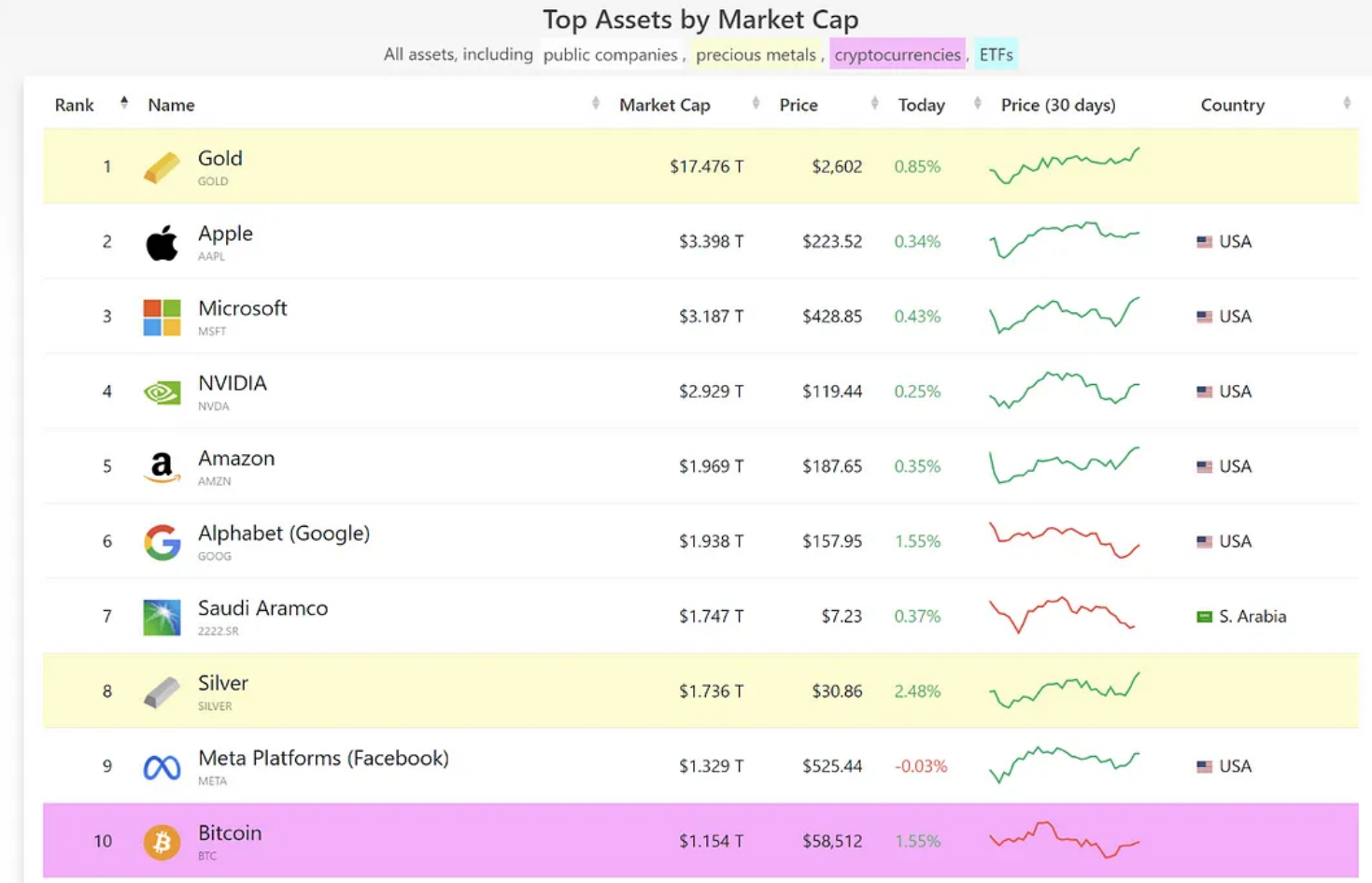
Source: CompaniesMarketCap
2) What is Bitcoin's positioning and future growth potential?
Is Bitcoin's safe-haven status limited to the crypto community?
So far, the US dollar still controls the world through its pricing power. Gold, as a "safe-haven asset" for hedging risks and preserving value, usually sets new highs during major crises. The first gold bull market began after the collapse of the Bretton Woods system following World War II, when the US decoupled the dollar from gold, and geopolitical tensions and inflation were driving forces. The second bull market started in 2005, with the price of gold soaring. After the subprime mortgage crisis, a large amount of funds flowed into gold for hedging, and the bull market eventually ended after the Libya war in 2011, with geopolitical tensions again being the main factor. The turning point of the third bull market appeared in 2018, with the global COVID-19 pandemic and central bank liquidity injections being key driving forces, and local geopolitical conflicts also boosting the rise in gold prices. Gold has always been the first choice for risk hedging, and the Federal Reserve's quantitative easing policy and geopolitical factors are the main drivers of the rise in gold prices.
As of Thursday, September 12th (Beijing time), spot gold rose by 1.84% to $2,558.07 per ounce, setting a new historical high. Spot silver rose by 4.19% to $29.8792 per ounce; COMEX gold futures rose by 1.78% to $2,587.6 per ounce, also setting a new high (data source: Forward Research Institute). The claim that Bitcoin is a safe-haven asset, like gold, seems to have been overturned, as Bitcoin did not follow suit when gold soared, but instead its trend was more in line with the US stock market.
The greatest value of Bitcoin: a tool to resist economic sanctions and lack of trust in fiat currencies
In the context of economic globalization, countries all hope to internationalize their national currencies for global transactions, reserves, and settlements. However, this goal is constrained by the "trilemma" of monetary sovereignty, capital liquidity, and fixed exchange rates. Referring to the views in "Currency Wars," paper money itself has no intrinsic value—its value comes entirely from the support of national credit. Whoever controls a country's currency issuance can bypass that country's legal framework. Even the mighty US dollar, which has long maintained its massive credit endorsement, faces difficulties. Economic globalization itself contains contradictions between global currency dominance and national interests. For example, El Salvador has implemented a "dual currency" policy, promoting the use of Bitcoin nationwide to weaken the influence of the US dollar; and from September 2024, Russia will allow residents to conduct cryptocurrency transactions and use them for trade settlements to circumvent sanctions.
Bitcoin's dilemma: its value comes from hedging the risk of trust in fiat currencies, but its upward momentum still depends on the policies of powerful countries, the acceptance of monopoly capital, and the macroeconomic environment.
2. ETF is only a short-term pain reliever, not a fundamental solution
1) The post-ETF era of cryptocurrencies: the failure of the struggle for power

Source: The Guardian-News
Bitcoin was born against the backdrop of an economic crisis, and the unique properties of blockchain can resist the excessive issuance of sovereign currencies and currency policy intervention. Anti-authority, pursuit of freedom, and decentralization were once our beliefs and slogans. However, various "players" in the industry have speculative motives, and the dream of getting rich overnight seems to have become the main driving force behind industry growth. But in the end, Bitcoin ETFs are just a one-time, inevitable booster.
We once had a belief in resisting authority, but now we rely on that authority. In our crypto utopia, it seems that only profits matter, not direction. The market continues to cheer for positive news related to ETFs, hoping to bring in more funds as liquidity for exits. The community that once resisted authority is gradually handing over its labor achievements to this authority.
BlackRock, Vanguard, and Fidelity are companies that rule the world, and today, BlackRock is gradually taking control of Bitcoin.
Who are the most powerful companies in the world? Apple, Tesla, Google, Amazon, Microsoft? In fact, none of them. The real answer is the global asset management giants mentioned earlier. BlackRock has held the title of the world's largest asset management company for 14 consecutive years from 2009 to 2023.
The direct impact of the post-ETF era is that prices will become more aligned with traditional financial markets. Only those who hold the most tokens will have the most say, and the United States is gradually gaining ideological control in the crypto industry. According to a report from QCP Capital on September 10, 2024, macroeconomic uncertainty still dominates the crypto market, with Bitcoin's 30-day correlation with the MSCI Global Stock Index reaching 0.6, the highest level in nearly two years.
Undoubtedly, cryptocurrencies initially sprouted in China, but the "big players" have now changed. More professional competitors are on their way. In the future, it will not only be necessary to choose brand IPs and industry focuses, but also to have strong trading and execution capabilities. The Matthew effect will permeate every corner of the industry, and the crypto world is steadily evolving towards "Wall Street-level" trading complexity.
2) The Metaphor of the "Gold Rush"
Looking back at the California Gold Rush over a hundred years ago, hundreds of thousands of people flocked to California from around the world with dreams of getting rich overnight. However, most returned empty-handed, and some even lost their lives. In contrast, Levi Strauss took a different path. He used the gold rush to sell a large inventory of canvas and turned it into durable work pants, which were popular among gold prospectors due to their practicality. Later, he further improved these pants and became the founder of blue jeans, creating the globally renowned Levi’s brand.
Interestingly, Bitcoin's proof-of-work (PoW) mining and Ethereum's proof-of-stake (PoS) staking have astonishing similarities to this. The PoW mining frenzy prompted "prospectors" to carry mining machines, while PoS staking allowed them to use capital as a tool. However, characters like "Levi Strauss" are everywhere in this gold rush. Miners chase the dream of getting rich overnight, while "Levi Strauss" characters target the miners' funds. The 24/7 global crypto market provides countless opportunities for these "prospectors," but it also makes the market highly volatile. High risk accompanies high returns, and profit and risk constantly test everyone's courage and diligence.
The fast pace, continuous trading, and highly volatile market are both enticing traps and endless trading opportunities, which is the allure of cryptocurrencies. The combination of strong financial attributes and low barriers makes cryptocurrencies a natural high-quality "gold mine." While we cheered for ETFs, hoping they would bring in more external funds, the reality is that ETFs are opening the door for more "Levi Strauss" characters.
More "Levi Strauss" characters will enter the crypto market
The launch of ETFs will not only bring in external funds as "exit liquidity," but will also attract risk hedgers. The biggest innovation in blockchain so far is the on-chain finance, which has established a "self-sustaining economic cycle" within the crypto market, effectively avoiding direct intervention from the powerful and "old capital." However, in the post-ETF era, cryptocurrencies to some extent are handing over comprehensive financial derivatives to these forces, further attracting more arbitrageurs and large capital, squeezing the already limited market profit space.
3. Difficulty Breaking Through the Primary Market
The primary market has poor liquidity and high fully diluted valuation (FDV)
Recently, compared to the past, tokens issued in the primary market generally exhibit extremely high fully diluted valuations (FDV) and low liquidity. According to Binance's report "Observations and Reflections on Overvalued and Illiquid Tokens," the ratio of market capitalization (MC) to fully diluted valuation for tokens issued in 2024 is the lowest in recent years. This indicates that a large number of tokens are yet to be unlocked in the future, and by the first few months of 2024, the fully diluted valuation of issued tokens had already approached the total FDV of all tokens issued in 2023.
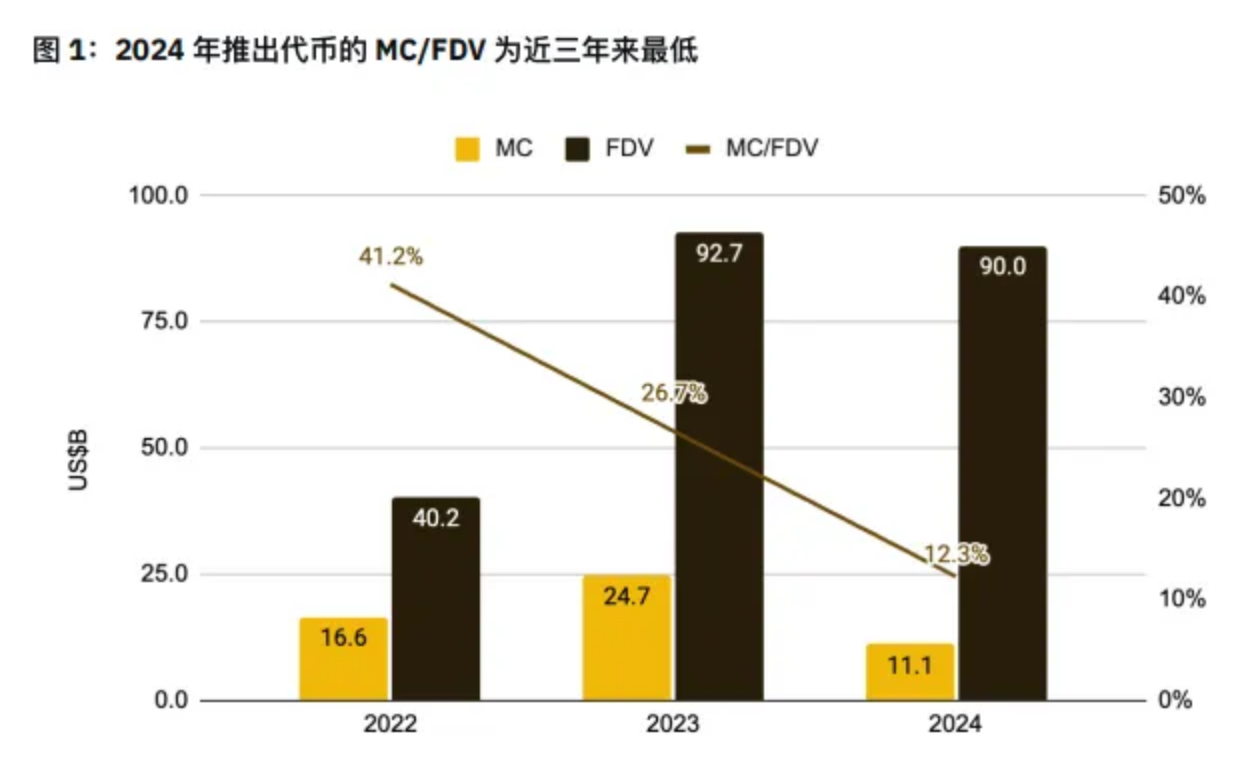
Source: @thedefivillain, CoinMarketCap, and Binance Research Institute, data released on April 14, 2024
In a market with low liquidity, tokens will continue to unlock after the TGE (Initial Token Offering), creating tremendous selling pressure. But have VCs (venture capitalists) really made money in this round? Not necessarily. In most cases, compliant and regulated projects require tokens to undergo at least a one-year cliff period before unlocking and release. In the case of high FDV and low liquidity, projects may experience a sharp price drop due to token unlocking, although small VCs may still sell in the secondary market or through off-market presales.
As shown in the chart below, the circulating supply ratio of these tokens is less than 20%, with the lowest being as low as 6%, highlighting the severe reality of high FDV.
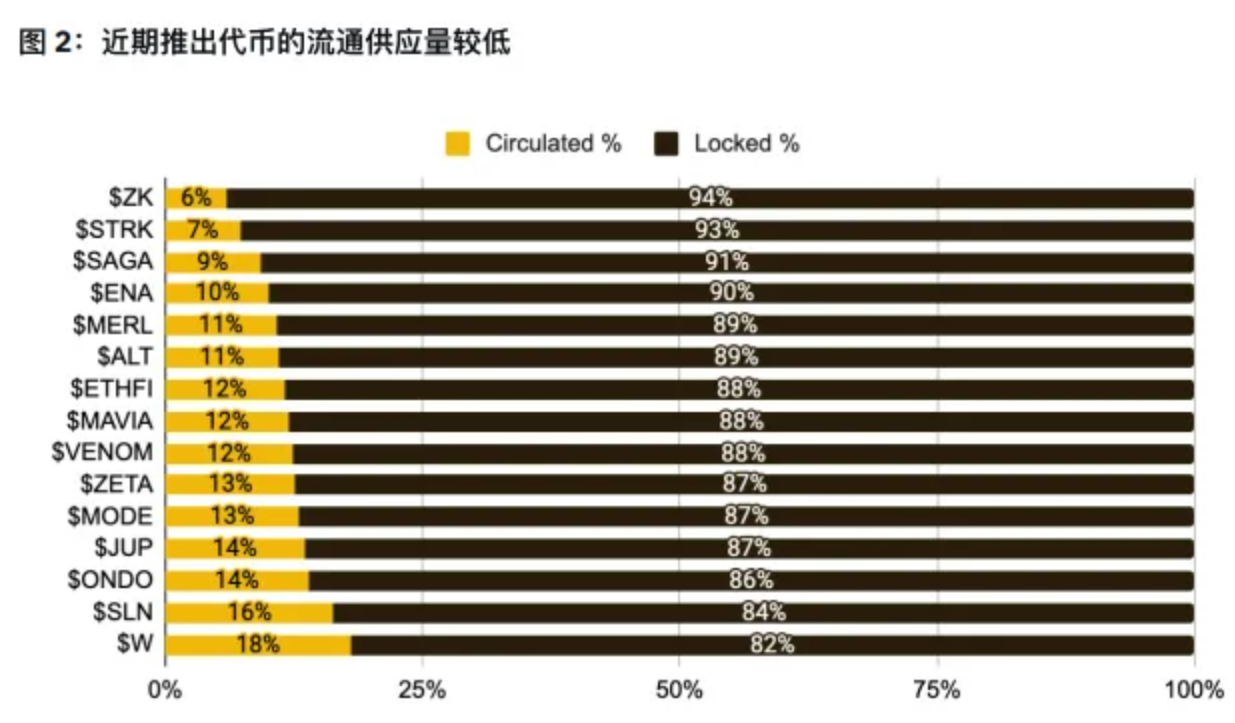
Source: CoinMarketCap and Binance Research Institute, data released on May 14, 2024
4. Conclusion
Clearly, the capital-driven momentum is currently not effective. In addition to the above factors, there are other objective factors leading to low liquidity and high FDV:
1) Market fragmentation and excessive competition: In the previous cycle, domestic and foreign capital joined forces to hype DeFi and Layer-1 chains. However, in this cycle, funds and participants are dispersed across multiple narratives, with Western and Eastern capital often not supporting each other's projects. This has led to a shortage of buyers to meet the quantity of sellers.
2) Lack of a bull market for altcoins, lack of speculation: The infrastructure of chains based on EVM has matured, and funds and projects are striving in the same direction. The so-called "Ethereum killers" have not brought about new breakthroughs. Furthermore, in a market without a bull market for altcoins, when a project succeeds in a certain area, imitating projects quickly emerge, claiming to be the next undervalued opportunity.
3) Complicating simple problems and turning complexity into a story: Pseudo-innovation is everywhere, and the phenomenon of overcomplicating simple problems is widespread. Repackaging old concepts is often just a way to market a bigger dream to the market.
4) The Matthew effect is everywhere: The crypto industry has been developing for over 16 years, and the monopoly interests at the top have become basically solidified. Whether in technology, projects, or capital, the strong get stronger and the weak get weaker. Those who have survived to this day have further consolidated their control over the narratives.
5) Challenges to sustainable growth: Lack of innovation and liquidity are the most urgent challenges facing the market at present.
Original article link: https://www.hellobtc.com/kp/du/09/5416.html
Source: https://medium.com/ybbcapital/stagnation-bubble-crisis-breakthrough-e123966e4f73
免责声明:本文章仅代表作者个人观点,不代表本平台的立场和观点。本文章仅供信息分享,不构成对任何人的任何投资建议。用户与作者之间的任何争议,与本平台无关。如网页中刊载的文章或图片涉及侵权,请提供相关的权利证明和身份证明发送邮件到support@aicoin.com,本平台相关工作人员将会进行核查。


