🧐 "WeChat Mini Program The Matrix" of WEB3 | Whoever can make encryption technology simpler can become the next king—
Having been in the industry for a long time, I have come into contact with a large number of people who want to participate in Crypto, from the sanctity of private property, the underlying logic of cryptocurrency, to the wealth effect, and how to benefit from cryptocurrency, etc.
Everyone's eyes are shining, and everyone is full of expectations for this familiar yet unfamiliar field, because it is full of money and temptation here.
But when it comes to practical operations, everyone feels that it's too complicated. Creating wallets, storing mnemonic phrases and private keys, interacting on the chain, and other things have led most people to choose to give up.
Perhaps for those of us familiar with cryptocurrencies, creating and using wallets is as simple as it gets, but for newcomers, this step is as difficult as asking your 80-year-old grandfather to play Honor of Kings.
On one hand, cryptocurrency technology is constantly iterating, and there are endless innovations in gameplay. On the other hand, there are a large number of new groups outside the circle who are trapped in the "investment deadlock" due to the threshold issue.
I believe this is the most urgent problem at present. While insiders always think about "breaking the circle" to attract external groups, the reality is that a bunch of newcomers are impatiently stomping their feet outside the door, which is very fragmented.
This dilemma is extremely similar to the early days of the Internet.
In 1994, Yang Zhiyuan was preparing his graduation thesis at Stanford and found it very inconvenient to search for information on the Internet. Users had to remember the website addresses of each site and then enter the addresses to visit them. So they came up with a solution, which was to classify and organize numerous website addresses and put them into the software they wrote, allowing users to find the desired websites through their software. Thus, Yahoo was born and became synonymous with the Internet.
Yahoo only did classified search, like a phone book, directly listing everything you could do on the Internet, allowing you to search on your own. This step directly shook the Internet.
In summary, in the era of WEB3 on the Internet, whoever can efficiently and conveniently transmit information, whoever can break the boundaries between WEB2 and WEB3, can grasp the wealth code and become the next version's successor.
Imagine if users could interact with blockchain services using familiar interfaces (such as social login) without needing deep technical knowledge. Wouldn't this break through the current bottleneck and bring in a large number of users?
Therefore, whoever can efficiently and conveniently transmit value, whoever can complete this action more conveniently, can grasp the wealth code of the encryption era.
The functionality introduced today has shown some initial effectiveness, and the core is what we are going to talk about today, the WEB3 WeChat Mini Program The Matrix!
If you can send BTC transfers to your friends while chatting without leaving the chat app, just like sending WeChat red packets, isn't that a cool thing to hear?
Now, in the world of WEB3, this is about to become a reality—
Its success may set a precedent for how to integrate Web2 and Web3 in the future, focusing on user experience, developer convenience, and widespread adoption.
1️⃣ What is The Matrix?
The Matrix is a one-stop mini-chain ecosystem solution jointly launched by @nubitorg and @tomosocial, aiming to connect Web2 and Web3, creating a seamless user ecosystem.
It is designed as a comprehensive solution for consumer applications, using blockchain technology to make it more popular and accessible.
Specifically:
1) Bridging Web2 and Web3:
The Matrix provides a platform that makes the interaction between traditional Internet (Web2) and decentralized networks (Web3) more seamless.
This means that users can use more familiar Web2 tools and interfaces to experience Web3 functions, such as decentralized finance (DeFi), NFT, etc.
2) Developer tools:
For developers, The Matrix provides tools and frameworks (such as Nubit DA, DeKit, Minichain) that allow them to build applications on the blockchain without involving complex code. This includes no-code tools, simplifying the development process.
3) User experience:
Through cooperation with @tomosocial, The Matrix may integrate social login functionality, allowing users to easily use cryptocurrencies and decentralized applications without deep knowledge of blockchain technology. For example, @tomowallet simplifies the use of cryptocurrencies through social login.
By leveraging platforms with over 900 million users like Telegram, The Matrix aims to transform it into the center of decentralized applications.
2️⃣ Project Background
@nubit_org Nubit was previously a Bitcoin native data availability layer (DA layer), and is now upgraded to a next-generation consumer network that provides a one-stop Minichain construction solution based on the Bitcoin trust mechanism.
Nubit aims to bridge the gap between Web2 and Web3 through the suite of minichain solutions they provide. The project has held an Alpha testnet event and raised $12 million in funding, led by Polychain.
@tomo_social Tomo provides a Web3 social wallet solution aimed at driving the adoption of cryptocurrencies through simplified user experience.
Tomo is a SocialFi application that provides creators with the most feature-rich token social experience, including direct messaging, private rooms, digests, all supported by the ERC 4337 smart wallet;
Tomo's wallet allows users to log in with social accounts, supports multiple chains, and emphasizes bringing Bitcoin into the Ethereum L2, Solana, and Cosmos ecosystems. Tomo also provides developer tools to help dApps integrate wallet services.
In summary, @nubitorg and @tomosocial are each promoting the application and popularization of blockchain technology in their respective fields. Nubit focuses on technical innovation, especially around Bitcoin's scalability, while Tomo focuses on user experience and the integration of social wallets.
3️⃣ Six Components of Matrix
1) Unified Wallet
The unified wallet is the core of Matrix, providing a seamless and secure wallet experience for Web2 users to enter the Web3 world smoothly. The unified wallet, driven by the Tomo Telegram SDK, provides comprehensive support for multiple blockchains, including Bitcoin, Solana, Ethereum, Ton, and other networks, offering users a seamless and powerful multi-chain experience, allowing users to easily access and manage multiple networks in a single, unified wallet.
As a non-custodial wallet, users always maintain complete control over their assets, while enjoying a consistent and user-friendly interface. By supporting social login options such as Google, Apple, Facebook, X (Twitter), GitHub, and Discord, the wallet significantly reduces the entry barrier, enabling users to easily transition to the Web3 domain. In addition, the integrated fiat deposit/withdrawal function further simplifies the process, allowing users to easily deposit and withdraw funds.
The unified wallet becomes the main entry point for Web2 users to experience Web3 blockchain interactions as intuitively as possible.
2) Minichain
Minichain is a dedicated blockchain tailored to specific application needs, designed to ensure the best performance and security within the Matrix ecosystem, providing a flexible, scalable, and independent environment for various decentralized applications (dApps), while settling on major Layer 1 networks such as Ethereum and Bitcoin.
By allowing developers to customize minichains according to application requirements, minichains ensure efficient resource utilization, minimizing redundancy and enhancing performance. This modular approach not only enhances security by isolating the blockchain of each application but also simplifies the upgrade and maintenance process.
As more minichains are deployed, they build a strong and interconnected ecosystem within Telegram, each chain optimized for its specific use case, promoting innovation and specialized dApp development.
3) Universal Bridge
The universal bridge aims to facilitate efficient and secure cross-chain transactions within the Matrix ecosystem, addressing common challenges in cross-chain communication.
Traditional cross-chain transactions are often asynchronous, leading to risks such as incomplete or failed transactions. The universal bridge overcomes these issues by adopting a shared ordering protocol for all minichains, achieving synchronous cross-chain message delivery and atomic transactions across multiple chains. This feature is crucial for executing complex operations such as cross-minichain arbitrage or flash loans, ensuring that all parts of the transaction are completed as expected.
The Universal Bridge also supports gas fee interoperability across minichains, allowing users to seamlessly pay transaction fees between different minichains and promote greater innovation through secure integrated applications. By utilizing Nubit DA for direct data sharing, the Universal Bridge ensures the consistency and reliability of the entire minichain ecosystem, further enhancing cross-chain interactions.
4) Nubit DA (Data Availability)
Nubit DA is the core pillar of data availability within the Matrix, providing a scalable and trustless layer for all minichains to ensure the security and efficiency of data. As the ecosystem expands, the volume of data generated by multiple chains is increasing, making data availability a critical issue.
Nubit DA ensures the accessibility and consistency of data throughout the entire ecosystem by leveraging the unparalleled security of Bitcoin. Nubit DA includes validators, full storage nodes, and light clients, with each component playing a crucial role in maintaining data integrity and availability.
Validators are responsible for proposing and validating blocks, full storage nodes ensure reliable data storage, and light clients verify data availability through sampling. This comprehensive approach not only enhances the security of each chain but also facilitates smooth interaction and data exchange between them, making Nubit DA a key component in maintaining the robustness of the Matrix ecosystem.
5) Decentralization Kit (DeKit)
Decentralization Kit (DeKit) is a developer toolkit designed to simplify the integration of decentralized functionality into Telegram applications, making it more user-friendly for both Web2 and Web3 developers.
Based on the Model-View-Controller (MVC) architecture, DeKit divides the application into three interconnected components—model, view, and controller—allowing developers to separate the internal representation of information from the way it is presented and accepted by users. This architecture is particularly suitable for Web2 developers familiar with frameworks like WeChat Mini Program, helping them transition more smoothly to Web3 development.
DeKit simplifies ledger management, user interface development, and smart contract logic through an easy-to-use API, enabling developers to quickly launch and expand their minichains without worrying about the complexity of underlying technologies. By making decentralized development more convenient, DeKit plays a crucial role in expanding the Matrix ecosystem.
6) Minichain-as-a-Service (MaaS)
Minichain-as-a-Service (MaaS) utilizes DeKit to provide developers with the ability to create and manage custom minichains for specific applications, offering a code-free dashboard that simplifies the traditionally complex process of blockchain deployment, making it user-friendly even for non-technical users.
Through the MaaS platform, developers can configure their minichains, adjust sorters, gas limits, and middleware solutions, and easily deploy their applications. MaaS also integrates infrastructure services such as RPC services, state verification, and chain explorers, which are crucial for maintaining the integrity and performance of minichains.
By reducing the operational burden typically associated with managing blockchain networks, MaaS allows developers to focus on innovation rather than infrastructure management. This comprehensive ecosystem solution covers the entire range of blockchain needs, from infrastructure construction to user participation, ensuring the success of every minichain in the Matrix.
4) Advantages of Matrix
Based on Telegram, which is currently one of the most privacy-focused and widely used social apps globally, similar to developing mini-programs on WeChat, users have already formed usage habits, only requiring expansion in development.
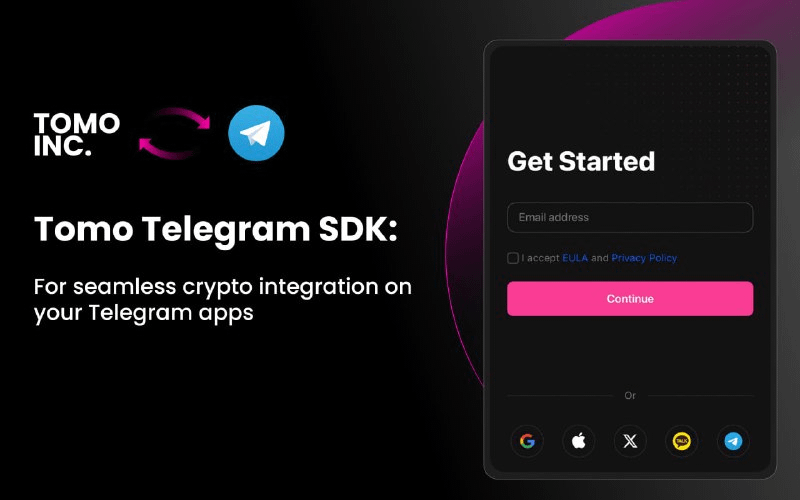
Backed by Tomo, Tomo Telegram SDK provides a simple solution for developers who want to add encryption features to their Telegram Mini Apps. The apps developed by developers allow users to create and manage encrypted wallets using their existing social accounts without complex settings and leaving the application, just like our WeChat wallet function, with features such as instant transfers, group red packets, and enhanced security.
Lowering the entry barrier for WEB2 users, by reducing the complexity of WEB3 and simplifying the usage process, making applications closer to the usage habits of WEB2, can better attract incremental WEB2 users.
5) Conclusion
Today, #Binance launchpool launched $HMSTR; this is a Telegram game based on the TON public chain, with the core gameplay being "Play-to-Earn".
Seeing the universe's largest institution recently betting on the TON ecosystem also shows a very positive outlook for Telegram's user base.
Consumer applications on Telegram/TON are the future trend, and Nubit The Matrix may be the solution!
The Matrix represents not only a technological bridge but also a philosophical shift towards making blockchain technology an indispensable yet inconspicuous part of everyday digital interactions.
By building programs that are closer to the usage habits of WEB2, it narrows the gap between WEB3 and WEB2 applications, making it possible for WEB3 DAPPs to enter every household.
In the future, whoever controls the traffic, controls the distribution of benefits, and holds ultimate power. By integrating with Web2 platforms and providing developer tools, the project not only lowers the barrier to using blockchain applications but also provides new opportunities for developers, heralding the important role of blockchain technology in the future Internet ecosystem.
免责声明:本文章仅代表作者个人观点,不代表本平台的立场和观点。本文章仅供信息分享,不构成对任何人的任何投资建议。用户与作者之间的任何争议,与本平台无关。如网页中刊载的文章或图片涉及侵权,请提供相关的权利证明和身份证明发送邮件到support@aicoin.com,本平台相关工作人员将会进行核查。


