With the development of high-performance blockchain technology, the true value of PayFi will rapidly expand and scale.
By: Shigeru Satou
PayFi, short for Payment Finance, refers to an innovative technology and application model that combines payment functions with financial services in the field of blockchain and cryptocurrency.
The core of PayFi lies in the process of sending, receiving, and settling cryptocurrency, rather than transaction behavior. This model not only covers cryptocurrency payments and transactions, but also includes various financial activities such as lending, wealth management, and cross-border payments. Through decentralized technology, PayFi makes financial activities more efficient, secure, and reduces friction and costs in traditional financial systems, thereby promoting seamless value transfer and financial inclusion on a global scale.
PayFi was first proposed as a new concept by Lily Liu, the chair of the Solana Foundation, at the EthCC conference in July 2024. In her view, PayFi represents a new way of constructing financial markets, creating financial primitives and product experiences around the time value of money (TVM) of currency. These are difficult or impossible to achieve in traditional or even Web2 finance.
The vision of PayFi is to use blockchain technology to innovate payment systems, achieve more efficient, low-cost transactions, provide a completely new financial experience, create more complex financial products and application scenarios, and create an integrated value chain, thereby forming a new financial cluster.
The CGV Research team believes that with the development of high-performance blockchain technology, the true value of PayFi will rapidly expand and scale in this environment. This expansion can accelerate the integration of payments and financial services, making cryptocurrencies more practical and efficient in daily transactions and more complex financial operations. In the future financial ecosystem, PayFi will become a key driving force.
PayFi: Inheriting and Expanding Bitcoin's Payment Vision
The birth of Bitcoin originated from the concept of "decentralized payment" proposed by Satoshi Nakamoto in his revolutionary white paper "Bitcoin: A Peer-to-Peer Electronic Cash System." This concept not only introduced a new form of currency - Bitcoin, but more importantly, it envisioned a global payment system without intermediaries, which could bypass the limitations of traditional financial institutions and achieve more efficient and transparent value transfer. Satoshi Nakamoto's vision aimed to completely reform the existing payment system, eliminate high fees, lengthy settlement times, and financial exclusivity.
However, although Bitcoin successfully led the cryptocurrency revolution, its original intention as a daily payment medium has not been fully realized. Bitcoin is more often seen as a store of value rather than a currency for daily transactions.
Over time, the emergence of stablecoins filled this gap. Stablecoins bridge the value of fiat currency to the blockchain, creating the first practical application scenario for blockchain payments. Since 2014, the growth of stablecoins has expanded exponentially, proving the strong demand for blockchain payments in the market. Stablecoins allow users to enjoy the transparency and decentralization advantages of blockchain technology while avoiding the risks of cryptocurrency price fluctuations. As of now, stablecoins support approximately $2 trillion in annual payments, approaching the annual payment processing volume of Visa.
However, despite the advancement of stablecoins in blockchain payments, blockchain payments still face many challenges, such as poor user experience, transaction delays, high costs, and compliance issues. These challenges limit the widespread application of blockchain payments as a mainstream payment medium.
The further expansion of the payment ecosystem particularly depends on the promotion of financial tools and financing mechanisms. In the traditional financial system, tools such as credit cards, trade finance, and cross-border payments greatly promote payment applications on a global scale.
As an emerging industry, blockchain does not necessarily need to completely rebuild a market, but can provide more valuable products and solutions through blockchain technology based on the existing market. It is in this context that PayFi has emerged.
By utilizing the high performance and low-cost transaction characteristics of advanced public chains, PayFi not only enables blockchain payment systems to surpass traditional financial mechanisms, but also creates a more liquid and adaptable global financial market. This evolution is both a return to the original intention of Bitcoin and a significant innovation based on Bitcoin. Through PayFi, the blockchain payment system will truly unleash its potential, driving the global financial system towards a more efficient and inclusive future.
Core Concept of PayFi: Time Value of Money (TVM)
"Time is more valuable than money. You can get more money, but you cannot get more time."
The Time Value of Money (TVM) is a core concept in finance, emphasizing the difference in the value of funds at different points in time. The basic principle of TVM is that the present value of a sum of money is usually higher than the same amount of money in the future. This is because funds held at present can be immediately used for investment, generating returns, or for consumption, providing immediate utility.
In simple terms, the important concept behind the time value of money is "opportunity cost." If the holder of funds does not use the funds immediately, they lose potential investment opportunities and cannot gain potential returns. Therefore, the present value of funds must reflect these forgone opportunities. For example:
Loans and Mortgages: In bank loans, interest rates are calculated based on TVM, and the interest paid by borrowers is actually compensation for the right to use the funds provided by the bank;
Investment Evaluation: When evaluating investments such as stocks, bonds, or real estate, investors consider the present value of future returns to determine the attractiveness of the investment;
Capital Budgeting: When companies conduct capital budgeting, they evaluate the future cash flows of different projects and calculate their present value through discounting, helping management make the most favorable investment decisions, and so on.
Through blockchain technology, PayFi allows users to realize the time value of funds on-chain in a cost-effective and efficient manner; by using smart contracts and decentralized platforms, PayFi enables users to manage and invest funds without intermediaries, maximizing the efficiency of fund utilization. This new model not only significantly reduces transaction costs but also shortens transaction times, allowing funds to quickly enter the market for reinvestment or other purposes.
In addition, PayFi's infrastructure provides the possibility to develop more complex on-chain financial products, such as on-chain credit markets, installment payment systems, and automated investment strategies based on smart contracts, expanding to more complex financial products and application scenarios, creating an integrated value chain, thereby forming a new "financial cluster."
Bonding RWA + DeFi: Building a New Financial Cluster Centered on PayFi
In the financial system, Real World Assets (RWA) and Decentralized Finance (DeFi) each have unique advantages but also face their own challenges: RWA has a huge market scale and stable value, but relatively low liquidity, and insufficient transparency and transaction efficiency; DeFi has efficient trading mechanisms and global liquidity, but mainly relies on crypto assets, lacking direct connection with the real economy.
Contrary to some industry views such as "PayFi is a sub-direction of the RWA track," CGV Research believes that RWA is part of the PayFi ecosystem. In addition to RWA, PayFi also involves a wider range of crypto assets, smart contract-driven financial services, and decentralized payment and settlement systems. Leveraging DeFi to drive the introduction and application of RWA is an important part of PayFi's core functions.
RWA needs DeFi to improve liquidity and transaction efficiency, achieve fast, low-cost global financing through the digitization and smart contracts of blockchain, and enhance transaction transparency and security. At the same time, DeFi enriches asset categories by introducing RWA, reduces volatility risks, provides stable sources of income, and connects with the real economy, promoting its practical application and development on a global scale.
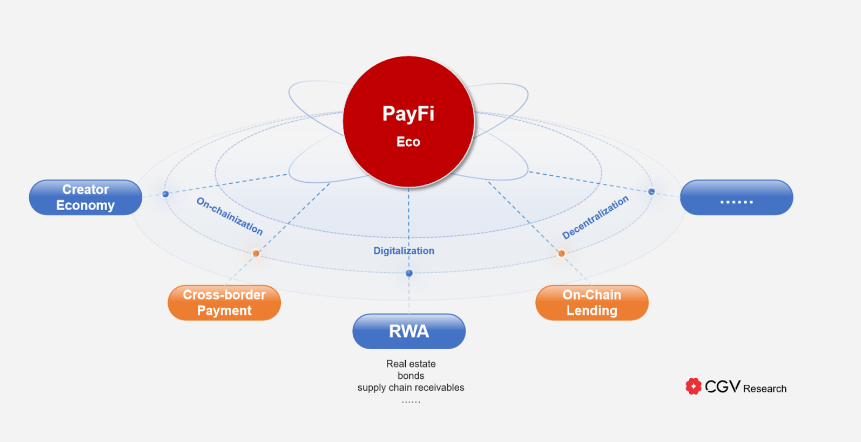
Through PayFi, RWA and DeFi are no longer separate financial systems, but interdependent and complementary organic entities, achieving the integration and innovation of real-world assets and on-chain financial services.
Digitization and On-Chain: Introducing RWA to the blockchain. The PayFi platform first digitizes RWA through smart contracts, enabling its representation and trading on the blockchain. This process ensures the transparency and security of the value and ownership of RWA on-chain. Through this method, traditional RWA assets can be divided into small units, facilitating trading and investment on a global scale.
Smart Contracts and Payment Systems: Achieving efficient transactions and settlements. Once RWA is digitized, the PayFi platform uses smart contracts to automate the trading and settlement process. This not only speeds up transaction speeds and reduces costs but also ensures transaction transparency and security. In addition, PayFi's on-chain payment system makes the transfer and payment of these assets simpler and more efficient, addressing common settlement delays and high fees in traditional finance.
Liquidity Pools and Financing Channels: Providing funding support for RWA. PayFi's liquidity pools provide ample funding support for RWA, enabling these assets to obtain financing from global investors. By using RWA as collateral, PayFi allows investors to participate in financing activities on DeFi platforms while providing stable funding sources for RWA. This model not only increases the liquidity of RWA but also provides diversified investment opportunities for DeFi investors.
Risk Management and Transparency: Enhancing market trust. Through blockchain technology, PayFi ensures the transparency and verifiability of all RWA transactions, reducing information asymmetry and operational risks. The automatic execution of smart contracts reduces the risk of human intervention, while the immutability of the blockchain ensures the security of transaction records. All of this enhances market trust and drives further integration of RWA and DeFi.
In the future, PayFi will play an increasingly important role in promoting global asset liquidity, reducing transaction costs, and enhancing market transparency. In Lily Liu's view, PayFi integrating RWA and institutional finance into on-chain liquidity pools, creating an integrated value chain, constitutes the "new financial cluster," which may be the biggest theme in the current cycle of the crypto market.
Why PayFi Happens on Solana?
Why does PayFi happen on Solana instead of other L1 public chains or L2 solutions? Lily Liu's answer is: "Solana has three major advantages: high-performance public chain, capital liquidity, and talent mobility." These advantages constitute barriers that other competitors find difficult to overcome at this stage.
First, high-performance public chain. Solana's core technological advantage lies in its unique Proof of History (PoH) consensus mechanism, enabling it to process over 65,000 transactions per second (TPS), with transaction confirmation times typically around 400 milliseconds. This performance far exceeds Ethereum's 10-15 TPS and longer confirmation times. Even Ethereum's L2 solutions, such as Optimistic Rollups, struggle to match Solana in terms of latency and throughput. Although Visa claims its servers can handle 56,000 TPS, in actual use, Visa only processes an average of 1,700 transactions per second. In comparison, Solana can fully meet actual payment needs.
Second, capital liquidity. As of August 30, 2024, the total value locked (TVL) in the Solana ecosystem has exceeded $10 billion and has attracted significant investments from top venture capital funds such as Andreessen Horowitz (a16z), Polychain Capital, and Alameda Research. This capital liquidity provides strong financial support for the expansion of PayFi.
Finally, talent mobility. The Solana Foundation actively promotes the development of the developer community, organizing over 500 hackathons and developer education programs globally. As of 2024, the Solana ecosystem has over 5,000 active developers, making it one of the fastest-growing blockchain developer communities globally. The strong talent pool supports the development of various innovative projects and continues to attract new technical and financial talent to join the ecosystem, laying a solid foundation for the development of PayFi.
PayFi uses programmable payments to bridge the traditional world with the blockchain world, making it possible to scale and expand credit finance on-chain. Solana's advantages not only support the development of PayFi but also make it highly competitive in the future global payment and financial market.
Taking PYUSD as an example, PayPal chose Solana as the new public chain for PYUSD payments, mainly due to Solana's fast settlement capabilities, low transaction fees, and strong developer ecosystem. Solana's token extension features, including confidential transfers, transfer hooks, and memo fields, provide the necessary flexibility and commercial utility for PYUSD.
As PayPal puts it: "These features are not optional. If PYUSD is to be effective in a wider range of business areas, it must be provided to merchants." Today, Solana has become the primary platform for PYUSD, capturing 64% of the market share, while Ethereum only holds 36%. In addition, as early as September 2023, Visa had already expanded the settlement function of USDC from Ethereum to Solana.
Application Scenarios and Typical Projects of PayFi
The essence of PayFi is to reshape and upgrade the traditional financial system using advanced encryption technology, so all financial scenarios can and should be redone with PayFi.
1. Cross-Border Payments and Trade
The main challenge of traditional cross-border payments lies in the isolation within the centralized sovereign currency system. Due to the impact of foreign exchange controls, capital flows, and other national currency policies, cross-border payments have always been plagued by complex processes, lengthy settlement times, and high costs. Initially, it was thought that cryptocurrency payments could replace traditional cross-border payments as an excellent solution, but there are still many shortcomings in enterprise-oriented solutions.
Today, the cross-border payment industry still heavily relies on pre-funding to achieve same-day settlement. Currently, over $4 trillion is locked in pre-funding accounts, which is a huge and implicit cost for financial institutions and the global payment industry. PayFi can optimize this by leveraging traditional credit finance to drive encrypted services.
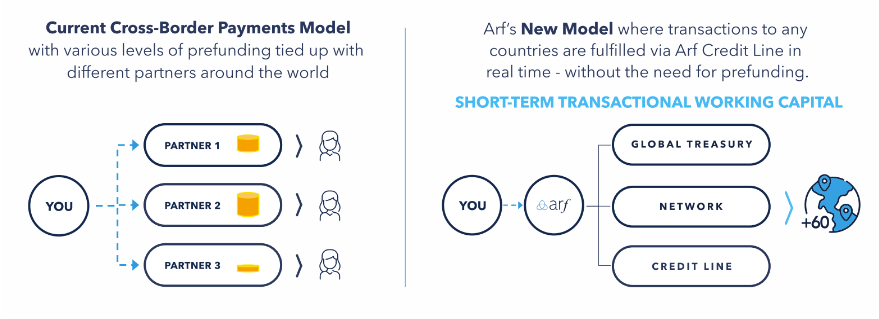
Comparison of the current cross-border payment model with the Arf improvement model (from: Arf)
Arf (@arf_one): The world's first regulated, transparent short-term liquidity solution designed to support cross-border payments. Headquartered in Switzerland. By providing licensed currency service businesses and financial institutions with operational funds and settlement services based on digital assets, as well as local entry and exit capabilities, Arf eliminates the capital-intensive business model of the cross-border payment industry. Arf provides a unified liquidity network for cross-border payments and trade, eliminating prefunding requirements and providing 24x7 transparent compliance services. As of now, Arf's on-chain transaction volume has recently exceeded $1.6 billion, with no defaults, making it one of the fastest-growing stablecoin use cases.
2. Supply Chain Finance
Supply chain finance combines financial services with supply chain management, providing systematic financial products and services to upstream and downstream enterprises in the supply chain based on trade relationships and transactions in the supply chain, through control and management of information flow, logistics, and fund flow in the supply chain. Traditional supply chain finance is constrained by cumbersome contracts and legal work, and is difficult to automate evaluation, resulting in slow financing processes that severely impact the financing turnover of small and medium-sized enterprises. PayFi significantly simplifies the process of accounts receivable financing, alleviating the problem of enterprise financing difficulties.
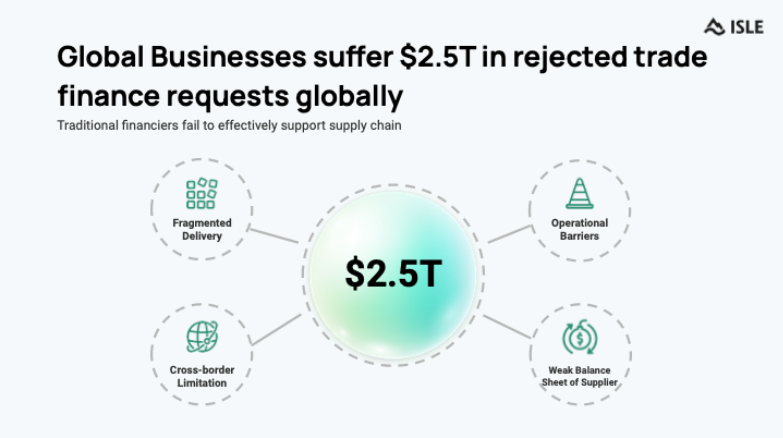
Global enterprises face a $2.5 trillion trade financing demand rejection annually due to the limitations of traditional financial institutions (from: Isle Finance)
Isle Finance (@isle_finance): The first project to provide RWA PayFi network for supply chain payments, introducing instant Web3 liquidity into supply chain finance and providing competitive returns with A-grade quality to liquidity providers. Through Isle, the real-time settlement and liquidity management of blockchain technology are combined with supply chain payments, allowing supply chain participants to process payments and settlements more quickly and improve fund utilization efficiency. At the same time, on-chain liquidity providers can anchor the payment stability of high-credit buyers and share early payment discounts provided by suppliers with buyers. Isle's main clients include high-net-worth individuals (HNWIs), native crypto users, DAO treasuries, asset managers, and family offices, and allow ordinary users to stake ISLE tokens for liquidity mining rewards.
3. Consumer Finance
For PayFi targeting consumer finance for end users, which may be the point of interest for users, mainly occurs in the consumer finance field, which is also the part emphasized by Lily Liu in the PayFi sharing, "Buy Now, Pay Never." Users can cover current expenses by committing future income, with the enforced part implemented by on-chain smart contracts. In consumer finance, the key for PayFi is to bridge the service providers in the merchant network to act as acceptors in the middle, enabling consumers to access a diverse range of consumption scenarios.
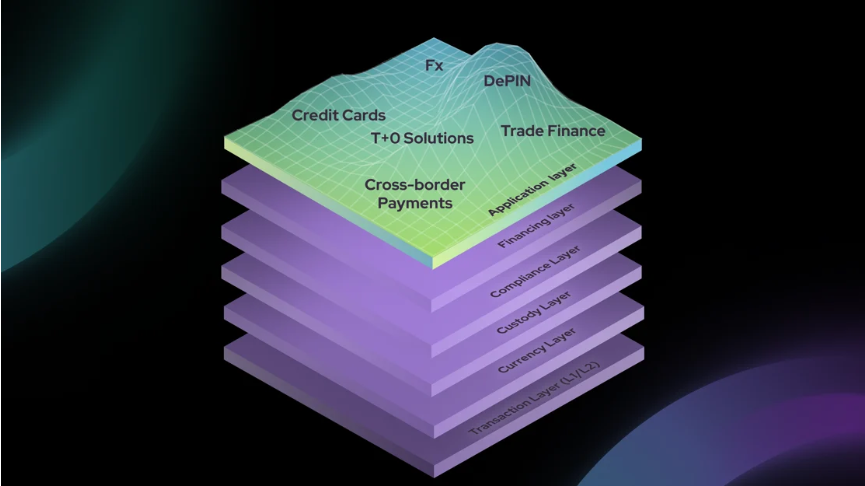
Open stack of compliant payment financing solutions for the PayFi Stack (from: Huma Finance)
Huma Finance (@humafinance): Pioneered the PayFi Stack, an open stack aimed at building compliant payment financing solutions, and advocated for industry leaders to optimize solutions to meet the unique needs of PayFi. The initial stack includes the following layers: transactions, currency, custody, financing, compliance, and applications. For the financing layer, it includes everything from credit rating, underwriting to RWA oracle, etc. As a representative project of the financing layer, Huma focuses on short-term financing commonly seen in the payment field, with total financing payments exceeding $280 million as of August 26, 2024, with a default rate of 0 (single-caliber statistics).
CrediPay (@Credix_finance): Helps businesses increase sales and improve cash flow through seamless and risk-free credit services. Sellers offer flexible payment terms to buyers at attractive prices and collect prepayments. We manage and protect customers from any credit and fraud risks, allowing them to focus on the most important things: increasing sales and profitability. Currently, Credix's services are mainly focused in Latin America, such as accounts receivable factoring, etc.
Opportunities and Challenges for PayFi
1. Market Growth Space
The core goal of PayFi is to introduce the time value of money onto the chain and reconstruct the financial system in a more programmable, sub-custodial, and decentralized manner. With the rapid increase in the number of global stablecoins and the continuous improvement of cryptocurrency infrastructure, PayFi is expected to become a significant force in transforming traditional finance.
According to Statista, the total global digital payment transaction volume is expected to reach approximately $9.46 trillion in 2023, and this number is expected to continue growing, possibly reaching $14 trillion by 2027. Meanwhile, data from mordorintelligence shows that the DeFi market size is estimated to be $466.1 billion in 2024, and is expected to reach $784.7 billion by 2029, with a projected compound annual growth rate of 10.98%.
Calculations by the CGV Research team indicate that assuming PayFi can capture 10% of the total global digital payment transaction volume (a conservative estimate), by 2030, the market size of PayFi (estimated at $1.8 trillion) will be 20 times that of the DeFi market size ($87 billion). This means that PayFi has enormous market potential and is expected to play a significant role in the global digital payment field.
2. Regulatory and Compliance Challenges
As the issuance of global stablecoins continues to increase, central banks around the world are gradually easing their attitudes towards stablecoins. Broadly speaking, stablecoins anchored to fiat currencies can be seen as a digital extension of fiat currencies. The payment business mainly involved in PayFi projects still operates under the regulation of the sovereign currency system, using stablecoins as a medium.
On one hand, current PayFi projects focus on compliance and typically only allow licensed institutions to participate, while individual users need to undergo strict KYC processes and reviews. On the other hand, many PayFi projects tend to expand their business in third-world countries, where local regulations are usually less robust, resulting in relatively lower compliance risks.
3. Technical and Security Risks
After years of DeFi development, although security issues have not been completely eliminated, many security vulnerabilities have been identified, and after rigorous audits, the security of on-chain PayFi is essentially equivalent to that of traditional DeFi.
However, the technical challenge mainly lies in the off-chain part. As PayFi requires a large amount of real-world asset integration, ensuring the enforcement of off-chain logic remains an unresolved issue. Current solutions typically involve using an intermediary entity to handle the alignment between on-chain and off-chain, but this solution still needs further improvement.
Conclusion
PayFi, as the new wave of payment finance, is reshaping the global financial ecosystem with its unique charm. It not only inherits the payment vision of Bitcoin but also elevates the efficiency and inclusiveness of financial services to new heights through the innovation of blockchain technology. With the support of high-performance public chains like Solana, the market size of PayFi is expected to achieve exponential growth, becoming a major driving force in the future financial market.
As Lily Liu foresaw, PayFi tightly integrates RWA and DeFi, creating an integrated value chain and forming a new financial cluster. This revolutionary innovation will drive the global financial system towards a more efficient and inclusive direction.
免责声明:本文章仅代表作者个人观点,不代表本平台的立场和观点。本文章仅供信息分享,不构成对任何人的任何投资建议。用户与作者之间的任何争议,与本平台无关。如网页中刊载的文章或图片涉及侵权,请提供相关的权利证明和身份证明发送邮件到support@aicoin.com,本平台相关工作人员将会进行核查。


