Author: Revc, Golden Finance
The Babylon platform announced the official launch of its Bitcoin staking mainnet. In the initial stage, the platform set a staking limit of 1000 bitcoins, which has already been reached. According to platform data, more than 12,700 users have participated in staking, with a total staked value of over 1000 bitcoins.
What is Babylon
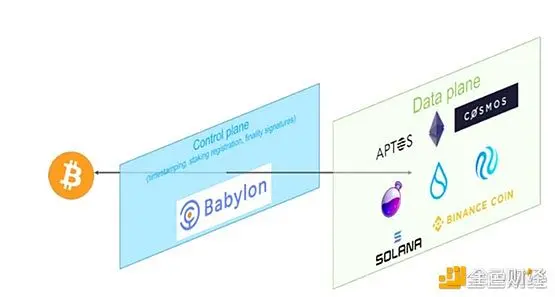
Babylon is a protocol designed to use the security of Bitcoin to provide security for other PoS chains. Babylon can provide a secure, non-cross-chain, non-custodial native staking solution for PoS chains, including BTC layer2, and promote cross-chain interoperability. It is often likened to the Eigenlayer of the Ethereum ecosystem.
Core Principles of Babylon's Operation
- Remote Staking: Utilizing Bitcoin's UTXO model and script system to stake, penalize, and reward Bitcoin.
- Timestamp Server: Providing immutable timestamps for PoS chain events by recording them on the Bitcoin blockchain.
- Three-layer Architecture: Bitcoin as the base layer, Babylon as the middle layer, and PoS chains as the top layer. Babylon is responsible for recording PoS chain checkpoints on Bitcoin.
Advantages of Babylon
- Enhancing PoS chain security: Utilizing Bitcoin's security to improve the resistance to attacks of PoS chains.
- Shortening staking periods: Using Bitcoin's timestamp mechanism to shorten PoS chain staking periods.
- Promoting cross-chain interoperability: Achieving seamless communication and data sharing between different blockchains.
- Bringing new vitality to the Bitcoin ecosystem: Activating dormant bitcoins and bringing new application scenarios to the Bitcoin ecosystem.
Overview of the BTCFi Ecosystem
The Bitcoin ecosystem has entered a phase of major construction, with various parties rushing into the BTCFi track, given the nearly $1.5 trillion worth of assets waiting to be activated. The following is an inventory of leading BTCFi projects:
BounceBit
BounceBit integrates CeFi and DeFi to provide more flexible yield options for Bitcoin. Users can earn dual income by providing liquidity custody and restaking assets on multiple chains.
Key Features:
- CeFi+DeFi integration: Depositing Bitcoin into CeFi platforms while participating in DeFi protocols to earn dual income.
- Liquidity custody: Providing liquidity custody services, allowing users to redeem assets at any time.
- Restaking: Allowing users to restake staked bitcoins in other protocols to earn more income.
- Technical design: BounceBit ensures the security of cross-chain assets through a multi-layer security mechanism involving validator consensus, Mainnet Digital's custody services, and Ceffu's MirrorX technology, reducing the risk of hacking attacks.
Solv Protocol
Solv Protocol creates a fully liquid Bitcoin asset, SolvBTC, which can be used in various DeFi protocols.
Key Features:
- SolvBTC: A derivative asset representing staked bitcoins that can be used on multiple chains.
- Decentralized asset management: Ensuring asset security through smart contracts and multi-signature mechanisms.
- Cross-chain interoperability: Supporting the use of SolvBTC on multiple blockchains.
- Technical design: Concentrating various liquidity resources and investment opportunities on a single platform, users can automate investments by setting up a trading strategy Vault.
Yala
Yala aims to build a multi-chain stablecoin ecosystem using Bitcoin's liquidity.
Key Features:
- Multi-chain stablecoins: Providing stablecoins based on Bitcoin that can be used on multiple chains.
- DeFi ecosystem: Offering lending, staking, and other DeFi services.
- Modular architecture: Flexible and scalable, supporting custom modules.
Currently, many protocols in terms of security solutions tend to adopt a more centralized approach, namely CeFi and multi-signature, attempting to maximize the flow of value on the Bitcoin chain. This is because while UTXO and other chain validation methods ensure decentralization, the lack of a comprehensive smart contract system on the Bitcoin chain makes it difficult to stimulate value flow, with chain validation mostly used in the restaking track.
Reflections on the Bitcoin Restaking Track
Returning to the restaking track where Babylon is located, blockchain mainly shares security consensus through modularization, allowing modular blockchains to utilize the security, decentralization, and value consensus of high-quality public chains such as Bitcoin and Ethereum to provide infrastructure for other blockchains, thereby improving the performance and efficiency of blockchains. Currently, there are mainly three types of solutions:
Ethereum-based solutions:
- Pros: High security, strong legitimacy, and direct utilization of Ethereum's ecosystem resources.
- Cons: Throughput and cost may be lower, not suitable for all types of application chains.
New DA layer solutions (such as Celestia):
- Pros: Good performance, low cost, aimed at providing security and decentralization comparable to Ethereum.
- Cons: Security and decentralization still need to be verified over time, lack of legitimacy, and may face rejection from the Ethereum community.
Proof of Stake (POS) shared security solutions (such as Babylon, EigenLayer):
- Pros: Inherit the legitimacy and security of Bitcoin or Ethereum, providing more practical value for their assets, and high flexibility.
- Cons: Relatively new, long-term performance still needs observation.
Babylon adopts the core concept of Proof of Stake (POS), utilizing the value of Bitcoin or Ethereum assets to create shared security services. The advantage lies in providing more practical value for the main chain assets while inheriting legitimacy and security, and offering higher flexibility. However, this also raises a series of considerations:
In the Ethereum network, the security responsibility of stakers is greater than that of non-stakers, as staked ETH participates in consensus maintenance, while circulating ETH actually benefits from network security, and stakers also incur opportunity costs. From the perspective of shared security, the current Proof of Stake shared solutions are inferior to Ethereum's base solutions, unless the assets in the Proof of Stake solutions are assets like stETH, which correspond to ETH participating in validation in the Ethereum network. Roughly speaking, if the Ethereum network is secure, other PoS networks staking stETH are also secure.
In Babylon's PoW+PoS solution, the logic of shared security is not yet perfect. Firstly, the main personnel responsible for maintaining the security of the Bitcoin network are miners. Although miners are also driven by the interests of the BTC token value itself, the holders staking in the Babylon protocol do not actively maintain the security of the Bitcoin network, and thus do not directly transfer the security of the Bitcoin network to the PoS network connected to Babylon. Here, we can consider whether beneficiaries of security can also transfer security guarantees to others. In other words, the security of the entire PoS network is less related to the Bitcoin network and more related to Bitcoin stakers. Therefore, we need to consider whether shared security is at the asset level (more like a guarantee) or at the network level.
BTC stakers or holders do not actively maintain the security of the Bitcoin and PoS networks. From the design of the first phase of Babylon, the share of 1000 bitcoins is a very small portion of the existing circulating supply of bitcoins. Economically, PoS chains currently do not share the security of the Bitcoin network, and the security of shared assets and the security of the network where the shared assets are located are two different concepts, which is worth further exploration.
In addition, technically, how the PoS timestamp coordinates with the Bitcoin network block timestamp is a challenge. The Bitcoin network has a block time in minutes, with some uncertainty in block time and transaction confirmation, while the finality of transaction confirmation in the PoS network is in seconds, leading to a coordination issue between PoS and PoW blocks.
Conclusion
The Bitcoin network is the most valuable decentralized network, and the numerous BTCFi projects, including Babylon, have the potential to make the Bitcoin network the cornerstone of the entire crypto industry, bringing new possibilities to the Bitcoin ecosystem.
In the process of development, in addition to focusing on the inheritance of decentralized properties, as BTCFi projects involve massive funds, attention to the security of protocols and smart contracts is also crucial.
免责声明:本文章仅代表作者个人观点,不代表本平台的立场和观点。本文章仅供信息分享,不构成对任何人的任何投资建议。用户与作者之间的任何争议,与本平台无关。如网页中刊载的文章或图片涉及侵权,请提供相关的权利证明和身份证明发送邮件到support@aicoin.com,本平台相关工作人员将会进行核查。


