Author: Wenser, Odaily Star Daily
On August 12th, an article claiming to be authored by a "Yale University professor" proposed the concept of "ServerFi," emphasizing "the privatization through asset synthesis and a model focused on providing continuous rewards for high-retention players." It also stated that "research results show that ServerFi is particularly effective in maintaining player engagement and ensuring the long-term viability of the game ecosystem, providing a hopeful direction for the future development of blockchain games." Although later verified by 0xUClub founder Jack, this article is likely to be "plagiarized content" published under the name of Yale University. However, users who have some expectations for the GameFi field still question: Will ServerFi be the "life-saving straw" for future GameFi games?
This article briefly summarizes different viewpoints and provides an analysis and response to this question.
Market View: Mixed Reviews, Overall Positive
After the emergence of the ServerFi concept, there was a considerable amount of discussion in the market. For details on the concept, please refer to the article "Yale University: ServerFi, a new symbiotic relationship between games and players."
Overall, the majority of Chinese KOLs and practitioners have a positive view, with Web3 MMORPG game MetaCene directly changing the X platform account suffix to "ServerFi" and stating, "We are pleased to launch the world's first ServerFi product," and openly stating "let the server belong to you (referring to players)." Here are some representative viewpoints:
Folius Ventures investor and Myshell team member Aiko stated, "In my opinion, the characteristics of ServerFi include:
- Trade and taxation between different servers
- Diverse server cultures: high competition and peace
- New production and consumption curves
- Solving the resource depletion and death spiral caused by overdevelopment in a single environment
- Providing honor and income for server managers (distributors, agents, etc.)
If an economic system is not sustainable, it is because it is not complex or diverse enough. Just like a tropical rainforest. When it has a broad environment (or map) and diverse species, it naturally tends to balance."
Cryptocurrency researcher and Chinese KOL Haotian stated, "The new operating framework of ServerFi includes 3 features: 1) Focus on long-term participation and value creation; 2) Reduce the structural risks of Ponzi schemes and reduce speculative behavior; 3) Driven by the decentralized community spirit of web3."
Cryptocurrency KOL Dr. Jinglee expressed, "As an academic article, there are some questions about the 'entropy increase' theory used in the article and the process of demonstrating it through simulation experiments, including unclear definitions of how players 'contribute' to the server, among other things."
AC Capital partner and Open-Rug host Crypto V (Cryptocurrency Veda) stated, "This model is fundamentally no different from play-to-earn, it just changes the assumption of 'participating in the game will make money' to 'the game itself can make money,' fundamentally it is a dividend distribution mechanism (for players)."
Eureka Guild co-founder and GameFi field researcher Leslie believes, "ServerFi does propose some useful logic, but it should not be a concept driven by FOMO. For Web3 games to succeed, they need to meet the conditions of gameplay, game theory, and economic adaptation. Balancing the accumulation of core players and the balance of new and old players is a problem that a game needs to focus on."
It can be seen that for the implementation of ServerFi, currently, people can only discuss more from the perspectives of "server ownership," "distribution of interests between game projects and players," and it is difficult to delve into topics such as "economic models," "game lifecycle," and "specific resource exchange." The original ServerFi article also leans more towards mathematical fitting and deduction, rather than actual project comparisons.
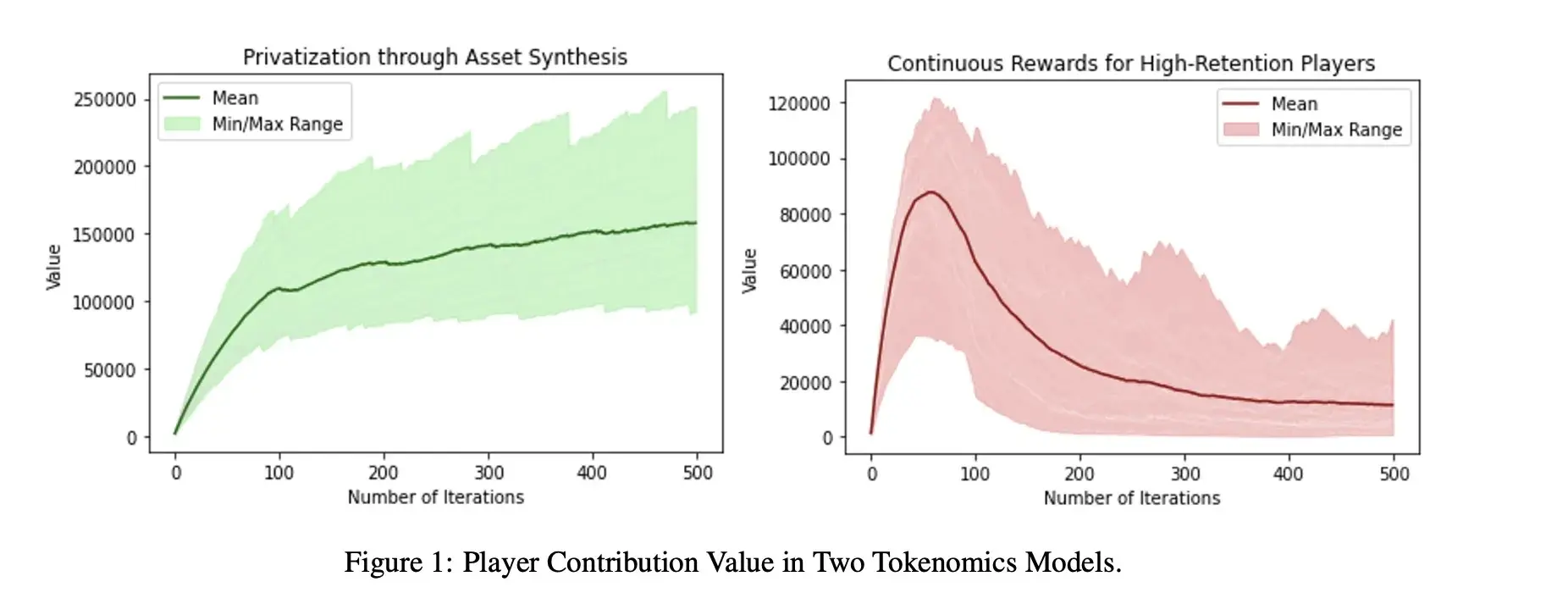
Player contribution value data in 2 economic models
ServerFi: Establishing an "Imagined Community of Interests"
Upon closer examination, the core proposition of ServerFi mainly revolves around the following 3 aspects:
3 Core Propositions: Number of Players, Server Value, Contribution Return Ratio
Firstly, the number of players is the premise for the establishment of ServerFi. If the number of players cannot meet a certain level, the conditions for ServerFi are still not met: without enough players, there are no relatively "veteran players" and "new players," and there is no creation chain for "in-game assets." This is precisely a major "challenge" for current GameFi games—the lack of gameplay and a limited number of players.
Secondly, the value of the server is the core of ServerFi's operation. As the hierarchical system of game players is gradually established and the in-game economic system is gradually improved, due to the circulation of internal currencies, items, and other "assets," this server has corresponding "quantifiable value"—usually linked to the fiat currency system. In other words, the core of ServerFi's operation lies in a "Server" that generates value through accumulation, which is also the reason why many people still spend a lot of money on setting up and playing private servers for games like Legend of Mir—high-level players like the feeling of "one-hit kill," and private server providers provide corresponding service scenarios and experiences. If the "value" of this server cannot accumulate or be monetized, then ServerFi cannot operate.
Finally, the contribution return ratio is an adjustable parameter of ServerFi. If the adjustable "numerical parameters" in traditional GameFi games such as Axie Infinity and STEPN are the production speed of items and the output rate of tokens, then ServerFi can be said to have achieved "fuzzification and dimensionality reduction" of parameters: obtaining in-game assets and synthesizing them is only the first step of making a contribution, and the amount and speed of return depend more on the "operation and operation of game servers" and "transactions between servers." Previous GameFi games were limited to the dimensions of "player PVP" and "player system PVE," with the game project party exercising the role of "God" from a "God's-eye view," and now, players, servers, and game projects need to form an "community of interests," thereby stimulating the enthusiasm of different role subjects to invest in, maintain, and expand the development of the "server."
ServerFi: Envisioning an Alternative "Anti-Ponzi Solution"
Based on the above core propositions, we can further deduce that the next step for GameFi games of the ServerFi type needs to be "clearing and suppressing the sidelines" or "clearing and restraining the sidelines":
The emotional value and entertainment value of the game are aspects that the ServerFi model cannot solve and must rely on the products provided by the GameFi game itself, such as "item collection," "card drawing," "social rankings," and "real-world feedback." It's okay to have less, but it cannot be absent, otherwise, no one will "join the game."
The ownership of the server, the conditions for synthesizing in-game assets, and the clarity between the two are issues that need to be considered in stages at the beginning of the ServerFi model design. This involves the distribution of interests between "project parties, high-level players, low-level players, and free players," as well as the "economic model design of in-game assets and game servers."
Introducing a "penalty mechanism" or "punishment mechanism" similar to a multi-signature protocol to ensure that the adjustment of the "contribution return ratio" can be in a state of dynamic balance or without objections from all parties. This is precisely a point that current GameFi games lack or are unable to address, as the cost is mainly borne by the project party, and in order to achieve "quick harvesting" and "short-term profits," regardless of the degree of success, it is difficult for the project party to resist temptation and extend the return period. Conversely, players also find it difficult to adopt a "long-term" approach after investing time, energy, and funds.
Therefore, the real implementation of ServerFi is unlikely to be completed overnight.
Conclusion: Expanding the Scope of Servers or Changing the "Rules of the Game"
Countless GameFi project parties and players hold "Fantasy Westward Journey" in high regard, all because it found a "swaying but stable" "tightrope walking" between specific historical backgrounds and different game communities, thereby achieving a dual adaptation of gameplay and economics. However, similar cases are unlikely to become a model.
In comparison, ServerFi is a "new perspective," especially after expanding different "server types." The following figure, although not directly related to the GameFi game industry, has some parts that can be used for reference. If the existing concept of "game servers" is generalized, different servers can also be seen as "player factions," which can enable greater liquidity exchange within a larger scope, thereby continuously upgrading the construction of GameFi games.
After all, in other words, isn't the entire earth a huge "server"?
免责声明:本文章仅代表作者个人观点,不代表本平台的立场和观点。本文章仅供信息分享,不构成对任何人的任何投资建议。用户与作者之间的任何争议,与本平台无关。如网页中刊载的文章或图片涉及侵权,请提供相关的权利证明和身份证明发送邮件到support@aicoin.com,本平台相关工作人员将会进行核查。


