Original | Odaily Planet Daily (@OdailyChina)
Author | Golem (@web3_golem)

In recent days, the Bitcoin ecosystem has become increasingly lively, with various sectors making substantial progress after months of lengthy construction. Sensing users have already refocused their attention on the Bitcoin ecosystem in hopes of uncovering wealth opportunities in this wave.
Although it is difficult to become an early Alpha hunter, requiring "soaking" in the ecosystem and investing a lot of time and effort, even if we cannot become pioneers, we cannot afford to miss this wealth train. This article from Odaily Planet Daily will sort out the recent major developments in the Bitcoin ecosystem to help everyone understand the rapid ecological hotspots and key points.
Traffic gap: Fractal Bitcoin mainnet to launch on September 1
The current biggest hotspot in the Bitcoin ecosystem is the scalability solution for Bitcoin developed by UniSat, Fractal Bitcoin. It is developed based on the core code of Bitcoin, fully compatible with existing Bitcoin wallets, tools, and mining equipment; in terms of performance, Fractal's block confirmation time is about 30 seconds; in terms of smart contracts, Fractal introduced OP_CAT in the test network on August 13, but the cross-chain bridge implementation has not been finalized yet.
The 24-hour active addresses of Fractal Bitcoin testnet have exceeded 8.3 million, and on August 19, Fractal Bitcoin activated the BRC-20 service in the test network, allowing users to experience the deployment and engraving of BRC20 operations. Many users believe that active participation in the test network testing may lead to receiving airdrops on the mainnet.
In terms of the ecosystem, more than a dozen projects have announced that they will be built on Fractal Bitcoin. Odaily Planet Daily previously selected 10 promising ecological projects and recommended reading "Countdown to the launch of the Fractal mainnet, listing ten potential projects in the ecosystem".
Babylon Bitcoin mainnet staking to launch on August 23
Babylon is a self-hosted Bitcoin staking protocol, with a total financing amount of over 96 million US dollars. The main participating institutions include Paradigm, Polychain, HashKey Capital, IOSG Ventures, Amber Group, HTX Ventures, Galaxy Digital, Binance Labs, and OKX Ventures.
Babylon has been quite popular due to its excellent self-hosted staking technology solution and luxurious investment lineup. The test tokens on the test network have experienced a situation of high demand. Recently, Babylon announced that the Bitcoin mainnet staking will launch on August 23, with an initial total staking limit of 1000 BTC, and the minimum staking amount per transaction is 0.005 BTC, with a maximum of 0.05 BTC. The competition when officially launched may also be intense.
As there are currently no active PoS chains, staking will not directly reward users with staking rewards, but will use a point system to record them. The liquidity staking protocols PumpBTC and pSTAKE in the Babylon ecosystem are also conducting staking reward activities.
Active start of RGB ecosystem projects
RGB is a universal Bitcoin smart contract protocol that can issue assets and implement smart contract functions in the Bitcoin network. The development of the RGB protocol has been quite long, with many contributors and institutions supporting it since 2019, but mostly in the background of development work, with little progress in ecosystem construction.
However, two projects in the RGB ecosystem have recently attracted a lot of attention. One is the first large-scale airdrop of the RGB20 token project Jerry's box. On August 16, it took a snapshot of addresses holding some runes, BRC20, and Bitcoin NFT, and those holding any of these assets are eligible for the airdrop, as shown in the snapshot assets below.
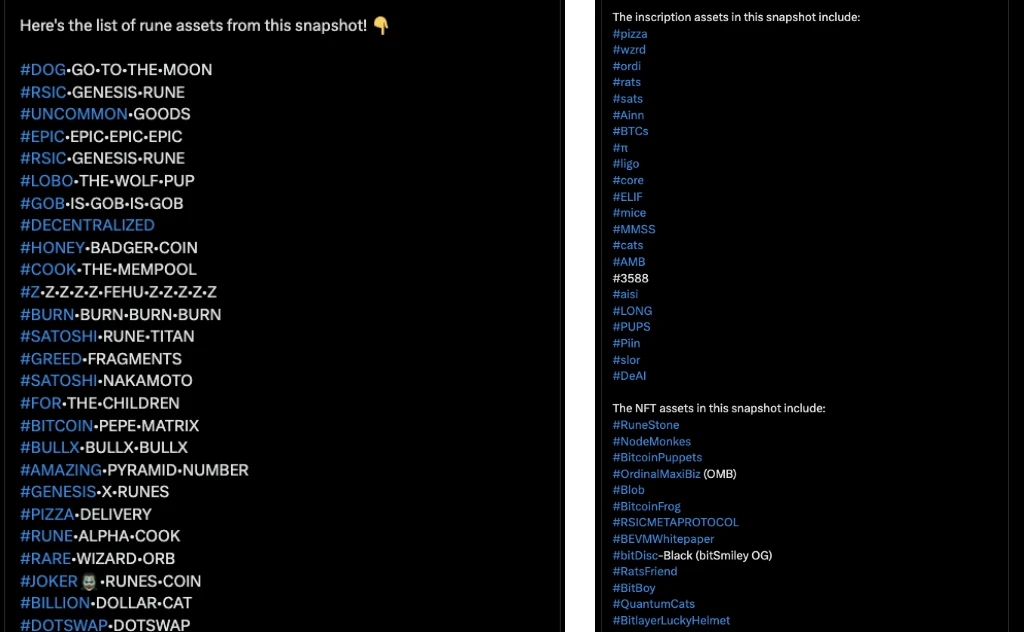
Because RGB20 assets require a specific address for receiving, users need to go to the official website to associate a whitelist address with a BiHelix format address, as detailed in the association tutorial released by the Bitcoin ecosystem wallet wizz wallet. However, to intercept studios and bots, the official rules for receiving airdrops have been changed, and whitelist addresses need to transfer at least 0.0001 BTC to a BiHelix format address to be valid. Other rule changes can be found in the author's tweet published on X platform.
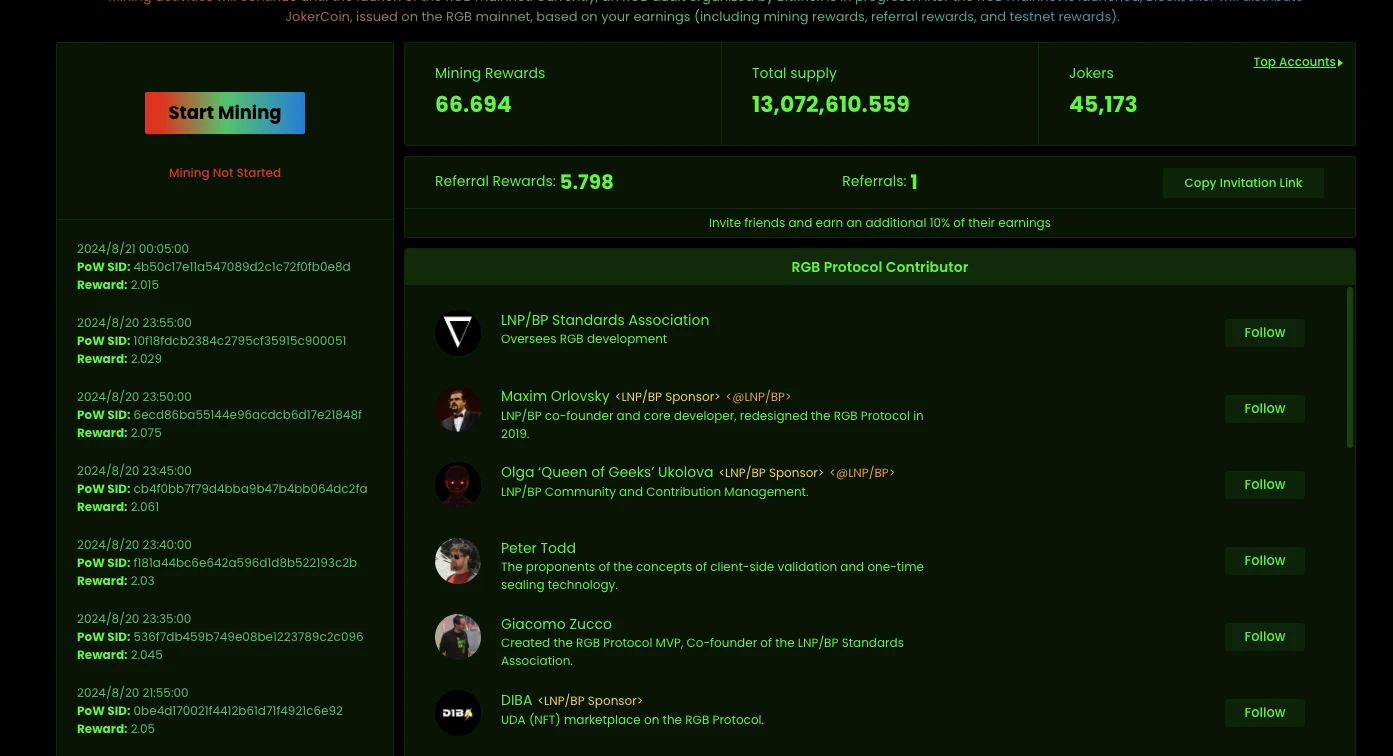
The other is the Meme project BlockJoker, which issues tokens through free mining using POW. Users only need to click to enter the official website, link their X account, and click on the top left to start mining. An average of 2 to 3 tokens are produced every 5 minutes, and there are currently over 45,000 nodes participating in mining. The mining of BlockJoker will continue until the RGB mainnet is launched, so its total amount is not certain.
First batch of stablecoins launched on the Lightning Network
On July 23, the main developer of the Lightning Network, Lightning Labs, announced the release of Taproot Assets on the Lightning Network. Users can mint Taproot Assets on Bitcoin and transfer them quickly and at low cost through the Lightning Network. Unlike other Bitcoin asset protocols, the Lightning Network is not intended to create more new assets on the mainnet, but is committed to introducing stablecoins into the Lightning Network. Previously, the author also detailed the advantages of the Lightning Network developing stablecoins in "The Lightning Network is on the right track with stablecoins".
Currently, projects have launched stablecoins on the Lightning Network. Speed Wallet has bridged USDT from Ethereum to Taproot Assets and integrated it into their Lightning Network custodial wallet, with the stablecoin on Taproot Assets being labeled as USDT-L. Lnfi Network (formerly known as Nostr Assets) announced the launch of LN Bridge, bridging Ethereum's USDT to Taproot Assets and labeling it as TA-USDT.
Atomicals Virtual Machine Beta Release
Atomicals is also a smart contract protocol built on the Bitcoin mainnet. Although it had high popularity in the Bitcoin ecosystem in the second half of last year, the heat gradually subsided due to cycle rotation and the project's "halal" approach. However, the Atomicals protocol is still considered by many Bitcoin ecosystem players as the most ideal layer of smart contract solution.
Although the development progress of Atomicals has been slow, it is still steadily progressing. On August 15, the official release of the test version of the Atomicals virtual machine was announced. Developers can define their own rules for managing the creation and transfer of their assets through smart contracts (using Bitcoin scripts). Perhaps soon we will see AVM's performance on the mainnet.
Runes remain the main transaction type on the Bitcoin network
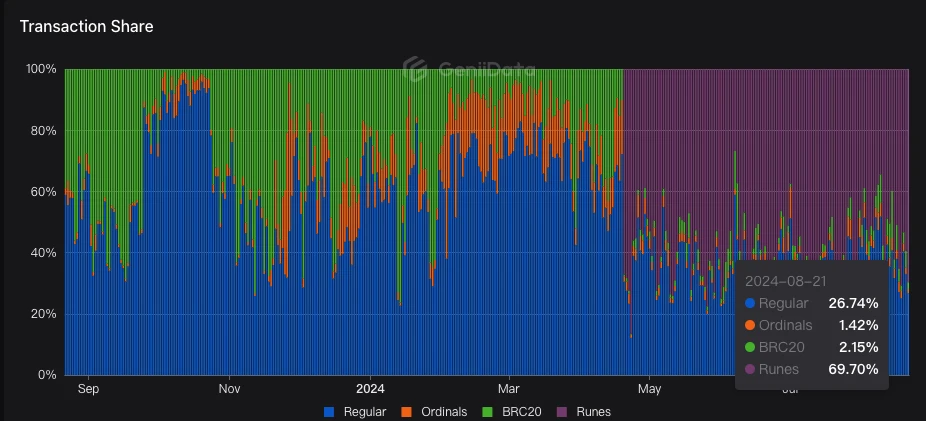
According to Geniidata data, runes have remained the main transaction type on the Bitcoin network since August, accounting for over 50% of transactions on average. This is followed by regular Bitcoin transactions, while BRC-20 and Ordinals together account for no more than 10% of the overall transaction share. Additionally, the total number of holding addresses for runes has exceeded that of BRC-20.
At the same time, in terms of minting, the 0th rune UNCOMMON•GOOD remains the most popular rune asset. Currently, the number of holding addresses for the 0th rune has reached 193,002, making it the rune with the highest number of holders. The following three points roughly summarize the reasons why Bitcoin ecosystem players hold the 0th rune:
Holding the 0th rune across multiple addresses to receive airdrops from other ecosystem projects, such as the aforementioned Jerry's box;
Minting some 0th runes while gas fees are low, waiting to sell for profit when gas fees rise;
Belief that the 0th rune will be the "sats" of runes, with potential based on a strong community, number of addresses, and other factors.
免责声明:本文章仅代表作者个人观点,不代表本平台的立场和观点。本文章仅供信息分享,不构成对任何人的任何投资建议。用户与作者之间的任何争议,与本平台无关。如网页中刊载的文章或图片涉及侵权,请提供相关的权利证明和身份证明发送邮件到support@aicoin.com,本平台相关工作人员将会进行核查。


