Stader (SD) is gradually becoming an important project in the cryptocurrency field. On July 30, 2024, Coinbase announced that it would list Stader (SD) and planned to start trading the SD-USD trading pair at around 1 a.m. on July 31. This news has increased market attention to Stader.
In fact, as early as July 10, Coinbase had already added Stader (SD) to its listing roadmap, indicating market recognition and expectations for Stader. With the start of trading, Stader will receive more liquidity support and expand its influence in the global market.
Next, we will analyze the current status of Stader in detail and understand its technical advantages and market performance.
Current LSD Market Analysis and Analysis of Stader's Market Performance
The Liquidity Staking (LSD) market has grown rapidly in the past few years and has become an important part of the cryptocurrency field. LSD allows users to participate in staking without locking their assets, thereby earning additional income. With major blockchain networks such as Ethereum transitioning to the Proof of Stake (PoS) mechanism, the demand for LSD has significantly increased. Currently, the total locked value (TVL) of the liquidity staking market has exceeded $50 billion, with protocols such as Lido, Rocket Pool, and Marinade occupying the majority of the market share.
In this thriving market, Stader, as a multi-chain liquidity staking protocol, has demonstrated its unique competitive advantages. Stader recently launched the Ethereum liquidity staking token ETHx, which successfully lowered the barrier to entry for node operation by adopting a multi-pool architecture and distributed verification technology (DVT). The design of ETHx allows permissionless node operators to run nodes with a deposit of only 4 ETH, the lowest requirement in the current market. In addition, Stader also offers a no-deposit scheme for permissioned node operators, allowing them to earn a 5% commission, attracting more experienced node operators to join.
Since the launch of ETHx, Stader's market performance has significantly improved. According to the latest data, Stader's total locked value has reached $91 million, making it one of the main liquidity staking protocols on multiple chains. Particularly on the Hedera and Polygon chains, Stader's performance is outstanding, with TVL reaching 154 million Matic and over $20 million in reward distribution, respectively. Additionally, Stader plans to expand its operations to more chains, including Ethereum, Avalanche, and Solana, further enhancing its market influence.
Through continuous innovation and expansion, Stader has not only established a foothold in the existing LSD market but also demonstrated its significant potential for future development. With Coinbase's listing plan, Stader will undoubtedly attract more investor attention and gain a more favorable position in future market competition.
Core DVT Technology Enables Stader to Achieve Decentralization and Low-Cost Operation
Stader Labs is led by an experienced team, with members having rich experience in technology, strategy, and the cryptocurrency field. CEO and co-founder Amitej has over 10 years of experience in strategic consulting and startup management, while CTO and co-founder Sidhartha has deep expertise in cryptocurrency mining and technology applications. The team's diverse background provides a solid foundation and unique perspective for Stader's development.
Stader's main use cases include liquidity staking and integration into decentralized finance (DeFi). As a multi-chain liquidity staking platform, Stader allows users to stake on different blockchains and unlock the liquidity of staked assets by issuing liquidity tokens such as ETHx, MaticX, and BNBx. These tokens can be used not only for staking to earn rewards but also for trading and lending in various DeFi protocols, further improving capital efficiency.
One of Stader's technical features is its multi-pool architecture and distributed verification technology (DVT). The multi-pool architecture allows Stader to allocate users' assets in different staking pools, including permissionless staking pools and permissioned staking pools. DVT significantly reduces the risk of validators by distributing validator responsibilities to multiple nodes, increasing the system's fault tolerance and security. This design ensures that Stader not only safeguards network security but also significantly lowers the barrier to entry for node operation, requiring only 4 ETH as a deposit.
Compared to other projects in the LSD race such as Lido and Rocket Pool, Stader demonstrates clear advantages. While Lido holds a dominant position in market share, its high centralization and high node operation requirements pose certain risks. Although Rocket Pool uses distributed verification, its node operation costs remain high. In contrast, Stader, through its multi-pool architecture and DVT technology, not only reduces node operation costs but also provides higher flexibility and decentralization.
Furthermore, Stader's token economics design has unique advantages. Its native token SD is used for governance and transaction payments, and it generates real returns through staking. Stader regularly repurchases SD tokens and stakes them as xSD, providing sustained support to the market. This design ensures the capture of token value and long-term growth potential.
Overall, with its innovative technical architecture, diverse use cases, and strong team background, Stader has demonstrated unique competitive advantages in the LSD race. With its continued expansion and technological upgrades, Stader is poised to gain a more favorable position in future market competition.
Recent Activity: Staking ETH with Stader on Arbitrum Yields a 10% Annualized Staking Reward
ETHx adopts a multi-pool architecture and distributed verification technology (DVT), giving it significant advantages in security, flexibility, and decentralization. The multi-pool architecture allows users to allocate their assets in different staking pools, including permissionless staking pools and permissioned staking pools. This design not only lowers the barrier to entry for node operation, allowing anyone with 4 ETH to participate in staking, but also reduces the risk of penalties through DVT technology, increasing the system's fault tolerance.
Additionally, the ETHx token can be used in various DeFi protocols, further enhancing its value and utility. Users can use ETHx for liquidity mining, lending, and trading in multiple liquidity pools, such as wstETH-ETHx and ETHx-ETH pools on Camelot, Ramses, Balancer, and Pancake Swap.
Stader Labs is committed to ensuring the security and reliability of ETHx. Through regular security audits and multi-layered security measures, ETHx has made significant contributions to safeguarding user assets. Stader Labs' team background and technical strength further enhance the competitiveness and attractiveness of ETHx in the market.
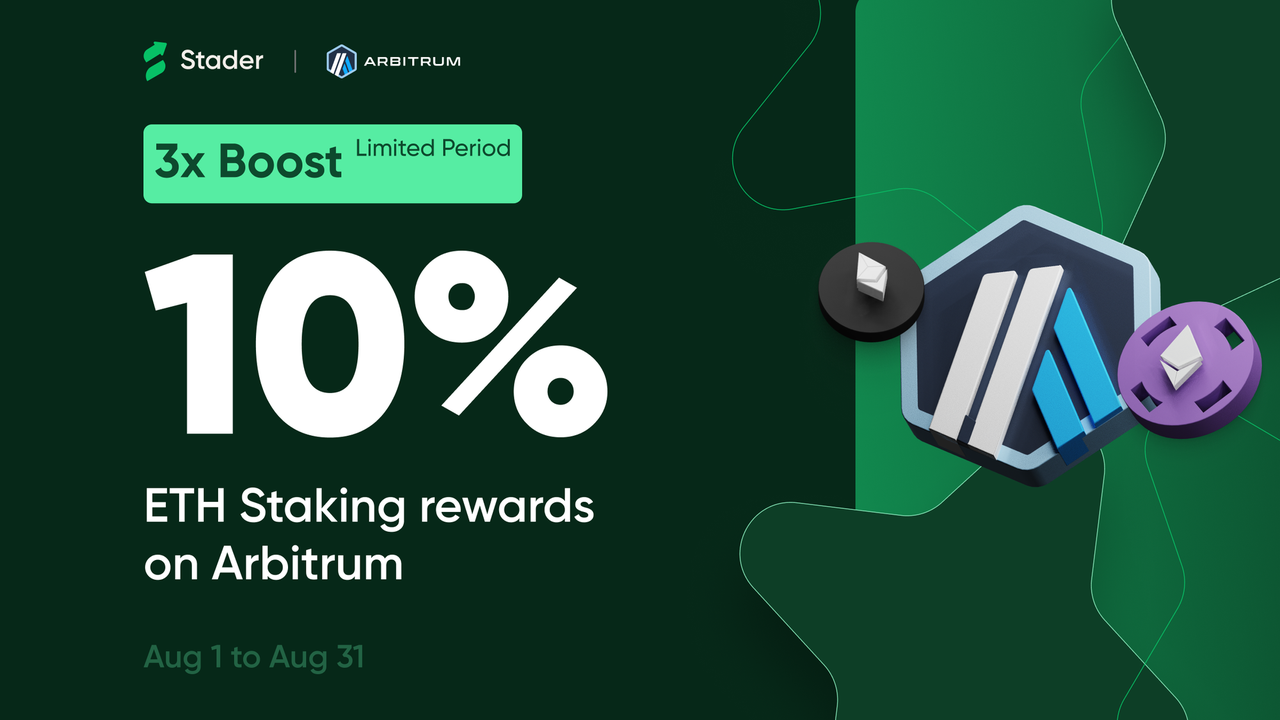
Stader Labs has launched a special activity on Arbitrum. From August 1 to August 31, 2024, users can stake ETH with Stader on Arbitrum and earn up to a 10% annualized staking reward. This activity provides users with an excellent opportunity to maximize staking rewards while enjoying the convenience of liquidity staking.
To participate in the activity and learn more details, please visit the Stader Labs official website. Through this activity, Stader Labs not only demonstrates its innovative capabilities in the liquidity staking field but also provides users with a high-return, low-threshold staking solution. With the promotion of ETHx, Stader Labs' position and influence in the LSD market will be further enhanced.
Can it Lead the Next Wave in the LSD Market? Stader's Performance is Worth Watching
As Stader continues to develop in the Liquidity Staking (LSD) market, it has demonstrated significant advantages in technology and market performance. However, the complexity of the market environment and the intensity of competition also bring challenges.
Recently, Coinbase listed Stader (SD) and added it to the listing roadmap. Although this news has attracted widespread attention, the price of SD has not surged as expected. Currently, the price of SD is $0.4028, with a market capitalization of $17.81 million and a total locked value (TVL) of $364 million. This indicates that further consolidation of market confidence in Stader is still needed.
Stader has launched the ETHx liquidity staking token on Arbitrum and introduced a special activity offering up to a 10% annualized staking reward, showcasing its innovation and attractiveness. Through its multi-pool architecture and distributed verification technology (DVT), Stader provides a more efficient and secure staking solution, with unique advantages compared to competitors such as Lido and Rocket Pool.
However, the key question is whether Stader can continue to lead the next wave in the LSD market. This depends on its ability to find a balance between technological innovation and market promotion, and to enhance user trust and participation. Despite facing challenges, Stader has demonstrated tremendous potential and room for growth with its innovative technology and clear strategy. Its future success will depend on its ability to continue driving technological advancement and market influence, providing users with sustained high returns and security.
免责声明:本文章仅代表作者个人观点,不代表本平台的立场和观点。本文章仅供信息分享,不构成对任何人的任何投资建议。用户与作者之间的任何争议,与本平台无关。如网页中刊载的文章或图片涉及侵权,请提供相关的权利证明和身份证明发送邮件到support@aicoin.com,本平台相关工作人员将会进行核查。


