The Democratic presidential candidate will be decided at the party convention in Chicago from August 19th to 22nd.
Source: unchainedcrypto
Compiled by: 0xjs@Golden Finance
On July 21st, U.S. President Joseph Biden unexpectedly announced his resignation as the Democratic presidential candidate and endorsed Vice President Kamala Harris to become the Democratic presidential candidate.
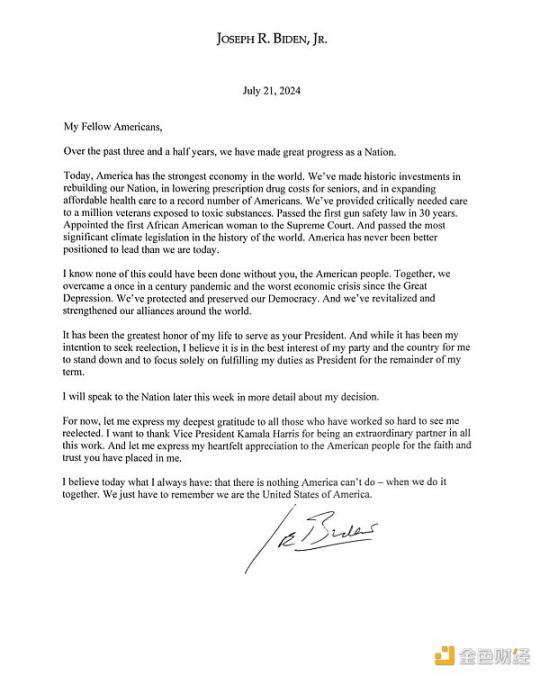
This has forced the cryptocurrency industry to consider the potential impact of her and other potential Democratic presidential candidates on the industry.
Although Harris is now an absolute favorite to win the nomination, her position on the candidate list is still uncertain, especially as some Democrats are concerned about her ability to defeat Republican candidate Donald Trump in the presidential election.
The Democratic presidential candidate will be decided at the party convention in Chicago from August 19th to 22nd.
Here are the most likely views of potential Democratic presidential candidates on cryptocurrency:
Vice President Harris
Harris has never voted on any important matters related to cryptocurrency policy in Congress, and as Vice President, she has remained largely silent on this technology.
Given her time as a senator and state attorney general in California, some believe she is a friend of Silicon Valley and may be favorable to the cryptocurrency industry. (Translator's note: Financial disclosures show that Harris and her husband, Douglas Emhoff, have not ventured into the cryptocurrency field and prefer to invest in government bonds and emerging markets. However, during the 2020 campaign, Harris hired Ryan Montoya, former Chief Technology Officer of the NBA's Sacramento Kings, as her scheduling and advance director. Under Montoya's leadership, the Sacramento Kings became the first team in the world to accept Bitcoin.)
However, if she were to be elected president and decide to implement the Biden administration's caution towards cryptocurrency and the hostile stance of the U.S. Securities and Exchange Commission towards the industry, the situation may not change much.
Governor Gavin Newsom of California
Newsom has been a top surrogate for the Biden campaign, but many believe he has been shadow campaigning for president for some time. Regarding cryptocurrency, Newsom has taken specific actions that have influenced cryptocurrency regulation in California. In May 2022, Newsom signed an executive order to establish a licensing framework for cryptocurrency companies in California. Although he initially vetoed a bill in September 2022 aimed at establishing such a framework, he did sign the "Digital Financial Assets Act" in October 2023, which some believe allows California to compete with New York on the BitLicense regulatory system.
Among potential candidates, Newsom may have the deepest understanding of the cryptocurrency industry, which means he may be able to make the wisest policy decisions, at least willing to work with the cryptocurrency industry to formulate national policies and education. However, several other governors are considered more likely to receive support from Democratic donors and ultimately defeat Trump.
Governor Gretchen Whitmer of Michigan
Whitmer is seen as a potential candidate because she would help win a key battleground state. Whitmer has not discussed her stance on cryptocurrency in any significant way, nor has she pushed cryptocurrency policy in Michigan in any major way. This suggests that if she were to become president, she might take a more proactive stance on cryptocurrency policy issues, or simply not be interested in cryptocurrency from a policy perspective. Although other states like California have already implemented regulatory frameworks for the industry, there is no indication that Whitmer would do much in the cryptocurrency space.
Governor JB Pritzker of Illinois
Reportedly worth $3.5 billion, Pritzker is a candidate who can fund his own campaign. If one of the potential candidates could be described as "bullish on cryptocurrency," it is likely Pritzker—at least until the collapse of FTX in 2022, his office remained silent on cryptocurrency. However, in a Facebook post in 2021, Pritzker welcomed the expansion of the cryptocurrency ATM company CoinFlip in Chicago and wrote, "The future of cryptocurrency is in Illinois."
In addition, Illinois under Pritzker's leadership was an early adopter of cryptocurrency. Furthermore, his office's decision to stop promoting the industry after the FTX scandal broke out is not uncommon, as many legislative bodies, including Congress, quickly abandoned efforts to advance cryptocurrency policy until more people understood what happened with FTX. However, if the cryptocurrency industry hopes to see someone become the Democratic presidential candidate, or under Harris as the vice presidential candidate, Pritzker may be the best choice.
Governor Josh Shapiro of Pennsylvania
Like Whitmer, Shapiro is considered a potential presidential candidate because he is the governor of a key battleground state. During his tenure, the Pennsylvania Department of Banking and Securities decided to include "cryptocurrency" in the state's money transmission law's definition of "money," which contradicted the policy in 2019 before Shapiro became governor. Although Shapiro has not done anything significant in the cryptocurrency space, he has also not made any negative comments about the industry, even after cryptocurrency mining companies took advantage of state tax breaks intended to help build data centers. Therefore, he may be willing to study establishing a regulatory framework for cryptocurrency at the national level.
Potential U.S. Senators or Cabinet officials
Although the likelihood of governors winning the presidential nomination is low, the positions of two U.S. senators and a cabinet official on cryptocurrency are worth briefly reviewing.
Senator Cory Booker (Democratic Party, New Jersey)
Booker is a co-sponsor of the "2022 Digital Commodity Consumer Protection Act," which would authorize the Commodity Futures Trading Commission to regulate digital assets as commodities. In addition, he voted to overturn the U.S. Securities and Exchange Commission's SAB 121 resolution, which currently requires cryptocurrency exchanges and custodians to record clients' cryptocurrency holdings as liabilities on their balance sheets, a measure strongly opposed by the cryptocurrency industry. Ultimately, President Biden vetoed this resolution. According to Open Secrets, Booker received $17,500 in campaign donations from the cryptocurrency industry in 2024.
Senator Mark Kelly (Democratic Party, Arizona)
Along with Booker, Kelly is one of twelve Democratic senators who voted to overturn SAB 121. In the same Open Secrets survey, Kelly revealed that he has received $3,323 in campaign donations from the cryptocurrency industry in 2024.
Secretary of Transportation Pete Buttigieg
So far, as Secretary of Transportation, Buttigieg has not expressed any opinions on cryptocurrency issues, nor has he made any comments or positions to indicate his stance on cryptocurrency.
免责声明:本文章仅代表作者个人观点,不代表本平台的立场和观点。本文章仅供信息分享,不构成对任何人的任何投资建议。用户与作者之间的任何争议,与本平台无关。如网页中刊载的文章或图片涉及侵权,请提供相关的权利证明和身份证明发送邮件到support@aicoin.com,本平台相关工作人员将会进行核查。


