1. What is Modular Blockchain
When we discuss modular blockchain, we must first understand the concept of Monolithic Blockchain. Monolithic chains, such as Bitcoin and Ethereum, are known for their comprehensiveness, independently handling various aspects of the network, from data storage to transaction verification, and smart contract execution. In this process, monolithic chains play the role of a generalist, involved in all aspects.
Taking Ethereum as an example, a mature monolithic blockchain can generally be roughly divided into four architectures: the following figure explains the role of each architecture in the blockchain by likening accounting on the blockchain to a game of football:
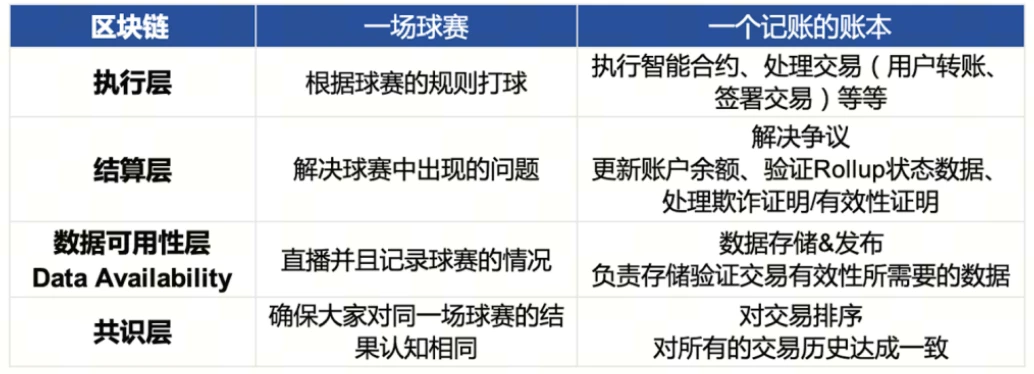
Through this analogy, we can better understand how the various architectures of the blockchain work together. Monolithic blockchain concentrates all functions on a single chain for execution, while Modular Blockchain is a new type of blockchain architecture that decomposes the blockchain system into multiple specialized components or layers, with each component responsible for specific tasks such as consensus, data availability, execution, and settlement.
Modular Blockchain, like a group of specialists, focuses on deep exploration and technological innovation in their respective fields. This focus enables Modular Blockchain to provide excellent performance and user experience in specific functions, such as offering faster transaction processing at lower costs.
In terms of node architecture, monolithic chains rely on full nodes, which must download and process a complete copy of the blockchain data. This not only places high demands on storage and computing resources but also limits the speed of network expansion. In contrast, Modular Blockchain adopts a light node design, only needing to process block header information, significantly improving transaction speed and network efficiency.
A significant advantage of Modular Blockchain is its flexibility and collaboration. It can outsource non-core functions to other specialists, creating a synergistic effect and significantly improving overall performance. This design philosophy is similar to LEGO bricks, allowing developers to freely combine different modules according to project requirements to create diverse solutions.
While monolithic chains have advantages in global control, security, and stability, they also face challenges in scalability, upgrade difficulty, and adapting to new requirements. Modular Blockchain stands out with its high flexibility and customizability, simplifying the creation and optimization process of new blockchains.
However, Modular Blockchain also faces its unique challenges. Its complex architecture increases the workload for developers in design, development, and maintenance. As an emerging technology, Modular Blockchain has not yet undergone comprehensive security testing and market fluctuations, and its long-term stability and security still need further verification.
2. Why Modular Blockchain is Needed
Why is modular blockchain technology widely regarded as a "future trend" and receiving extensive attention? This is closely related to the well-known "impossible triangle" theory in the blockchain field. The "impossible triangle" of blockchain refers to the difficulty of a blockchain network achieving optimal states in security, decentralization, and scalability at the same time.
Scalability concerns the network's ability to process a large number of transactions and maintain efficient, low-cost operations as user and transaction volume grows. It is typically measured by TPS (transactions per second) and latency (time required for transaction confirmation).
Security involves the cost and difficulty of protecting the blockchain network from attacks. For example, Bitcoin's POW mechanism requires an attacker to control over 51% of the network's computing power, while Ethereum's POS mechanism requires collusion of over 1/3 of the nodes.
Decentralization describes the operation of the network not relying on a single central node but being distributed across numerous nodes. The more nodes and the wider the geographical distribution, the higher the degree of decentralization of the network.
The core point of the "impossible triangle" is that it is difficult for a blockchain system to achieve optimization in all three characteristics. For example, among many public chains, Bitcoin and Ethereum stand out in decentralization and security due to their widespread node distribution and sufficient number of nodes.
However, they sacrifice a certain level of scalability, resulting in slow transaction speeds and high transaction fees: Bitcoin's block time is approximately 10 minutes, and Ethereum's TPS is about 13. During periods of high transaction volume, Ethereum's transaction fees can be as high as hundreds of dollars.
It is in this context that modular blockchain technology has emerged, addressing the challenges of scalability and transaction costs in traditional public chains by assigning different functions to specialized modules. For example, Bitcoin's Lightning Network and Ethereum's Rollup technology are manifestations of modular thinking.
The advantage of modular blockchain lies in its layered architecture, allowing each layer to be optimized for specific needs. The data layer can focus on data storage and validation, while the execution layer can handle smart contract logic. This separation not only improves performance and efficiency but also promotes interoperability between different blockchains, providing a foundation for building an open and interconnected ecosystem.
In summary, modular blockchain technology provides a new approach to address the limitations of traditional public chains. While maintaining decentralization and security, it achieves higher scalability and lower transaction costs, holding profound significance for the widespread application and long-term development of blockchain technology.
3. Analysis of Modular Blockchain Projects
3.1 Execution Layer
Based on its architectural characteristics, modular blockchain can be divided into different types. Among these types, the data availability layer and consensus layer are often designed as a unified whole due to their close interdependence. This is because when nodes receive transaction data, they usually also determine the order of transactions, which is the core of blockchain security and immutability.
Based on this design principle, we can understand different projects of modular blockchain from the aspects of the execution layer, data availability layer, consensus layer, and settlement layer.
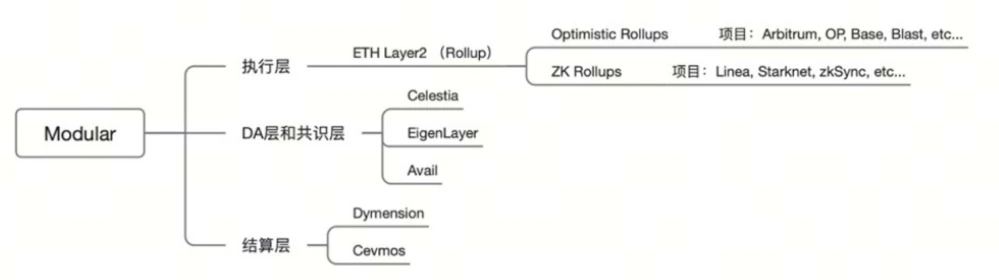
Layer 2 technology, as an extension of the execution layer in blockchain architecture, is a manifestation of the concept of modular blockchain. It aims to improve the scalability of the main chain by building off-chain networks, systems, or technologies on the underlying blockchain.
Layer 2 solutions allow faster and more cost-effective transaction processing while maintaining the security and decentralization characteristics of the underlying blockchain. According to the dune board created by @0xning, it can be seen that the gas consumption for Layer 2 verification and settlement in the Ethereum ecosystem averages less than 10%, significantly saving users' transaction costs.
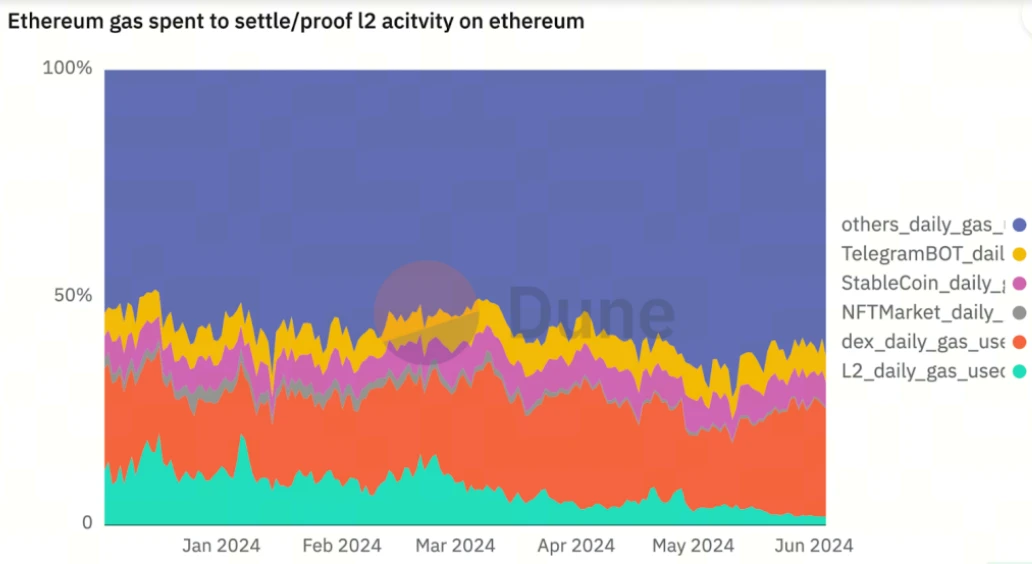
source: https://dune.com/0xning/ethereum-gas-war
Rollup technology is currently the mainstream solution for Layer 2, with its core concept of "off-chain execution, on-chain verification," executing calculations and other work off-chain, and then uploading calldata back to the main network.
Off-chain execution: In the Rollup model, transactions are executed off-chain, and the underlying blockchain is only responsible for verifying transaction proofs in smart contracts and storing original transaction data. This design significantly reduces the computational burden on the main chain, reduces storage requirements, and allows more efficient transaction processing. To further reduce costs, Rollup uses transaction bundling technology. It can be compared to containerization in logistics, where shipping each item individually would incur high shipping costs. Rollup technology significantly reduces the cost of each transaction by bundling multiple transactions together for a single "shipment."
On-Chain Verification
On-chain verification is crucial for the security of Layer 2 networks. Layer 2 networks must provide cryptographic proofs to resolve potential disputes on the underlying blockchain. Currently, two mainstream proof mechanisms are fraud proofs and validity proofs, which respectively support Optimistic Rollups and ZK Rollups.
Optimistic Rollups' Fraud Proofs
Optimistic Rollups adopt an optimistic assumption that all transactions are valid by default unless there is clear evidence of errors. This model relies on fraud proofs (challenges) during the challenge period, where any network participant can submit proof to challenge the state of smart contracts, ensuring fairness and transparency in the network.
According to L2BEAT data, there are a total of 16 Layer 2 networks using the Optimistic Rollups mechanism, such as Arbitrum, OP, Base, and Blast.
ZK Rollups' Validity Proofs
In contrast to Optimistic Rollups, ZK Rollups take a more cautious approach, requiring all transactions to undergo validity proofs before being accepted. This proof mechanism acts as a verification process, ensuring that every transaction and computation in the Layer 2 network is accurate and error-free.
In summary, validity proofs are the cornerstone of ZK-Rollups, requiring each batch of transactions to be accompanied by corresponding proofs, ensuring that smart contracts on the underlying blockchain can verify and approve state changes. For validation nodes, ZK Rollups provide a zero-error settlement mechanism, as each transaction must undergo strict validity verification.
According to L2BEAT data, there are a total of 11 Layer 2 networks using the ZK Rollups mechanism, such as Linea, Starknet, and zkSync.
3.2 Celestia
Celestia, as a pioneer in the field of modular blockchain, is essentially a data availability layer that provides a solid foundation for dApps and Rollup development. By deploying on Celestia's data availability and consensus layers, application developers can focus on optimizing execution logic while leaving data availability and consensus complexity to Celestia. Celestia's architectural design provides diverse solutions for modular expansion, primarily including the following three types:
Sovereign Rollup: Celestia provides the data availability and consensus layers, while the settlement and execution layers are independently implemented by their respective sovereign chains.
Settlement Rollup (e.g., Cevmos project): Based on the data availability and consensus layers provided by Celestia, Cevmos provides settlement layer services, while the application chain takes on the role of the execution layer.
Celestium: The data availability layer is managed by Celestia, while the consensus and settlement layers rely on the robust Ethereum network, allowing the application chain to focus on the execution layer.
Celestia has implemented innovative technologies, significantly reducing data storage costs and optimizing storage efficiency.
Erasure Codes Technology
One of Celestia's innovations is the application of erasure codes. In a paper co-authored by Mustafa Albasan (one of Celestia's founders) and Vitalik Buterin titled "Data Availability Sampling and Fraud Proofs," a new architectural concept is proposed, where full nodes are responsible for block production, while light nodes are responsible for block verification. Erasure codes technology introduces redundancy in data transmission, ensuring complete recovery of original data blocks even in cases of up to 50% data loss.
This mechanism means that to ensure 100% data availability of block data, block producers only need to publish 50% of the block data to the network. If malicious producers attempt to tamper with 1% of the block data, they would actually need to tamper with the entire 50% of the data, significantly increasing the cost of malicious behavior.
Data Availability Sampling
Celestia addresses blockchain scalability issues by introducing Data Availability Sampling (DAS) technology. The workflow of DAS includes several key steps:
- Random sampling: Light nodes perform multiple rounds of random sampling of block data, requesting only a small portion of the block data each time.
- Gradual confidence increase: As light nodes complete more rounds of sampling, their confidence in data availability gradually increases.
- Confidence threshold reached: Once the light nodes reach a preset confidence level (e.g., 99%) through sampling, they consider the block's data to be available.
This mechanism allows light nodes to verify the availability of block data without downloading the entire block data, ensuring the integrity and availability of blockchain data. Celestia focuses on providing data availability rather than execution state, increasing block production rates and allowing each block to accommodate more sampled data, significantly increasing TPS (transactions per second).
3.3 EigenDA
EigenDA is a secure, high-throughput, and decentralized data availability service launched as the first Active Verification Service (AVS) on EigenLayer. AVS can be understood as node operators, a subset of the thousands of node operators on Ethereum, who, in addition to their primary role (responsible for Ethereum consensus verification), also provide additional services (serving networks with consensus verification needs such as rollups) to earn additional income.
With the increasing amount of re-staked Ethereum and more AVS joining the EigenLayer ecosystem in the future, Rollups can achieve lower transaction costs and higher security composability within the EigenLayer ecosystem.
EigenLayer is a re-staking protocol based on Ethereum, utilizing Ethereum's stakers as validators, leveraging Ethereum's partial security to avoid trust risks associated with centralized service providers or proprietary tokens, thus reducing the development threshold for other projects. It also enhances Ethereum's trust network, increasing the value and influence of Ethereum.
In terms of architecture, EigenDA uses ZK technology to verify the state data submitted by Layer 2 and Restaking ETH ensures consensus security for the EigenDA network, ultimately finalizing the submission and storage of Layer 2 state data on the Ethereum mainnet. Therefore, EigenDA acts as a subcontractor for the verification and finality of the Ethereum mainnet's DA service, rather than a competitor like Celestia.
3.4 Avail
Avail is a modular blockchain project announced by the Polygon team in June 2023, which split from Polygon in March of this year and operates as an independent entity. Currently, Avail is running on the testnet and recently completed a $43 million Series A financing round, jointly led by Dragonfly and Cyber Fund.
The core architecture of Avail consists of Avail DA, Avail Nexus, and Avail Fusion. Avail DA is a modular data availability layer, similar to Celestia, providing DA services for various blockchains. Avail Nexus is a standardized cross-chain messaging protocol, similar to Cosmos' IBC protocol, facilitating interoperability between different cross-chains. Avail Fusion introduces a multi-asset staking POS consensus, aiming to provide secure consensus for the entire Avail network.
In terms of technology, Avail DA uses Kate polynomial commitments to avoid fraud proofs, does not assume that the majority of nodes are honest, and does not rely on full nodes to obtain data availability. This is different from Celestia's architecture, which is based on fraud proofs, resulting in fundamental differences between the two at the technical level.
3.5 Dymension
With the emergence of modular data availability blockchain projects such as Celestia and Avail, the competition in the modular DA War will become increasingly intense. The functionality of Ethereum as a DA layer will also be diverted, and it is very likely that a "one super, multiple strong" competitive pattern will emerge in the future.
3.6 Cevmos
Cevmos, named after Celestia, EVMos, and CosmOS, aims to provide a settlement layer for EVM-compatible rollups. As Cevmos itself is a rollup, all rollups built on it are collectively referred to as settlement rollups. Each rollup on Cevmos achieves redeployment of existing rollup contracts and applications on Ethereum through a minimal bidirectional trust bridge with Cevmos rollup, reducing migration efforts. Rollups on Cevmos publish data to Cevmos, which then processes the data in batches and publishes it to Celestia. Similar to Ethereum, Cevmos acts as the settlement layer to execute rollup proofs.
4. Bitcoin Ecosystem's Modular Blockchain
With the wealth effect brought by the Ordinals protocol and the approval of Bitcoin ETF, multiple favorable factors have injected new vitality into the Bitcoin ecosystem. The market's attention has quickly turned to the Bitcoin ecosystem, and institutional investor funds have flowed into this area, demonstrating confidence and expectations for the future development of the Bitcoin ecosystem.
In this context, Bitcoin Layer 2 technology is flourishing, with numerous technical solutions emerging, forming a diverse and vibrant technical ecosystem. Various innovative solutions are driving the expansion and optimization of the Bitcoin network. Although the industry has not yet reached a unified consensus on the precise definition of Bitcoin Layer 2, this article will explore the possibility and methods of building Bitcoin Layer 2 from a modular perspective, drawing inspiration from the concept of modular blockchain in Ethereum.
4.1 Merlin Chain
In the current Bitcoin Layer 2 arena, Merlin Chain has the highest TVL, reaching several billion dollars, making it the most attention-grabbing project in the Bitcoin ecosystem. As a Bitcoin Layer 2 network, Merlin Chain supports various native Bitcoin assets and is also compatible with EVM, demonstrating its dual focus on the Bitcoin and Ethereum ecosystems.
Merlin's features revolve around ZK-Rollup network, decentralized oracle network, and on-chain fraud prevention.
ZK-Rollup network: The core of ZK-Rollups lies in the use of zero-knowledge proofs. Zero-knowledge proofs, as an encryption method in cryptography, allow one party (the prover) to prove a statement to another party (the verifier) without revealing any information other than the correctness of the statement.
Merlin Chain processes and computes transactions off-chain, avoiding the high transaction fees and network congestion of the Bitcoin network. Additionally, ZK-Rollup can compress multiple transaction proofs into batches, requiring the Bitcoin main chain to verify a single proof containing multiple transactions, significantly reducing the workload of the main chain and improving transaction efficiency.
Decentralized oracle network: Merlin's decentralized oracle network acts as a Data Availability Committee (DAC) to check and ensure that the sequencer has accurately published complete DA data off-chain. The decentralized nature of the oracle network lies in its use of a POS form, allowing anyone to run an oracle node by staking sufficient assets. This staking mechanism is flexible, supporting assets such as BTC, MERL, and proxy staking similar to Lido.
On-chain Fraud Prevention: Merlin introduces the BitVM approach and similarly adopts the "optimistic ZK-Rollup" mechanism, which can be simply understood as assuming all ZK Proofs are trustworthy by default, and only punishing operators when errors occur. Because verification takes place on the Bitcoin mainnet, it is technically limited to fully verify ZK Proofs on the Bitcoin chain and can only verify a specific step of the ZK Proof calculation in special cases. Therefore, people can only point out errors in a specific calculation step of ZKP during off-chain verification and challenge them through fraud proofs.
4.2 B² Network
B² Network adopts a modular design, with the Rollup layer (ZK-Rollup) responsible for execution, the data availability layer (B² Hub) for data storage, B² Nodes for off-chain verification, and the final settlement layer being the Bitcoin mainnet. The ZK-Rollup layer of B² Network uses the zkEVM solution to execute user transactions within the second-layer network and output relevant proofs. The Rollup layer is responsible for submitting and processing user transactions, while the DA layer is responsible for storing copies of aggregated data and verifying relevant zero-knowledge proofs.
B² Hub is a DA network built off-chain with data sampling capabilities, seen as a pioneer in modular Bitcoin expansion solutions. B² Hub draws inspiration from Celestia's design approach and introduces data sampling and erasure code technology to ensure rapid distribution of new data to numerous external nodes and minimize the risk of data withholding. Additionally, the Committer in B² Hub uploads storage indexes and data hashes of DA data to the Bitcoin chain for public access.
According to B² Network's future plans, the EVM-compatible B² Hub is expected to become the off-chain verification layer and DA layer for multiple Bitcoin Layer 2 solutions, forming a functional extension layer for the Bitcoin chain. Given that Bitcoin itself cannot support many use cases, the method of building a functional extension layer off-chain is expected to become increasingly common in the Layer 2 ecosystem.
As the first modular third-party DA layer for Bitcoin, B² Hub can help other Bitcoin Layer 2 solutions utilize the Bitcoin main chain as the ultimate settlement layer and inherit the security of Bitcoin, promoting the expansion of the Bitcoin network and enhancing the diversity of its applications.
5 Conclusion
The slogan "Modular is the future" is gradually transitioning from an idea to reality. Modular blockchain technology, with its flexibility and scalability, provides a solid foundation for building the next generation of decentralized applications. This technology allows developers to select and combine different modules according to specific needs, creating more efficient, secure, and maintainable blockchain solutions.
The rise of modular blockchain represents a more "soulful" plug-and-play product concept. In this concept, blockchain is no longer seen as a closed system, but as an open and scalable platform where various services and functions can be easily inserted and removed like LEGO blocks. This flexibility allows developers to quickly build and deploy blockchain solutions based on specific application needs. Originating from the Ethereum ecosystem and now making its mark in the Bitcoin ecosystem, modular technology has demonstrated its capabilities in various tracks of the cryptocurrency industry. For example, the modular public chain Chromia, which uses "relational database" technology, has collaborated with multiple games such as My Neighbor Alice and Chain of Alliance in the gaming field; in the RWA track, Chromia has created the Ledger Digital Asset Protocol (Ledger DAP), which has been adopted by several projects.
In the AI field, CARV focuses on building a modular data layer for AI and Web3 games, ensuring privacy and security in the data processing process through technologies such as Trusted Execution Environment (TEE) and zero-knowledge proofs.
As modular blockchain technology continues to mature and expand into various application areas, we have reason to believe that this technology will bring more innovative possibilities to various industries. From the birth of Bitcoin to the widespread application of modular blockchain today, we have witnessed how blockchain technology has evolved from a single digital currency application to an ecosystem supporting complex and diverse applications. In the future, modular blockchain will continue to drive technological progress and lay the foundation for building a more open, flexible, and secure digital world.
免责声明:本文章仅代表作者个人观点,不代表本平台的立场和观点。本文章仅供信息分享,不构成对任何人的任何投资建议。用户与作者之间的任何争议,与本平台无关。如网页中刊载的文章或图片涉及侵权,请提供相关的权利证明和身份证明发送邮件到support@aicoin.com,本平台相关工作人员将会进行核查。


