Original | Odaily Planet Daily
Author | Wenser
On June 24th, Berachain's ecological liquidity staking protocol Infrared Finance announced the completion of a new round of financing, with participation from Binance Labs, and the specific amount has not been disclosed. According to Raito Bear, co-founder and CEO of Infrared, this round of financing is a strategic round in which Binance Labs participated as the only investor.
In May, former Polygon Labs DeFi head Jack Melnick joined Berachain to lead the DeFi ecosystem construction; in April, Berachain announced that the scale of its Series B financing had increased to $100 million, led by Brevan Howard Digital's Abu Dhabi branch and Framework Ventures, with participation from Polychain Capital, Hack VC, and Tribe Capital, among others, and its valuation has exceeded $1 billion.
After the conclusion of many L1 and L2 network dramas, based on the recently proposed Proof Of Liquidity (POL) mechanism, Berachain may become a key player in "reviving the glory of L1 public chains." Odaily Planet Daily will provide a brief analysis in this article for readers' reference.
Current market situation: "The world has been suffering from the points system for a long time"
In the article The world has been suffering from the points system for a long time, a review of the rise and decline of the points system written by senior author Nan Zhi of Odaily Planet Daily, we can see that the emergence of the points system is due to specific market conditions and other factors.
First of all, in terms of timing, Blur was born during a bear market when the market was cold, and the points system was an effective means of extending the project's lifecycle. At least in terms of time, it can delay the expected issuance of coins and alleviate the urgency of coin issuance.
Secondly, in terms of project differences, projects that typically involve trading, order placement, and liquidity locking tend to adopt the points system. On the one hand, it is to clarify the user's behavior trajectory and input cost, and on the other hand, it provides users with relatively intuitive and clear "numerical incentives." Many people have experienced the visual stimulation brought by the continuous growth of points, even though it is not a change in balance, it is indeed more advantageous than the static interface in the past.
Thirdly, in terms of user fission, the points system can achieve a wider range of social fission through invitation links. Moreover, the generation of rankings can also bring more significant conversion effects to the project's marketing and operations. Many times, whales will invest a large amount of money for the title of "top ranker," which has a certain similarity to the psychological effect and marketing advantage of Web2 live streaming platforms.
Finally, in terms of off-exchange trading, the points system also provides price guidance for token listing. Both off-exchange trading platforms like Aevo and Whales Market, and off-exchange OTC trading groups using the double collateral model, can gather a certain amount of liquidity through the points system. Moreover, insiders also know that due to the impact of time difference and anonymity, off-exchange trading sometimes has a certain premium effect, making it easy to boost the price of project points after the points system activities end.
In addition, Robinson Burkey, co-founder of the Wormhole Foundation, recently expressed his views on the points system regarding the progress made since the launch of the W token airdrop nearly 3 months ago. "I think the best airdrops are those that are unexpected by users. However, I think we can no longer return to that simple era and have to enter the era of points activities and witch wars. Airdrop farming is acceptable, and the question becomes whether the protocol can provide good farming for farmers. I personally support points programs because they can reduce the workload of protocol teams (i.e., reduce the time associated with anti-witch work)."
Of course, after being overwhelmed by project points activities, the current points system has made people feel aesthetically fatigued and even rebellious, mainly due to:
The restrictions of the points system on liquidity locking. Blast's fund locking restrictions have become a vivid and detestable example.
The unfriendliness of the points system to retail investors in the market. Whales and large investors obtain substantial returns through large funds, while retail investors receive meager rewards.
The long-term damage of the points system to the ecological network. Many times, the points system has created false prosperity for projects, just as after the end of the LayerZero airdrop, the daily trading volume plummeted by over 95% compared to the peak, leaving the project with nothing but a mess after the points system activities ended.
Therefore, the market is calling for innovation in the points system, and Berachain's Proof Of Liquidity (POL) has emerged.
Proof Of Liquidity: Rewarding liquidity provision, nurturing the ecosystem
Previously, Smokey, co-founder of Berachain, stated: "Berachain is the first chain to vertically integrate liquidity into the base layer. Block rewards from validators flow to applications on the chain and ultimately to their users, bringing liquidity to DApps in the Bera ecosystem. Berachain is the application layer aggregate."
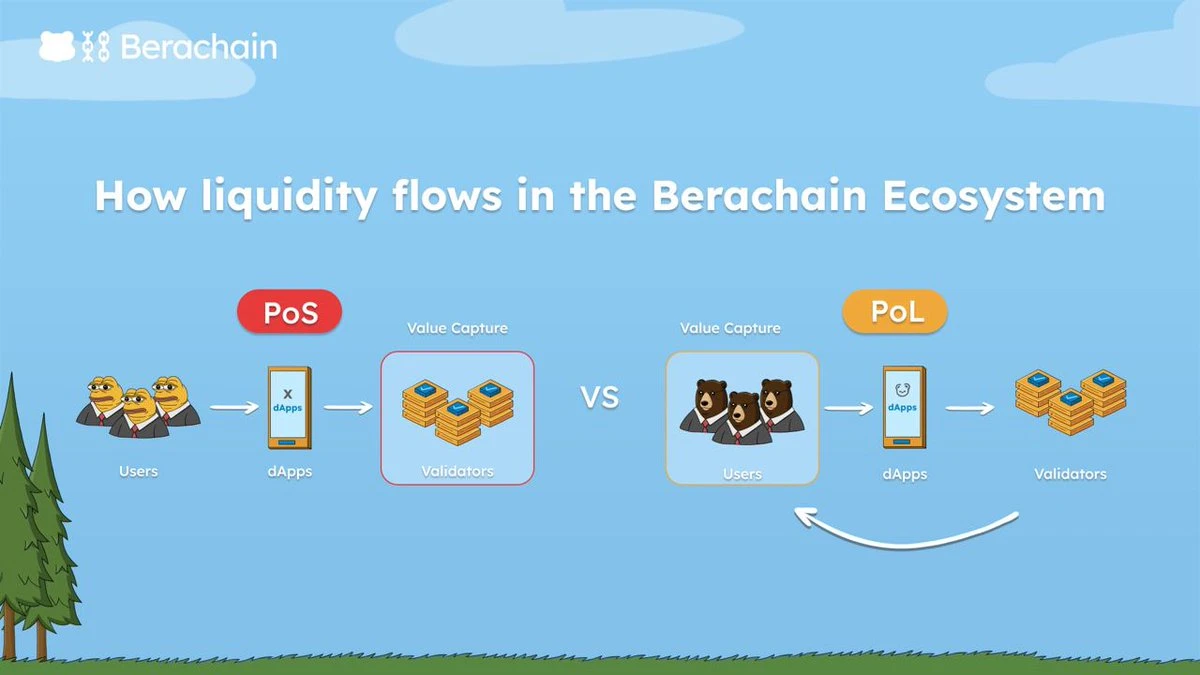
POL mechanism diagram
So, what is the POL mechanism, and what are its characteristics and advantages? The following is a specific introduction.
What is the POL mechanism?
According to the latest explanation from Berachain's official release (https://x.com/berachain/status/1805639727548350896), simply put, the POL mechanism is an accelerator for the application layer of Berachain—through the joint efforts of users, protocols, and validators, it expands the liquidity and security of the ecosystem.
In this process, the roles played by the three are different, including:
(1) Users: Providing liquidity and staking LP, accumulating BGT rewards and LP fees (BGT rewards in the liquidity pool are calculated based on the global weighted average of the validator's liquidity pool).
The user's BGT (Berachain's ecological governance token) income is based on two factors: 1. The total assets staked; 2. The amount of BGT sent to the dashboard.
(2) Validators: Building blocks in turn and receiving block rewards based on the amount of BGT delegated to them.
Validators will use a portion of the BGT obtained through block building via their "berachef" to be directed into the project liquidity pool of their choice.
berachef interface: https://bartio.station.berachain.com/validators/0x40495A781095932e2FC8dccA69F5e358711Fdd41
(3) Application projects: Create proposals to create new liquidity pools and qualify the reward pool to receive the validator's BGT input.
Because the liquidity pool is just a smart contract that accepts single asset staking, it can exist in the form of DEX pools or any other asset pool in the Berachain ecosystem.
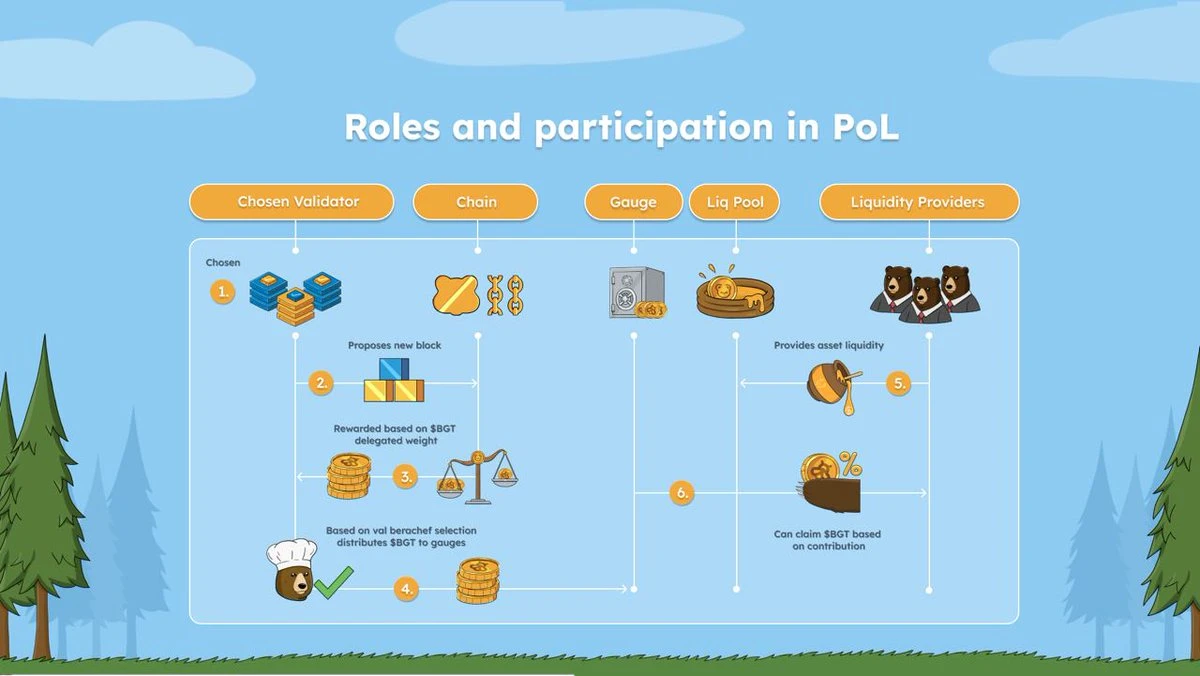
Roles and participation in the POL mechanism diagram
How does the advantage of the POL mechanism manifest?
If the above version sounds a bit complex, in plain language, Berachain's POL mechanism matches BGT liquidity with different application token rewards by introducing the "validator" as an intermediary role:
- Users stake assets to the dashboard built by validators.
- Validators mobilize BGT assets to support different applications and receive corresponding application rewards.
- Application projects need to attract support from validators through proposals and reward them, for the allocation to validators and users.
At the same time, in this process, users and validators can flexibly enter and exit assets. The three parties of users, validators, and application projects form a "community of interests," which can achieve a positive flywheel effect through the accelerated circulation of liquidity, thereby promoting the overall development of the Berachain ecosystem. Specifically:
- Users: Maximize the benefits of staked assets by providing liquidity to application projects and delegating BGT to a unified validator.
- Validators: Earn rewards through more BGT delegation and service protocol liquidity rewards, effectively collaborate with application projects, and create greater profits.
- Application projects: Increase the circulation efficiency of liquidity funds by guiding liquidity with validators and directly incentivizing users through BGT token issuance, compared to traditional liquidity mining.
In this process, BGT becomes the main circulating asset in the ecosystem, and application projects can issue their own assets to form exchanges and circulation with BGT assets, ultimately achieving a win-win situation for all parties. In addition, the POL mechanism also decentralizes the generation and distribution of incentives, allowing users, validators, and application projects to decide the flow of BGT. A more efficient liquidity circulation and a win-win solution are undoubtedly the best choice.
Conclusion: A community of interests can drive the ecosystem community, not the other way around
Different from the points system, the POL mechanism allows different roles in the Berachain ecosystem to find their own "ecological niche," thereby forming a relatively complete "community of interests," rather than forcing the three parties to participate because of point rewards.
Compared to Blast's ecosystem, which uses points and golden points as "carrots in front of users" and arrogantly dilutes the early liquidity input and rewards through various mechanisms, Berachain's POL mechanism is undoubtedly more transparent and fair, and is expected to attract more users, validators, and application projects to join.
As a meme-worthy L1 public chain known as the "playground for infinite economic games," Berachain may grow into another uniquely characteristic blockchain network.
免责声明:本文章仅代表作者个人观点,不代表本平台的立场和观点。本文章仅供信息分享,不构成对任何人的任何投资建议。用户与作者之间的任何争议,与本平台无关。如网页中刊载的文章或图片涉及侵权,请提供相关的权利证明和身份证明发送邮件到support@aicoin.com,本平台相关工作人员将会进行核查。


