Title: Jordan, PANews
Reference: The Wall Street Journal

In October 2023, Andrei Grachev, the Russian managing partner of DWF, posted a photo of a Lamborghini on social media with the caption "DWF Lambo," which quickly caught the attention of the cryptocurrency industry—how could the head of this seemingly not very large cryptocurrency institution afford a Lamborghini supercar?
Andrei Grachev, 36, formerly served as the head of the Russian branch of the cryptocurrency exchange Huobi. Records show that he is a co-founder of DWF Labs, but is based in Switzerland.
DWF Labs plays the role of a market maker (MM) in the cryptocurrency market, a type of intermediary company that simultaneously buys and sells assets, usually indifferent to the rise or fall of asset prices. The role of market makers is to increase market liquidity, making it easier for participants to buy and sell assets, and they profit by pocketing the price difference between buying and selling. In traditional finance, market makers must maintain price neutrality according to the exchange rules they operate under.
On Binance's trading platform, DWF Labs is labeled as "VIP 9," which means that the company's monthly trading volume must reach at least $4 billion. At this level, Binance typically provides trading fee discounts and enjoys private client manager services.
According to a person familiar with Binance's operations, Binance does not require market makers to sign any specific agreements governing their trades, which means that to a large extent, Binance allows market makers to trade as they wish. However, a Binance spokesperson stated that all users on the platform must adhere to the general terms of use prohibiting market manipulation.
However, according to a proposal document sent to potential clients in 2022, DWF Labs did not adopt price neutrality rules, but proposed to use its active trading positions to boost token prices and create so-called "artificial trading volume" on exchanges including Binance to attract other traders. In a report prepared for a token project client that year, DWF even directly stated that the institution had successfully generated about two-thirds of the token's artificial trading volume and was working to create a "believable trading pattern" that could bring "bullish sentiment" to the project token if they collaborated with DWF Labs.
The YGG Incident Exposes Market Manipulation Issues at DWF
In August 2023, Binance announced the listing of high-leverage derivative contracts related to the YGG token. YGG is the native token issued by the blockchain gaming guild Yield Guild Games and is also a company invested in by DWF Labs, which had previously agreed to sell tokens worth $10 million to DWF Labs, accounting for about a quarter of its market value at the time.
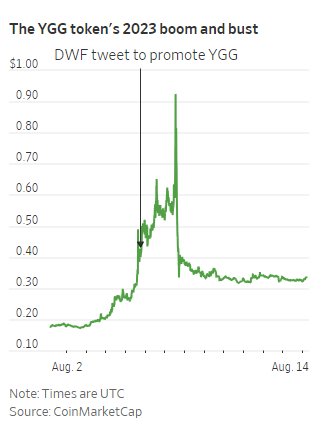
Andrei Grachev had previously lavishly praised YGG on social media, claiming that the listing would bring "sustainability and strength" to the token. However, shortly after the launch of the YGG derivative contract on Binance, its price experienced a sharp decline (as shown in the image above).
The cryptocurrency industry took note of this volatility, and two other market maker companies privately expressed concerns to Binance about DWF Labs. One of the market makers complained to Binance's VIP client department about DWF Labs' trading, and this department reported the matter to Binance's market monitoring team. Soon after, in September 2023, Binance's market monitoring team began investigating DWF Labs.
Investigation and Dismissal
According to insiders at Binance, the investigators found that DWF Labs was suspected of manipulating the prices of YGG and at least six other tokens, and had conducted wash trades totaling over $300 million in 2023, leading to the conclusion that these actions violated Binance's terms of use.
Furthermore, it was alleged that similar wash trades had formed a significant scale on Binance's trading platform, especially among the VIP clients on whom Binance's business relied. The top trading clients (traders with monthly trading volumes exceeding $100 million) accounted for two-thirds of Binance's total trading volume last year. Therefore, the investigators recommended the closure of hundreds of users who violated the terms of use before the first half of 2023.
In the case of DWF Labs, the investigation found that after Andrei Grachev promoted YGG on social media, DWF sold nearly 5 million tokens in two batches when the price of YGG was close to its market peak, causing the token price to collapse. However, YGG co-founder Gabby Dizon claimed to be unaware of Binance's investigation results.
In late September 2023, Binance's market investigation team submitted a report, concluding that DWF Labs was suspected of market manipulation and recommended removing DWF Labs. However, things seemed to have changed.
Over the next few days, the head of Binance's VIP client department and its staff questioned the investigation results and complained to the company's leadership. As a result, Binance's executives stated that the market investigation team did not have enough evidence to show that DWF Labs was involved in market manipulation, and that the discovered wash trades might have been incidental self-trades, which might not constitute manipulation. Binance also believed that the head of the market investigation team had cooperated too closely with the initial complainants against DWF Labs. A week later, Binance claimed to have dismissed several investigators involved in this matter in order to save costs.
Responses from All Parties
Undoubtedly, Binance plays a pivotal role in the global digital currency economy. Currently, Binance's platform has listed about 400 cryptocurrencies and provides derivative products that allow users to bet on price directions. The number of Binance users is as high as 190 million, and industry data shows that its spot and derivative trading value in March exceeded $4 trillion.
According to The Wall Street Journal, a former insider at Binance stated that Binance seems to be "shielding" DWF Labs' market manipulation behavior. Due to DWF Labs' huge trading volume, Binance not only did not stop DWF Labs as recommended by the market investigation team, but also dismissed the investigators who were investigating the market maker, likely in order to earn high trading fees from large clients.
In response, a Binance spokesperson stated that they do not agree with any claims that they allow market manipulation, and that Binance is prioritizing improving its compliance functions. The spokesperson said, "We have a strong monitoring framework to identify market abuse and take action. Binance does not favor any individual user for the safety of the platform, regardless of their scale."
At the same time, the spokesperson pointed out that Binance does not make decisions to delist users lightly and requires sufficient evidence to prove that they have violated the terms of use. In any case, Binance does not trade for profit and does not manipulate the market, and added that its operations are "subject to strict scrutiny." The spokesperson disclosed that over the past three years, Binance has closed nearly 355,000 user accounts for violations, involving a trading volume of over $25 trillion.
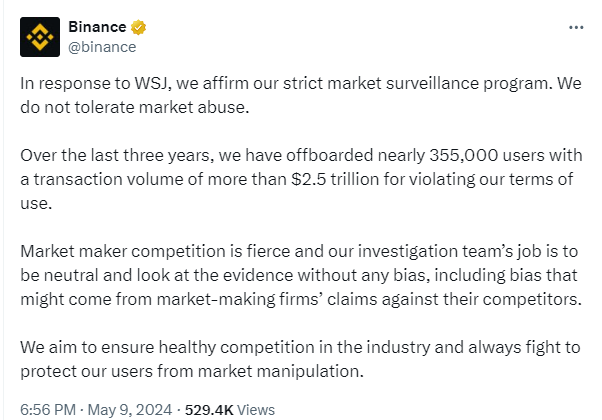
Following The Wall Street Journal's disclosure of wash trades and potential market manipulation issues by DWF Labs on the Binance trading platform, Binance responded on the evening of May 9th on social media, writing:
"Binance firmly refutes any claims that its market monitoring plan allows market manipulation on the platform. Binance has a strong market supervision framework to identify market abuse and take action. Any users who violate the terms of use will be removed, and market abuse will not be tolerated. In the past three years, nearly 355,000 users have been removed for violating the terms, involving a trading volume of over $2.5 trillion. Binance has 190 million users. They can rest assured that Binance prioritizes the platform's security and does not favor any individual, regardless of their scale. In other words, these decisions are not made lightly by us. Binance will use various tools for in-depth investigations, and only when there is sufficient evidence of users violating our terms will they be removed. In addition, Inca Digital recently conducted an independent investigation into Binance's market monitoring practices, verifying the effectiveness of the methods and finding the smallest traces of abnormal trading activity."
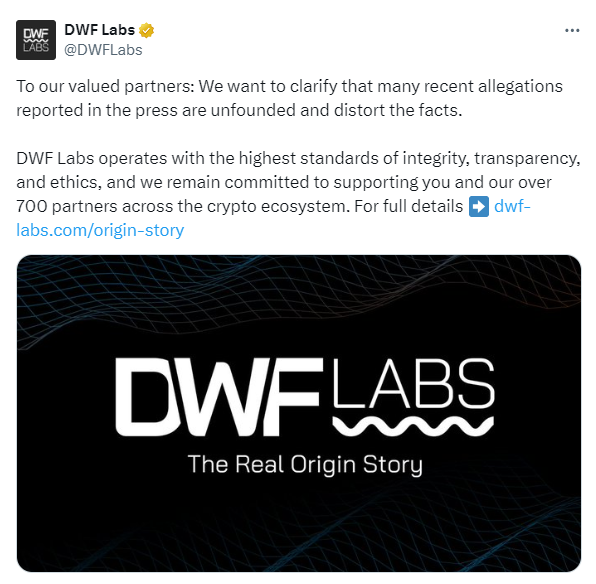
As a party involved in this incident, DWF Labs also responded on social media, stating:
"DWF Labs hopes to clarify that many of the recent media allegations are unfounded and distorted the facts. DWF Labs operates with the highest integrity, transparency, and ethical standards, and remains committed to supporting over 700 partners."
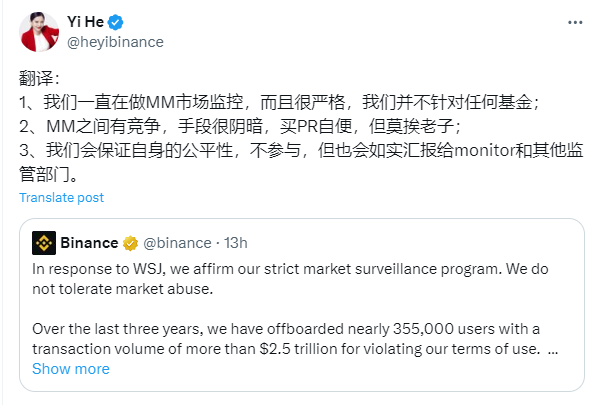
Subsequently, He Yi, co-founder and Chief Customer Service Officer of Binance, interpreted Binance's response, emphasizing that Binance has been conducting strict market monitoring for market makers (MM), but not targeting any funds. He also suggested that there is competition and dark tactics among market makers, implying that some market makers engage in PR activities, but this should not involve Binance. Binance will ensure its own fairness, not participate, but will truthfully report to the monitor and other regulatory authorities. He Yi also added:
"People are influenced by their own culture, background, and biases. I am very grateful to WSJ for their long-term dedication to Binance, which has given us a lot of exposure and saved us a lot of budget. But I have noticed an interesting phenomenon, that some mainstream media articles are beginning to output emotions and biases, no longer based on facts. For example, the complaints (views) of former employees can become articles; while Binance helped law enforcement agencies, actively investigated and reported the main culprit of Zkasino (facts) which are not worth reporting."
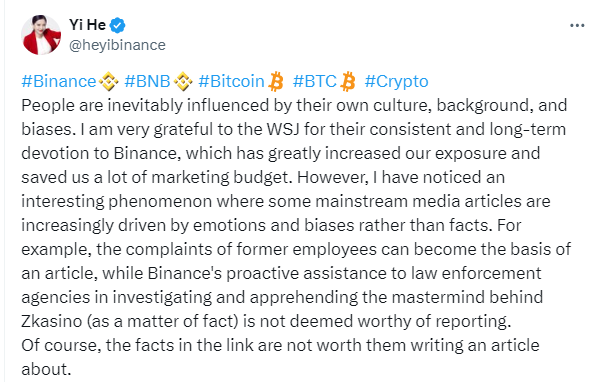
From He Yi's response, it seems that this incident may have been caused by competition among market makers, and it is likely that competitors have released some negative news in the media for public relations purposes to target market-making institutions like DWF Labs.
On the same day that The Wall Street Journal published the article, Binance announced the launch of a new coin mining project, and at least for now, Binance does not seem to have been greatly affected by this incident._
免责声明:本文章仅代表作者个人观点,不代表本平台的立场和观点。本文章仅供信息分享,不构成对任何人的任何投资建议。用户与作者之间的任何争议,与本平台无关。如网页中刊载的文章或图片涉及侵权,请提供相关的权利证明和身份证明发送邮件到support@aicoin.com,本平台相关工作人员将会进行核查。


