Author: Techub News
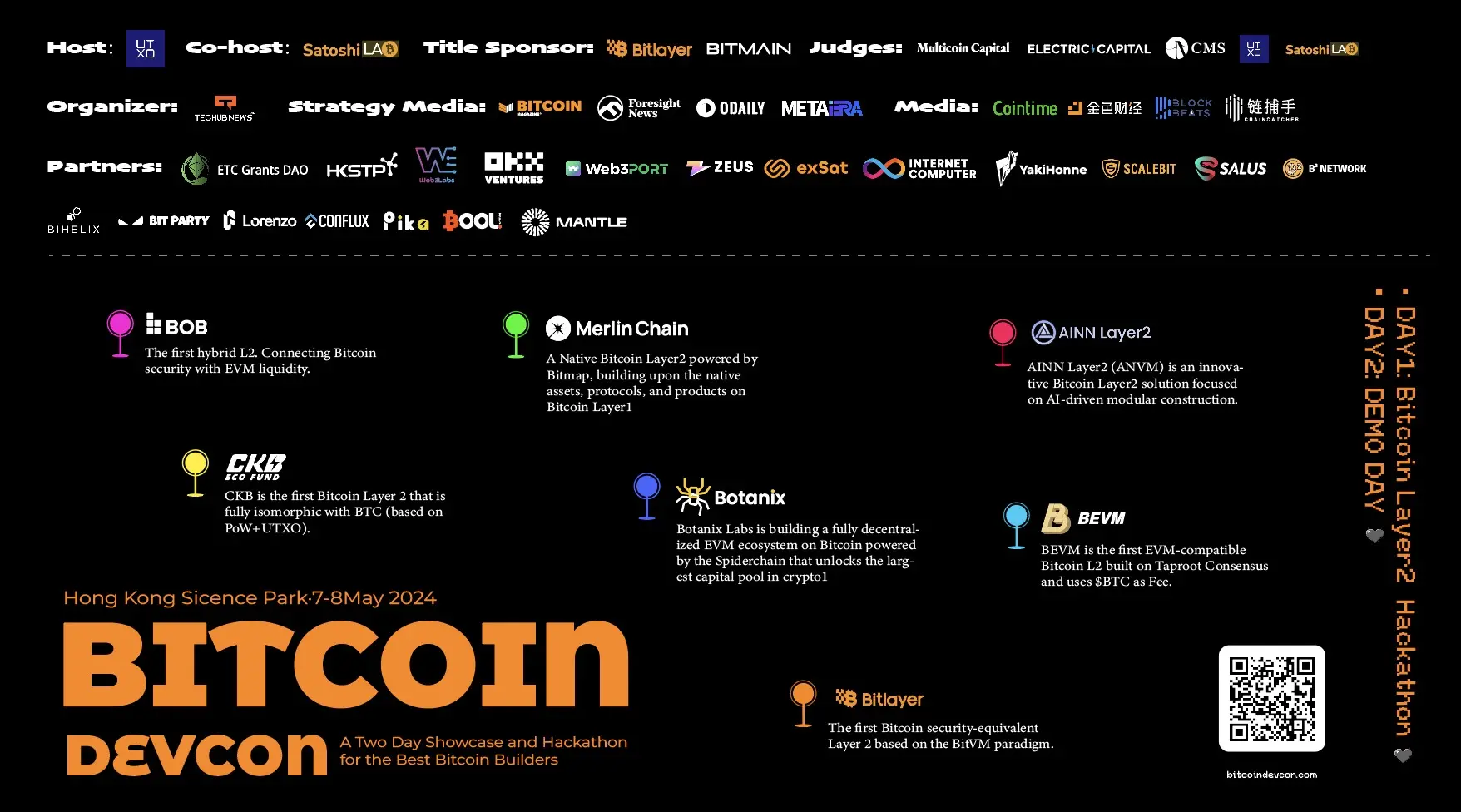
On May 8th, the Bitcoin Devcon conference concluded successfully, bringing together global Bitcoin elites to discuss the future of Bitcoin. After a day of intense discussions and exchanges, the agenda on the second day was even more exciting, featuring guest keynote speeches, high-profile roundtable forums, and displays of innovative ecological projects, all showcasing the vitality and innovation of the Bitcoin ecosystem.
The Bitcoin Devcon conference was organized by UTXO Management, co-organized by Satoshi Lab, and received strong support from Yakihonne and Web3port, with full coverage provided by Techub News. The conference attracted numerous developers, engineers, researchers, designers, artists, and investors in the Bitcoin field, who collectively brainstormed the future development trends of Bitcoin and injected new vitality into the global Bitcoin ecosystem.
It is worth mentioning that the choice of venue for this conference not only acknowledges the crucial role played by Hong Kong in the early development of Bitcoin but also represents our firm determination to move forward from the historical starting point of Bitcoin activities towards the future. Here, global Bitcoin enthusiasts witnessed the growth and expansion of the Bitcoin ecosystem and collectively anticipated a bright future for Bitcoin.
This article will present the highlights of the day's speeches in text form, allowing you to appreciate the wisdom and insights from developers, founders, and renowned institutions from around the world. Let us look forward to the future of the Bitcoin ecosystem together, expecting more innovation and breakthroughs.
Isaac Tse, Senior Business Manager of HKSTP, delivered a keynote speech titled "Hong Kong Science Park - Your Ideal Launch Platform"
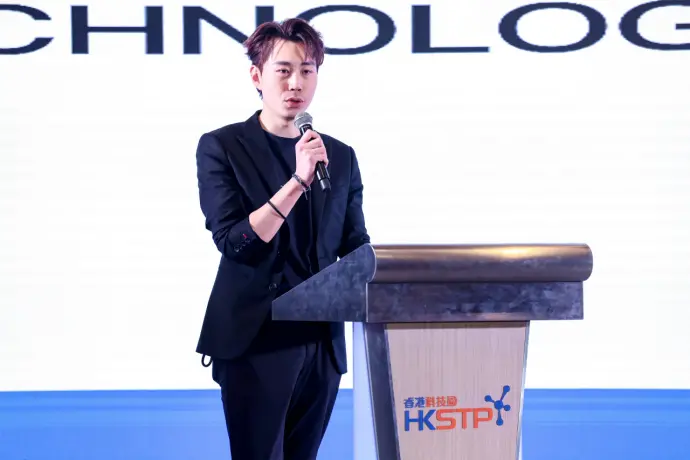
Isaac Tse, Senior Business Manager of HKSTP, delivered a splendid speech at the Hong Kong Science Park, showcasing the unique charm and enormous potential of the park as a center for technological innovation. Despite Hong Kong traditionally being seen as a center for finance and trade, under the government's impetus, the Hong Kong Science Park has transformed into a cradle for technological innovation, attracting a large number of tech companies and fostering a vibrant tech ecosystem.
As the management and operation organization of the park, HKSTP collaborates closely with the government to support the growth of enterprises. From incubating startups to expanding the global business of mature enterprises, HKSTP and numerous partners have jointly created a comprehensive and in-depth tech ecosystem.
Tse emphasized their goal of establishing Hong Kong as an international center for technological innovation. Under this goal, the Hong Kong Science Park has brought together over 1007 tech companies, which are thriving within the park and collectively scripting a new chapter in Hong Kong's technological innovation.
Arwen, Asia-Pacific Market Manager of BSquare, delivered a keynote speech titled "Introducing Bitcoin DA Layer and Expanding the Ecosystem"

Arwen, Asia-Pacific Market Manager of BSquare, delved into the new development direction of the Bitcoin ecosystem in his keynote speech "Introducing Bitcoin DA Layer and Expanding the Ecosystem." Arwen first pointed out the main difference between Bitcoin and Ethereum, namely the limitations of Bitcoin in executing smart contracts. To address this limitation, they introduced the DA layer (Data Availability layer), enabling more decentralized finance (DFS) projects such as dfinance, social finance, and gaming to survive and collectively expand within the Bitcoin ecosystem.
Arwen stated that their goal is to build a multifunctional Bitcoin layer to expand the Bitcoin ecosystem and provide Bitcoin DA layer support for more zk roll-ups and op roll-ups in the market. They aim to achieve this goal through four key aspects: fast, cheap, and secure transactions, simple access for individual users, collaboration with account abstraction solution providers such as Particle Network, and providing rich tools and resources for developers.
Matt, CEO of Lorenzo Protocol, delivered a keynote speech titled "The Importance of Building a Bitcoin Liquidity DeFi Ecosystem"
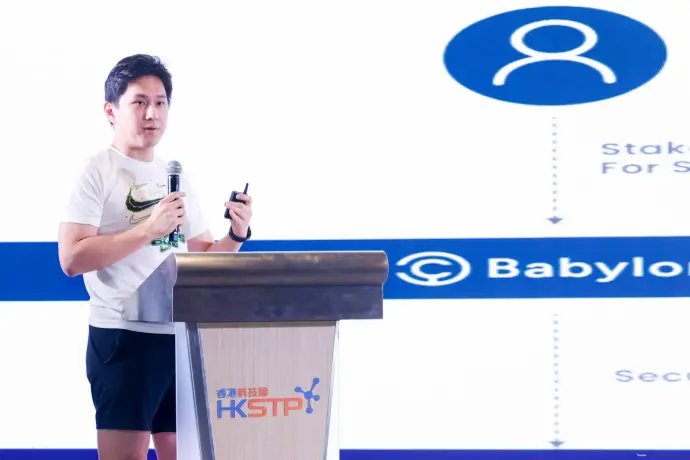
Matt, CEO of Lorenzo Protocol, emphasized the importance of building a Bitcoin liquidity DeFi ecosystem in his speech. With the expansion of the Bitcoin ecosystem and the prosperity of Altos, the demand for BDC liquidity continues to rise. To meet this demand, they are building an efficient market to facilitate supply-demand matching. Matt pointed out that while these projects consume liquidity, idle BDC also needs to be fully utilized. Therefore, Lorenzo Protocol is dedicated to creating a market platform for BDC holders to find high-quality projects and increase liquidity value. To avoid users losing liquidity due to collateral, they pursue a DeFi ecosystem that combines flexibility and opportunity. This ecosystem aims to promote mutually beneficial cooperation between Bitcoin holders and project parties, driving the prosperity and development of the entire ecosystem.
Roundtable Discussion on the theme "Nurturing Bitcoin Ecosystem: Challenges, Opportunities, and Future Prospects"
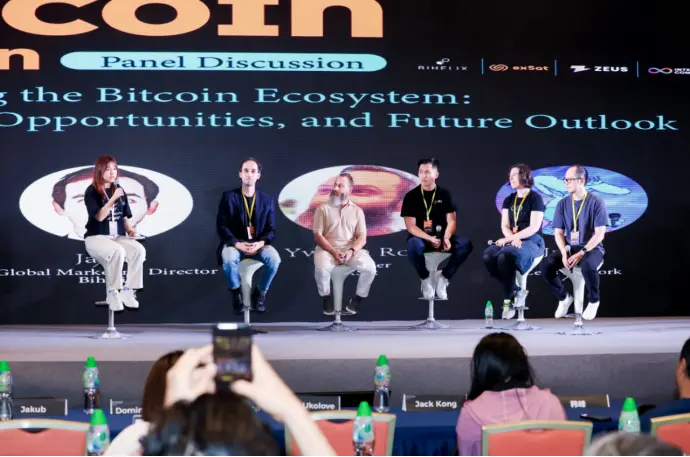
At today's roundtable discussion, several industry leaders gathered to engage in in-depth discussions on nurturing the Bitcoin ecosystem, addressing its challenges, opportunities, and future prospects. Participants included Jakub, Global Marketing Director of Bihelix; Yves La Rose, Founder of exSat; Justin, Founder of Zeus Network; Aisling Connolly, Senior Research Scientist at ICP DFINITY Foundation; and Ken Liao, Co-founder and CEO of Xverse.
They unanimously agreed that the development of the Bitcoin ecosystem faces multiple challenges such as technical bottlenecks, market acceptance, and regulation. However, they also recognized the enormous opportunities brought about by technological innovation, market potential, and policy support. Looking to the future, the participants expressed optimism, believing that the Bitcoin ecosystem is expected to continue to grow and become an important pillar of the digital economy.
During the discussion, the guests shared their experiences and insights, and put forward suggestions such as strengthening technological research and development, enhancing market education, and optimizing regulatory environment to promote the healthy development of the Bitcoin ecosystem. They also emphasized the importance of collaboration, believing that only through cooperation can win-win situations be achieved, driving the prosperity of the Bitcoin ecosystem together.
The atmosphere of the entire meeting was enthusiastic, and the guests' speeches provided valuable thoughts and insights for the participants. Finally, the host summarized the speeches of the guests and thanked everyone for their participation and support. This roundtable discussion not only deepened the participants' understanding of the Bitcoin ecosystem but also provided valuable suggestions and directions for the future development of Bitcoin.
Leonidas, Co-founder of Ord.io, delivered a keynote speech titled "Bitcoin is an Innovation"
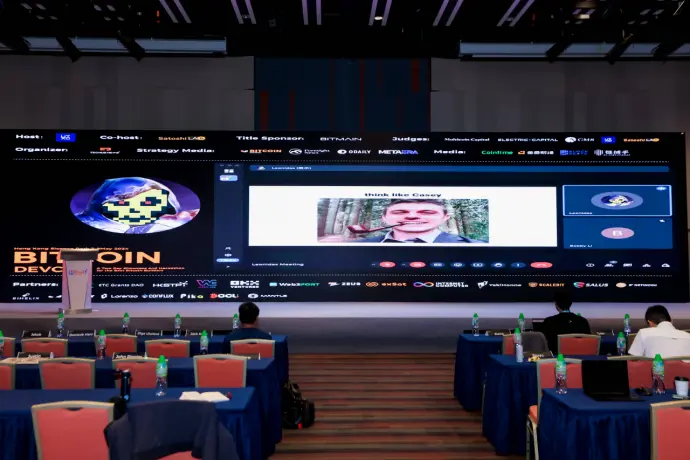
Leonidas, co-founder of Ord.io, delivered a speech titled "Bitcoin is an Innovation." In his speech, Leonidas stated that since October 2008, when a photographer using the pseudonym Satoshi Nakamoto released a white paper describing a purely decentralized network called Bitcoin, Bitcoin has become a crucial innovation. He believes that people need to focus on harnessing the energy brought about by this innovation.
Leonidas emphasized that although many interesting applications and experiments have emerged on other cryptocurrencies, people should not simply replicate this code. Instead, they should, like Satoshi Nakamoto, create something entirely new from first principles. He used the example of Satoshi Nakamoto creating Bitcoin to demonstrate how, starting from scratch and using the fundamental idea of immutable tokens, a more robust digital asset was created.
Leonidas' speech was full of insights and inspiration, encouraging people to create new things from first principles, like Satoshi Nakamoto, rather than simply replicating existing technologies and applications.
Han Feng, founder of Bel2, delivered a keynote speech titled "BeL2 - Your Money, Your Bank"

Han Feng, founder of Bel2, delved into the concept, challenges, and future prospects of Bitcoin in his keynote speech "BeL2 - Your Money, Your Bank." Han Feng emphasized the importance of Bitcoin as a decentralized currency, stating that the core idea of Bitcoin is to reclaim the issuance right from the government and central banks, allowing ordinary people to participate in the currency issuance process. He mentioned that the emergence of Bitcoin has given people the freedom to control their assets and currency, which is the greatest freedom. At the same time, he criticized attempts to centralize the management and expansion of Bitcoin, considering it a betrayal of the original principles of Bitcoin.
Han Feng further pointed out that the biggest challenge facing Bitcoin currently is the problem of good money being driven out by bad money. Although Bitcoin is the most bullish currency, its liquidity is the worst because Bitcoin holders are unwilling to sell. He believes that to improve Bitcoin's liquidity, this profound contradiction needs to be addressed. He suggested drawing inspiration from the historical relationship between gold and the US dollar, treating Bitcoin as a consensus wealth and increasing its liquidity through the issuance of stablecoins.
Finally, Han Feng called on everyone to adhere to the original principles of Bitcoin, not accepting any extensions to Bitcoin's credit and functionality. Only in this way can Bitcoin truly become people's money and people's bank. His speech was passionate and conviction, earning enthusiastic applause from the audience.
Wu Ming, co-founder and CTO of Conflux, delivered a keynote speech titled "Achieving Ultimate Security, Efficiency, and Customizability through the BTC Ecosystem"

Wu Ming, co-founder and CTO of Conflux, delved into the challenges of security, efficiency, and customizability in the BTC ecosystem in his keynote speech. He emphasized the balance between security and performance in blockchain development, pointing out that historical projects often sacrifice security in pursuit of performance. Wu Ming proposed a vision for the future BTC ecosystem to achieve both ultimate security and high performance, analyzing the relationship between different consensus mechanisms and market value, and security. He showcased the implementation of high security and scalability through the example of Ethereum Layer 2 extensions, emphasizing the importance of Layer 3 and customizability. Finally, Wu Ming discussed why Bitcoin needs Layer 2 and highlighted the challenges and possibilities for the future of BTC Layer 2.
Wu Ming stated, "I hope that the future BTC ecosystem can strike a balance between security and performance. The focus of the Conflux team's work includes building a decentralized, secure cross-chain asset mechanism and expanding a customizable virtual machine execution environment to promote ecosystem development and cross-ecosystem interaction."
Justin, founder of Zeus Network, delivered a keynote speech titled "Zeus Network Solana as Bitcoin's L2"
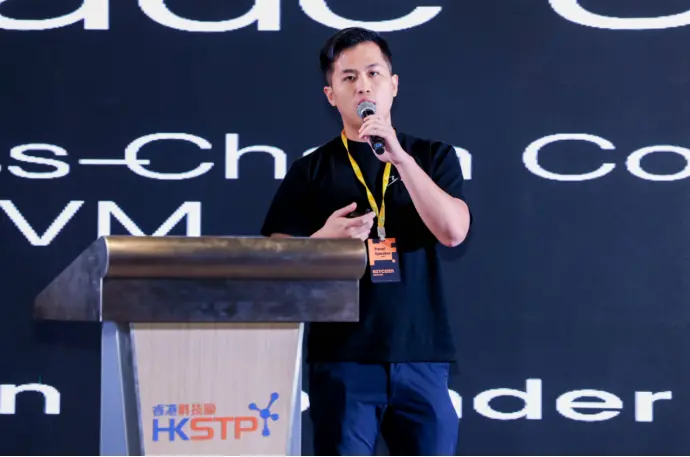
Justin, founder of Zeus Network, outlined the concept of using Solana as Bitcoin's Layer 2 (L2) in his speech. He criticized some projects for using Bitcoin only as "gas," rather than truly leveraging its value and potential. Justin emphasized that true blockchain innovation should focus on facilitating C2C and C2B transactions and promoting interaction with project parties, Libert, and DIY application development. He chose Solana as Bitcoin's L2 because Solana has high performance, low cost, and strong support from users and developers. Justin introduced how Zeus Network uses slot versions to connect with the Bitcoin mainnet, forming a 1.5-layer solution to improve the performance and scalability of Bitcoin applications. He believes that the rapid growth of big assets and the important position of Solana demonstrate its potential and value as Bitcoin's L2, bringing new opportunities for the development of Bitcoin applications.
Aisling Connolly, Senior Research Scientist at ICP DFINITY Foundation, delivered a keynote speech titled "Supporting Bitcoin L2 through Chain Fusion on ICP"
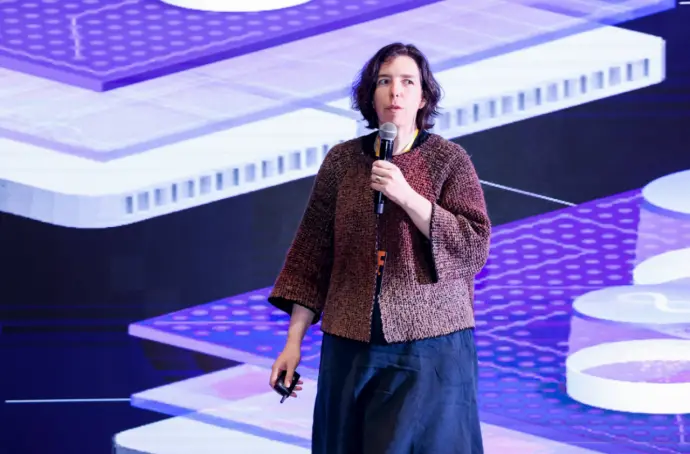
Aisling Connolly, Senior Research Scientist at ICP DFINITY Foundation, detailed how the ICP network provides support for Bitcoin's Layer 2 (L2) through Chain Fusion technology in her speech. The ICP network is a network composed of standard node hardware running in independent data centers, aiming to achieve decentralization. Connolly pointed out that the DFINITY Foundation provides a range of tools using the ICP network and Chain Fusion technology to help developers build Bitcoin's L2 solutions, accelerating development and reducing risk. She emphasized DFINITY's expertise in the cryptocurrency field, particularly its advanced encryption technology, ensuring network security and privacy. Connolly's speech showcased the unique perspective and strong capabilities of the DFINITY Foundation in the Bitcoin L2 field, injecting new vitality into the development of the Bitcoin ecosystem.
David Kim, PoW Ecosystem Manager at Bitmain, delivered a keynote speech

David Kim, PoW Ecosystem Manager at Bitmain, discussed how Ethereum Classic (ETC) empowers the Bitcoin ecosystem in his speech. He emphasized the similarities between ETC and Bitcoin in PoW and supply mechanisms, pointing out that ETC's EVM functionality can introduce more diverse decentralized applications to the Bitcoin network. David Kim stated that Bitmain is committed to building industry infrastructure and supporting the PoW ecosystems of ETC and Bitcoin. He believes that through cooperation and integration, ETC and Bitcoin can jointly promote the development of the cryptocurrency field, achieving broader applications and stronger network security. In conclusion, David Kim's speech showcased the potential for cooperation between ETC and Bitcoin, providing a new perspective and opportunities for the future development of the cryptocurrency field.
Roundtable Discussion on "Exploring the Investment Prospects of Emerging Projects within the Bitcoin Ecosystem"
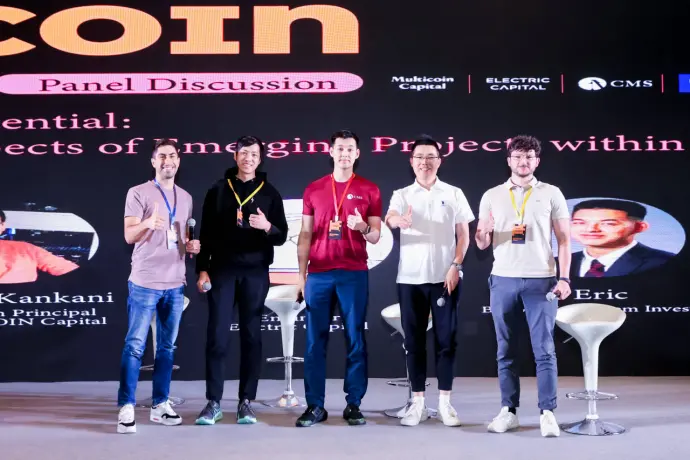
In the roundtable forum "Exploring the Potential: Investment Prospects of Emerging Projects within the Bitcoin Ecosystem," the guests collectively discussed the investment potential of emerging projects within the Bitcoin ecosystem. Vishal Kankani (MULTICOIN Capital) emphasized the importance of team strength, technological innovation, and market potential. Engineers from Electric Capital analyzed the potential and sustainability of emerging projects from a technical and engineering perspective. Eric (CMS Bitcoin Ecosystem Investor) focused on the project's business model and market adaptability. Jademont (Founding Partner of Droplet Capital) emphasized the importance of community support and project vision in investment decisions. Seb Ramirez (NC Partners Investment Team) focused on the long-term growth potential and scalability of projects. The guests unanimously agreed that exploring the potential of emerging projects within the Bitcoin ecosystem requires a comprehensive consideration of factors such as technology, team, market, and community.
Next is the Demo Day project showcase, which has been selected for two months and reflects their innovative capabilities in the Bitcoin ecosystem. We also hope that these projects will drive the diversification of the Bitcoin ecosystem.
UTXO stack

UTXO partner John Riggins pointed out in the Demo Day speech that the Bitcoin ecosystem lacks native solutions to address the challenges of programmability and scalability. He believes that although there are many Bitcoin layer tools on the market, the multi-chain bridging method has not truly solved the fundamental problem. Therefore, he proposed a solution to address programmability issues directly at the Bitcoin base layer and introduce more flexible and simple programmability through the RGB++ protocol. They also plan to provide a UK-based Layer 2 solution to enhance security and high-speed transactions. The RGB++ protocol supports the construction of smart contracts on Bitcoin, combining the capabilities of Layer 1 and Layer 2 to provide a native cross-layer cost solution without the need for bridging. This solution is expected to bring revolutionary progress to the Bitcoin ecosystem.
Fractal Bitcoin
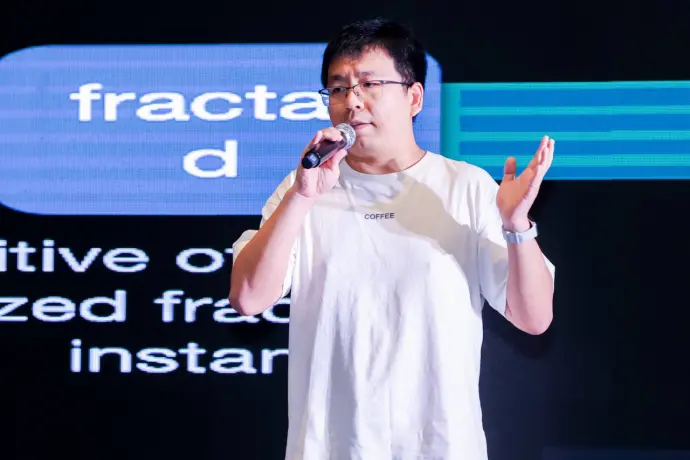
At Demo Day, project representative Laurendo introduced Fractal Bitcoin, a scaling method designed specifically for Bitcoin. He emphasized that previous attempts by the team, such as the Lightning Network, were not ideal, leading to the development of Fractal Bitcoin, which achieves native scaling for Bitcoin without introducing new variables and components. Its core is a virtualization method that virtualizes Bitcoin nodes into new instances without historical burdens, supporting protocols such as runes and BRC20 to achieve elegant scaling. Laurendo also mentioned the Unicet Wallet developed by the Unicet team, which supports switching between the main network and Fractal Bitcoin, providing convenience for users. In conclusion, Fractal Bitcoin offers a new, more elegant, and simple way of scaling for the Bitcoin ecosystem.
Bihelix
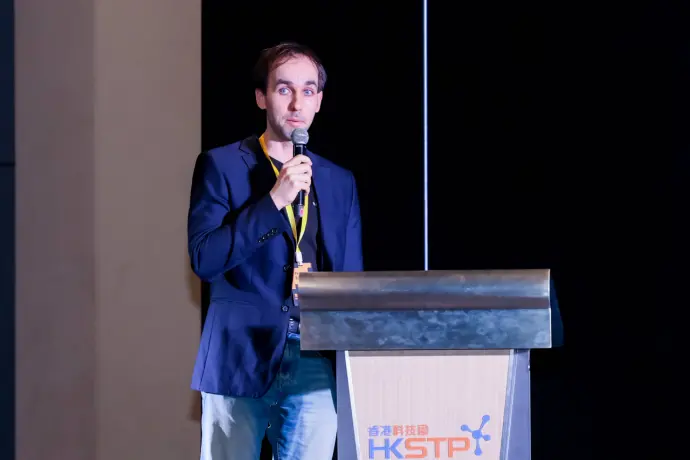
At Demo Day, Jakub, the Global Marketing Director of Bihelix, delivered a speech on integrating the RGB protocol and the Lightning Network. He pointed out that despite Bitcoin's 15-year history, its ecosystem still lacks an application ecosystem, with a large amount of capital in a dormant state. With the introduction of ordinals, the culture and interest of Bitcoin builders are experiencing a revival, and market demand is growing. However, despite technologies like SegWit and Taproot, Bitcoin's development remains relatively slow. To catch up with Ethereum, there is a need to add more smart contracts to Bitcoin and solve the impossible triangle problem. Existing solutions such as sidechains and colored coins have limitations, so they are exploring better scaling and smart contract methods. Integrating the RGB protocol and the Lightning Network is a feasible solution that is expected to inject new vitality into the Bitcoin ecosystem.
TerpLayer

Hannah, co-founder of TypeLayer, emphasized their role as an infrastructure service provider, focusing on the core issues of data pricing and data trust in the native environment. TypeLayer's infrastructure includes three main service components, one of which is "Verified Essentials Offline," with its own consensus mechanism to verify Bitcoin base layer data. In addition, it provides text tagging functionality to help developers modularize and build similarity. Its infrastructure includes basic trends and large coin-based trends, with a decentralized node verification network, providing various services such as ZK guardians and GRB services to ecosystem members. TypeLayer has collaborated with commercial clients to support serialized data on the first layer of Bitcoin.
ZKM
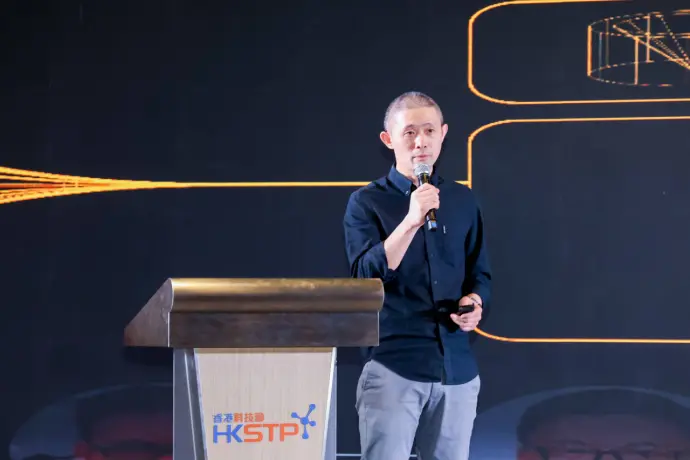
Kevin, founder and CEO of ZKM, introduced the universal zero-knowledge observatory they are building, aiming to solve the fragmentation problem of blockchain and provide unified liquidity. The team has a strong background and is supported by multiple well-known institutions. They have built a complete system, including observatory technology, verification networks, and upper-level frameworks, to achieve cross-chain connection and universal verification. Kevin specifically mentioned the team's focus on idle Bitcoin assets and their desire to collaborate to ensure the security of user assets and provide expansion capabilities.
SHELL Finance
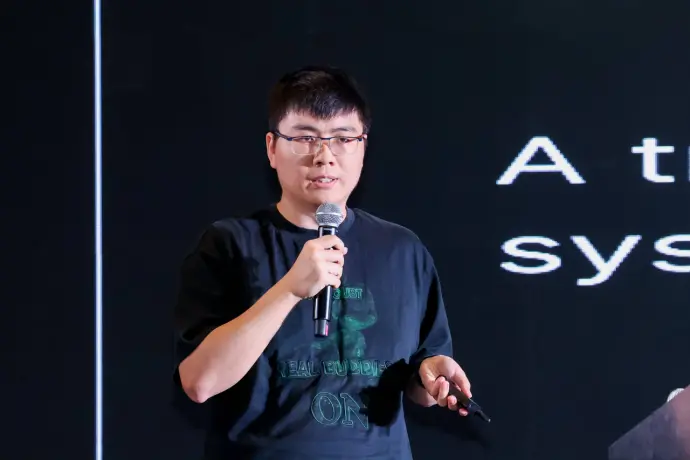
The SHELL project representative introduced their work in building a large-scale native lending mechanism, aiming to achieve functionality similar to IV or MakerDAO but with technological innovation, using PSBT, DLC, and Beacon native technology. The reason for choosing a large native platform is its high transaction fees and limited income sources for miners. The project representative mentioned the unsustainability of transaction fees in other projects, so they hope to build a large-scale quantitative trading mechanism to achieve sustainable transaction fees. They also showcased the process of lending using native assets such as ORDINALS and RAINS, demonstrating the technical strength, innovative thinking, and market insight of the SHELL project.
OpenBit

The OpenBit project representative introduced their goal of improving the liquidity of Bitcoin. He pointed out that despite Bitcoin being a trillion-dollar ecosystem, its liquidity has always been an issue. To address this problem, OpenBit is dedicated to building a cross-chain liquidity infrastructure to introduce Bitcoin's liquidity to other levels.
He emphasized three major advantages of OpenBit. First, they provide native asset support for the entire Bitcoin ecosystem, enabling assets to flow freely between different levels. Second, they have built a secure and efficient infrastructure to ensure smooth liquidity. Finally, they provide critical infrastructure support for blockchain builders, users, traders, and liquidity providers.
During the presentation, the judges may ask questions about how OpenBit ensures asset security, how it collaborates with other blockchain platforms, and how it attracts more liquidity providers. The project representatives need to be prepared with appropriate answers to showcase OpenBit's technical strength and market prospects.
iOracle
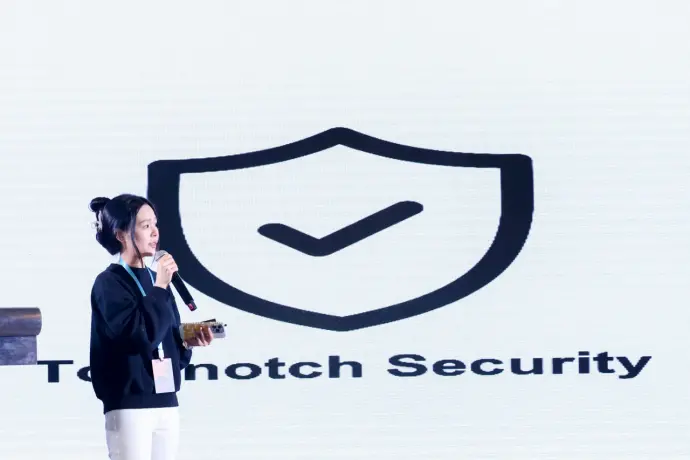
iOracle representative Kayla introduced a hybrid nature-based testing framework based on deep learning, specifically designed for Bitcoin. The framework innovatively combines deep indexing with zero-knowledge provable data aggregation, developing the I Know network and ZK processor. This novel and highly potential technological combination lowers the entry barrier and utilizes a large number of nodes to achieve top-notch security performance. iOracle uses the most secure data aggregation consensus algorithm to ensure honest execution and verifiability. Compared to other decentralized indexing solutions, iOracle is more efficient, with performance increasing as the number of nodes grows. Nodes only index individual blocks, rather than synchronizing the entire chain history, improving efficiency. Multiple computing tasks can be executed in parallel, demonstrating iOracle's advancement and practicality.
Bool Network
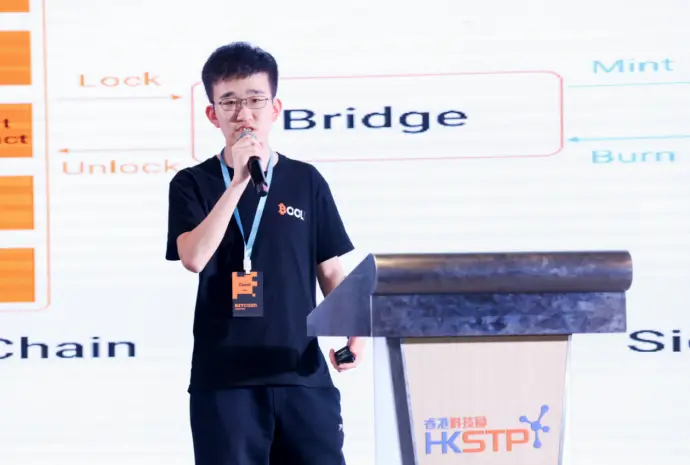
The Bool Network project representative introduced a project aimed at safeguarding users' asset security recovery on Beacon. By submitting transaction data to Daily and allowing users to submit module routing proofs of remaining assets, the project conducts double checks in case of issues to ensure the safe transfer of user assets to Beat Coin. Additionally, Bool Network's vision is to ensure integrity and provide convenience for developers, open-sourcing the code and providing Beta Collier to further promote the development and application of blockchain technology. Use cases include Bitcom Bridge, ensuring the secure transfer of Bitcoin to other assets and supporting various native Bitcoin assets. The project representative emphasized Bool Network's openness and scalability, providing powerful tools for developers to address the current centralization issues in indexers.
Bittap

Ray, the representative of Bittap, introduced Bittap as a non-custodial wallet and decentralized marketplace based on the Type Perss protocol, aiming to be an infrastructure on the Bitcoin network, providing robust asset management and trading solutions for users. He also explained the Temper Asset, a new asset insurance protocol, emphasizing its low complexity and lack of burden on the Bitcoin network, but pointing out its infrastructure limitations that restrict users. Therefore, Bittap is dedicated to filling this gap using the latest ap technology, allowing everyone to issue and manage their assets. Ray's presentation showcased Bittap's role in providing users with a more convenient and secure Bitcoin trading experience, highlighting its importance in the Bitcoin ecosystem.
Lnfi Network

The Lnfi Network representative introduced their platform as a Layer 2.5 solution aimed at driving global adoption of the Lightning Network. They pointed out that the asset lockup volume of the Lightning Network is lower than Ethereum, mainly due to the lack of decentralized financial applications. To address this, Lnfi Network has launched the "Lightning Fire" solution to provide infrastructure for decentralized finance. The project has Bitcoin security at Layer 1 and token insurance, Lightning Network support for instant transactions and native support for Table Assets at Layer 2, and allows various applications to be built at Layer 3. Using Starbucks as an example, Lnfi Network can enable the issuance of token assets and develop a points system, while the simple Lightning Network only supports basic payment transfers. Lnfi Network's innovation and practicality were highlighted.
Dotswap

Lin Zheming, the founder of Dotswap, enthusiastically introduced his product, DotSwap, at the meeting today. This is a product that innovatively combines liquidity, smart contracts, and AMM exchanges, aiming to be a leader in the native field. Despite many competitors in the A1 native field, he is confident in his project.
Lin Zheming pointed out that with the popularity of fair launches and public minting, the community's enthusiasm for the fair launch model is increasing. However, this has also brought about a problem: limited liquidity before tokens are listed on centralized exchanges. To address this issue, their team has developed an AMM exchange based on PSVT, aiming to increase liquidity before tokens are listed.
He emphasized the importance of the liquidity issue using Satoshi Nakamoto's token as an example. Despite the mining cost of this token being as high as 300 BTC, its trading volume on mainstream trading platforms is far lower. This indicates that the fees are currently being used more for minting rather than actual liquidity.
Lin Zheming then introduced their solution—Dotswap. This is the first native room to provide an AMM model for Rooms and BS 20s, ASC 20s, and other tokens. Since its launch in September last year, it has been warmly welcomed by users. Dotswap is fully participatory and completely decentralized, requiring no deposits or bridges. It supports mobile devices, has a simple and intuitive interface, and provides one-click trading, greatly facilitating users.
Vertex Labs

The Vertex Labs project representative introduced the BSAA wallet, aimed at addressing blockchain network congestion issues. They pointed out that Layer 2 networks often face challenges such as lack of equality and a single ecosystem, and often use EVM, requiring users to use multiple wallets. To address this, Vertex Labs proposed the Beat Sign and Obstruct Account Wallet solution as connectors between DS and BTC networks, allowing users to operate through a Bitcoin network wallet and submit for verification to Layer 2 networks. The project uses ERC 4337 technology mechanisms and plans to use Hash Log and Hash Time Log to reduce gas costs and achieve cross-chain asset management. Vertex Labs emphasized the security advantages of its solution, aiming to bring greater convenience and security to the blockchain industry.
dustup

The Vdustup project representative Richard Bensberg introduced their Bitcoin-native esports software platform, aiming to promote the popularity of Bitcoin through the esports industry. The esports industry has a large user base, but they hope to significantly increase the number of users using the esports platform. They believe that by using Bitcoin as the currency for esports competitions, they can change the mainstream's negative perception of Bitcoin. Although the project is currently in its early stages, they hope to receive more support and collaboration to achieve this goal. Richard overcame technical difficulties, successfully showcased the project, and hopes to attract more attention and support to drive the project forward.
Summary
After a day of exciting guest keynote speeches, high-profile roundtable forums, and innovative ecosystem project presentations, the Bitcoin Devcon 8 event came to a successful conclusion. These sessions not only fully demonstrated the vitality and innovation of the Bitcoin ecosystem but also brought together the wisdom and power of global Bitcoin elites to jointly plan for the future development trends of Bitcoin.
As the final project came to a close, attendees expressed that they had gained a lot from the day's activities, deepening their understanding of the Bitcoin ecosystem and igniting more expectations and aspirations for the future. The guests' insightful speeches not only brought profound insights but also resonated with and stimulated the thinking of the attendees; the high-profile roundtable forums provided a platform for exchanging and colliding ideas, sparking sparks of different viewpoints; and the presentation of innovative ecosystem projects allowed everyone to see the emerging new forces and opportunities in the Bitcoin ecosystem.
Overall, the Bitcoin Devcon 8 event was not only a successful exchange event but also an important milestone in the development of the Bitcoin ecosystem. We look forward to Bitcoin continuing to innovate and break through in the future, bringing more surprises and possibilities to the global digital currency field.
免责声明:本文章仅代表作者个人观点,不代表本平台的立场和观点。本文章仅供信息分享,不构成对任何人的任何投资建议。用户与作者之间的任何争议,与本平台无关。如网页中刊载的文章或图片涉及侵权,请提供相关的权利证明和身份证明发送邮件到support@aicoin.com,本平台相关工作人员将会进行核查。


