Author: Sina Finance
Early Thursday Beijing time, Federal Reserve officials unanimously decided to keep the benchmark interest rate unchanged in the range of 5.25% to 5.5%, and the rate statement reiterated the need to see more evidence of cooling inflation before cutting rates. The Fed expressed new concerns about inflation, suggesting that it may maintain higher rates for a longer period of time, but will not raise rates again.
Powell said at a press conference, "So far this year, the data has not given us more confidence in cutting interest rates. Inflation data higher than expected means that it may take us longer to have confidence in cutting interest rates, longer than expected." Powell said, "The Fed's next move is unlikely to be a rate hike. The premise of a rate hike is that officials need to see convincing evidence that monetary policy is not restrictive enough to bring the inflation rate back to the central bank's 2% target. But we have not seen evidence to support this conclusion."
These remarks reassured investors who were worried that the Fed might make a more aggressive response to inflation. Both the U.S. stock and bond markets rose, and the futures market showed a slight increase in the likelihood of two rate cuts this year, rather than the expected one cut before the meeting. However, Powell did not suggest a rate cut this year, nor did he suggest that rates have peaked.
Fed Decision: Unanimously agreed to maintain rates unchanged, reiterating the need to gain greater confidence in inflation before cutting rates
① Inflation Outlook: Lack of further progress in achieving the 2% inflation target in recent months
The latest statement from the Federal Open Market Committee (FOMC) reiterated the consistent statement since December that "inflation has slowed over the past year but remains high." But it added a sentence: "There has been a lack of further progress in reducing inflation in recent months."
Another change is that the Fed stated that the risks to achieving the dual goals of employment and inflation "have become more balanced over the past year," using the past tense. The previous statement used the present tense, indicating "are becoming more balanced."
② Balance Sheet Reduction: The pace of reducing Treasury holdings will slow to $250 billion per month starting in June, while the MBS reduction limit will remain at $350 billion per month
Officials also outlined plans to slow the pace of balance sheet reduction. Starting in June, the upper limit for U.S. Treasury holdings that are not reinvested after maturity will be reduced from $600 billion to $250 billion per month. The upper limit for mortgage-backed securities (MBS) will remain unchanged at $350 billion, but the Fed will reinvest principal amounts exceeding the limit into U.S. Treasuries rather than MBS.
Regarding the balance sheet, policymakers generally agreed with the view of the March meeting that a cautious approach should be taken to further reducing the balance sheet. Officials emphasized that the decision to slow the balance sheet reduction is unrelated to the timing of rate cuts.
③ Reiterating Strong Employment Growth
Although price pressures rapidly cooled in the last few months of 2023, progress in achieving the 2% inflation target stalled in 2024. At the same time, strong labor market conditions and stable consumption and investment support continued economic expansion. The rate statement reiterated strong employment growth, low unemployment, and steady economic growth.
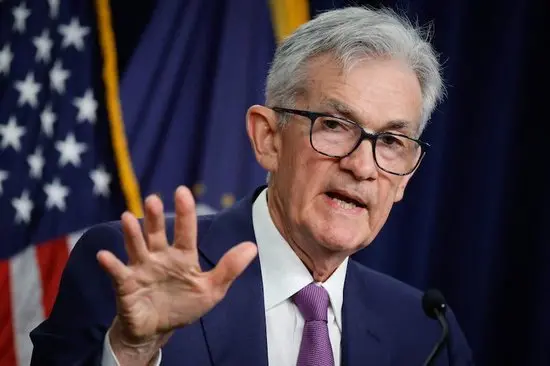
Key Points from Powell's Press Conference: It will take longer than expected to gain confidence in cutting rates, and the next move is unlikely to be a rate hike
① Powell: The next move is unlikely to be a rate hike
Federal Reserve Chairman Powell said the next move is unlikely to be a rate hike. Earlier, the Fed announced that it would keep rates unchanged and hinted at new concerns about inflation. "It is clear that policy is restrictive," Powell said. "We believe that over time, its restrictiveness will reach a sufficiently high level."
② Powell: It will take longer to gain confidence in the decline in inflation
Federal Reserve Chairman Jerome Powell said that the decision-making body may need more time than previously expected to gain sufficient confidence in the trajectory of inflation to initiate rate cuts. Powell said at a press conference, "We have said that we do not think it would be appropriate to lower the target range for the federal funds rate until we are confident that inflation is sustainably moving toward our 2% target." The U.S. central bank decided on Wednesday to keep the benchmark interest rate unchanged and hinted at new concerns about inflation. "It may take longer than previously expected to gain the confidence needed," Powell said.
③ Powell: Not very confident about rate cuts this year
Federal Reserve Chairman Powell said, "I am not very confident about rate cuts this year, and I don't know if inflation will decrease enough to warrant a rate cut. Given the current situation, I believe the Fed's policy stance is in a good position. Considering growth or inflation, I don't think there is stagflation. 2023 witnessed a year of very high productivity growth, and potential economic output may experience significant growth."
④ Powell: Committed to maintaining a restrictive policy stance at the appropriate time
Federal Reserve Chairman Powell said that the Fed is committed to maintaining a restrictive policy stance at the appropriate time; the next policy rate adjustment is unlikely to be a rate hike. The focus of the policy is on how to maintain its restrictiveness. If a rate hike is to occur, evidence is needed to show that the policy is not sufficient to bring inflation back to our target level. We are concerned about the duration of the policy's restrictiveness.
⑤ Powell: Slowing the pace of quantitative tightening does not mean the Fed's balance sheet will shrink more slowly than expected
Federal Reserve Chairman Powell said that slowing the pace of quantitative tightening does not mean the Fed's balance sheet will shrink more slowly than expected; slowing the pace of balance sheet reduction is not a loosening of policy. The decision to slow the pace of balance sheet reduction will reduce the likelihood of pressures in the money market and ensure a smooth transition. The current slowing of the pace of balance sheet reduction is to ensure a smooth process, rather than causing market turmoil as it did last time.
⑥ Powell: As inflation falls below 3%, the Fed's employment target becomes the focus again
Federal Reserve Chairman Powell said that as inflation falls below 3%, the Fed's employment target becomes the focus again.
⑦ Powell: Unexpected weakness in the labor market could be a reason for rate cuts
Federal Reserve Chairman Powell said the timing of rate cuts will depend on the data. Unexpected weakness in the labor market could be a reason for rate cuts.
⑧ Powell: Long-term immigration's impact on inflation should be neutral
Federal Reserve Chairman Powell said that due to immigration, the potential output of the U.S. economy has experienced "significant increases"; potential economic output may experience significant growth. Immigration should have a neutral impact on inflation in the long term; initially, immigration may create more supply in the economy rather than demand.
⑨ Powell: Housing inflation will slow down as long as market rents remain low
Federal Reserve Chairman Powell said that market rents are hardly rising now. It will take several years for market rents to fully reflect in renewal rents. I believe that as long as market rents remain low, this will be reflected in inflation.
⑩ Powell's response to the U.S. election: Elections are not part of our consideration
Federal Reserve Chairman Powell said that the Fed will always take action at the right time, without considering other factors. Elections are not a factor the Fed is concerned about.
Market Performance: Powell dampens the possibility of rate hikes, U.S. stocks and U.S. Treasuries rise
U.S. stocks expanded their gains after the Fed's decision was announced, with the Nasdaq 100 index's increase expanding to 1%, reaching an intraday high, but the subsequent increase narrowed, and the Nasdaq 100 index erased its gain of 1.3% after the FOMC meeting statement.
After the Fed announced that it would keep rates unchanged and Powell answered questions, investors flocked to the U.S. stock and bond markets, pushing down yields. Powell insisted that the data has not convinced policymakers that inflation is falling to the Fed's 2% target, so a rate cut is unlikely at the moment. He also did not suggest the possibility of a rate hike. During his speech, major U.S. stock indices rose by more than 1%.
U.S. Treasuries rose, with the gains mainly occurring during Powell's press conference after the Fed announced that it would keep rates unchanged. Powell dampened the possibility of rate hikes, stating that the next policy rate adjustment is unlikely to be a rate hike, which helped the bond market avoid the previously feared hawkish turn. It seems that short covering to some extent boosted the bond market, leading to an expansion of the day's gains before the close.
Shortly after 3 p.m. New York time, the yield curve dropped by as much as 9 basis points from the short end to the middle, with the 2-year yield at around 4.95%, briefly falling to 4.923%. The steepening trend of the yield curve was largely maintained, and the 5s30s yield spread expanded by about 3 basis points that day.
OIS contracts linked to the Fed's meeting turned more dovish, returning to levels similar to those before the release of the Employment Cost Index on Tuesday; the market's implied rate cut by December was about 33 basis points, compared to 26 basis points at the close on Tuesday.
免责声明:本文章仅代表作者个人观点,不代表本平台的立场和观点。本文章仅供信息分享,不构成对任何人的任何投资建议。用户与作者之间的任何争议,与本平台无关。如网页中刊载的文章或图片涉及侵权,请提供相关的权利证明和身份证明发送邮件到support@aicoin.com,本平台相关工作人员将会进行核查。


