Original Title: Bitcoin Capital Efficiency with Liquid Staking
Original Author: Mikhil Pandey, Co-founder and Chief Strategy Officer at Persistence Labs
Original Translation: Deep Tide TechFlow
Introduction
This article is the result of Mikhil Pandey, co-founder and chief strategy officer of Persistence Labs, exploring the "rabbit hole" of today's Bitcoin landscape.
Through this article, Mikhil Pandey attempts to lead everyone to understand the role of Bitcoin in the cryptocurrency world, the current Bitcoin landscape, the role of BTC liquid staking, and his thoughts on the direction of future development.
Understanding Bitcoin
Is Bitcoin a store of value? The largest peer-to-peer payment network? A global remittance system? Digital gold? A tool for traditional financial hedging? The first proof-of-work blockchain in history?
What exactly is Bitcoin? Which of the above describes Bitcoin? In short, I believe all of them, and more.
Bitcoin is a first-layer blockchain originally designed for the distrust and transparent flow of currency value, an idea that emerged during the 2008 global financial crisis.
The native digital asset BTC driving this network has evolved from one of the boldest financial experiments of our time into the largest cryptocurrency.
Today, Bitcoin, both as a network and an asset, has become a playground for finance, mechanism design, and hope.
- The smartest people are pushing Bitcoin towards a more useful, capital-efficient, and programmable future.
- The world's largest institutions are offering BTC ETFs to provide exposure to the general public.
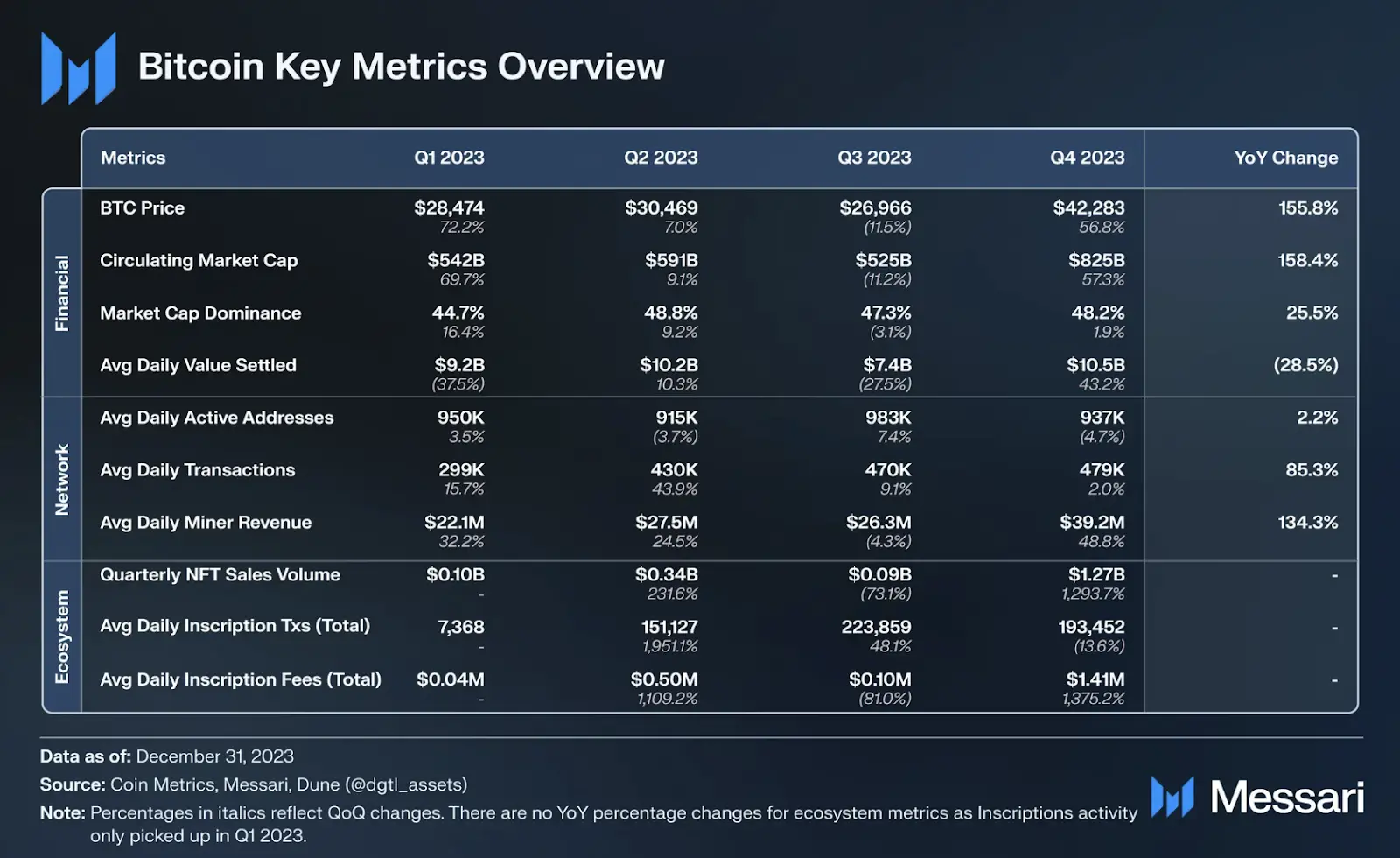
- A new generation of builders is finding unique ways to utilize Bitcoin block space, including Ordinals, NFTs, BRC-20, Runes, staking, and more.
- Bitcoin network activity has reached historic highs, generating more value (fees) for miners than ever before.
Bitcoin is for everyone. The best part is that the various perceptions of BTC are a feature, not a flaw.
Two Pillars Built on Bitcoin
For the public, Bitcoin is gradually transitioning from a "network" to an "ecosystem." Recently, the ecosystem built on top of Bitcoin has seen exponential growth.
This is not uncommon, as stakeholders have attempted to build on top of Bitcoin in addition to community network improvements. In fact, this is part of Satoshi Nakamoto's vision.
Satoshi Nakamoto once said, "The design supports a variety of possible transaction types that I designed years ago. Escrow transactions, bonded contracts, third-party arbitration, multi-signature, etc. If Bitcoin catches on, these are things we'll want to explore in the future, but they all must be designed at the beginning to make sure they're possible later."
Since 2012, people have been continuously trying to extend Bitcoin beyond payments to broader use cases:
- Decentralized domain name services (Namecoin)
- Broader asset representation (Colored Coins, MasterCoin, Counterparty)
- Extending the Bitcoin network through sidechains, Rollups, and L2 (Taproot, Stacks, Liquid Network, Merlin, Urbit, Lightning, bitVM, etc.)
- Extending BTC functionality through Ordinals and Runes (Memes, NFTs, BRC-20, BRC-420) and revenue (Babylon, BounceBit, Stroom Network, Trustless Machines, etc.)
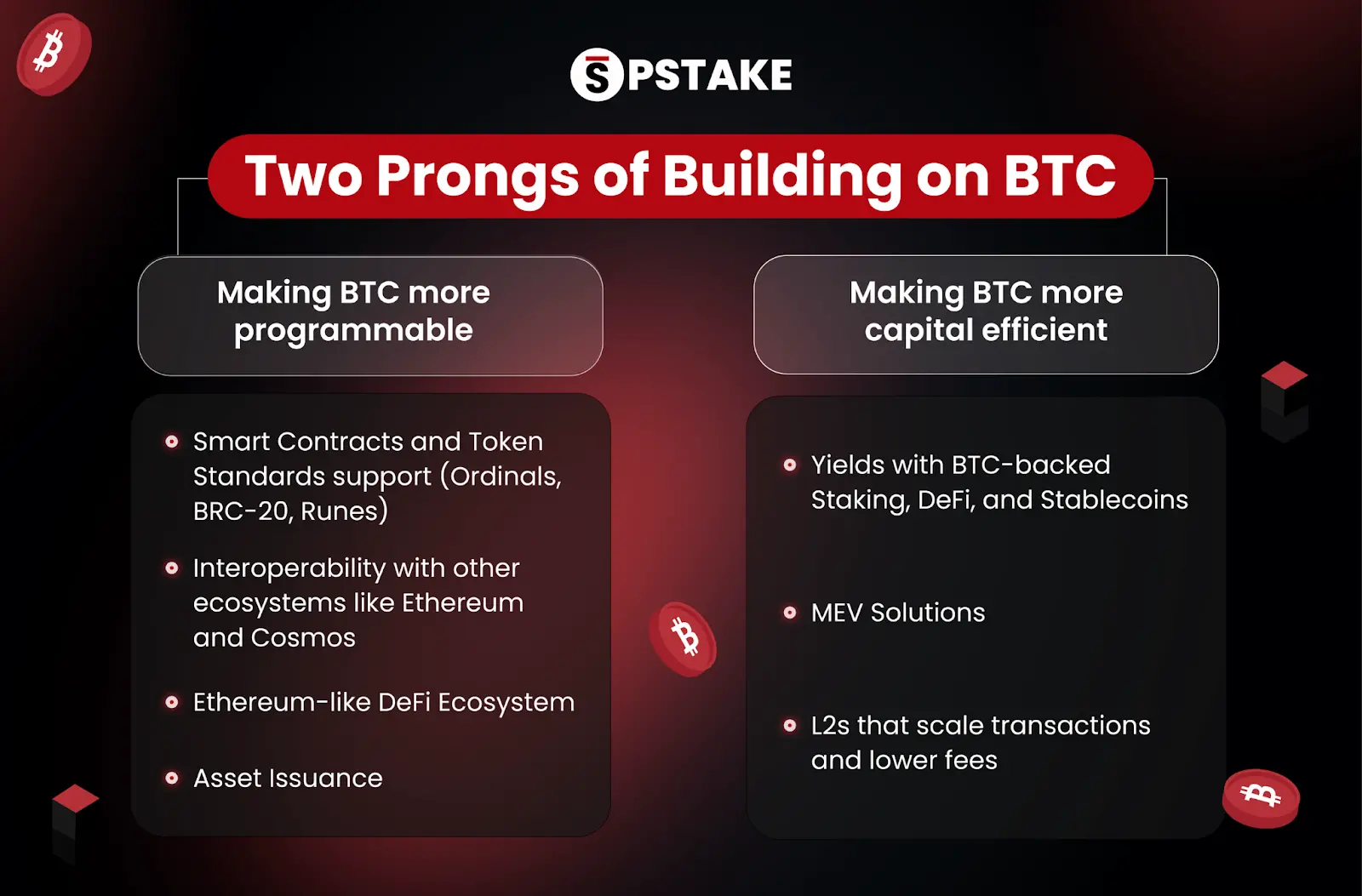
But where are these developments leading Bitcoin? Portal Ventures' article on Bitcoin perspectives summarizes it best:
- Making Bitcoin more programmable to address smart contracts and scalability limitations for deployment on the Bitcoin network.
- Making BTC more capital-efficient, creating a super-financialized system built with BTC.
Where Does BTC Liquid Staking Apply?
Bitcoin is a proof-of-work network, where miners contribute computing power to solve mathematical problems for block production and receive new Bitcoin as a reward.
So, how does staking come into play in the market, let alone liquid staking? Let's understand some basics of blockchain.
Consensus involves maintaining a continuous agreement on the network's state (data, transactions, balances, etc.). While PoW relies on computing power (mining) to achieve and maintain network consensus, PoS includes the concept of security guarantees. Staking involves locking tokens to participate in consensus, contributing to the overall network security, and receiving staking rewards.
When we need to trust that others/counterparties will behave well, we typically set up collateral to ensure good behavior. A typical example is a landlord collecting a security deposit from a tenant.
In short, PoS is driven by trust in the economic security of assets. What could be better than having economic trust in assets worth billions of dollars? And what's better than Bitcoin?
By "locking" BTC, its economic security can be extended to almost any crypto application. Imagine a world where financial applications of all shapes and sizes on various blockchains can utilize BTC, adding vitality and security to each application.
Trustless BTC staking (hence, liquid staking) brings the potential for vibrant development to BTC-dominated DeFi, making BTC more capital-efficient. The possibilities are endless, including money markets, stablecoins, economic security, insurance, and more.
What Is the Future of Bitcoin?
Some may argue that BTC has already achieved capital efficiency in terms of market value, adoption, and its primary role as a value store in the cryptocurrency world.
This raises the question: What exactly is capital efficiency? Wall Street defines it as "how effectively a company uses funds to operate and grow." In this context, BTC is essentially idle most of the time with retail holders, miners, and institutions.
This can be attributed to several factors:
- Lack of sustainable revenue opportunities
- Friction in moving BTC by risk-averse holders
- Lack of institution-friendly revenue products
- Unknown security risks of moving BTC out of the Bitcoin network
- Opposition from some OG Bitcoin holders
Recently, the entire industry has been working to address the various obstacles facing BTC in order to unleash its liquidity and capital efficiency in the crypto world.
While the Bitcoin community seems somewhat divided (which is always best), it is important to closely monitor significant developments in the Bitcoin ecosystem such as Bitcoin L2, minimal trust BTC staking, Ordinals and Runes, VM, and more.
BTC liquid staking is not just a saying. It has arrived and may determine the returns of cryptocurrencies. With the expectation that simple BTC-based financial products will bring much-needed liquidity and utility to today's DeFi landscape, the future of Bitcoin has never been more exciting.
We have already seen exponential growth in Ethereum's liquid staking and subsequent vibrant developments in on-chain finance. When the same thing happens to the asset that first created the "crypto" asset class, the possibilities and doors opened can only be imagined.
免责声明:本文章仅代表作者个人观点,不代表本平台的立场和观点。本文章仅供信息分享,不构成对任何人的任何投资建议。用户与作者之间的任何争议,与本平台无关。如网页中刊载的文章或图片涉及侵权,请提供相关的权利证明和身份证明发送邮件到support@aicoin.com,本平台相关工作人员将会进行核查。


