Every innovation in the Web3 protocol standard is not only a leap in technology, but also a catalyst for the birth of new models and new asset forms in the entire digital economy. The innovation of standards, especially in the representation of assets, interoperability, and user interaction, provides developers with the opportunity to build more complex, responsive, and user-friendly applications. With the development of blockchain technology, we have witnessed the evolution from single-function tokens to multi-functional smart contract platforms, each step accompanied by the introduction of new protocol standards and improvements to old standards.
This Bing Ventures research article introduces new standards in the field of semi-fungible tokens (such as ERC-404, TinySPL, and Asteroids) and related representative projects, and evaluates these standards to a certain extent.
We believe that the innovation of semi-fungible tokens should consider key issues in four directions, and their performance in practical applications and market acceptance should also be considered in specific evaluations.
- Enhanced asset interoperability: In a multi-chain and cross-chain environment, the free flow and interchange of assets is an important direction for the development of blockchain technology. New protocol standards should support seamless asset transfer and smart contract interoperability between different blockchain platforms.
- Binding of assets and identity: With the popularization of digital identity, combining user identity with asset ownership to provide more secure and personalized services will become a focus of innovation. This not only enhances security, but also may open up new models for identity-based customized services and permission management.
- Scalability and cost efficiency: As blockchain applications expand, protocols must be optimized to support higher transaction volumes and lower transaction costs. For example, by reducing the load on the main chain through layered solutions or state channel technology, the overall efficiency and response speed of the system can be improved.
- Simplification of user experience: Simplifying the interaction between users and blockchain technology, allowing non-technical users to easily participate in the blockchain ecosystem. This includes improving wallet interfaces, transaction processes, and asset management tools to make them more intuitive and easy to use.
By driving innovation in these key areas, semi-fungible tokens will be able to optimize the performance of existing technologies and platforms, as well as explore new application scenarios and market opportunities, ultimately promoting the health and sustainable development of the entire blockchain industry.
ERC-404 Token Overview
First, the ERC-404 token introduces the concept of semi-fungibility. Semi-fungible tokens are a brave attempt to find a middle ground between fully interchangeable tokens (such as ERC-20 tokens) and unique tokens (such as ERC-721 tokens). However, this attempt brings not only technical challenges, but also raises questions about market acceptance. Although it theoretically provides a more flexible ownership model for assets, in practice, this semi-fungibility may lead to market confusion, and investors may find it difficult to determine the true value of the token.
Unique Value Proposition
Semi-fungibility
The ERC-404 token introduces the new concept of semi-fungibility to the blockchain ecosystem. By bridging the gap between the fungibility of ERC-20 tokens and the uniqueness of ERC-721 tokens, ERC-404 provides a multifunctional solution for digital assets.
Fractional ownership
This standard allows for fractional ownership of unique digital assets (such as artwork or virtual real estate). It democratizes access to high-value assets by making them easier to acquire and transfer.
Independent trading
The dual nature of ERC-404 tokens and their corresponding NFTs enables independent trading, enhancing the liquidity and practicality of the digital asset market.
Mechanism
Each ERC-404 token is intrinsically linked to a unique NFT, creating a symbiotic relationship between fungible and non-fungible assets. The minting of an NFT results in the creation of the corresponding fungible token, and vice versa. Token fragmentation leads to the destruction of the associated NFT, while a sufficient number of fragmented shares combine to form a complete token, triggering the minting of a new NFT.
Risks
Lack of formal review and security audit
- Security vulnerabilities
The biggest risk comes from ERC-404 tokens not undergoing rigorous security audits. Without these audits, there may be undiscovered vulnerabilities that malicious actors could exploit, leading to fund losses or other security breaches.
- Experimental nature
While the innovative aspects of ERC-404 are hopeful, they also introduce uncertainty. New code, especially untested code, carries a higher risk of critical errors or design flaws.
Compatibility
- Compatibility with existing infrastructure
Official ERC standards benefit from widespread support from wallets, exchanges, and other infrastructure. The unofficial status of ERC-404 may hinder its compatibility, limiting its practicality and seamless interaction with the broader Ethereum ecosystem.
- Interoperability issues
The unique mechanisms of ERC-404 tokens may lead to compatibility issues with existing smart contracts and dApps designed for ERC-20 and ERC-721 tokens. These issues may make their use in certain applications complex, or even unusable without significant modifications.
Community and ecosystem impact
- Precedent of unofficial standards
Adopting ERC-404 without going through the formal EIP process may encourage the proliferation of other experimental standards without proper review. This could lead to a fragmented ecosystem and increased risk of security events due to the lack of coordinated review and audit.
- Trust issues
Part of the strength of the Ethereum ecosystem lies in the trust in its standards and governance processes. Bypassing these processes may undermine confidence among developers, investors, and users, potentially slowing down the pace of innovation and adoption.
ERC-404 Project Introduction
404Bakery

Bakery 404 represents a revolutionary advancement in democratizing token creation within the Ethereum blockchain ecosystem. By leveraging the unique properties of ERC-404 tokens, Bakery 404 provides a direct, user-friendly, and fast platform for anyone interested in deploying custom tokens.
Innovation of 404Bakery
Bakery 404 simplifies the token creation process, making it accessible not only to professional builders, but also to a wider audience. This accessibility is crucial for promoting innovation and participation within the Ethereum ecosystem.
Key Features
- User-friendly token creation
Through a simplified process, users can create tokens by specifying attributes such as name, ticker code, and supply, without the need to write any code.
- Rapid deployment
Tokens can be deployed on the Ethereum mainnet within minutes, with plans to expand support to Base and Arbitrum networks.
- Accessibility
The token creation process is guided by a Telegram bot, making it more accessible to a wide user base and eliminating barriers to entry into the crypto space.
Operation Process of Bakery 404
The platform utilizes an intelligent Telegram bot as an interactive guide for the token creation process. This approach not only simplifies the experience, but also adds an engagement aspect lacking in traditional token creation tools. Users can make decisions about their token characteristics through a conversation interface.
Step 1: Start a conversation with the bot
Action: Open Telegram and use the provided link to find the 404 Bakery Deploy Bot.
Purpose: This initiates your interaction with the bot, which will guide you through the deployment process.
Step 2: Create a new Ethereum wallet
Action: If you do not have an Ethereum wallet, the bot will generate one for you. Ensure secure storage of the provided private key.
Purpose: An Ethereum wallet is crucial for managing your ERC-404 tokens and paying deployment fees on the Ethereum mainnet.
Step 3: Fund the wallet
Action: Ensure that your newly created or existing Ethereum wallet has at least 0.3 ETH.
Purpose: ETH is used to pay the fuel fees related to deploying your tokens on the Ethereum mainnet.
Step 4: Start Deployment
Action: Enter /deploy in the chat with the bot to initiate the deployment process.
Purpose: This command indicates to the bot that you are ready to continue creating your ERC-404 token.
Step 5: Provide ERC-404 Token Details
Action: When prompted by the bot, input the name and ticker code of your ERC-404 token.
Purpose: These details personalize your token, making it identifiable on the blockchain.
Step 6: Add IPFS and Website Links
Action: Provide an IPFS link containing the metadata of your token and a website link for the token.
Purpose: The IPFS link hosts the metadata of your token in a decentralized manner, while the website link provides additional information about your token.
Step 7: Contract Deployment
Action: After confirmation, the bot will deploy your ERC-404 token contract on the Ethereum mainnet.
Purpose: This ultimately completes the creation of your token, making it available for your intended purposes.
Token Economy
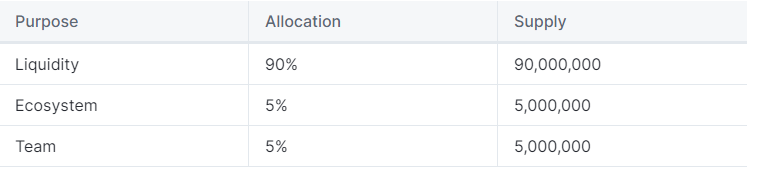
Source: 404Bakery Doc
- Liquidity Pool (90%): Locked in UNCX
- Ecosystem (5%): Used for activities in collaboration with well-known marketing agencies, influencers, and centralized exchanges (CEX).
- Team (5%): Intended to incentivize and retain the team.
Token Holder Benefits
Profit-sharing model Token holders of $BAKE can receive 50% of the platform's trading fees as income. This innovative model provides passive income to token holders, directly linking the success of the Bakery404 platform to the financial well-being of its community.
Exclusive access and fee waivers Members can use all Bakery404 services for free by holding only 0.1% of $BAKE tokens in their wallets. This exclusive benefit includes creating ERC-404 tokens, deploying smart contracts, and using other platform features, enhancing the utility and attractiveness of $BAKE tokens.
Asterix Labs

Asterix Labs, based on the pioneering DN404 technology, is dedicated to redefining the landscape of digital assets and their underlying standards.
What is DN404
DN404, as a revolutionary token standard, challenges the established ERC404 and is collectively created by a group of cryptocurrency enthusiasts. It aims to provide similar benefits to ERC404 but with higher efficiency and lower transaction costs. By adopting a dual-contract system that integrates ERC-20-based divisible token share contracts and mirror ERC-721 contracts for unique NFTs, DN404 addresses the limitations of its predecessor while ensuring compatibility with existing token standards. This focus on efficiency and security has quickly gained support from developers and users seeking a more sustainable decentralized NFT solution.
DN404 Features
Dual-contract system Unlike ERC404's attempt to merge ERC-20 and ERC-721 standards into a single contract, DN404 utilizes two interlinked contracts. This approach simplifies the token creation process and minimizes potential vulnerabilities and security risks.
Reduced transaction costs DN404 provides a competitive advantage in transaction costs, with developers reporting an average of approximately 20% savings in gas fees compared to ERC404. This reduction is particularly important in the Ethereum network, where gas fees can fluctuate significantly.
Enhanced security The separate contract structure of DN404 provides enhanced security features and reduces the risk of potential vulnerabilities compared to ERC404's single-contract approach.
Efficiency and performance DN404 prioritizes efficiency and security, providing a reliable framework for tokenization and asset management, making it a strong competitor to ERC404 within the Ethereum ecosystem.
Project Performance

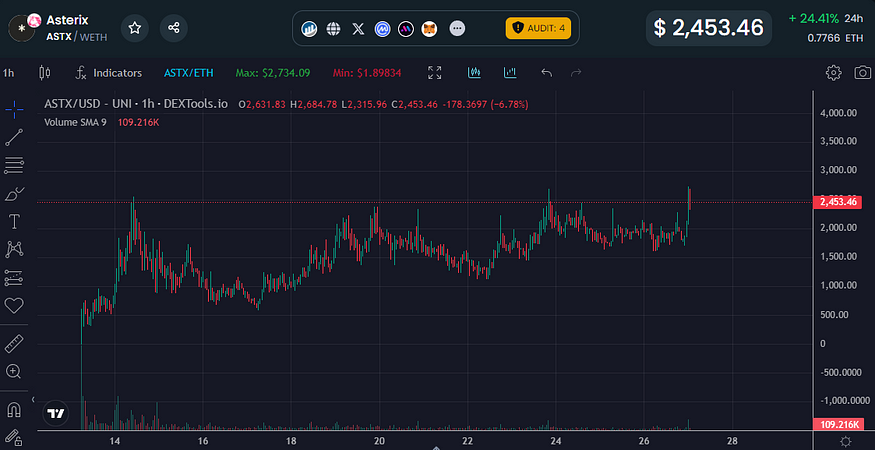
Source: Opensea, DEXTools
The NFT floor price is 0.9 ETH, and although the trading volume is not high, the token's price has spontaneously increased by over 10 times since its issuance date.
DeFrog
DeFrog, as the first PFP project driven by the ERC404 token standard, includes 10,000 uniquely designed DeFrogs, each offering a blend of rarity, artistic value, and technological innovation.
Project Performance


Source: Opensea, DEXTools
As the first ERC404 PFP project, it experienced a tenfold increase in the early stages, and is now trading at around a two-fold increase.
Anon
ANON has developed the ERC352 standard, a milestone innovation in the NFT ecosystem. This new standard aims to address and overcome limitations in previous NFT standards (including ERC721 and ERC1155) by introducing enhanced liquidity mechanisms, improved rarity features, and support for fractional ownership. The ERC352 standard introduced by ANON is based on the foundational principles of ERC404 and further pushes the boundaries of digital asset management and ownership possibilities.
Key Innovations
Enhanced liquidity mechanisms ANON's ERC352 standard facilitates seamless interaction between ERC20 and ERC721 standards by integrating whitelist functionality, significantly reducing gas fees, and enhancing market liquidity and accessibility.
Improved rarity features ERC352 addresses one of the most pressing challenges in the NFT space, rarity management. Through complex contract mechanisms, it ensures the maintenance of the rarity and uniqueness of each NFT, preserving their value and appeal.
Support for fractional ownership By strengthening the mechanism for token fragmentation, ERC352 opens up new opportunities for broader investor participation in the NFT market. This not only makes NFTs more accessible, but also increases their rarity and value by locking fractions before the entire token is available for purchase.
Project Performance


Source: Opensea, DEXTools
The NFT project has minimal trading volume on Opensea, and the token only experienced a tenfold increase in price when it was listed, but has now fallen back to the opening price.
Alphabet

Alphabet is innovating the points ecosystem using the ERC-404 token standard and cross-chain messaging. Although the founder's background is anonymous, they have extensive experience, having served in the cryptocurrency teams of UNICEF and Deloitte.
Project Overview
Alphabet's mission is to transform the implementation of points programs, using the ERC-404 standard to promote transparent, efficient, and decentralized incentive schemes. This initiative seeks not only decentralized points programs but also aims to redefine their utility and accessibility on a global scale.
- Innovative use of ERC-404
Inspired by the novel approach of ERC-404, which blends the fungible and non-fungible aspects of tokens, Alphabet plans to apply this standard to create a smoother and more versatile points system. The system aims to significantly reduce operational costs while increasing the liquidity and utility of points as incentives.
- L1 Blockchain Development
At the core of Alphabet is the creation of a new L1 blockchain specifically designed for running points programs. Major L1 token holders of Alphabet can stake their tokens to earn fees from these programs, introducing a sustainable economic model that rewards participation and supports the ecosystem.
- Art and Community Engagement
Alphabet also emphasizes community engagement and aesthetic appeal, planning to refresh its art in the coming weeks. The project has allocated significant marketing budget to ensure visibility and appeal within the crypto community, attracting key opinion leaders and movements to spread the message.
Goals and Vision
- Decentralization of Points Programs
Alphabet aims to shift the paradigm of current points programs from centralized to decentralized, providing a transparent and autonomous mechanism for protocols to incentivize and reward community participation.
- On-chain Implementation
By leveraging ERC-404 and cross-chain messaging, Alphabet seeks to bring traditional points programs onto the blockchain, ensuring that these incentive measures are accessible, transparent, and efficient.
- Building a Composable Ecosystem
The project focuses on creating a gas fee-efficient and composable ERC-404 standard that can seamlessly integrate into different protocols and blockchains, promoting a universal system for earning and distributing on-chain points.
Project Performance

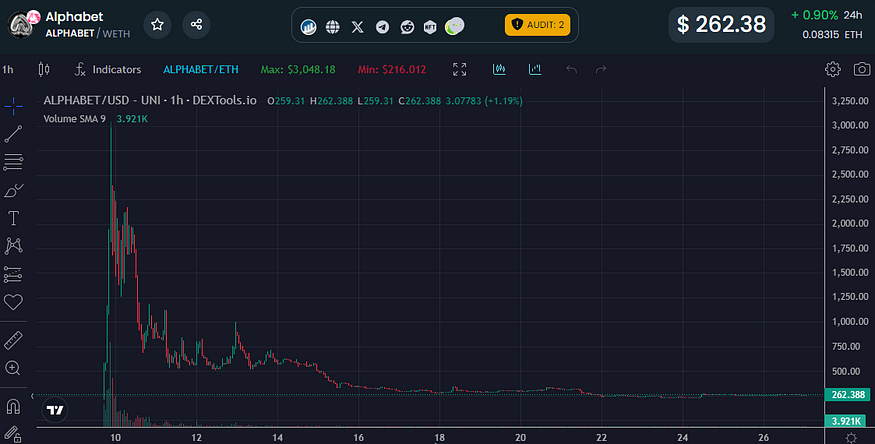
Source: Opensea, DEXTools
The NFT project has minimal trading volume on Opensea, and the token only experienced a tenfold increase in price when it was listed, but has now fallen back to the opening price.
SHEboshis

In October 2021, the Shib community introduced its first NFT collection, Shiboshis, consisting of 10,000 male characters. Recently, SHEboshis marks an innovation in the female and NFT space, strongly supporting the future of NFTs within the Shib ecosystem. Developed using ERC-404 technology, SHEboshis aims to expand the functionality and inclusivity of the Shib NFT space.
Mechanism
SHEboshis provides a unique distribution mechanism based on the number of Shiboshis held by users and the duration of holding, with priority given to Leash holders at the time of purchase. However, due to a contract vulnerability, this mechanism was bypassed in the initial stages, and the tokens went directly into public sale. These tokens, built on ERC-404 technology, are tradable and will be traded on Uniswap and Shibaswap.
Pairing Mechanism
Shib plans to introduce a pairing mechanism between Shiboshi and SHEboshis, implying the generation of offspring NFTs/tokens. The specific details of this output have not been disclosed, and the feature is expected to launch later this year.
Integration into Shiboshi Game
Similar to Shiboshis, SHEboshis will play a role in the Shiboshi game, a strategy game utilizing NFTs within the Shib ecosystem. This integration emphasizes the equal status and potential value alignment between Shiboshis and SHEboshis.
Project Performance


As an official product launched by Shib, continuous empowerment is expected in the future, and the first-generation NFT series Shiboshis also experienced a good increase in the initial stages. The second generation of SHEboshis is relatively inexpensive, and the price may rebound after the launch of ERC-404 trading.
ERC-X
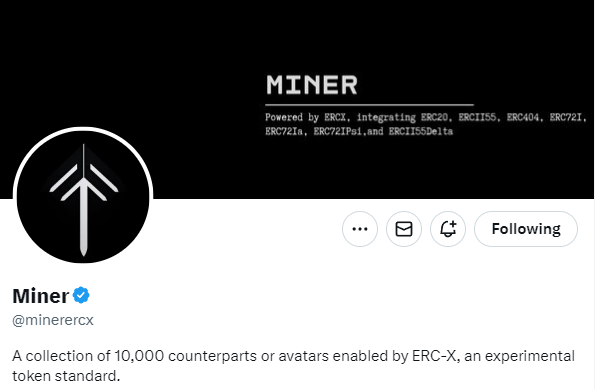
MINER is a collection of 10,000 avatars or equivalents made possible through the implementation of the experimental token standard, ERC-X. Setting itself apart by providing a versatile tokenization approach, ERC-X combines features of several established ERC standards, including ERC20, ERC404, ERC721, ERC721A, ERC721Psi, ERC1155, and ERC1155Delta.
ERC-X optimizes the utility and efficiency of token standards on the Ethereum network. Its design facilitates the integration of various standards into a unified framework, allowing for a wide range of applications while maintaining fuel efficiency and scalability.
- Fuel Efficiency and Cost-effectiveness
One of the hallmark features of ERC-X is its significant fuel efficiency. By optimizing transaction costs, ERC-X enables the possibility of token trading with small capital, depending on Ethereum's fuel prices. This efficiency contrasts sharply with the prohibitive transaction costs under the original standards, making ERC-X a practical solution for large-scale operations. ```
Although ERC-X has made significant progress in improving fuel efficiency and reducing transaction costs, the optimization may lead to more complex underlying logic. This complexity poses a challenge not only for developers building applications on ERC-X but also increases the risk of security vulnerabilities, as more complex code is often harder to audit and verify.
- Scalability and Flexibility
ERC-X's scalability is evident in its support for projects of any scale, thanks to its flexible token/NFT ratio. This adaptability is further enhanced by its ability to present NFTs as ERC721 or ERC1155 tokens. Such flexibility ensures that ERC-X can cater to a wide range of applications, from simple token transfers to complex NFT integrations.
While ERC-X has contributed to the scalability and flexibility of tokens and NFTs, the integration across standards may also lead to compatibility issues. Especially when interoperating with legacy standards and infrastructure, unexpected technical barriers may arise. This necessitates a continuous process of updates and adaptation to ensure ERC-X operates smoothly within existing ecosystems.
- Innovation through ERC1155Delta
Integrating elements of ERC1155Delta into ERC-X is a key innovation that significantly enhances the standard's optimization capabilities. The extension of ERC1155Delta to the ERC1155 standard enables ERC-X to provide dual functionality; it supports the generation of both ERC721 and ERC1155 tokens, ensuring compatibility with markets that support either format.
While integrating ERC1155Delta into ERC-X brings new innovations and added functionality, the complexity of this design may lead to challenges for developers and users in understanding and utilizing it in practical applications. Particularly for users unfamiliar with the features of ERC1155Delta, understanding how to effectively leverage these features may require a learning curve.
- EasyLaunch: Simplifying Token Launch
ERC-X's EasyLaunch feature streamlines the token launch process to just two steps: deployment and liquidity addition. This simplicity represents a significant improvement compared to the more complex processes associated with other standards, which require multiple preliminary steps before adding liquidity. Therefore, EasyLaunch represents a major advancement in making token launches more accessible and reducing time consumption.
While the EasyLaunch feature simplifies the token launch process, could this simplification potentially obscure certain key considerations for token issuance? For example, considerations for liquidity management, security verification, and long-term tokenomic strategies may be overlooked due to the simplified process. Therefore, while EasyLaunch improves accessibility and efficiency, developers and projects need to exercise caution in its use, ensuring that in-depth project planning and careful security audits are not sacrificed.
Summary
Fractional Ownership: Democratization or Complication?
The introduction of fractional ownership, while intended to democratize access to high-value assets by lowering entry barriers, actually increases the complexity of trading and management. The practicality of this approach is limited by users' understanding and adaptability to managing such assets, as well as the market demand for liquidity of fractionalized assets.
Independent Trading: Liquidity Booster or Potential Source of Chaos?
The dual nature of ERC-404 tokens and their NFTs, aimed at enhancing market liquidity, sounds exciting. However, in reality, this may lead to market fragmentation, with one part of the market focusing on traditional NFTs and another part pursuing the new model of ERC-404. This fragmentation may actually dilute liquidity rather than enhance it.
In summary, current ERC-404-related projects are still in the early stages. While these projects experienced some appreciation in the initial stages due to the novelty of ERC-404 and the leadership of the flagship project Pandora, the prices gradually fell back to near the opening price. Additionally, ERC-404 has also given rise to new standards such as ERC-352 and DN404. These projects demonstrate Ethereum's ecosystem's self-adjusting ability from the bottom up, and this community-driven asset management approach has established its user base. As long as future optimization of technology and user experience continues, a complete ecosystem is expected to be built.
Tiny_spl
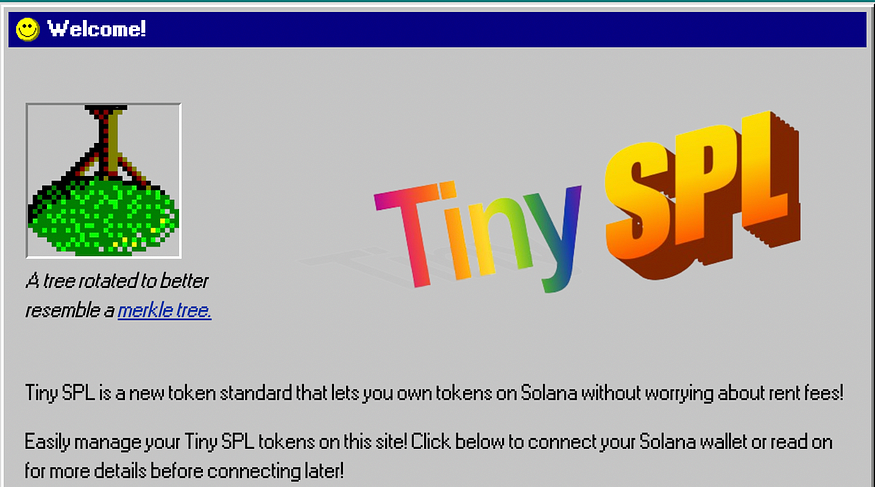
Tiny SPL represents a new approach within the Solana ecosystem to address the challenge of on-chain data storage costs through the use of innovative state compression technology.
Background
Solana's Rent Mechanism
Solana has implemented a unique account model that includes a rent mechanism. Unlike Ethereum, which primarily charges transaction fees, Solana also charges rent for storing data on the blockchain. This rent is calculated based on the token balance of the account and is designed to ensure efficient use of storage resources. Accounts unable to pay rent may be deleted, although accounts with a balance exceeding two years' rent are exempt. With technological advancements and decreasing storage costs, the rent cost is expected to decrease, although fluctuations in SOL price may affect users' actual cost burden.
Operation Mechanism of Tiny SPL
Tiny SPL emerges as a smaller and more efficient iteration of the Solana Program Library (SPL) token standard. Its main innovation lies in the ability to achieve token ownership without the associated rent cost, thanks to state compression. This approach significantly reduces on-chain storage requirements by compressing data verifiability into a single hash using Merkle trees. This breakthrough is particularly applied to reduce the cost of minting NFTs on Solana by several orders of magnitude, as demonstrated by projects like Helium Mobile, which minted nearly a million NFTs at a fraction of the traditional cost.
Differences between Tiny SPL Tokens and Standard SPL Tokens:
- No Rent Payment
By utilizing state compression, Tiny SPL tokens circumvent the need to pay rent, addressing one of the major costs associated with token ownership on Solana. Partial visibility of NFTs: Unlike regular tokens appearing in wallet balances, Tiny SPL tokens are only partially visible as NFTs, reflecting their unique storage and management methods.
- Interactive Experience
Tiny SPL introduces a unique token management experience, including the process of splitting and merging tokens. These operations are crucial for adjusting token quantities in transactions and incur nominal fuel fees.
Project Introduction

Deez Nutz
Deez Nutz, as an experimental product of the Tiny SPL protocol, provides holders with flexibility in managing their held assets in an innovative way. It allows users to split, merge, and exchange their tokens directly through the interface, connecting to their digital wallets. This token aims to provide a seamless experience for users who want to customize their asset holdings according to their needs.
Key Features
- Splitting $NUTS
Holders can split their $NUTS tokens into smaller denominations, allowing for finer control over their assets. This can be done in integer or fractional form, with the minimum split quantity being 1. This feature is particularly useful for users who want to distribute their assets or manage them more effectively.
- Merging $NUTS
Users can choose to merge their $NUTS balances, merging up to 50 token balances at a time. This can streamline their wallets and simplify asset management. The process involves selecting the balances to merge and confirming the transaction through their wallet.
- Exchanging $NUTS
The platform provides an exchange feature where users can exchange their $NUTS tokens for SOL (and vice versa), with the trade limit set to the user's highest combined token balance minus 1. This feature is suitable for users who want to diversify their investment portfolios or adjust their holdings according to market dynamics.
Project Performance

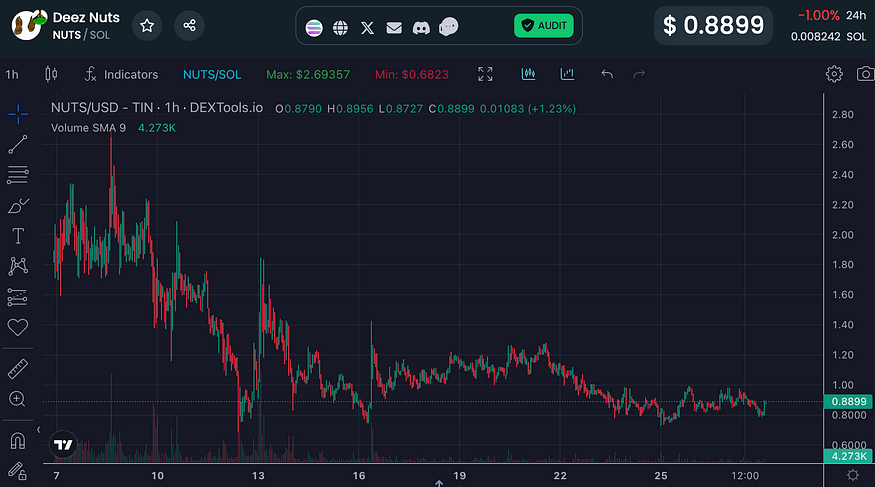
Source: Magic Eden, Dextools
The project's performance has not been ideal, with a decrease of approximately 50% from the issuance price, indicating that the market is yet to be widely accepted.
Summary
Tiny SPL is currently in the technical experimentation phase, and its initial challenges around the splitting and merging functionality have been resolved. The protocol's ability to reduce storage costs while maintaining the security and decentralization of the Solana base layer marks a significant innovation. However, the actual application and future adoption of Tiny SPL will depend on its ability to meet the needs of projects that require large-scale token issuance without bearing rental costs.
Solana's co-founder, Anatoly Yakovenko, has highlighted the potential significance of Tiny SPL through social media, emphasizing its potential within the ecosystem. The community's response and the evolving use cases of the protocol will further determine its position in optimizing blockchain efficiency and accessibility within the broader strategy of Solana.
By circumventing the need to pay rent on Solana, Tiny SPL provides an alternative to prevent accounts from being deleted. The innovation of this mechanism lies in providing token holders with a nearly cost-free method of storing tokens. However, this bypassing of the rental mechanism may be seen as a distortion of Solana's ecosystem's original design principles. The establishment of the rental mechanism is to ensure efficient resource utilization and system sustainability, and the emergence of Tiny SPL may raise questions about the enforcement of this principle.
Asteroid
Asteroid is a pioneering protocol framework created on the Cosmos Hub through the collaboration of Delphi Labs and the Astroport Foundation. It stands out by allowing anyone to permanently publish data on the blockchain, introducing a set of tools including indexers, browsers, APIs, and the specification of Cosmos' fungible token (CFT-20), as well as token distribution, minting tools, and comprehensive software solutions. The introduction of $ROIDS as the first CFT-20 token highlights its innovative approach to tokenization and data anchoring on the Cosmos Hub.
Mechanism Overview and Technical Analysis
Asteroid simplifies the interaction with the blockchain, enabling users to connect through the Keplr wallet to publish data or mint CFT-20 tokens. This process allows users to interact with web3 technology without needing a deep understanding of smart contracts.
- Meta-Protocol Framework
Asteroid operates as a meta-protocol framework, providing a foundational layer upon which other protocols or applications can be built. This scalability is crucial for fostering innovation and diversifying use cases within the Cosmos ecosystem.
- Arbitrary Content Anchoring
The framework's support for the ability to anchor arbitrary content is an innovative feature in the market. It breaks down barriers that typically require smart contract development, allowing for the direct publication of various data types on the blockchain. This feature has the potential to significantly lower the entry barriers for developers and creators who wish to leverage blockchain technology.
CFT-20 Token Overview
Asteroid introduces a new mechanism for asset creation and distribution within the Cosmos ecosystem through the introduction of CFT-20 tokens. Fungible tokens are crucial for a wide range of applications, from financial instruments to digital collectibles, enhancing the practicality and flexibility of the Cosmos Hub.
- Accessibility of Toolkits
The open-source nature of the Asteroid toolkit promotes a transparent and inclusive development environment. By providing exploration, indexing, and token minting tools, Asteroid ensures that developers have the necessary resources to innovate and effectively expand the capabilities of the Cosmos Hub.
- Tokenization Innovation
The introduction of CFT-20 tokens expands the practicality and interoperability of digital assets within the Cosmos ecosystem.
- Simplified Blockchain Interaction
Enabling non-experts to access blockchain technology is an important step towards democratizing the web3 space.
Project Introduction
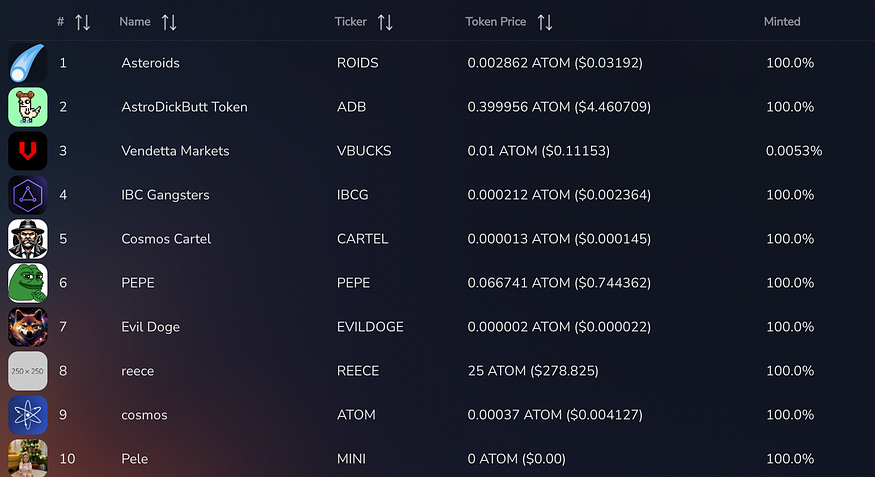
Essentially, the Asteroid Protocol, like the Uniswap market in the Cosmos ecosystem, provides a one-stop inscription creation or marketplace service. Although the track has not been widely accepted, the project team is still actively building.
Summary
Asteroid simplifies the interaction with the blockchain and, coupled with the innovative CFT-20 token standard, positions itself as a catalyst for the future development of the Cosmos ecosystem. The framework's scalability and inclusivity can transform the Cosmos Hub into a central database for numerous projects. Drawing from the catalytic role of inscriptions such as ordi and rats in the Bitcoin ecosystem, it can be expected that CFT-20 will bring similar effects to Cosmos.
Asteroid's support for the anchoring of arbitrary content is an innovation in the market. It opens the door for various data types to be permanently stored on the blockchain. The prospect of this capability is exciting as it greatly expands the scope and depth of blockchain applications. However, arbitrary content anchoring also brings about issues of data proliferation and quality control. Without proper review and filtering mechanisms, the blockchain may be inundated with irrelevant or inappropriate content, increasing storage burdens and diminishing the value and reputation of the entire ecosystem.
These protocol standards exhibit the following common industry trends:
- Flexibility and liquidity of assets: The market demands more flexible asset management tools that can adapt to various financial and non-financial use cases.
- Cost efficiency: As blockchain applications expand, reducing operational costs becomes an important requirement, whether through reducing transaction fees or storage costs.
- Participation of non-technical users: With the widespread adoption of blockchain technology, simplifying technical complexity to attract non-technical users becomes an important development direction.
In the long run, the adoption of innovations depends primarily on their ability to address core market needs and their potential economic and social impact. Asteroid, with its emphasis on the participation of non-technical users and the concept of a meta-protocol, has the potential to have a profound impact on a wide range of applications. This emphasis on inclusivity and usability may drive faster market adoption and ecosystem growth. ERC-404 addresses the market's need for complex asset management tools through its flexible asset ownership and liquidity enhancement features. While facing some market confusion and security challenges, its potential market breadth cannot be ignored. While TinySPL addresses specific issues (data storage costs) within a specific ecosystem (Solana), its impact may be relatively limited, especially as multi-chain and cross-chain operations become the norm.
免责声明:本文章仅代表作者个人观点,不代表本平台的立场和观点。本文章仅供信息分享,不构成对任何人的任何投资建议。用户与作者之间的任何争议,与本平台无关。如网页中刊载的文章或图片涉及侵权,请提供相关的权利证明和身份证明发送邮件到support@aicoin.com,本平台相关工作人员将会进行核查。


