In a previous article - "Runes 协议上线五天,大家在 FUD 什么?", I briefly analyzed the underlying reasons for the FUD of the Runes protocol: the current first-layer protocol only supports the excessive issuance of assets without introducing greater value in asset circulation. Due to the lack of further development beyond speculation and memes, the high gas caused by Runes only maintained for a few days before plummeting back to a "normal level" below 50.
So, what kind of first-layer protocol do we need to support the longer-term development and narrative value of the BTC ecosystem, instead of most protocol assets ending up at zero after a few memes and a wave of hype?
Author: Portal_Kay
X /推: @portal_kay
1. Comparison of Mainstream BTC First-Layer Protocol Features
Before discussing this issue, we need to have a basic understanding of several mainstream BTC first-layer protocols. Here, we summarize the content of the course "Overview of Bitcoin First-Layer Asset Protocols" by Cipher from the perspectives of additional data position, two-step operation, balance model, and issuance method.
(Strongly recommend Cipher's course content, which provides clear explanations of several protocols. Interested friends can check it out.
Details:
https://www.youtube.com/watch?v=mgUxYU5tcJM)
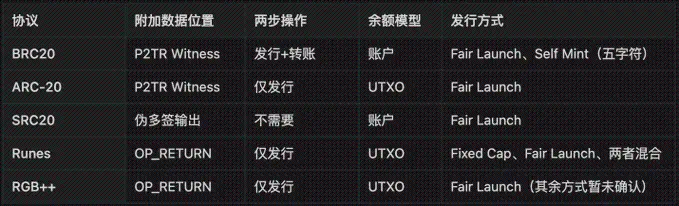
2. What Kind of Protocol Can Support the BTC Ecosystem Explosion?
If we expect a BTC ecosystem where various DApps flourish and Bitcoin assets circulate fully, the first-layer asset issuance protocol needs to have these 4 characteristics to achieve this vision:
1. Efficient and Convenient Asset Circulation
Firstly, efficient asset circulation, whether on the first layer or the second layer, is the foundation for unlocking the value of assets. Circulation on the second layer is relatively easier to achieve. Here, we mainly discuss the circulation of assets on the first layer, which can be divided into two types:
1.1 Transfer transactions of assets themselves
Due to the underlying logic of PoW, the circulation of assets on the first layer will naturally be limited by the 10-minute block generation interval. Therefore, the convenience of asset transactions on the first layer only needs to be as smooth as BTC transactions, where any amount of transfer can be completed with a single transaction, to meet the basic requirements.
For assets transferred between two wallets, except for BRC-20, other protocol assets can already achieve single transaction transfers of any amount. The major issue lies in DEX order placement. Currently, ARC-20, Runes, and RGB++ can only execute all assets on a single UTXO in a single order transaction, rather than allowing users to choose any amount for order placement.
For example: If a wallet contains 2 Runes, and each Rune is worth 100 tokens. The scenarios that users hope to achieve and the operations currently supported by the trading market are as follows:
1️⃣ Place an order for 50 tokens: Cannot be directly achieved; a split operation must be performed in advance to transfer 50 tokens from one UTXO to another, and then place an order for the 50-token UTXO.
2️⃣ Place an order for 150 tokens: Cannot be directly achieved; similar to the previous scenario, a transfer and split operation is required; then, in the exchange, select one 100-token Rune and one 50-token Rune to place separate orders.
It is evident that the current trading of various first-layer protocol assets on DEX is not flexible enough, which inevitably reduces the liquidity of these assets.
1.2 Exchange between different assets
In addition to the transfer transactions of assets themselves, asset circulation also includes the exchange between various first-layer assets. Ideally, this exchange should not rely on a centralized node to be completed. To achieve this function, it not only depends on the protocol's capabilities but also requires another important infrastructure: Swap based on the first layer. Currently, many projects have emerged in this field, with Dot Swap being one of the fastest. MagicEden has also reserved an entrance for Rune Swap, and the product is expected to be launched soon.
Furthermore, if a credible stablecoin based on the BTC network can be introduced, the exchange between assets will be more efficient. As an intermediate medium for exchange, a stablecoin can allow users to more intuitively see the actual price of an asset and eliminate concerns about exchange rates due to fluctuations in the intermediate medium.
2. Flexible and Diverse Asset Issuance
If the goal is to lay the foundation for the explosion of the BTC ecosystem, the first-layer protocol must support more flexible asset issuance methods, as a simple Fair Launch cannot cover diverse usage scenarios. Currently, the Runes protocol can support 3 different asset issuance methods:
(1) Fair Launch, i.e., 100% open, fair minting;
(2) Fixed Cap, i.e., 100% pre-mined by the project party;
(3) A combination of the two, where the project party pre-mines a portion, and the remaining portion is Fair Minted.
Only when the protocol supports flexible asset issuance methods can it meet the practical usage scenarios of various projects, such as:
1️⃣ Issuing meme coins, 100% Fair Mint, entirely based on community consensus;
2️⃣ Project parties issuing governance tokens, distributed to various stakeholders according to token economics planning, including investors and the ecosystem;
3️⃣ Reward tokens for a certain project, 100% pre-mined and airdropped to community users;
4️⃣ Projects co-built by project parties and the community, with a portion reserved by the project party for operational needs, and the remaining portion Fair Minted by the community.
5️⃣ …
3. Limited Programmability Supported on the First Layer
The core value of the BTC first layer lies in having the broadest consensus and maximum asset security. With the guarantee of asset security on the first layer, only basic programmable features need to be implemented to stimulate significant asset liquidity.
In this regard, one of the solutions currently visible is Babylon. Although Babylon has not launched its own first-layer protocol, it utilizes BTC's timelock and hash lock settings to allow BTC assets to be staked and earn staking rewards while being held in the owner's wallet. Therefore, other BTC first-layer protocols can also utilize these BTC settings to enhance their own protocol's programmability on the first layer.
In addition, the ARC-20 protocol has also disclosed that it is developing AVM, which can implement smart contracts on the BTC first layer to realize basic DeFi functions such as recharging, staking, and borrowing. However, AVM has not yet disclosed many implementation details, so this area will not be elaborated further.
With the efforts of various projects, I believe that more excellent solutions will emerge in the future. At that time, if it is possible to securely achieve an annualized interest income of 5% or more, it should be able to attract a large volume of BTC funds to participate.
4. Second Layer Supporting Complex Smart Contracts
Since the BTC first layer cannot achieve Turing completeness, it inherently lacks the conditions to operate complex smart contracts. In this case, we can only rely on the second layer to host the flourishing of DApps. Of course, the high programmability of the second layer must still be based on the premise that assets can inherit most of the security of the main network.
Recently, several EVM-compatible L2 projects have experienced varying degrees of congestion in cross-chain fund bridges, leading to a deeper understanding of this issue: temporary changes in the conditions for crossing funds, insufficient liquidity of cross-chain bridges, high fees, and so on. These problems will undoubtedly deter large BTC funds. If a second layer cannot improve the liquidity of BTC assets, then such a second layer would not be very meaningful.
The BTC ecosystem needs an asset circulation method that suits its own characteristics. At this point, the most competitive solution should be the "homogeneous binding" scheme implemented by RGB++ on the CKB network. First-layer assets can safely jump to the second layer through Leap operations without the need for cross-chain bridges. At the same time, the CKB network can support the construction of complex smart contracts, providing a foundation for the emergence of various ecological DApps.
3. Vision for the Development of the BTC Ecosystem
The scene I hope to see for the true rise of the BTC ecosystem is as follows:
🔹 The first-layer asset issuance protocol gradually stabilizes, allowing assets to perform simple DeFi operations on the BTC main network, such as: Swap, liquidity mining, collateralized borrowing, etc.
🔹 First-layer assets can enter the second layer network safely, conveniently, efficiently, and at low cost.
🔹 Various new and interesting applications emerge on the second layer network, including but not limited to various DeFi, GameFi, and SocialFi products.
🔹 A large number of active users and real asset-flowing DApps emerge within the entire ecosystem. These DApps issue their own project tokens based on a credible first-layer protocol, gradually giving the core assets in the ecosystem actual business value support.
Seeing these envisioned scenes, some friends may think, "What's so magical about these? It's not much different from the current situation on Ethereum." Yes, with my limited imagination, I indeed couldn't think of a more exciting new story. However, for the BTC network, all of these need to be built from scratch. Even if it only reaches the current state of Ethereum, the value of the entire ecosystem could reach trillions of dollars. Moreover, we are relying on a value network like BTC, which already carries the value of 50% of encrypted assets.
Let's witness the occurrence of this process together, or even better, choose to be a participant and contribute in your own way to build together!
Disclaimer: This article is for reference only and should not be used as legal, tax, investment, financial, or any other advice. It does not represent the position of RunesCC.
免责声明:本文章仅代表作者个人观点,不代表本平台的立场和观点。本文章仅供信息分享,不构成对任何人的任何投资建议。用户与作者之间的任何争议,与本平台无关。如网页中刊载的文章或图片涉及侵权,请提供相关的权利证明和身份证明发送邮件到support@aicoin.com,本平台相关工作人员将会进行核查。


