EIGEN's on-chain staking and dispute resolution mechanism supplements the subjective disputes and faults that cannot be handled by ETH's on-chain staking mechanism.
Author: TechFlow of Deep Tide
After much anticipation, Eigenlayer has finally announced more details about its token economy today and revealed that it will allocate 15% of EIGEN tokens to users who participated in restaking through a linear unlocking method.
Does the EIGEN token itself have more value? What specific purpose does it serve? What impact can it have on restaking and the entire Ethereum ecosystem?
The answers can be found in the 40-plus-page token economic whitepaper released by Eigenlayer.
Unlike typical projects that briefly illustrate token economics with a few diagrams, Eigenlayer has devoted a significant amount of content to explain the role of the EIGEN token and its relationship with ETH in a detailed, meticulous, and somewhat technical manner.
The research team at Deep Tide has carefully reviewed this whitepaper and summarized the technical highlights into easy-to-understand language to help you quickly grasp the role and value of EIGEN.
Key Points Overview
Functionality of EIGEN Token and Issues to Address
- Universality and Restaking
Traditional blockchain tokens are usually used for specific tasks, such as ETH being primarily used for Ethereum's block validation. This limits the token's utility and flexibility.
Through the restaking mechanism, users can use their staked ETH assets for multiple tasks and services without unlocking or transferring these assets.
- Intersubjectively Verifiable
The whitepaper uses the term "Intersubjectively" to describe complex network tasks that are difficult to verify through simple automated programs and require subjective consensus from human observers.
In these tasks, the EIGEN token serves as a medium for "social consensus." In scenarios requiring verification from different perspectives, EIGEN can be used as a voting tool, allowing token holders to influence network decisions through voting.
- Forking Tokens and Slashing
Disagreements over certain issues or decisions within the network may arise, necessitating a mechanism to resolve these disagreements and maintain network consistency.
In the event of significant disagreements, the EIGEN token may undergo forking, creating two independent token versions, each representing a different decision path. Token holders need to choose which version to support, and the unselected version may lose value.
If network participants fail to properly execute staking tasks or engage in improper behavior, EIGEN staked tokens may be slashed as a punishment for their misconduct.
Relationship Between EIGEN and ETH
- Supplementary, Not Replacement: The EIGEN token is not intended to replace ETH but to complement it.
ETH is primarily used for staking and network security as a general-purpose working token. ETH staking supports the reduction of objective faults (e.g., validators making mistakes will be penalized).
EIGEN staking supports the reduction of subjective faults (errors that cannot be verified on-chain, such as incorrect price data provided by an oracle), significantly expanding the range of digital tasks that blockchain can securely provide for users.
EIGEN Token: Provides a new social consensus mechanism specifically for addressing subjective errors beyond the capabilities of ETH
To understand the role of the EIGEN token, one must first understand the role of the ETH token.
Before the concept of Eigenlayer and restaking, ETH could be seen as a "specific-purpose" working token. In simpler terms:
ETH tokens are used to maintain network security, generate new blocks, and perform tasks related to maintaining the Ethereum blockchain, and cannot be used for other purposes.
In this scenario, the characteristics of ETH are:
Specific working purpose;
Strong objectivity, meaning errors such as double signatures on the Ethereum chain or errors in Rollup aggregation can be objectively judged on-chain using predefined rules, leading to penalties for validators.
With Eigenlayer, ETH has essentially transformed into a "general-purpose" working token. In simpler terms:
ETH can be restaked for various tasks, such as new consensus mechanisms, Rollup, bridges, or MEV management solutions, not limited to staking on the Ethereum chain alone, which is an important function of Eigenlayer.
However, in this scenario, despite the change in usage, ETH still retains the following characteristics:
- "Objective" limitations still exist because reduction and penalties can only be applied to objectively verifiable tasks on the Ethereum chain.
However, not all errors in the crypto world can be attributed on-chain, and not all disputes can be resolved through on-chain consensus algorithms.
At times, these non-objective, difficult-to-prove, and highly disputed errors and issues significantly impact the security of the blockchain itself.
For an extreme example, consider an oracle reporting 1 BTC = 1 USD. This data is fundamentally incorrect, and no on-chain contract or consensus algorithm can identify it. Furthermore, penalizing validators with ETH will not resolve the issue, as:
You cannot use an on-chain objective solution to sanction an off-chain subjective error.
The price of an asset, the availability of a data source, the correct operation of an AI interface… These issues cannot be resolved through on-chain consensus and require more of a "social consensus" reached through subjective discussions and judgments.
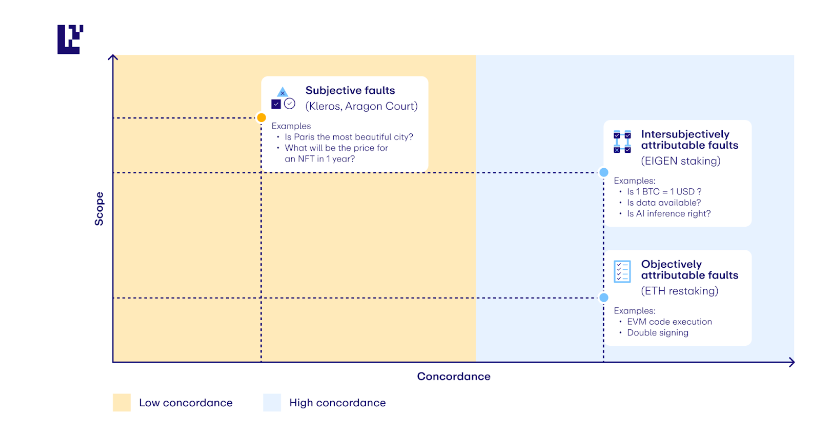
Eigenlayer refers to these types of issues as "Intersubjectively attributable faults": a set of faults with broad consensus among all reasonable active observers in the system.
Therefore, the EIGEN token has a role to play — providing a supplementary new social consensus mechanism beyond ETH to maintain network integrity and security, specifically addressing these "intersubjective" faults.
Specific Approach: EIGEN Staking, Token Forking
ETH continues to serve as a general-purpose working token, while EIGEN acts as a general-purpose "intersubjective" working token, complementing each other.
If a validator stakes ETH and objective faults occur, the staked ETH can be reduced and penalized.
Similarly, you can stake EIGEN, and when intersubjective faults (which cannot be directly judged on-chain and require subjective judgment) occur, the staked EIGEN can be reduced and penalized.

Let's consider a specific scenario to see how EIGEN comes into play.
Suppose there is a decentralized reputation system based on Eigenlayer, where users can rate service providers on the platform. Each service provider will stake EIGEN tokens to demonstrate their reputation.
Before this system begins, two essential stages are required:
Setup Stage: Coordinated rules among system stakeholders are encoded to determine how disputes should be resolved after they arise;
Execution Stage: The pre-agreed rules are executed in an obvious manner, preferably executed locally.
In this system, users can execute the conditions they have pre-agreed upon themselves.
So, if a service provider is found to have provided false services or misled users, the platform's community consensus mechanism may trigger a challenge, leading to a token forking event, resulting in two versions of the EIGEN token — EIGEN and bEIGEN.
Now, users and AVS can freely decide which version to respect and value. If it is widely believed that the staked token holders have behaved improperly, users and AVS will only value the forked token, not the original token.
As a result, the original EIGEN tokens of malicious stakers will be slashed and penalized through this forking mechanism.
This essentially constitutes a social consensus adjudication system to address disputes that cannot be objectively handled on the ETH chain.
It is also worth mentioning that for users and other stakeholders, you don't need to worry about the impact of this "fork."
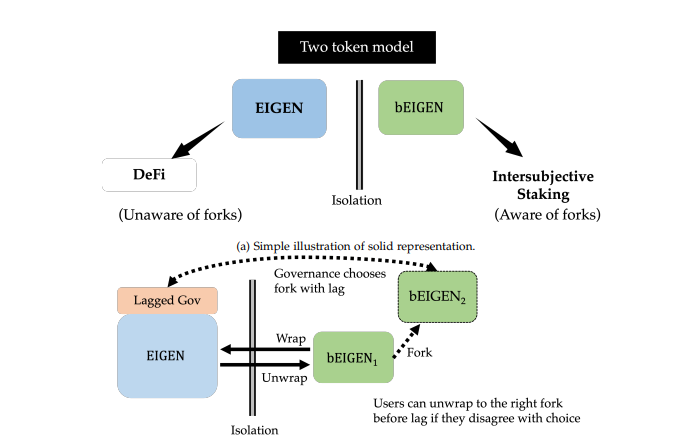
Typically, after a token fork, you must make an overall choice, which also affects the use of your tokens elsewhere.
However, Eigenlayer has created a barrier between CeFi/DeFi use cases and EIGEN staking use cases, so that even if bEIGEN is affected by intersubjective forking disputes, EIGEN holders using it for non-staking applications do not need to worry, as they can redeem bEIGEN's fork at any time in the future.
Through this forking isolation mechanism, Eigenlayer not only enhances the efficiency and fairness of dispute resolution but also protects the interests of users who are not involved in the dispute, ensuring the overall stability of the network and the security of user assets while providing powerful functionality.
In Summary
It is evident that Eigen's on-chain staking and dispute resolution mechanism supplements the subjective disputes and faults that cannot be handled by ETH's on-chain staking mechanism, unlocking a wide range of previously unattainable AVS on Ethereum, and providing robust security for the crypto economy.
This may open the door to innovation in areas such as oracles, data availability layers, databases, AI systems, game virtual machines, intent and order matching, MEV engines, prediction markets, and more.
However, based on the roadmap provided in its whitepaper, the current use cases for EIGEN are still in a very preliminary stage, more like a fully developed concept but far from actual implementation.
With users being able to officially claim EIGEN tokens after May 10, the envisioned utility of EIGEN in response to market price changes remains to be seen. We eagerly await the outcome.
免责声明:本文章仅代表作者个人观点,不代表本平台的立场和观点。本文章仅供信息分享,不构成对任何人的任何投资建议。用户与作者之间的任何争议,与本平台无关。如网页中刊载的文章或图片涉及侵权,请提供相关的权利证明和身份证明发送邮件到support@aicoin.com,本平台相关工作人员将会进行核查。


