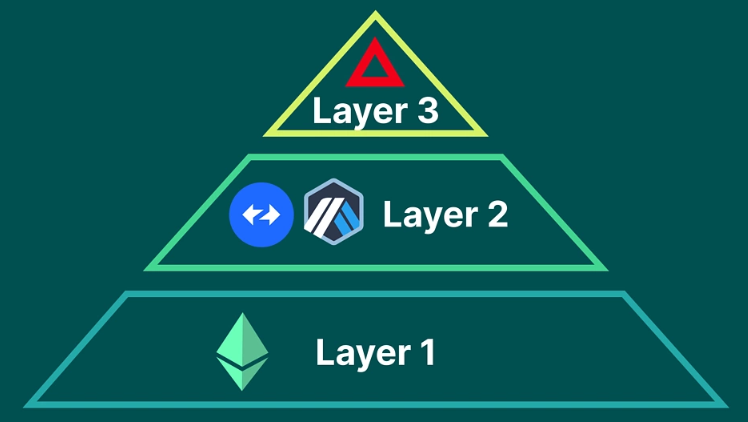
L3 chains have lower costs, but are less decentralized than L2 chains, and there is still controversy over their interoperability and necessity.
Author: @jarrodWattsDev
Translation: Plain Blockchain
TLDR (Summary):
L3 chains have very low costs, but they are less decentralized than L2 chains.
The current decentralization of L2 chains is not ideal, and it may be worth waiting for improvement before building L3 chains on top of them.
L3 chains still face almost the same problems as today's L2 chains, lacking interoperability.
It can be said that there is not even a need for L3 chains to achieve the scalability we want. There are still plenty of improvements at the L2 chain level and ways to make it extremely cheap today.
In the cryptocurrency field, discussions about L3 chains are increasing. Is L3 chain being overly hyped, or does it really have some advantages? This article will discuss the pros and cons of L3 chains. Here are the arguments for and against L3:
1. Arguments for L3:
1) Lower user costs: Most of the cost of L2 is still submitting data back to Ethereum. L3 submits their data to L2 instead of L1, so users pay a small L2 fee instead of a huge L1 fee to store data.
When the cost of submitting data is low, transaction costs for users can also be low.
Imagine the cost of submitting data from L2 -> L1 is $100.
If we simplify, this $100 will be allocated to L2 users in the form of gas fees. Essentially, the chain pays the $100 fee to Ethereum through users paying L2 sequencers "repayment" in gas fees.
In contrast, the cost of submitting data from L3 -> L2 is $0.10. Users now pay gas fees to cover $0.10 instead of $100.
Compared to L2, users of L3 may pay orders of magnitude smaller fees.
2) Lower entry costs: The argument here is that CEX (centralized exchange) does not directly support some L2.
To use these L2, the process is: CEX -> L1 -> L2
1 L1 fee is used to transfer to L1 address
- 1 L1 fee is used for bridging to L2
Assuming this is about $40 in total.
L3 chains built on L2 supported by CEX avoid this, as the process is: CEX -> L2 -> L3
1 L2 fee is used to transfer to L2 address
- 1 L2 fee is used for bridging to L3
Assuming this is about $0.20 in total.
This is effective, but it also feels like it can be solved in other ways. Cross-L2 interoperability solutions like aggregation layers are being built to address this issue.
2. Arguments against L3:
1) Current decentralization of L2: I think the key point here is that L2 is not yet ready to become a settlement layer for other chains like Ethereum.
Before becoming a trusted settlement point for other chains, L2 still needs many improvements in decentralization. Adding another layer increases scalability, but also increases the possibility of errors.
For most chains, the decentralization of L2 is still in its early stages. I think we should wait for them to enter the later stages before building chains on top of them. The same applies to L4, L5, and every layer in the future.
2) L2 is already good enough: L2, application chains, and their interoperability are already quite good and improving rapidly.
Today, very cheap L2 can be built in multiple ways: Polygon CDK, OP Stack, ZK stack, Arbitrum Nitro, etc.
By building for efficient transactions (validium) or using alternative DA solutions, they can also become extremely cheap.
Any team can create dedicated block space on the L2 level today.
3) L3 has almost the same problems as L2: Application developers can only reach a small portion of their potential audience by building on a single isolated chain. Liquidity and user numbers are limited.
Interoperability between L2s solves more problems than additional layers.
Source: https://twitter.com/jarrodWattsDev/status/1774616808668238006
免责声明:本文章仅代表作者个人观点,不代表本平台的立场和观点。本文章仅供信息分享,不构成对任何人的任何投资建议。用户与作者之间的任何争议,与本平台无关。如网页中刊载的文章或图片涉及侵权,请提供相关的权利证明和身份证明发送邮件到support@aicoin.com,本平台相关工作人员将会进行核查。


