Witnessing the eve of history.
Authored by: Gyro Finance
As the approval period for Bitcoin spot ETF approaches, the market is in a state of flux, with a mix of news.
There was false information leading to long positions being liquidated and Bitcoin plummeting, while institutions awaited the final form with anticipation. Positive news followed, and at the same time, the SEC's Office of Investor Education and Advocacy declared "Refuse FOMO," and Chairman Gary Gensler once again issued a warning about cryptocurrency investments on X platform in the early hours of today.
From public data, out of the 13 institutions applying for Bitcoin spot ETF, 10 have submitted modified final S-1 forms and subsequently lowered the ETF fees. Tomorrow, the first batch of spot ETFs will undergo final approval. Is Gary Gensler's warning a last fit of impotence or a cold comfort of knowing the truth?
The answer is about to be revealed, and from the perspective of institutions, the battle around the ETF, from model warfare to price warfare, has already begun.
01 Institutions submit final updates, racing to lower fees
On January 8, except for Hashdex, 10 major applicants including BlackRock, Ark Invest/21Shares, VanEck, WisdomTree, Invesco, Fidelity, and Valkyrie submitted modified final S-1 forms, as the form had been essentially finalized on December 29, 2023, so institutions made adjustments in the details.
According to the final forms, to make concessions to the SEC, most institutions' ETF models have shifted to a cash model rather than a physical model anchored by Bitcoin, including BlackRock, which initially insisted on a combination of physical and cash models. The main difference between these two methods lies in the entity purchasing Bitcoin. In a physical exchange, market makers and APs purchase Bitcoin, while in a cash purchase, the ETF issuer buys BTC physically and adds a cash custodian in between, reducing the number of intermediary institutions handling actual Bitcoin, creating a relatively closed system to make market maker transactions easier to track, reduce money laundering issues, and eliminate risks from banks and other financial institutions actually involved.
In this context, although the physical model is more operationally feasible and less risky for ETF issuers, institutions did not argue against it under the SEC's requirements. Only BlackRock indirectly expressed its helplessness in the latest updated S-1 form, mentioning that "the time for physical supervision approval is not yet clear, and Nasdaq's approval cannot be guaranteed at any time in the future." Additionally, Fidelity, WisdomTree, BlackRock, and JPMorgan Securities have designated Jane Street Capital as the "authorized participant" for their potential spot Bitcoin ETF, and as an authorized participant, the broker-dealer will be responsible for handling the creation and redemption of a basket of funds, including cash transfers between fund shares and the manager.
Apart from the model, the management fee rate is also noteworthy. Currently, due to highly consistent user categories, there is a winner-takes-all scale economy in the market. In order to compete for market share and lead the cryptocurrency market, ETF applicants have begun a price war.
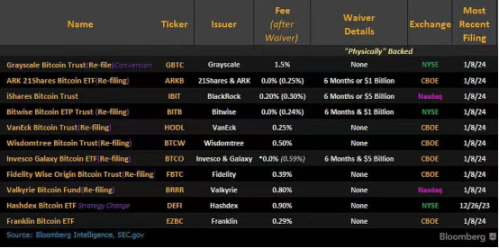
Comparison of major ETF funding rates, source: Bloomberg
In the United States, the average fee rate for ETF products is around 0.54%. However, as one of the world's largest financial institutions, BlackRock has stated that it will only charge a fee of 0.30%, with the first-year fee as low as 0.20%, until the ETF assets reach $5 billion. Under BlackRock's pressure, many institutions have had to lower their fees to gain scale at the cost of expenses. Currently, Bitwise has the lowest fee rate at only 0.24%. VanEck, which is in second place in the fee war, has adopted the lowest permanent fee among issuers so far—0.25%, and to gain more cryptocurrency recognition, it has even publicly stated that it will donate 5% of the BTC ETF profits to Bitcoin core developers. Ark/21Shares also plans to reduce fees from 0.80% to 0.25%, and waive management fees for the first six months or until the ETF assets reach $1 billion. It can be seen that almost all institutions' fee rates are significantly lower than the average fee rate.
In contrast, Grayscale has reduced its fees only slightly, from the existing 2% to 1.5% in its revised S-3 form. However, considering Grayscale's existing scale and liquidity, and the fact that its shares are unlocked over time, significantly reducing fees is not advisable. After all, for investors, liquidity is obviously more important than fees. Whether Grayscale can continue to maintain this arrogant attitude in the face of intensified market competition remains to be seen.
According to the rules, spot Bitcoin ETFs need to complete the 19b-4 form and the S- form before trading, representing the proposed changes to the securities exchange rules and the registration application of potential issuers. Previously, 11 applicants had submitted revised versions of the 19b-4 form. Among them, Grayscale, Valkyrie, ARK 21Shares, and Invesco submitted new proposed fund applications on January 5, and the Cboe BZX Exchange also submitted forms for VanEck, WisdomTree, Pando Asset AG, and Franklin Templeton.
As of now, as long as the SEC decides to approve the 19b-4 and make the S-1 effective, issuers can trade as early as the second working day after approval.
02 Nailed it? Market votes with its feet
From the market's perspective, as many as 90% of market participants believe that the Bitcoin spot ETF will be nailed, and there was even a situation in the community where the possibility of not being approved was ridiculed.
However, the market's behavior of voting with its feet has not changed. Just a few days ago, the CTC's false news event reoccurred. The same liquidation event, but this time, the false news from CTC brought Bitcoin to nearly $40,000, and this false news directly caused Bitcoin to drop by nearly 10%.
On January 3, on the 15th anniversary of Bitcoin's birth, the market experienced a comprehensive flash crash. Starting from 5 pm, Bitcoin continued to fall, reaching a low of $40,157.3 USDT from $45,000, with a drop of over 10% in 24 hours. Ethereum followed suit, dropping from 2380U to 2051.76U, and altcoins were also hit hard, with almost all of them falling by 20%. During this rapid decline, there were continuous liquidations of contracts. Coinglass data shows that the total liquidation across the network was $489 million, with long positions accounting for over 95%, once again violently clearing leveraged positions.
Although there is a lot of information about the events that caused this decline, including the poor performance of the U.S. stock market at the beginning of the year and the expected extension of the Fed's interest rate cut, a report from Matrixport is widely believed to be the key factor. On that day, Matrixport's report "Why the U.S. SEC will once again reject Bitcoin spot ETF" was widely circulated in the market. The report's view was that since all applications failed to meet key requirements, the SEC is expected to reject all proposals in January, and it also mentioned that the price of Bitcoin will fall to $36,000 to $38,000, and advised investors to buy put options. As it was a critical period for ETF approval, many people believed this was internal information from Matrixport, and panic quickly spread, with profit-takers quickly selling off and retail investors following suit, and the peak of the price drop happened just 4 hours after the report was released.
It is precisely because the market is eagerly anticipating the news that the fluctuations in the news have had an increasingly heavy impact on sentiment. After confirming that the news was not true, the price of Bitcoin quickly rebounded, and as the price approached, the price surge effect became more apparent. In the first week of January, the market value of USDT surged by over $1.83 billion, and the enthusiasm of European and Asian investors continued to rise. The market value of USDC, representing U.S. investors, also increased by over $780 million. It may be due to the game and pullback of spot ETF, the funds have not fully converted into purchasing power and have been stagnant on exchanges, but it is still evident that the market outlook is strongly positive. The market is also showing consistency, with Bitcoin briefly surpassing $47,000 this morning, setting a new high from last year to the present.
Is there a possibility of non-approval?
In terms of the overall market, the probability of non-approval continues to decrease, but of course, no one can guarantee 100% approval at the final moment. After all, even a 5% non-approval rate would be difficult for ordinary people to bear when it is foreseeable at the time of non-approval. This was evident in the violent deleveraging earlier.
Despite issuers coming out one after another to assure, the SEC's attitude still seems unclear. On January 6, the SEC's Office of Investor Education and Advocacy issued a statement "Refuse FOMO," reminding investors to be aware of the risks of cryptocurrency assets.
At the same time, a Wall Street non-profit organization called Better Markets submitted an 11-page letter to the SEC, using strong language to warn that approving a Bitcoin ETF would be a "serious, if not historic, mistake," and emphasizing that this action would "stamp the approval of the United States on a market thoroughly contaminated by fraud and manipulation." Upon closer examination, it seems to have a close relationship with well-known anti-crypto Democrat Elizabeth Warren and SEC Chairman Gary Gensler. After the publication of this letter, some industry insiders also expressed concerns, but the incorrect date in the document and the unspecified ETF applicants led industry insiders to discover that the document was an upgraded version of a previous opposition document from early summer this year.
On the evening of January 8, SEC Chairman Gary Gensler once again stated on X platform that individuals providing cryptocurrency investment/services may violate applicable laws, including federal securities laws, emphasizing that investing in cryptocurrency assets may come with extremely high risks and often involves severe volatility. Many major platforms and cryptocurrency assets have experienced bankruptcy and/or devaluation, and the investment environment is rife with various fraudulent activities.
Considering that Gary expressed similar remarks before the approval of the 21 futures ETF, some even consider it a signal for approval. Also this morning, Perianne, the founder and CEO of the Chamber of Digital Commerce, tweeted that the U.S. Securities and Exchange Commission (SEC) has issued supplemental comments on the pending applicant's S-1.
On the other hand, it is quite interesting that there seems to be a possibility of further delay for the Bitcoin ETF. Fox Business reporter Eleanor Terrett wrote that although there is no expected timetable for the committee vote on the spot Bitcoin ETF, every member of the SEC committee has the right to request a review and a full committee vote when they deem it appropriate, even if the spot Bitcoin ETF has already been approved and authorized for allocation.
03 The game of news continues, caution is the key
As of now, the game of true and false news is still ongoing, only awaiting the final conclusion tomorrow, and the bullish sentiment in the market is still evident. According to Deribit data, a large number of Bitcoin call options are concentrated at a strike price of $50,000 expiring on January 26, but compared to early November, the premium of call options relative to put options has decreased from 8% to about 2%. The market sentiment score for Bitcoin has reached as high as 76 points—this is the highest score since Bitcoin hovered near $69,000 in mid-November 2021. Standard Chartered Bank, which never misses a hot topic, has once again come out to predict that under the drive of ETF, Bitcoin will soar by 344% to $250,000 by the end of next year.
But from the initial investment seed funds set by various ETFs, there does not seem to be such a high purchasing power at the moment. Currently, the highest initial investment for the new ETF, Bitwise, is only $500,000, although Pantera Capital has stated that once the spot Bitcoin ETF is approved, it intends to inject $200 million into Bitwise. Next is VanEck, which has injected $72.5 million. Big brother BlackRock has only injected a $10 million seed fund for its Bitcoin spot ETF, but according to VanEck, over $2 billion is waiting to be injected into BlackRock's Bitcoin spot ETF in the first week after it goes public.
Of course, if some are not approved in January, other ETFs may be postponed to March, but the impact on market sentiment is self-evident. Looking at retail investors in the market, although most believe it can be approved and continue to increase, many also say they will buy put options to hedge risks.
Perhaps at this critical moment, caution is the key, after all, a 10% drop, while not much for the current price of Bitcoin, is still a significant loss for individuals.
免责声明:本文章仅代表作者个人观点,不代表本平台的立场和观点。本文章仅供信息分享,不构成对任何人的任何投资建议。用户与作者之间的任何争议,与本平台无关。如网页中刊载的文章或图片涉及侵权,请提供相关的权利证明和身份证明发送邮件到support@aicoin.com,本平台相关工作人员将会进行核查。