Author: Nianqing, ChainCatcher
Recently, the on-chain credit lending protocol 3Jane released its white paper. The content of the white paper indicates that 3Jane is a credit-based money market that enables zero-collateral loans. It verifies wallet addresses and bank accounts using zero-knowledge proof technology to provide credit loan limits, and implements risk control for zero-collateral loans through penalties on credit scores and auctions of defaulted debts.
Although the unsecured credit market has matured in traditional finance, it remains dominated by over-collateralized lending in DeFi, following the model of "collateralizing 100 to borrow 50." Additionally, existing unsecured lending protocols like Maple Finance and Goldfinch primarily target institutions and market makers, making it difficult for ordinary users to borrow efficiently.
According to the white paper, 3Jane will create a peer-to-pool credit-based money market that supports algorithmic, real-time unsecured USDC credit limits, providing funding for farmers, traders, businesses, and AI agents.
In simple terms, what 3Jane is doing is akin to common credit loan products in traditional finance, such as "Jiebei" in Alipay, which allows users to obtain loans based on their "Sesame Credit" scores. However, in a decentralized system lacking centralized institutional support, this product appears bold and aggressive.
Currently, the 3Jane product is still in the development stage, and the official early user application channel has been opened for relevant applications for early testing. However, it is important to emphasize that the off-chain credit technology platforms that 3Jane collaborates with, such as Plaid, currently support limited regions (e.g., the United States, Europe, etc.), primarily supporting the U.S. credit system. Therefore,** at the initial launch of the 3Jane product, it may only support a small number of regions, with areas like Asia potentially excluded.**
How does 3Jane operate?
According to the white paper, 3Jane will ultimately be built on the Ethereum ecosystem, targeting crypto-native users (such as yield farmers, traders, merchants, and AI agents) by relying on credit assessments of future cash flows, on-chain and off-chain assets, and credit scores to lend, enabling them to unlock capital efficiency through unsecured loans.

How does it work?
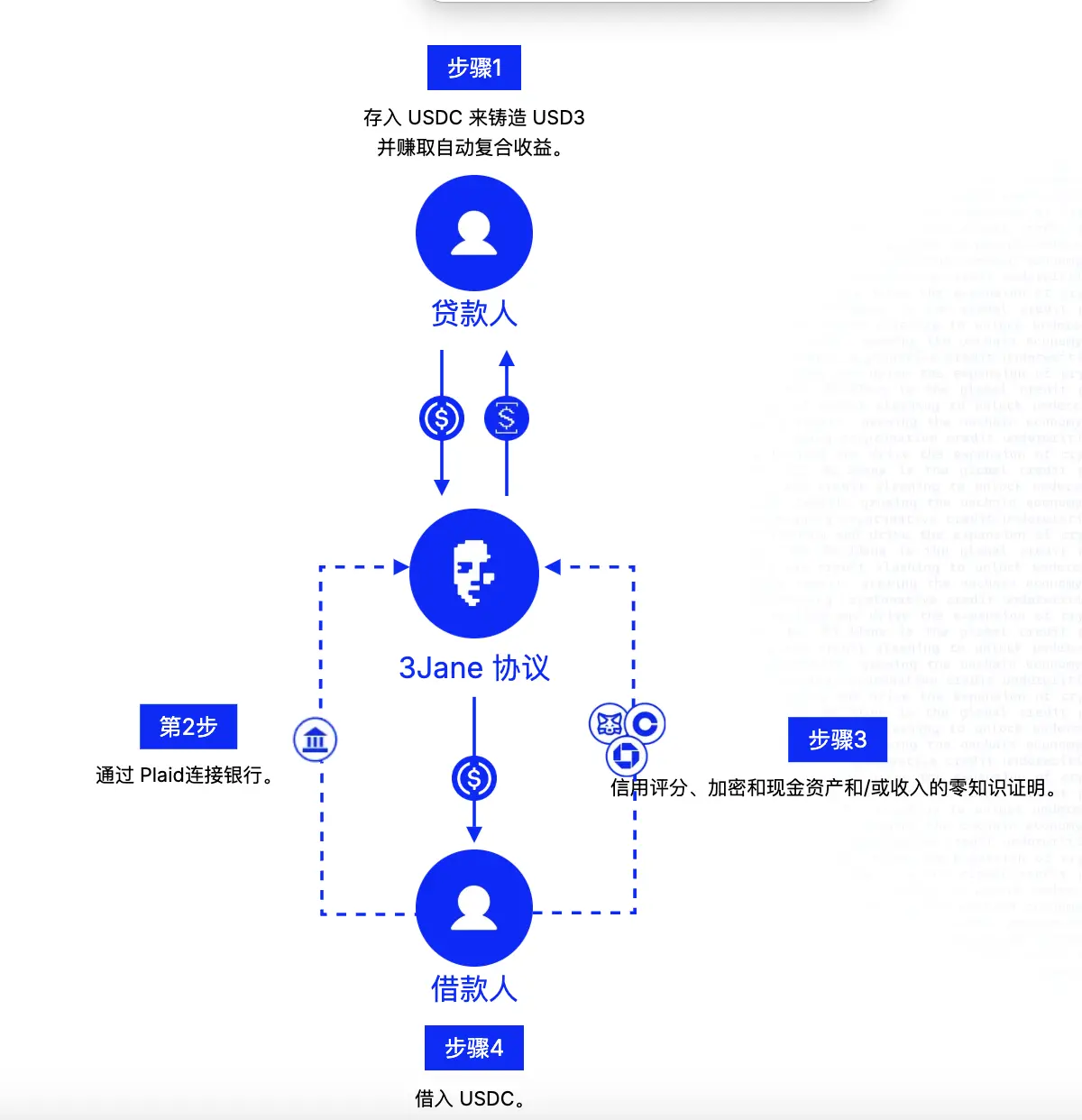
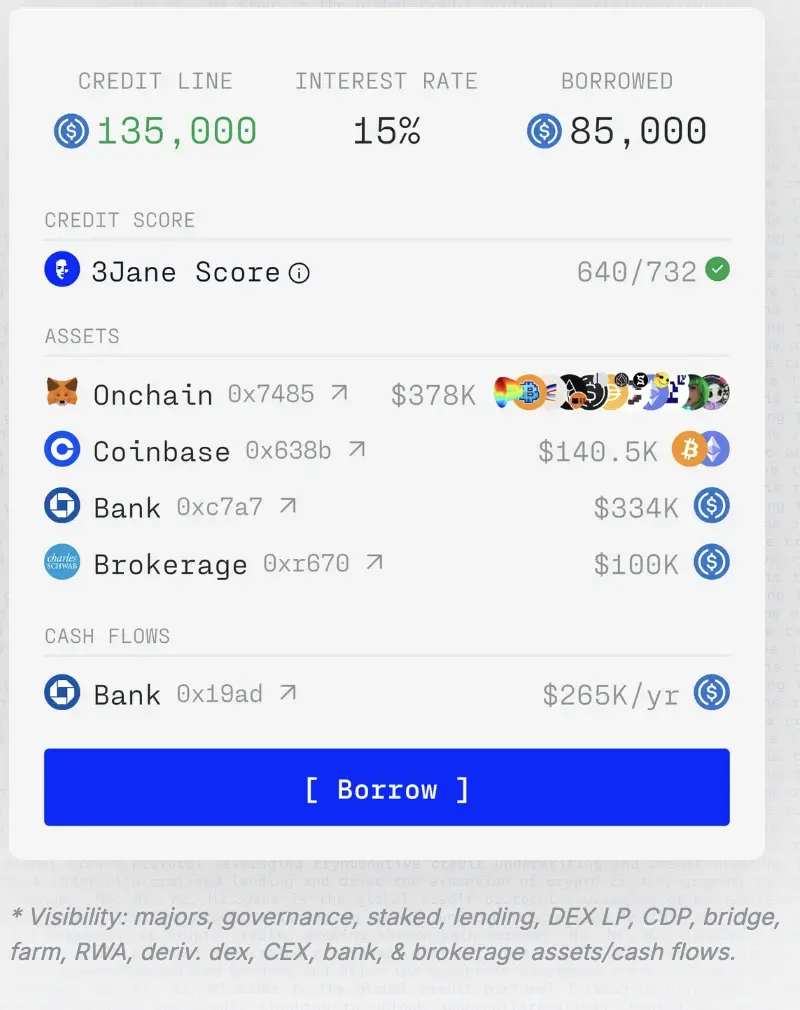
Lenders deposit USDC, which is converted into USD3 (stable yield) or sUSD3 (higher yield but higher risk) to lend to borrowers. Borrowers complete on-chain and off-chain credit authentication by connecting their wallets and bank accounts, and after a quick assessment by 3Jane, they receive a credit score and an unsecured credit limit.

How is the 3Jane credit score derived:
On-chain: 3Jane evaluates on-chain credit through Cred Protocol and Blockchain Bureau, analyzing behaviors such as lending, liquidation, holding assets, and exchange interactions on EVM chains. Both Cred Protocol and Blockchain Bureau are on-chain credit scoring tools that assign credit scores to crypto users by analyzing on-chain data (such as wallet transaction records). These two tools can cover over 500 million addresses, 8 EVM chains, and more than 100 DeFi protocols, analyzing a large amount of transaction data and generating credit scores ranging from 300 to 1000.
Off-chain: Using zkTLS (zero-knowledge technology) to pull asset and credit data from off-chain sources (banks, Credit Karma) while protecting privacy. Through ReclaimProtocol and EigenLayer, it obtains Transunion, Equifax credit scores, and Credit Karma records (VantageScore3.0, which is a widely used credit scoring model in the U.S., similar to "Sesame Credit Score"), and this process does not require providing a social security number. Additionally, 3Jane connects fiat to cryptocurrency using existing infrastructure. Plaid is the initial method by which 3Jane links off-chain reputation with on-chain Ethereum addresses. Plaid provides API services that connect users' bank accounts with various financial applications.
3Jane Funding Market Structure
Capital Flow:
Deposited USDC is first placed in Aave V3 to earn base yield, then allocated to borrowers.
USD3 is a high-priority token, while sUSD3 is subordinate debt, bearing losses first.
Lending Contracts:
Based on a modified version of Morpho Blue, replacing collateral logic with credit assessment.
Interest rate = base interest rate (IRBase) + risk premium (IRDRP) + overdue penalty (IR_LP).
Privacy and Transparency
- Privacy: Borrower data (name, phone number, etc.) is encrypted and stored in shards, only unlocked for collection agencies in case of default.
- Transparency: On-chain proofs (zkTLS Proofs) allow lenders to audit the health of the lending pool.
How to prevent bad debts in an unsecured state?
1. Repayment Incentives
Credit Score Penalty:
Failure to repay results in a "cut" to the 3Jane credit score, leading to lower borrowing limits and higher interest rates in the future.
Overdue Revenue Sharing:
Overdue penalties are shared with other borrowers, encouraging everyone to monitor and repay.
- Debt Auction (NPL Auction)
Process:
After a borrower defaults, their credit limit enters a default state.
An on-chain Dutch auction is initiated, where licensed collection agencies in the U.S. bid to take over the bad debt.
After recovering the money, the collection agency takes a commission (e.g., 20%), and the remainder goes back to the funding pool.
How to pursue:
Collection agencies use TLOxp (debt tracking tool) to locate individuals, which can report to credit bureaus affecting the borrower's real-world credit and can also take legal action for forced repayment.
3. Risk Management
Bad Debt Valuation and Write-downs
Dynamic Write-downs:
After default, the debt value is not immediately recorded as zero but calculated using a formula for the probability-weighted market value (M(t)).
The formula considers loss probability (L(t)) and recovery rate (R(t)), decreasing over time to avoid market panic.
Example:
Immediately after default, it may be valued at 50%, but if prolonged, it may drop to 10%, and ultimately to 0.
Funding Pool Layers
- USD3: 85% of the funding pool, prioritized for interest, low risk.
- sUSD3: 15% of the funding pool, high yield but incurs losses first, buffering against bad debt shocks.
Repayment Rules
Minimum Repayment:
Monthly repayment includes interest + a portion of the principal, but does not exceed asset appreciation or cash flow.
There is a grace period (G_p), after which penalties apply, and if not repaid, the debt will be auctioned.
Guarantee:
Repayment is linked to the borrower's actual income, reducing the risk of default.
- Credit Screening
Threshold:
The 3CA algorithm integrates assets, cash flow, and credit scores, directly rejecting loans for those who do not qualify.
Uses zkCoprocessor to prevent fraudulent addresses (Sybil attacks).
3Jane Team Background and Development Status
3Jane was founded by 3yakov (@_yakovsky) in 2024. 3yakov worked at Ribbon Finance for three years, initially joining as a smart contract engineer and later shifting to growth strategy. Apart from the founder, no other team member information has been disclosed.
Currently, the 3Jane product is still in development, but according to the official website, it has received support from institutions such as Coinbase, Lagrange, Reclaim, CRED, and EigenLayer. Circle co-founder and CEO Jeremy Allaire commented on 3Jane, stating, "The idea of 3Jane's AI-driven real-time unsecured USDC credit is very cool."

Current Status of On-chain Unsecured Lending Development
Cryptocurrency unsecured lending is a new direction for DeFi development. Due to challenges in risk management and the complexity of technical implementation, this field is still in its early stages. Some existing protocols include Goldfinch, TrueFi, and Maple Finance.
Goldfinch focuses on lending to real-world individuals and businesses, such as small businesses in developing countries. Goldfinch has introduced a decentralized auditor approval mechanism for borrower credit reviews, resulting in relatively lower capital efficiency; TrueFi emphasizes on-chain credit loans, using community voting and credit scores to determine who can borrow without necessarily requiring collateral. Borrowers are often institutions or entities with credit records, relying more on manual reviews for risk control; Maple Finance targets institutional unsecured lending, relying on professional teams to assess borrower credit, which is not fully decentralized, as borrowers need to provide financial statements, leading to privacy concerns.
Overall, 3Jane represents the latest and most aggressive attempt, optimizing some of the challenges faced by the above protocols. However, risk control remains one of the core obstacles to cryptocurrency unsecured lending. Although 3Jane has established credit score penalties and debt collection systems, the actual effectiveness of these constraints is uncertain. The deterrent effect of on-chain credit scores is limited, as there are still relatively few DeFi protocols using credit scores. Additionally, given the global nature of cryptocurrencies, it remains unclear how strong the deterrent effect of such defaults will be.
For example, Goldfinch has already encountered three defaults, with default amounts reaching tens of millions of dollars. Multiple defaults highlight the difficulties of unsecured lending, posing significant risks to lenders and the protocols themselves.
(This article only introduces early-stage projects and does not constitute investment advice.)
免责声明:本文章仅代表作者个人观点,不代表本平台的立场和观点。本文章仅供信息分享,不构成对任何人的任何投资建议。用户与作者之间的任何争议,与本平台无关。如网页中刊载的文章或图片涉及侵权,请提供相关的权利证明和身份证明发送邮件到support@aicoin.com,本平台相关工作人员将会进行核查。