The History of the Disappearance of Crypto Retail Investors, On-Chain Migration in Progress

CN
PANews
Follow
11 months ago
  • VCs and market makers are the main front-line barriers of exchanges.
  • Airdrops and memes initiate the process of on-chain value system reassessment.
  • The more complex token economics of projects mask the lack of growth.

Retail investors have been a bit frustrated lately. First, RedStone went through ups and downs, ultimately failing to fend off retail investors, and RedStone still got listed on Binance. Then, GPS pulled out the carrot and brought out the mud, with Binance striking hard against market makers, showcasing the absolute strength of the universe exchange.

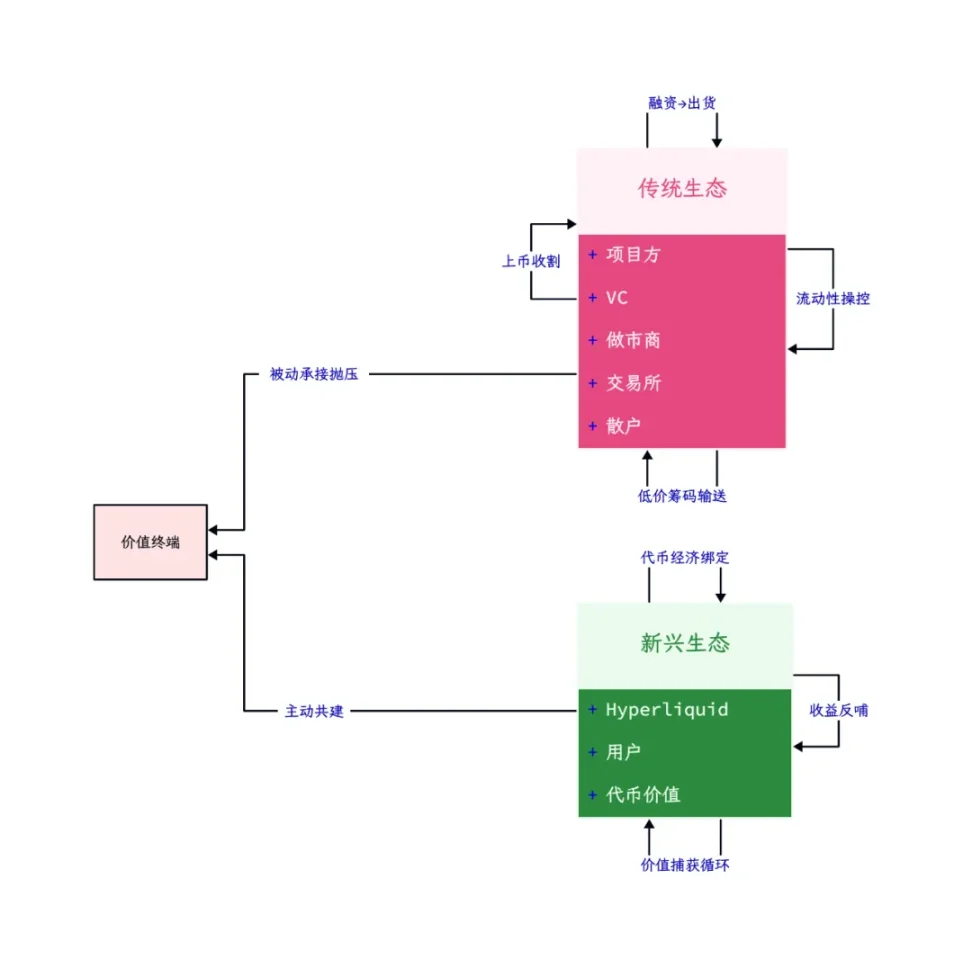
The story won't be perfect. As VC coins gradually decline, value coins have become an excuse for project parties, VCs, and market makers to offload their assets, completing the trilogy of establishing foundations, launching airdrop plans, and dumping on exchanges during each market's turbulence.

History of the demise of crypto retail investors, on-chain migration in progress

Image caption: Traditional and emerging value circulation, image source: @zuoyeweb3

It can be predicted that BTCFi ecosystems like Babylon and Bitlayer will repeat this process. Looking back, the bizarre trends and project performances after IP listings have no relation to each other but are positively correlated with the frenzied purchasing power of Koreans, and it cannot be ruled out that market makers, project parties, and exchanges are working together.

For this reason, Hyperliquid's approach is indeed unique, with no investments, no major exchanges, and no interests being split. It achieves a balance between project parties and early users, with all protocol revenues empowering its own tokens, satisfying the value preservation needs of later token buyers.

From the performance of IP and Hyperliquid, the unity and willingness to empower of the project parties themselves can suppress the concentration of chips and dumping behavior of exchanges and VCs.

As Binance pushes market makers to the forefront, its own industry barriers are rapidly collapsing.

Self-fulfilling prophecy, the revelation of RedStone

In my world, RedStone is buried 16 layers underground and needs to be mined before it can be ground.

Throughout the gold rush process, exchanges, with their absolute flow effect and liquidity, have become the final destination for tokens. On the surface, it seems that both exchanges and users are happy; exchanges acquire more tokens to attract users, while users can access new assets and seek potential profits.

On this basis, the empowering value of platform tokens like BNB/BGB can be layered on top, further consolidating their industry position.

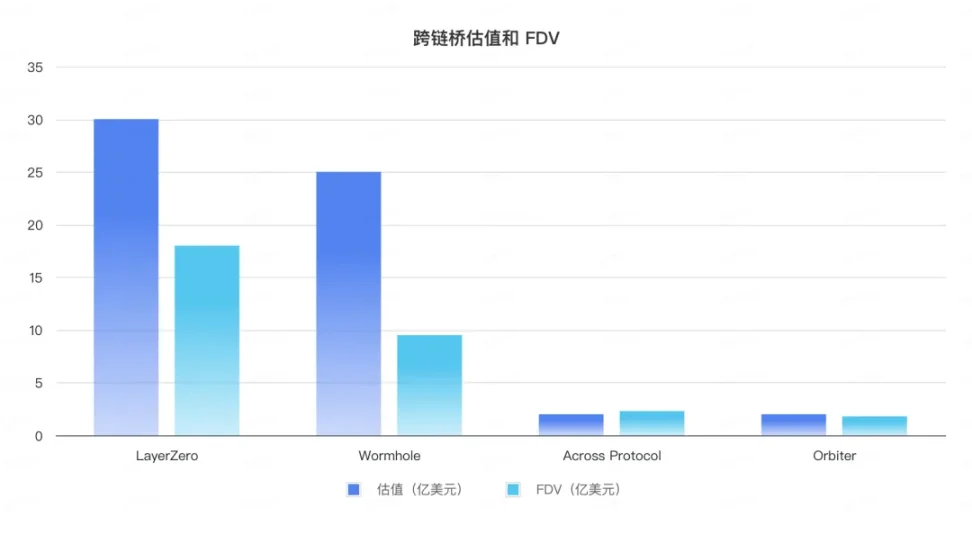
However, since 2021, with the participation of large Crypto VCs from Europe and America, the initial valuations of the entire industry have been excessively high. Taking the cross-chain bridge industry as an example, the last disclosed valuations before listing were LayerZero at $3 billion, Wormhole at $2.5 billion, Across Protocol at $200 million in 2022, and Orbiter at $200 million, while the current FDVs of the four projects are $1.8 billion, $950 million, $230 million, and $180 million, respectively.

History of the demise of crypto retail investors, on-chain migration in progress

Data source: RootData & CoinGecko, chart by: @zuoyeweb3

The endorsement effect of each Big Name added to the project is, in fact, at the expense of retail investors' interests.

From the VC coin storm that began in mid-2024 to the "girlfriend coin storm" AMA of He Yi in early 2025, the relationship between exchanges and VCs has become unsustainable on the surface. The endorsement and listing assistance from VCs seem ridiculous under the frenzy of memes, with the only remaining role being to provide funds. Driven by return rates, investment in tokens has effectively replaced investment in products.

At this point, Crypto VCs are at a loss. Web2 VCs cannot invest in DeepSeek, and Web3 VCs cannot invest in Hyperliquid. An era has officially ended.

After the collapse of VCs, exchanges only have market makers as a safe haven for retail investors. Users rush to the on-chain meme coins, and market makers can only be responsible for the PumpFun internal market after it runs out, and after the DEX external market runs out, a few listed tokens' market-making work. Of course, the relationship between on-chain business and market makers will not be deeply explored here; we will focus on exchanges.

At this time, meme coins, for market makers and exchanges, are priced as high as VC coins. If value coins have no value, then air coins clearly cannot be fairly priced based on air. Quick buy and quick sell have become the common choice for all market makers.

When the entire process is rolled around by the industry, a year of rapid access to Binance is not the original sin of market makers; the fact that Binance can be accessed quickly is the industry crisis. As the last link of liquidity, Binance can no longer discover truly long-term tokens, and thus, the industry crisis is born.

Binance can promote RedStone with issues or justly judge market makers, but what happens afterward? The industry will not change its existing model; there are still high-priced tokens waiting for the listing process.

Complexity and gigantism mean an end

With more and more Ethereum L2s, all dApps will eventually become a single chain.

Token economics and airdrop plans are becoming increasingly complex, from BTC as a Gas to the intricate ve(3,3), far exceeding the understanding of ordinary users.

Since Sushiswap relied on airdropping tokens to Uniswap users to capture the market, airdrops have become an effective buying method to stimulate early users. However, under Nansen's anti-witch-hunt scrutiny, airdrops have become a reserved program of wits between professional token farming studios and project parties, with only ordinary users being excluded.

Token farmers want tokens, project parties need trading volume, VCs provide initial funds, and exchanges need new coins, ultimately leaving retail investors to bear all, resulting in continuous declines and the impotent rage of retail investors.

Turning to memes is just the beginning; the real issue is that the entire industry of retail investors is reassessing their own interests and losses. If not trading on Binance, but on Bybit and Hyperliquid, what are the gains and losses?

Currently, the daily trading volume of on-chain contracts can reach 15% of Binance, with Hyperliquid accounting for 10% of Binance's share. This is not the end but the true beginning of the on-chain process. Coincidentally, the trading volume ratio of DEX to CEX is around 15%, while Uniswap's share of Binance is around 6%, highlighting Solana DeFi's rise.

History of the demise of crypto retail investors, on-chain migration in progress

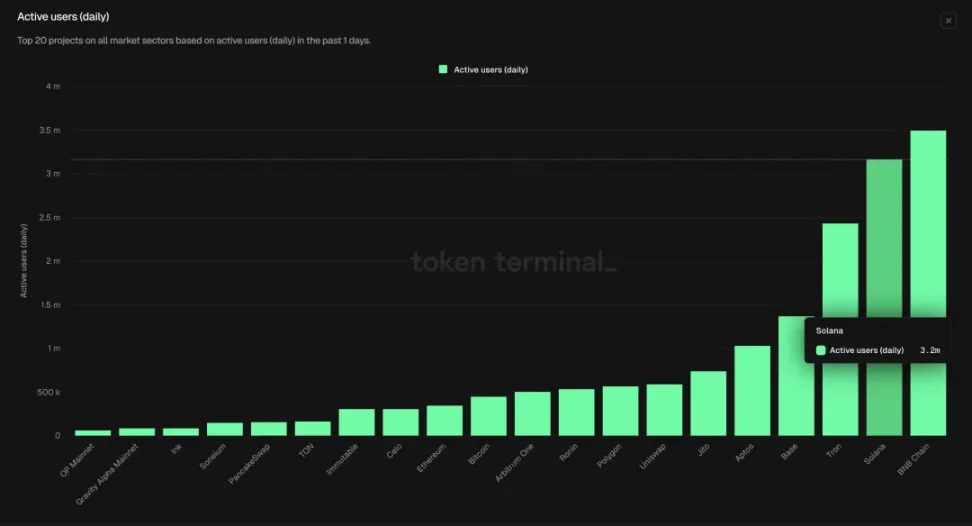
Image caption: On Chain DAU, image source: Tokenterminal

Binance has 250 million users, Hyperliquid only 400,000, Uniswap has 600,000 active users, and Solana has 3 million daily active users. We estimate the overall on-chain user group to be around 1 million, still in the very early adoption stage.

However, not only are there more L2s, but the token economics of dApps are also becoming increasingly complex, reflecting the project parties' inability to achieve a balance between their own interests and those of retail investors. Without the commitment of VCs and exchanges, projects cannot start, but accepting the division of interests from VCs and exchanges inevitably sacrifices the interests of retail investors.

In the evolutionary history of biology, whether through Darwin's theory of evolution or the probability measurements of molecular biologists, there is an undeniable basic fact: once a certain organism becomes enormous and exquisitely shaped, like the Pterosaur, it generally means entering a cycle of extinction. Nowadays, the ones that ultimately dominate the skies are birds.

Conclusion

The exchanges' cleaning of market makers is essentially an encroachment behavior under the existing competitive landscape. Retail investors still have to face the siege of VCs and project parties, and the situation will not fundamentally change. The shift to on-chain is still an ongoing historical journey. Even strong players like Hyperliquid have not yet prepared for the impact of hundreds of millions of users.

The fluctuations of value and price, the game of interests and distribution, will continue to interact in every cycle, forming the blood and tears history of retail investors.

免责声明:本文章仅代表作者个人观点,不代表本平台的立场和观点。本文章仅供信息分享,不构成对任何人的任何投资建议。用户与作者之间的任何争议,与本平台无关。如网页中刊载的文章或图片涉及侵权,请提供相关的权利证明和身份证明发送邮件到support@aicoin.com,本平台相关工作人员将会进行核查。

Share To
APP

X

Telegram

Facebook

Reddit

CopyLink