I. Structure and Core Significance
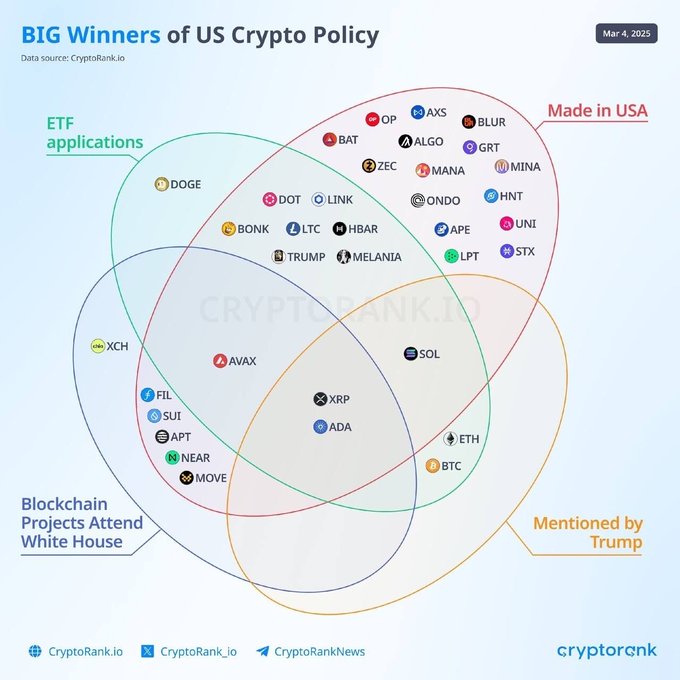
The diagram below illustrates several key beneficial factors of U.S. cryptocurrency policy, including:

ETF Applications: Green area, ETFs are important tools in traditional financial markets. The launch of cryptocurrency ETFs signifies an increased acceptance of these projects among institutional investors and mainstream financial markets. The approval of Bitcoin and Ethereum spot ETFs in 2024 has already proven the driving effect of ETFs on market prices and adoption rates.
Blockchain Projects Attend White House: Red area, this category indicates that these projects may have engaged in direct dialogue or policy-making activities with the U.S. government. Attention from the White House typically means these projects are significant in terms of regulatory compliance, technological applications (such as supply chain management, decentralized identity), or national strategic importance.
Mentioned by Trump: Orange area, Trump's attitude towards cryptocurrency has shifted from criticism to support in recent years, especially during the 2024 campaign, where he publicly endorsed cryptocurrency and launched his own NFT project and MEME coin. Projects mentioned by Trump may gain market attention and short-term price boosts due to his celebrity effect.
Made in USA: Orange area. These projects may have a natural advantage in policy support, especially in the context of U.S.-China technology competition.
II. Significance of Overlapping Areas
Dual Overlapping Area: Projects appearing in two categories simultaneously indicate advantages in multiple aspects. For example, BTC (Bitcoin) and ETH (Ethereum) appear in both the "ETF Applications" and "Mentioned by Trump" areas, showing dual benefits in policy support and public attention.
Triple Overlapping Area: Located at the center of the diagram, containing SOL (Solana), XRP (Ripple), and ADA (Cardano). These projects meet all three conditions of "ETF Applications," "White House Participation," and "Mentioned by Trump," making them the biggest potential beneficiaries of U.S. cryptocurrency policy.
III. Specific Project Classification and Analysis
1. Triple Benefit Projects (Center Area: ETF + White House + Mentioned by Trump)
These projects are located in the overlapping section of the three areas and are the "core winners" of policy support.
SOL (Solana):
Background: Solana is a high-performance Layer 1 blockchain known for its high throughput and low transaction costs, making it one of Ethereum's main competitors.
Analysis: Solana's presence in the center area indicates it is receiving significant attention in U.S. policy-making, possibly applying for an ETF while also gaining Trump's endorsement. Solana's high performance allows for widespread applications in DeFi (decentralized finance) and NFTs (non-fungible tokens), which may attract government interest, especially leveraging its leading position in MEME coins to capture a large share of on-chain active users.
XRP (Ripple):
Background: Ripple is primarily used for cross-border payments, and its token XRP has long been embroiled in legal disputes with the U.S. Securities and Exchange Commission (SEC) (starting in 2020).
Analysis: XRP's presence in the center area may indicate that its legal issues are being resolved or that its position in policy matters has improved. The SEC's regulatory stance on cryptocurrencies has softened in 2024, and if XRP can successfully apply for an ETF, it may see significant capital inflows.
ADA (Cardano):
Background: Cardano is a blockchain project focused on academic research and layered architecture, known for its scientific approach and sustainability.
Analysis: Cardano's position in the center area suggests it has gained more recognition in the U.S. market and may play a role in policy-making or government collaboration. Its technical strength may make it a candidate for government support.
2. Dual Benefit Projects
ETF Applications + Mentioned by Trump (Green + Orange Area)
BTC (Bitcoin):
Background: Bitcoin is the largest cryptocurrency by market capitalization and is considered digital gold. In early 2024, the U.S. approved the Bitcoin spot ETF, boosting its price and institutional adoption. By 2025, BTC is expected to be actively promoted as a strategic reserve currency for the U.S. and various countries and major listed companies.
Analysis: Bitcoin's simultaneous presence in the "ETF Applications" and "Mentioned by Trump" areas indicates its solid market position. Trump's mention may further enhance its public image, attracting more retail investors.
ETH (Ethereum):
Background: Ethereum is the second-largest cryptocurrency, supporting smart contracts and the DeFi ecosystem. In May 2024, the Ethereum spot ETF was approved.
Analysis: Ethereum's position in this area reflects its dual advantages in policy and public attention. The widespread applications of the Ethereum ecosystem make it a focal point for institutional investment.
White House Participation + Mentioned by Trump (Red + Orange Area)
TRUMP:
Background: Likely a meme coin or token related to Trump, commonly seen in projects driven by celebrity effects.
Analysis: Its presence in this area indicates it is more based on Trump's personal influence rather than technical strength. Such tokens typically exhibit high volatility and are suitable for short-term speculation.
MELANIA:
Background: Likely a token or project related to Trump's wife, Melania.
Analysis: Similar to TRUMP, the MELANIA token may also be based on celebrity effects, lacking long-term technical support.
HBAR (Hedera):
Background: Hedera is an enterprise-grade blockchain that uses a hashgraph consensus mechanism, suitable for supply chain management and decentralized identity scenarios.
Analysis: HBAR's presence in this area suggests it may have deep collaboration with the U.S. government while also attracting Trump's attention. Its enterprise-level applications may provide long-term development potential under policy support.
ETF Applications + White House Participation (Green + Red Area)
This area has no projects, indicating that there are currently no projects that meet the conditions of "ETF Applications" and "White House Participation" but have not been mentioned by Trump.
3. Single Category Projects
3.1 ETF Applications (Green Area)
Projects: DOGE (Dogecoin), BONK, XCH (Chia), AVAX (Avalanche), FIL (Filecoin), SUI, APT (Aptos), NEAR, MOVE.
Analysis:
Meme Coins: DOGE and BONK are meme coins with strong community-driven characteristics but limited technical applications. Their ETF applications may be more about attracting retail funds.
Layer 1 Blockchains: AVAX, SUI, and NEAR are high-performance Layer 1 blockchains, similar to Solana, and may seek to enter traditional financial markets through ETFs.
Storage and Infrastructure: Projects like FIL (decentralized storage) and XCH (green blockchain) have broader technical applications, and their ETF applications may reflect institutional optimism about their long-term value.
3.2 White House Participation (Red Area)
Projects: LTC (Litecoin), LINK (Chainlink), DOT (Polkadot).
LTC: Litecoin is a fork of Bitcoin with faster transaction speeds and may be of interest in government payment or settlement scenarios.
LINK: Chainlink provides decentralized oracle services and is a key infrastructure in the DeFi ecosystem; its White House participation may relate to data credibility.
DOT: Polkadot is a cross-chain protocol aimed at connecting different blockchains, and its technology may attract government interest in interoperability.
3.3 Mentioned by Trump (Orange Area)
Projects: OP (Optimism), AXS (Axie Infinity), BAT (Basic Attention Token), ZEC (Zcash), MANA (Decentraland), ONDO, APE (ApeCoin), LPT (Livepeer), UNI (Uniswap), STX (Stacks).
Analysis:
Diversity: This area includes various types of projects such as Layer 2 solutions (OP), DeFi (UNI), gaming (AXS), privacy coins (ZEC), and metaverse (MANA), reflecting the broad nature of Trump's mentions.
Speculation: Trump's mentions may be more about market hype rather than technical assessments. These projects may see short-term price increases due to heightened attention, but their long-term value will depend on their fundamentals.
3.4 Made in USA (Sub-label in Orange Area)
Projects: BLUR (NFT Market), ALGO (Algorand), GRT (The Graph), MINA, HNT (Helium).
Analysis:
Made in America: These projects originate from the U.S. and may have advantages in policy support. For example, ALGO and GRT are infrastructure projects focusing on high-performance blockchain and data indexing, potentially benefiting from government prioritization in technology.
Technical Applications: Projects like HNT (Internet of Things) and MINA (lightweight blockchain) may have technological innovations that make them more attractive in policy-making.
IV. Macroeconomic Trends and Policy Background
4.1 The Push for ETFs
Historical Background: 2024 is a breakthrough year for cryptocurrency ETFs, with the approval of Bitcoin spot ETF (January) and Ethereum spot ETF (May) injecting significant institutional funds into the market.
Trends in the Diagram: More projects (such as SOL, XRP, ADA, AVAX, etc.) are applying for ETFs, indicating that the integration of cryptocurrency with traditional finance is accelerating. The launch of ETFs may significantly enhance the market value and adoption rates of these projects.
4.2 Trump's Influence
Background: Trump's attitude towards cryptocurrency has shifted from criticism to support in recent years. He has publicly endorsed cryptocurrency multiple times during the 2024 campaign, even launching his own NFT project.
Reflected in the Diagram: The variety of projects mentioned by Trump includes meme coins (TRUMP, MELANIA), DeFi (UNI), gaming (AXS), etc., reflecting that his influence is primarily focused on market hype and public attention rather than technical evaluation.
4.3 White House Participation
Background: The U.S. government's attitude towards blockchain technology is shifting from regulatory pressure to cooperation and support. Projects participating in the White House may involve decentralized identity, supply chain management, or financial innovation.
Reflected in the Diagram: Projects like SOL, XRP, and HBAR in the White House participation area indicate they may play important roles in policy-making.
4.4 Advantages of Made in USA
Background: In the context of U.S.-China technology competition, the U.S. government may prioritize supporting domestic blockchain projects to ensure technological sovereignty.
Reflected in the Diagram: Projects marked as "Made in USA" (such as ALGO, GRT, HNT) may gain long-term development advantages under policy support.
V. Potential Market Impact
5.1 Center Area Projects (SOL, XRP, ADA)
Market Outlook: These projects have become the biggest winners due to triple benefits, potentially attracting more institutional funds and retail investors.
Specific Impacts:
SOL: Solana's high performance may make it the preferred choice in the DeFi and NFT sectors, and the approval of its ETF could further drive up its price.
XRP: If its legal issues with the SEC are resolved, ETF approval could trigger a massive influx of funds.
ADA: Cardano's scientific approach may give it an advantage in government collaborations, with significant long-term development potential.
5.2 ETF-Related Projects (BTC, ETH, AVAX, etc.)
Market Outlook: The launch of ETFs will bring more institutional funds to these projects, enhancing their market value.
Specific Impacts:
BTC and ETH: With approved ETFs, their market positions are solid, and mentions by Trump may further attract retail investors.
AVAX, SUI, NEAR: If ETFs are approved, they could become the next beneficiaries of high-performance blockchains.
5.3 Projects Mentioned by Trump (TRUMP, MELANIA, UNI, etc.)
Market Outlook: These projects may see short-term price increases due to hype, but their long-term value will depend on their fundamentals.
Specific Impacts:
TRUMP, MELANIA: Clearly meme coin characteristics, high volatility, suitable for short-term speculation.
UNI, OP: Strong technical capabilities of DeFi and Layer 2 projects, mentions by Trump may bring them more attention.
5.4 White House Participation Projects (HBAR, LINK, DOT, etc.)
Market Outlook: These projects may receive more government contracts or policy support, with significant long-term development potential.
Specific Impacts:
HBAR: Enterprise-level applications may give it an advantage in government collaborations.
LINK: The widespread application of oracle services may make it a bridge between DeFi and government cooperation.
VI. Conclusion
Biggest Winners: Solana, XRP, and Cardano have become core beneficiaries by simultaneously meeting triple benefits, likely to excel in policy support and market performance.
Market Leaders: Bitcoin and Ethereum continue to maintain dominance, with ETFs and mentions by Trump adding more attention.
Policy Support: Projects participating in the White House (such as HBAR and LINK) may benefit from government collaboration in long-term development.
Made in USA: Projects originating in the U.S. (such as ALGO and GRT) may gain competitive advantages under policy support.
免责声明:本文章仅代表作者个人观点,不代表本平台的立场和观点。本文章仅供信息分享,不构成对任何人的任何投资建议。用户与作者之间的任何争议,与本平台无关。如网页中刊载的文章或图片涉及侵权,请提供相关的权利证明和身份证明发送邮件到support@aicoin.com,本平台相关工作人员将会进行核查。