Ensure that all funds are clearly traceable on the blockchain, refuse to engage with illegal funds, and be wary of the money laundering traps behind "high returns."
Written by: Ye Yang
Due to China's strict regulations on virtual currencies, only allowing personal transactions between individuals and not permitting exchanges, the so-called allowance is merely a lack of prohibition, providing no protection for virtual currency transactions. Players in the crypto space need to find ways to deposit funds, endure market tests, and then find ways to safely withdraw funds to secure their profits. A careless mistake in the withdrawal process could lead to receiving dirty money, resulting in a frozen bank card and the need to return the illicit funds, or worse, losing everything and facing imprisonment. Many are searching for safe withdrawal solutions, and today, lawyer Mankun will analyze several widely circulated safe withdrawal methods online.
Withdrawal through Acquaintances
Withdrawing through acquaintances seems to be the simplest and most direct method, but it can be the most treacherous.
First, there is the definition of an acquaintance. Who qualifies as an acquaintance? Are people in the same trading group considered acquaintances? Are colleagues who also trade cryptocurrencies acquaintances? What about high school classmates you haven't contacted in years?
The term "acquaintance" seems to carry a certain magic, leading some to think: I know him, he won't scam me; even if I get scammed, I can easily find him to recover my losses. But if we strip away this veil of familiarity and think seriously, do you really know his character? Are you aware of his financial situation? Is your understanding limited to what he has told you about himself? Do you have his parents' contact information? Do you have his ID number? If he changes his phone, job, or city, can you still find him?
Moreover, even if he is a very good friend, it is not suitable to treat him as a stable withdrawal channel. Disagreements over price and fees due to interests and personal relationships can lead one or both parties to feel they are at a disadvantage, making such relationships unsustainable.
In summary, I do not recommend withdrawing through acquaintances at all.
Withdrawal via U Card
The "U Card" refers to MasterCard U Card, UnionPay U Card, etc., generally referring to the MasterCard U Card. It not only has all the functions of a regular bank card but also allows for deposits via USDT, enabling direct consumption of USDT for daily expenses or even direct withdrawals.
It sounds very convenient and quick. The U Card works by allowing users to make purchases, with the issuing bank deducting USDT based on the exchange rate. The issuing bank then conducts international settlement and clearing with its connected banks. The settlement of virtual currency and fiat currency occurs internally within the overseas issuing bank, meaning users do not directly engage with virtual currencies during transactions, thus avoiding the risk of ordinary withdrawals being frozen by the police due to dirty money.
The U Card can be said to have almost no criminal risk as long as users do not actively use it for illegal activities. However, the U Card also has its drawbacks: first, the card issuance fee and various transaction fees are relatively high, making it impossible to have both convenience and low cost; second, as a bank card from an overseas bank, even if KYC is relatively lenient, there are still significant barriers to obtaining the card. Particularly regarding the second point, this gives rise to another risk associated with the U Card: finding an agent to apply for the U Card, which could lead to falling into scams.
If you are capable of applying for the U Card yourself and can accept higher costs for convenience and low risk, then the U Card is a very suitable option.
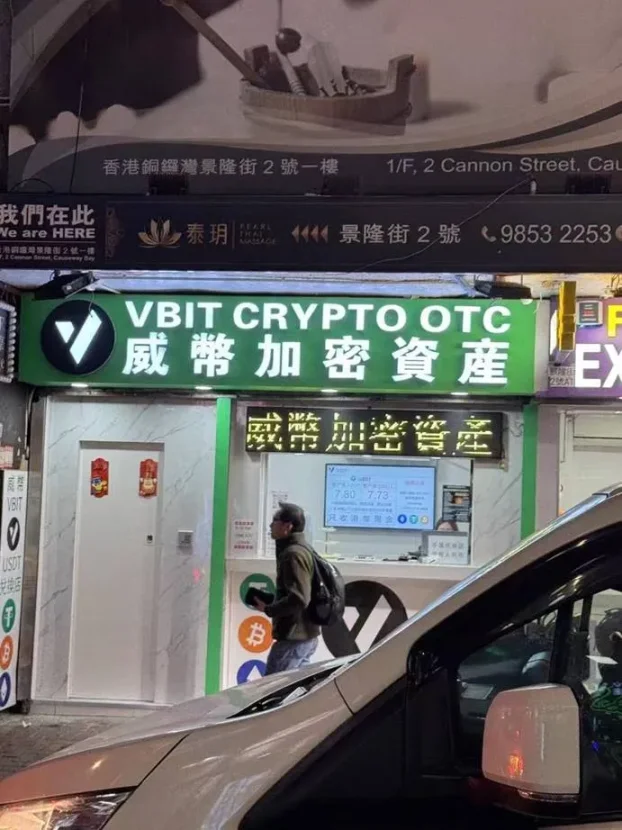
Hong Kong Offline OTC
Hong Kong's offline OTC, commonly referred to as physically going to Hong Kong, involves withdrawing funds at offline exchange shops.
Due to institutional reasons, Hong Kong's attitude towards virtual currencies is completely different from that of the mainland, being overall more open and accepting. On the streets of Hong Kong, there are various physical exchange shops that generally do not require customer identity verification, and the transaction limits are relatively high. Customers only need to leave a phone number or email to complete the transaction. Additionally, offline exchange shops often offer more attractive exchange rates compared to formal online trading platforms, attracting a large number of customers for deposits and withdrawals.
However, convenience and low cost mean that the risks of offline exchanges cannot be low. The absence of KYC and low transaction costs come with the downside of market disorder and lack of regulation. In the past, there have been significant money laundering and fraud incidents involving offline exchange shops. For this reason, on February 2, 2024, the Secretary for Financial Services and the Treasury of Hong Kong, Xu Zhengyu, stated that the government believes there is a need to regulate virtual currency over-the-counter (OTC) exchanges and will consult on the proposed regulatory framework in the short term, hoping that citizens and stakeholders will actively express their opinions. A few days later, on February 8, the Hong Kong government began public consultations on legislative proposals for a licensing system for virtual asset OTC service providers, primarily requiring all offline exchange shops to apply for licenses, limiting the types of virtual currencies that can be exchanged, and ensuring compliance with anti-money laundering regulations and penalties for violations.
Currently, the Hong Kong government has not yet implemented the above regulations, but it is already evident that the government is determined to regulate offline exchange shops. These unregulated offline exchange shops still exist on the streets of Hong Kong. If you happen to be traveling to Hong Kong, you might try making small withdrawals at these exchange shops, as you may not have the opportunity to experience such unregulated growth in the future.

Conclusion
Regardless of the withdrawal method chosen, please adhere to the following principles to mitigate legal and asset risks:
1. Legitimacy of Source
Ensure that all funds are clearly traceable on the blockchain, refuse to engage with illegal funds (such as those from telecom fraud, gambling, or black market transactions), and be wary of the money laundering traps behind "high returns."
2. Cautious Selection of Transaction Counterparties
Prioritize licensed exchanges or KYC-certified compliant OTC merchants, and avoid transactions with strangers or semi-acquaintances (even if they claim to be "reliable"), to prevent being drawn into financial liability.
3. Anticipate Policy Dynamics
Closely monitor regulatory changes in key areas (such as tightening of OTC licensing approvals in Hong Kong, new FATF cross-border payment regulations in the U.S.), as policy impacts often precede market perceptions.
4. Consensus on Safety Priorities
There exists a "trilemma" in virtual currency withdrawals: it is impossible to simultaneously achieve convenience, low cost, and low risk. Prioritize according to your own needs (e.g., compliance > timeliness > transaction fees).
In the Web3 industry, regulatory policies for virtual currency transactions are constantly evolving; today's "gray area" may become "illegal operations" tomorrow. Some withdrawal methods may be temporarily feasible, but once policies change, risks may be exposed instantly. Withdrawals not only concern the safety of funds but also involve legal responsibilities; a slight misstep could cross legal red lines and even affect personal freedom.
免责声明:本文章仅代表作者个人观点,不代表本平台的立场和观点。本文章仅供信息分享,不构成对任何人的任何投资建议。用户与作者之间的任何争议,与本平台无关。如网页中刊载的文章或图片涉及侵权,请提供相关的权利证明和身份证明发送邮件到support@aicoin.com,本平台相关工作人员将会进行核查。