The information, opinions, and judgments regarding the market, projects, currencies, etc., mentioned in this report are for reference only and do not constitute any investment advice.

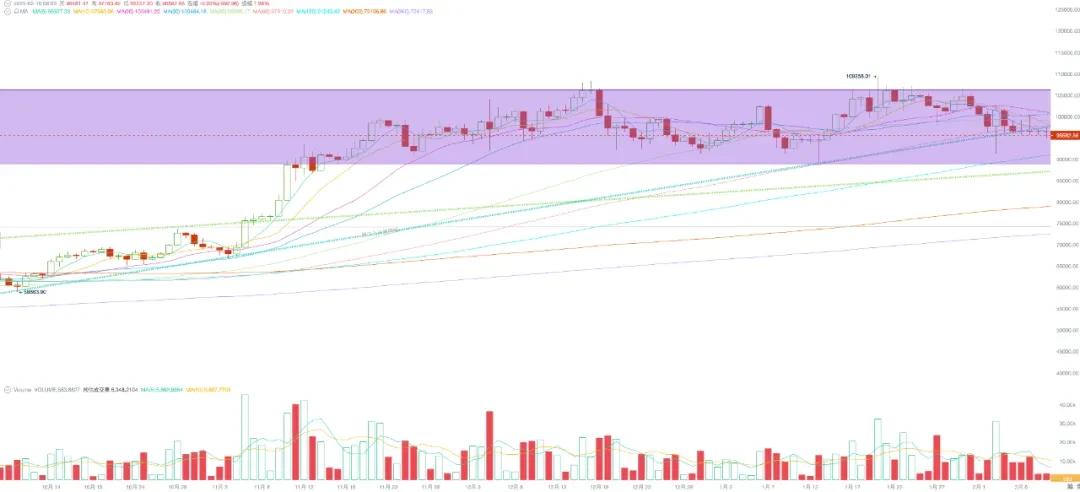
This week, BTC opened at $97,676.53 and closed at $96,475.82, down -1.23% for the week, with a maximum fluctuation of 11.69%, once again attempting to break through the $90,000 to $108,000 range, with trading volume slightly shrinking.
Due to the impact of tariffs on Canada, Mexico, and China, BTC initially experienced a flash crash on Monday but miraculously recovered. It has since been oscillating at low levels, indicating that its risk asset attributes currently outweigh its digital gold attributes in the market.
Last weekend and on Monday, short contracts pressured BTC, leading to the largest intraday volatility in recent times, reaching 11.69%, marking the lowest point since mid-January at $91,178.01. The severe fluctuations caused spot shorts to incur losses exceeding $800 million, while losses in the futures market are estimated to be as high as $10 billion.
Due to large-scale liquidations, BTC continued to oscillate around $97,000 after Monday. Following multiple macroeconomic negative impacts on the market on Friday, it appeared relatively stable. However, for the severely impacted market to recover and restart an upward trend, relying solely on internal forces is unlikely to succeed.
Currently, BTC is still operating within the "Trump bottom" ($89,000 to $110,000), with prices hovering around the second upward trend line, facing a short-term directional choice.
Macroeconomic and Financial Data
The 25% tariffs on Canada and Mexico were postponed at the last moment, allowing the violently declining BTC and U.S. stocks to recover lost ground without incident. However, by the weekend, the market faced a dual blow from economic and policy fronts.
After the chaotic release of the non-farm payroll data on Friday, the market experienced disordered trading and failed to find direction. Subsequently, the University of Michigan's consumer survey showed that consumer confidence dropped to a seven-month low due to heightened concerns about inflation. Following that, Trump announced that he would declare reciprocal tariffs on multiple countries next week.
As a result, the U.S. dollar index fluctuated upward to 108.31, indicating renewed market concerns about rising inflation and worsening interest rate hike expectations. The three major U.S. stock indices plunged during the session, dropping over 1% and erasing the week's gains.
After a period of decline, influenced by expectations of a rebound in inflation, U.S. Treasury yields rebounded. The one-year Treasury yield rose to 4.232%, and the ten-year yield rose to 4.494%, once again approaching the high of 4.5%, putting pressure on the equity market.
Fears of inflation and uncertainty regarding interest rate cuts have led to increased capital flowing into gold. This week, London gold achieved a six-week consecutive rise, reaching $2,861.81 per ounce, with the weekly increase expanding to 2.18%.
Next week, the market will welcome the release of the U.S. January CPI, and Federal Reserve Chairman Powell will attend a Senate Banking Committee hearing to testify on the semiannual monetary policy report, followed by an appearance at the House Financial Services Committee hearing the next day.
CPI and Powell's testimony will be the main factors dominating BTC's trends next week.
Selling Pressure and Liquidation
In terms of selling pressure, both long and short positions sold a total of 176,682 BTC, slightly up from last week, maintaining a normal level, while trading volume on exchanges slightly shrank during the same period.
The futures market was severely impacted, with open contracts losing over $10 billion in positions, making it the biggest victim of this week's volatile market.
Stablecoins and BTC Spot ETF
Stablecoins and BTC Spot ETF, along with ETH Spot ETF, saw a total inflow of $5.662 billion throughout the week, with $5.074 billion, $183 million, and $405 million respectively, maintaining a strong inflow trend.
However, it can be observed that the inflow scale of BTC Spot ETF, which directly translates into purchasing power, has declined for two consecutive weeks, which is the fundamental reason for BTC's weak price performance.
Cycle Indicators
According to the eMerge engine, the EMC BTC Cycle Metrics indicator is at 0.625, indicating that the market is in an upward phase.
EMC Labs was established in April 2023 by cryptocurrency asset investors and data scientists. It focuses on blockchain industry research and investments in the crypto secondary market, with industry foresight, insights, and data mining as its core competencies, aiming to participate in the thriving blockchain industry through research and investment, promoting the benefits of blockchain and crypto assets for humanity.
For more information, please visit: https://www.emc.fund
免责声明:本文章仅代表作者个人观点,不代表本平台的立场和观点。本文章仅供信息分享,不构成对任何人的任何投资建议。用户与作者之间的任何争议,与本平台无关。如网页中刊载的文章或图片涉及侵权,请提供相关的权利证明和身份证明发送邮件到support@aicoin.com,本平台相关工作人员将会进行核查。