We are on the brink of the next "takeoff" in the crypto industry.
Author: Karthik Senthil
Translation: Deep Tide TechFlow
Introduction
As the narrative around smart contracts gradually loses its appeal, the strong entry of AI brings a breakthrough, driving an unexpected wave of enthusiasm and innovation. From the consensus layer of Bitcoin to the execution layer of smart contracts, and now to the AI-driven application layer, has the crypto industry ushered in a third technological leap?
KOL @karsenthil has published his views on Crypto X AI at different times, believing that we are on the verge of the next "takeoff" in the crypto industry.
The original content is divided into two parts and is somewhat fragmented.
In the first part, the author expresses the view that AI will drive blockchain into the next technological leap. In the second part, he elaborates on the specific implementation paths of AI at the application and infrastructure levels, highlighting potential opportunities for investors and builders.
Deep Tide TechFlow has integrated and compiled this content, and below is the complete text.
Crypto X AI Argument (Part One) — We Are Welcoming a "Leap" Development
AI is driving blockchain towards the next major leap.
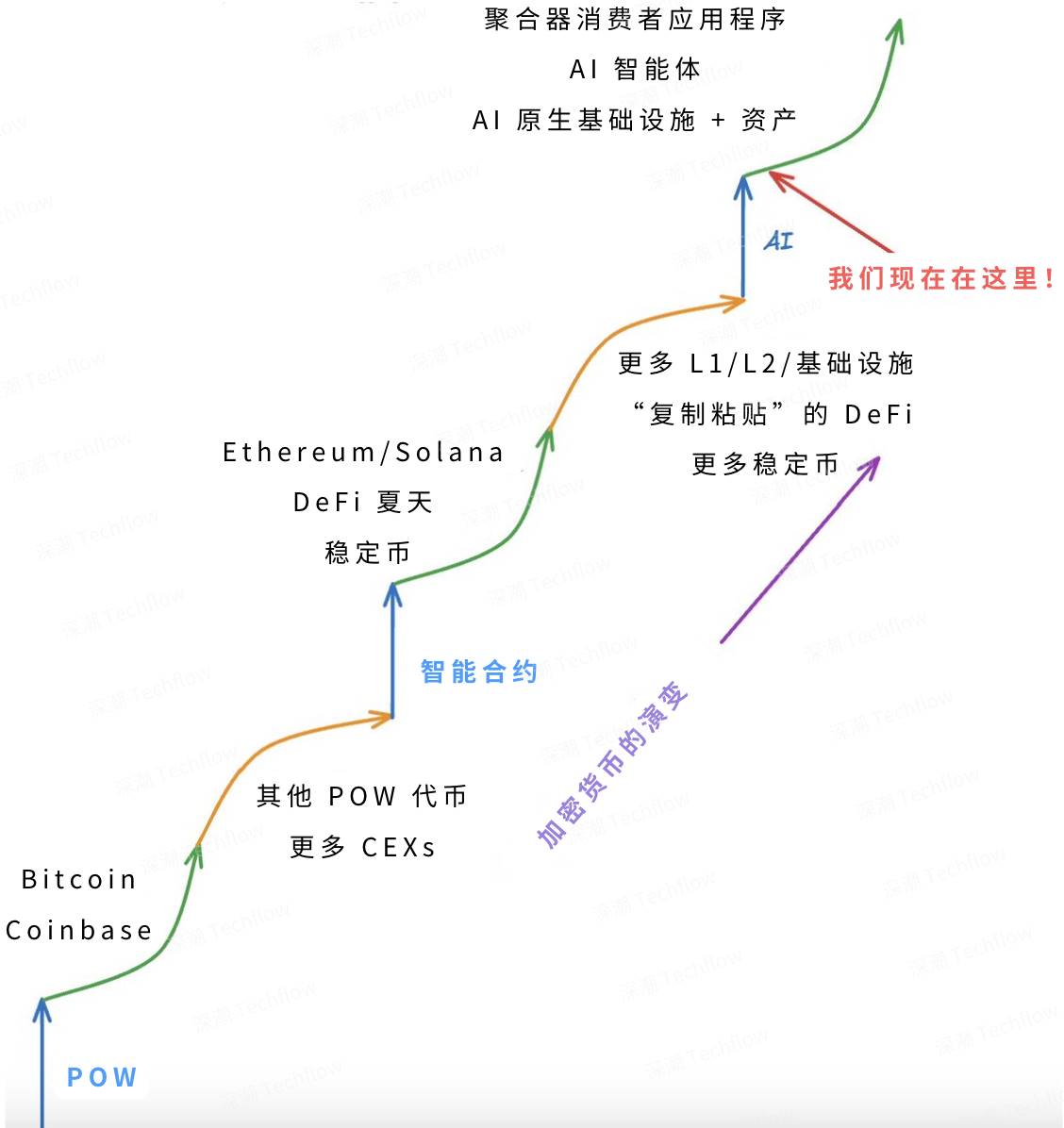
Each stage of blockchain development typically follows a similar trajectory:
A "leap" in technological advancement triggers a new wave of innovation;
As numerous imitators join in, technological progress gradually stagnates;
Then, the next technological leap occurs, pushing the industry forward.

Original image from @karsenthil, compiled by Deep Tide TechFlow
The first major leap in cryptocurrency occurred at the consensus layer, marked by the invention of Bitcoin and Proof of Work (PoW). From 2009 to 2014, this wave led to a growth of over 10,000 times in cryptocurrency market value (from about $750,000 to about $75 billion).
The second leap appeared at the execution layer, where the emergence of smart contracts endowed blockchain with programmability. Today, the vast majority of blockchain infrastructure (such as L1, L2) and applications (such as tokens, stablecoins, DeFi) rely on this core innovation. From 2014 to the present, this wave has driven the cryptocurrency market value to grow by about 500 times, reaching approximately $3.5 trillion, with projects born during this phase accounting for about 43% (approximately $1.5 trillion) of the total market value.
However, current technological progress has once again stagnated. Why is this happening? Here are my views (which may be controversial):
The potential of smart contracts has basically been exhausted. Even the recently popular memecoins are merely recombinations of existing technologies (such as tokens, bonding curves, NFT community trends) rather than entirely new inventions.
Smart contracts have become the main bottleneck for user experience (UX). Current crypto applications require direct interaction with smart contracts, meaning users must understand where the contracts operate, their functional significance, how to interact with them, and also need to sign transactions and pay gas fees.
Fortunately, the next technological leap has already arrived — it brings a new wave of innovation at the application layer by enhancing usability.
AI Will Become the User Experience Layer of Crypto Technology
The popularization of every new technology requires a strong "frontend" to simplify complexity and integrate functionality. Personal computers have graphical user interfaces (GUIs) and operating systems, the internet has web browsers and FAANG, and mobile devices have native applications and app stores.
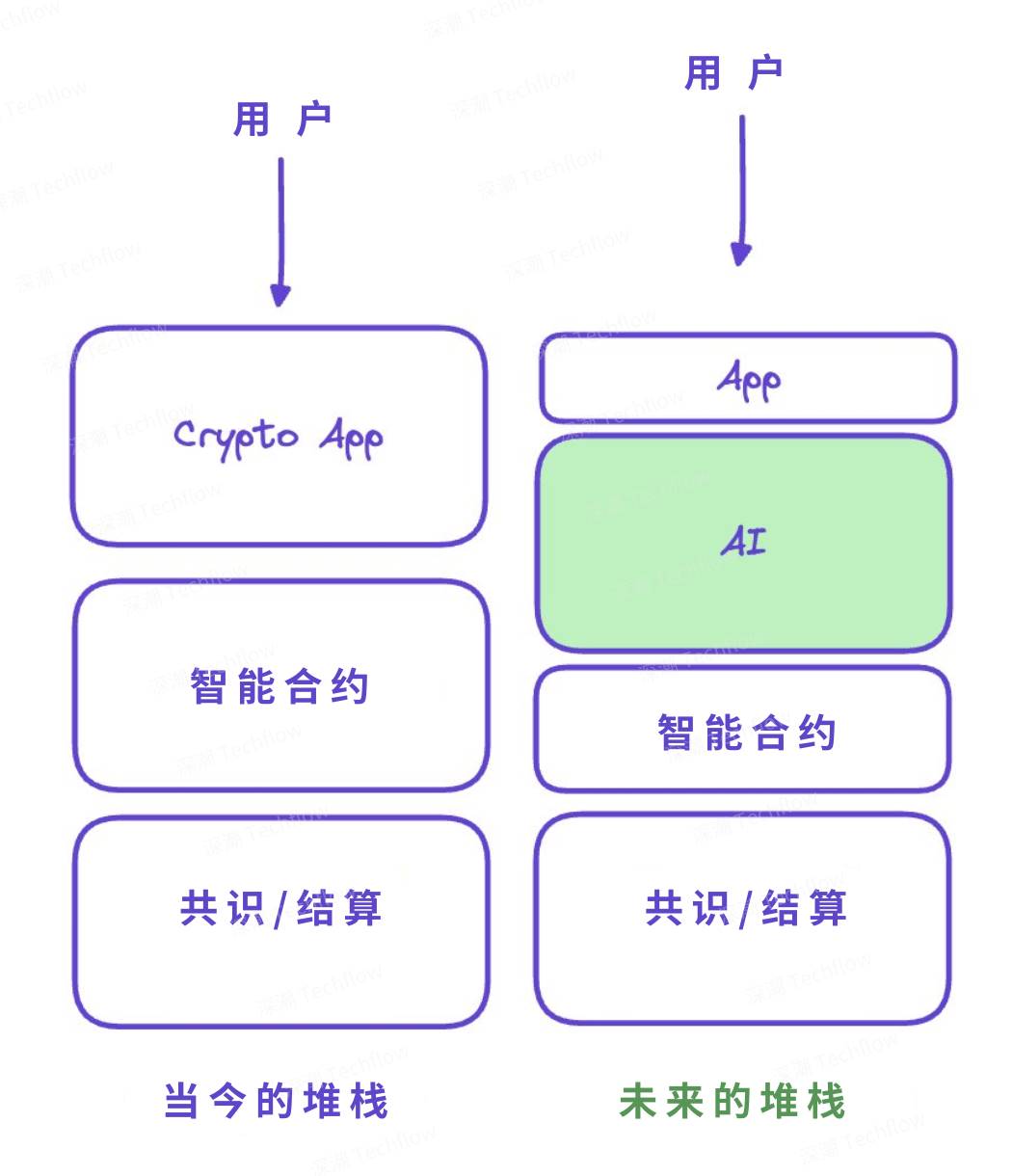
AI will become the user experience layer of blockchain technology, providing users with an order of magnitude better experience, thereby driving broader adoption. AI can solve three major user experience challenges in crypto technology: user guidance, execution of complex operations (which often require multiple steps, and large language models (LLMs) excel at handling these steps), and feature discovery. I predict that by 2030, 40% of the global population will have had on-chain transaction experiences, with over 95% of those transactions completed through AI. By then, people will unconsciously use applications powered by blockchain technology.

Original image from @karsenthil, compiled by Deep Tide TechFlow
To achieve this, AI will act as a bridge connecting the application layer and blockchain infrastructure, functioning both upward and downward in the tech stack. In the future, applications will interact directly with AI agents, which will aggregate and execute on-chain operations on behalf of users. Additionally, smart contracts will evolve into "intelligent tokens" that are deeply integrated with AI, providing users with generative and customized experiences, rather than the current one-size-fits-all model.
From the perspective of AI, the future of blockchain applications becomes clearer. For example, the next generation of financial super applications may leverage AI to proactively recommend and execute on-chain DeFi operations based on users' intentions and preferences (such as security, yield, etc.), combined with real-time information from prediction markets. Users will not need to understand the differences between L1 and L2, or the names of protocols and assets, nor will they need to know how cross-chain bridges work. The early signs of this trend have already begun to emerge.
Crypto X AI Argument (Part Two) — Opportunities for Builders and Investors
So, who will be the biggest winners?
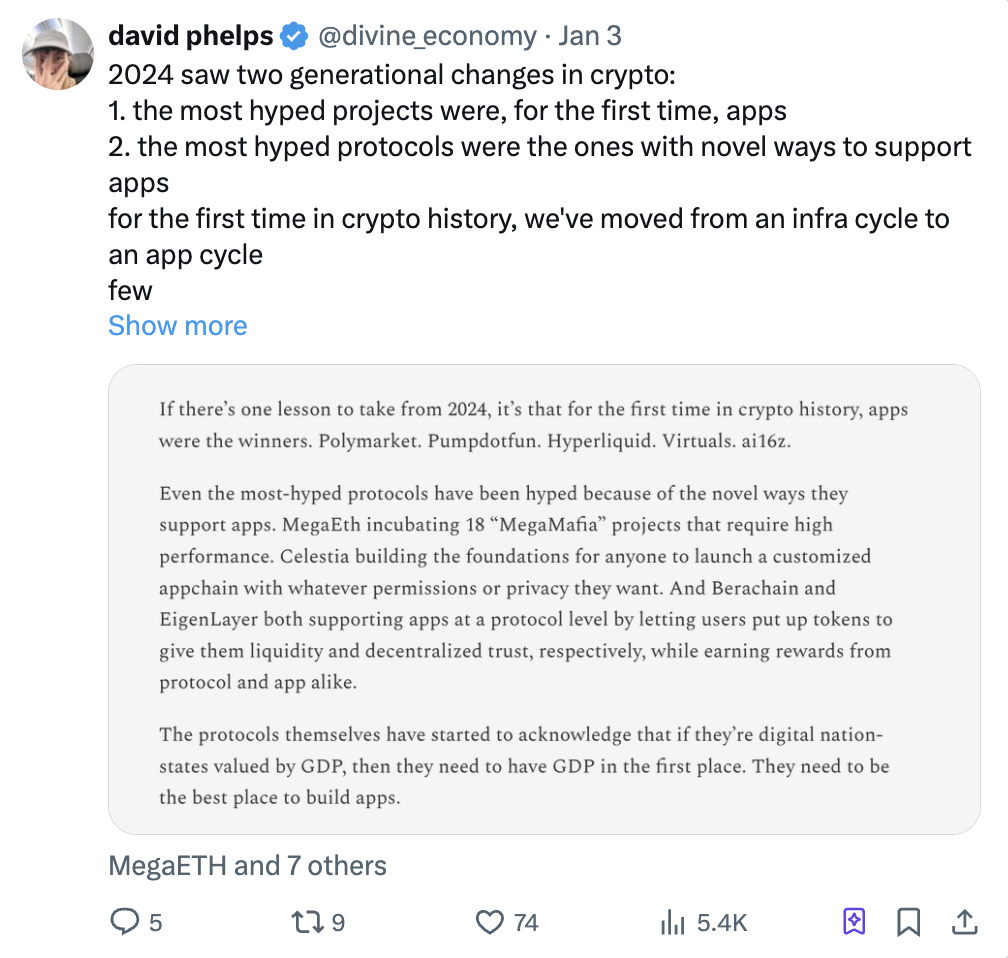
As AI-driven innovations accelerate at the application level, the answer is clear: applications remain the focus (of course, with the support of infrastructure, as this is still the crypto space). As David mentions below, we are already beginning to see a shift from infrastructure cycles to application cycles, and the addition of AI will further drive this trend.
@divine_economu: "In 2024, the cryptocurrency space will witness two significant milestones:
Popular projects will be application-led for the first time.
Popular protocols will be those that support application development in innovative ways.
This marks the first time in crypto history that we are transitioning from an infrastructure-dominated cycle to an application-centric cycle."

I am particularly optimistic about the following four types of crypto products, all of which are in the early stages of development and thus have enormous growth potential:
- ### Aggregators, also known as SuperApps
I predict that the future "FAANG of the crypto space" will emerge: these super applications will integrate functionalities from agents that simplify the on-chain user experience (UX) and connect directly with users. At the same time, these applications will vertically integrate the tech stack, enhancing their own application capabilities while attracting developers' attention by providing infrastructure (similar to Amazon or Google). In their respective fields (such as search and advertising, finance, commerce, social, etc.), these applications will exhibit monopolistic characteristics. Just as FAANG companies currently contribute about 20% to the S&P index, I expect this category of applications to capture a similar proportion of the crypto market share by 2030. Conservatively, this market opportunity is worth hundreds of billions, while optimistically it could reach trillions.
Especially in the DeFi (or DeFAI) space, I believe this is a killer application scenario: imagine a next-generation one-stop financial super application where users can seamlessly access all on-chain financial assets, receive investment advice or ideas, analyze market sentiment in real-time, and quickly execute investment decisions. Another exciting direction is a "crypto version of Google," which solves the discovery problem of crypto applications and assets by designing algorithms similar to "PageRank," while monetizing through advertising or innovative value streams.
Winners in this category will create unimaginable outcomes, as they will possess a key advantage that Web2 super applications lack: Tokens. Tokens are the only tools in the crypto space that have proven to have strong product-market fit (PMF), capable of attracting users, rallying believers and investors, and occupying market mindshare.
- ### Agents as SaaS
I am excited about AI agents that can perform exceptionally well in a specific domain. These agents can be used in combination with aggregators or other agents, much like today's SaaS products or financial products. For example, imagine a fully autonomous agent that accepts funds from liquidity providers (LPs) and makes top-tier investments in the crypto market (being among the top 1% of high liquidity traders while also participating in the best-performing investment opportunities), charging lower management fees than ETFs or funds. Or an agent capable of achieving high returns in prediction markets or sports betting. Another example is tools like @aix_bt, which can provide high-quality market and investment research data. These agents will enable users to access previously hard-to-reach markets (such as dollars or real-world assets (RWAs) that are now on-chain) and offer advanced investment strategies (such as quantitative trading or venture capital).
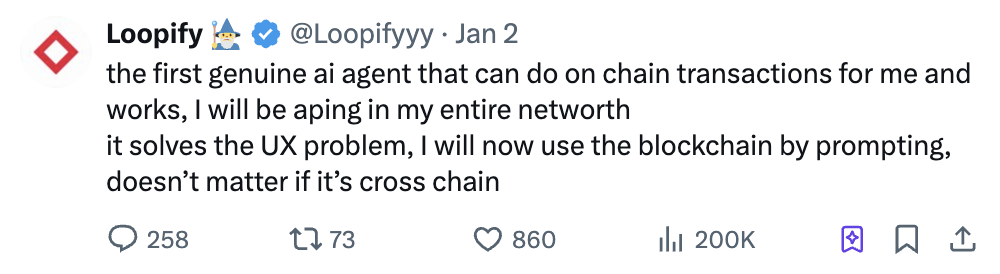
@Loopifyyy: "The first AI agent that can perform on-chain transactions for me and truly works, I would not hesitate to invest my entire net worth. It solves the user experience (UX) problem, and now I can use blockchain with simple prompts, regardless of whether it's cross-chain or not."

This is not limited to the financial sector. I can envision a future with an AI doctor, specifically trained for the personal profiles of individual patients, capable of charging insurance companies through crypto payment channels and issuing low-risk prescriptions. Or, an AI insurance agent that can find the cheapest home insurance for your house. Of course, to be frank, we still have a long way to go to realize these scenarios (most agents currently can't even complete basic on-chain interactions).
However, as these agents continuously innovate in customer acquisition, value realization, and pricing mechanisms through their native tokens (for example, users need to hold 100 AIXBT to access premium services), the opportunities in this field are nearly limitless. As this trend deepens, I believe that platforms specifically designed for trading and managing AI agents (similar to agent markets like eBay or OpenSea) will also see tremendous growth opportunities.
- ### AI-Native Infrastructure (AI-Native Infra)
The most important infrastructure opportunities in the future (such as the next generation of L1) will no longer focus solely on speed or cost optimization but will attract users by significantly enhancing user experience (UX). This enhancement will be achieved by building core architectures around AI agents and AI-driven smart contracts, natively supporting the following functions: efficient on-chain reasoning capabilities (see Section 4), providing verifiable off-chain reasoning capabilities through Trusted Execution Environments (TEEs), supporting smart accounts for semi-autonomous AI agent operations (with built-in protection mechanisms to execute tasks on behalf of users), accessing computational resources and model training capabilities, and enabling bidirectional value flow between agents to promote collaboration and innovation in economic models.
Similar to the current era of decentralized applications (dApps), many of the aforementioned second category of agents (especially long-tail agents) will choose to deploy on these new L1s rather than manage infrastructure themselves, while enjoying the network effects brought by proximity and composability. I am also excited about the potential of these new generation L1s, which may redefine value capture mechanisms, maximum extractable value (MEV), and consensus mechanisms (for example, can agents become validators?).
This does not mean I am pessimistic about Ethereum, Solana, or other mainstream L1/L2 ecosystems. In fact, these ecosystems will gradually introduce similar functionalities in the coming years. But I believe that the new L1s born in this era will better meet the needs of contemporary developers and thus gain tremendous growth potential. Projects like ai16z and Virtuals have already demonstrated the early signs of this trend, indicating the huge opportunity to become a winner in this field.
Innovation in L1 will continue and remain strong.
Intelligent Assets
Currently, some popular applications in the crypto space (such as stablecoins, NFTs, ERC-20/SPL governance tokens) are deterministic and static assets. They perform excellently in achieving predetermined goals, but what if users could own dynamic, self-optimizing intelligent assets that aim to achieve specific goals (such as increasing holders or enhancing value)?
Imagine smart contracts that can dynamically call models during on-chain execution, allowing assets to perform the following actions: adjusting token supply, releasing schedules, implementing burn or staking mechanisms, and even modifying other parameters that currently require hard coding or rely on social consensus to change. Each token could even be personalized based on the holder's preferences, providing users with a new level of personalized experience.
I anticipate that early explorations of such intelligent assets will focus on the NFT and DAO sectors. For example, NFTs could be generative in all aspects, not just limited to generating media content. Or, a governance token could automatically draft proposals or vote on behalf of users based on protocol history and user preferences.
As technology continues to mature, the primary application scenarios for this category may shift towards the financial sector. For instance, imagine Ethena's USDE stablecoin dynamically adjusting its synthetic dollar strategy based on macroeconomic conditions. This would be an exciting future!
免责声明:本文章仅代表作者个人观点,不代表本平台的立场和观点。本文章仅供信息分享,不构成对任何人的任何投资建议。用户与作者之间的任何争议,与本平台无关。如网页中刊载的文章或图片涉及侵权,请提供相关的权利证明和身份证明发送邮件到support@aicoin.com,本平台相关工作人员将会进行核查。