The silent evolution of the TON ecosystem, interpreting the tech-oriented TON DEX PixelSwap

CN
1 year ago

Exploring the Art of Simplified Trading with PixelSwap

Written by: Deep Tide TechFlow

Recently, Bitcoin has been performing well, with its price breaking historical highs and aiming for the long-awaited $100,000 mark. After three years of growing pains, Bitcoin has allowed the vast majority of holders to realize profits, and the approaching $100,000 price point has once again attracted global attention.

Similarly, the development process of most things experiences its unique growing pains, and the trajectory of the TON ecosystem this year is the best proof. With the opening of Telegram Mini Apps, the TON Network has entered its own cycle, with TVL growth on the rise and continuous ecological hotspots emerging. However, beneath the surface of the booming TON ecosystem, waves of controversial MiniGame token issuance have followed.

This wave of token issuance has superficially brought a brief prosperity to TON: trading volume surged, user numbers skyrocketed, and hot tokens emerged one after another. However, the essence behind this prosperity is that many game projects attract users to Farm through simple game mechanics and token incentives, but struggle to maintain long-term value. This not only fails to bring substantial progress to the TON ecosystem but also, to some extent, undermines market confidence.

In addition to the credibility damage caused by the token issuance wave, the TON ecosystem itself is also facing more fundamental challenges: DeFi facilities are key players in various ecosystems, serving not only as the basic guarantee for user transactions but also as the hub for healthy ecological development. Just as ETH's development cannot be separated from Uniswap's boost, a good DEX often becomes the fulcrum for ecological development. However, the current TON ecosystem is clearly struggling in this regard. The inadequacy of decentralized trading infrastructure, the lack of developer toolchains, and the fragmentation of user experience have made it difficult for liquidity to effectively gather within the ecosystem, and project parties find it hard to obtain stable and reliable liquidity support. This shortcoming in DeFi infrastructure not only restricts user trading experiences but also becomes a key bottleneck hindering the landing of quality projects, directly affecting the healthy development of the TON ecosystem.

In the face of the confidence crisis in the TON ecosystem, LayerPixel, as an All-in-One DeFi solution, is attempting to improve the "structural issues" within the TON ecosystem through its unique innovative architecture and its core sub-product, PixelSwap.

With PixelSwap's TGE approaching in Q4, this article will provide an in-depth analysis of PixelSwap and its series of innovative technical implementations, helping readers gain a head start in understanding PixelSwap's uniqueness and the details of the TGE.

PixelSwap: The Core DEX Under the LayerPixel Architecture

To understand PixelSwap, one must first understand its parent project, LayerPixel.

LayerPixel, as a Layer 1.5 solution on TON, addresses the asynchronous and heterogeneous limitations of the TON chain through a modular architecture design, fully leveraging its sharding advantages. At the same time, LayerPixel seamlessly integrates DeFi functions with Telegram Mini Apps, building a complete ecosystem that includes wallets, DEX, and oracles.

In the design framework of LayerPixel, several core components each play their roles:

  • PixelSwap, as the first modular DEX on TON, supports advanced trading models including weighted pools and LBP.

  • PixelWallet, as a smart contract wallet with account abstraction (AA) features, provides users with a smooth DApp interaction experience.

  • Pixacle serves as a decentralized oracle, providing fast and accurate price data support for DApps and smart contracts within the ecosystem.

  • LayerPixel also provides a complete toolchain for TON ecosystem developers, including convenient SDKs and API interfaces, as well as practical experience and tools accumulated by the LayerPixel team during the development process in the TON ecosystem.

As an important part of the LayerPixel architecture, PixelSwap's utility in the TON ecosystem is reflected in multiple dimensions.

In terms of security, the project collaborates with top global blockchain security audit institutions to provide the strongest protection for user assets. In terms of user experience, PixelSwap integrates deeply with Telegram Bot, developing a smooth Mini App interface that allows users to complete all DEX-related operations with one click in the familiar Telegram environment, truly achieving "silky" interaction.

Delving into the technical level, PixelSwap adopts an innovative layered architecture design, supporting various advanced trading algorithms. Among them:

  • The atomic swap function allows complex DeFi trading scenarios to be completed in a single transaction.

  • The weighted pool mechanism provides professional market makers with more refined liquidity management tools.

  • LBP (Liquidity Bootstrapping Pool) offers project parties a more flexible token issuance solution.

Thanks to the deep technical support of PixelSwap, "easy user interaction + effortless project token launch" has become possible within the TON ecosystem.

The ecological synergy between PixelSwap and LayerPixel unfolds, creating a clear and complete project incubation channel for TON ecosystem developers:

Developers can quickly build applications using the components provided by LayerPixel, and upon success, they can choose to deploy their projects on the PixelSwap platform. This synergy creates a virtuous cycle, with LayerPixel responsible for building the underlying infrastructure and development tools, while PixelSwap focuses on providing liquidity support for TON ecosystem projects.

This clearly defined ecological layout allows developers to focus on product innovation without worrying too much about underlying technical implementation and liquidity issues. This is precisely the positive interaction model needed for the vigorous development of the TON ecosystem.

Exploring the Art of Simplified Trading with PixelSwap

Technology is the primary productive force, and to truly understand the uniqueness of PixelSwap, it is essential to grasp the technical implementation principles that support its diverse functions.

Atomic Swap: All Steps Packaged Together

PixelSwap is the first and only DEX in the TON ecosystem to implement atomic swaps, which is one of PixelSwap's notable technological innovations and the foundation for users to achieve a smooth trading experience on PixelSwap.

Imagine the process of swapping tokens on a traditional DEX: first, authorize token A, wait for confirmation, then authorize token B, wait for confirmation again, and only then can the swap be executed. This process is like having to pass through three traffic lights to reach your destination. PixelSwap's atomic swap mechanism cleverly solves this problem. By designing a transaction orchestration system at the smart contract level, it packages all necessary operations (authorization, transfer, swap) into an indivisible atomic operation. It's like opening a dedicated tunnel in the city, allowing users to complete all transaction steps in one go with a single call from their TON wallet (like TONkeeper).

From a technical implementation perspective, PixelSwap's atomic swap is built on the internal messaging mechanism of TON smart contracts. Through a carefully designed contract architecture, it ensures that all transaction steps either succeed entirely or roll back completely, perfectly aligning with the atomicity requirement in the ACID properties of blockchain transactions. This not only reduces transaction gas costs but fundamentally eliminates the financial risks that may arise from intermediate states.

With the support of atomic swaps, users no longer need to go through complex operational steps for everyday small transactions; with one click, they can automatically complete all necessary steps for the transaction, packaging and hiding a series of on-chain transaction operations behind a simple interface, making the entire trading process as easy as using Alipay.

Weighted Pools and LBP: Innovative Liquidity Management

On the basis of ensuring an exceptional trading experience, PixelSwap has also made deep innovations in liquidity management. The platform supports two advanced liquidity pool designs: weighted pools and Liquidity Bootstrapping Pools (LBP).

Traditional DEXs generally use the constant product formula xy=k, like a cup filled with water; when you pour out some water, the remaining water level rises quickly, causing significant price fluctuations. PixelSwap innovatively introduces the weighted pool mechanism, using a more flexible formula: x^a*y^(1-a)=k, like a container that can adjust its shape, better adapting to market demands.

Based on the technical foundation of weighted pools, PixelSwap employs a dynamic adjustment mechanism called LBP (Liquidity Bootstrapping Pools). During the operation of the pool, the ratio of the two tokens automatically adjusts, allowing the contract to passively buy or sell assets in one direction. This provides a fairer and more efficient solution for token issuance of new projects.

Suppose a new project wants to issue tokens on TON. The traditional method is like directly setting up a stall with a fixed price like "1 TON = 100 TOKEN." But if the price is set too high, no one buys; if set too low, it will be snatched up by large holders in one go.

This is where PixelSwap's weighted pools and LBP come into play. It acts like an intelligent market regulation system:

  • What is the role of the weighted pool?

It adjusts the exchange ratio during trading. For example, if the project party invests 1 million TOKEN and 1000 TON in the pool, initially, TOKEN is made easier to exchange (high weight), giving early supporters a better price.

  • How does LBP cooperate?

It’s like putting a timer on this pool, automatically adjusting the difficulty of obtaining TOKEN over time (adjusting weight). Perhaps on the first day, 100 TON can be exchanged for 10,000 TOKEN, but by the seventh day, the same 100 TON can only be exchanged for 5,000 TOKEN.

Through the adjustment functions of weighted pools and LBP, the entire token issuance process becomes smooth and flowing. The project party only needs to set a reasonable price curve range, allowing the market to naturally discover the price. It’s like designing a soft landing runway for the token, avoiding severe price fluctuations while preventing excessive concentration of funds, truly achieving fair and efficient token distribution.

Value Contributors First, $PIX Token Distribution Selects Real Users

As mentioned earlier, the current market attitude towards TON ecosystem projects issuing tokens is not as enthusiastic as during the MiniGame token issuance wave. With the upcoming TGE of PixelSwap, the team understands the various concerns of market users. How to make the $PIX token different from the past and dispel market prejudices has been a key consideration from the very beginning.

Strictly Selected Distribution Mechanism and High-Quality User Profile

Real interaction means being one of us

Traditional projects often adopt a simple task completion model to obtain airdrops, which can easily attract bot accounts, ultimately leading to significant sell pressure. However, PixelSwap requires users to prove their activity through genuine on-chain interactions. Users engage in swaps or provide liquidity on the DEX, enhancing the "value" of their accounts while also participating in maintaining the healthy operation of the entire protocol. This deep involvement not only rewards users but also fosters a sense of identity with the protocol. The team has also cleverly combined GameFi with DeFi. Every real expenditure by users in the gaming ecosystem can be converted into token point rewards, ensuring that token holders are actual contributors to the ecosystem.

Connecting Partners and High-Quality Users through Airdrop

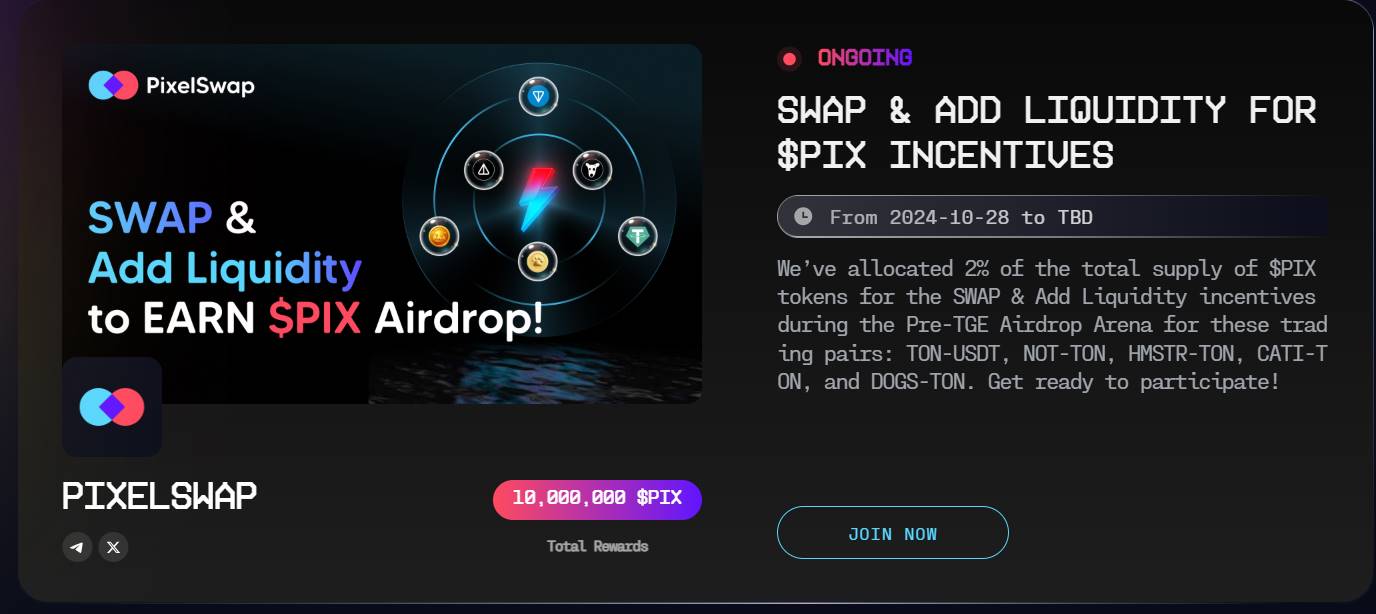
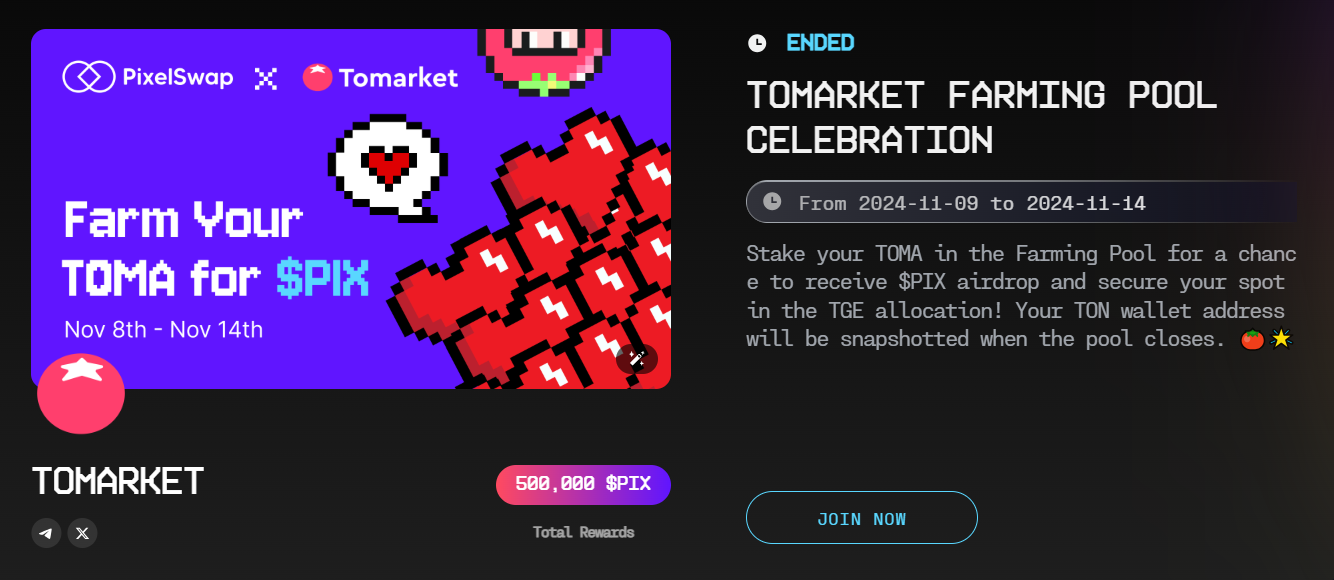
Through the PIXArena platform, users can engage in substantial interactions such as Farming Pools and Swaps with projects in the PixelSwap partnership landscape, earning $PIX airdrops. The "pay first, reap later" mechanism effectively filters out high-quality users who genuinely believe in the project's development. The airdrop platform PIXArena offers various innovative airdrop collaboration models, providing partnered projects with precise access to real users and creating a natural barrier against batch account arbitrage.

Token Economics

As a DEX project in the TON ecosystem, PixelSwap's token economics design revolves around sustainability and practicality in a "long-term" plan. The $PIX token plays a dual role in the ecosystem as both a governance token and an incentive tool.

Token Distribution and Unlocking

The total supply of $PIX tokens is set at 500 million, utilizing a gradual unlocking mechanism. The community incentive portion accounts for half of the total supply, which will be used to support ecosystem growth, including liquidity mining and trading incentives; early investors hold 20%, with 5% unlocking at TGE, followed by a 4-month cliff and 18 months of linear unlocking; the core team and future employees have a 15% token allocation, with a 12-month lock-up period and 2 years of linear unlocking; additionally, 15% is allocated for special distributions: 3% for IDO, 2% for advisors, and the final 10% for adding liquidity.

Revenue Distribution Mechanism

The protocol's revenue adopts a balanced distribution plan, splitting the income into two parts. One part supports the core team's development work, ensuring the project can continue to iterate and upgrade; the other part goes into a DAO-managed protocol treasury, with the usage of these funds entirely decided by community governance.

Early Ecosystem Development

In the initial phase after TGE, the team plans to use 3.5% of the community tokens to nurture the ecosystem. This includes 0.5% airdropped to paying users within the ecosystem; 1% for airdrops and collaborations with other Web3 ecosystem projects and KOLs, such as 0.14% of the total $PIX allocated for the Gate.io platform's initial subscription on December 18; and 2% for retrospective airdrops and early liquidity incentives.

Conclusion

From initially carrying the grand vision of Real Mass Adoption to now facing a dual test of confidence and enthusiasm, the ups and downs of the TON ecosystem itself reflect the evolution of emerging phenomena.

At this uncertain juncture, the interplay between technological innovation and market perception creates an interesting paradox: the lower the market sentiment, the more grounded builders are needed; and the less complete the infrastructure, the more it tests the technical insight and strategic patience of project parties. The practices of LayerPixel and PixelSwap precisely touch on the core of this proposition—how to return crypto applications to the essence of solving real problems while maintaining technological innovation.

From a broader perspective, the development of any emerging phenomenon is rarely smooth sailing. The short-term decline in enthusiasm may be a necessary process, allowing the entire ecosystem to settle and reflect, thus finding a clearer direction in the next development cycle.

In this process, what truly deserves attention is not the superficial prosperity or downturn, but the pragmatic exploration that genuinely drives ecological development beneath the surface of market fluctuations. This may be the ultimate standard for judging project value.

免责声明:本文章仅代表作者个人观点,不代表本平台的立场和观点。本文章仅供信息分享,不构成对任何人的任何投资建议。用户与作者之间的任何争议,与本平台无关。如网页中刊载的文章或图片涉及侵权,请提供相关的权利证明和身份证明发送邮件到support@aicoin.com,本平台相关工作人员将会进行核查。

Share To
APP

X

Telegram

Facebook

Reddit

CopyLink